
Bitcoin Forecast: What to Check on Levels, Holding Period and Buying Route Before the Quarter Ends
Bitcoin stands at $83,877 at 16:40 UTC on September 25, 2026, and the measured volatility of the past 30 days spans a band of $73,600 to $94,200 for the coming month. More important than that band before the quarter ends are three checks: holding period, buying route under MiCA and the reporting duty in force since January 2026.





Which topics should we dive deeper into?
Select what genuinely interests you. Your picks feed directly into our editorial planning.
Crypto news that's actually worth your time.
Weekly. 60 seconds. Carefully curated by our editors: no hype, no promo flood, no spam.
A Bitcoin forecast worth anything today does not consist of a single number, but of a range, a reason and an action. The Bitcoin price stands at $83,877 on September 25, 2026, the equivalent of 73,605 euros (according to CoinGecko). The measured volatility of the past 30 days produces a band between roughly $73,600 and $94,200 for the coming month, within which the price will stay with a probability of about two thirds. More important than that band, though, for you as a German investor is the calendar: the third quarter ends on September 30, the Crypto Asset Tax Transparency Act took effect on January 1, 2026, and Germany's transition period under MiCA expired on December 31, 2025. This article adds both sides together: the levels the market sets, and the checks you can carry out today regardless of the price.
Bitcoin forecast on September 25, 2026: what the price is currently measuring
Bitcoin stands at $83,877. Over the past 24 hours the price has lost 1.1 percent, moving between $83,230 and $85,208. Over seven days it is up 3.4 percent, over 30 days up 7.6 percent. The twelve-month view looks different: there it is down 25.0 percent. Market capitalisation is $1.685 trillion, trading turnover over the past 24 hours $37.6 billion, and 20,089,253 Bitcoin are in circulation.
The all-time high of $126,080 dates from October 6, 2025. The current price sits 33.5 percent below it. Anyone reading a forecast today that names the all-time high as the next waypoint should know this figure: from $83,877 to $126,080 is a gain of 50.3 percent. That is no argument against such a target, but it frames the time horizon in which it would be reachable.
The sentiment index from alternative.me, which builds a value between 0 and 100 out of volatility, trading volume, market dominance and survey data, stands at 71 points on September 25, placing it in Greed territory. The previous day it also stood at 71. A high reading is not a sell signal; it says only that the market is pricing in little fear right now. For your planning that means one thing above all: the price of hedging is lower in such phases than it is after a slump.
The range of the past 30 days: $75,590 to $86,597 as the frame for any forecast
For this article, the daily closing prices of the past 180 days were retrieved from CoinGecko's market data API and analysed. The result is the most robust part of any forecast, because it predicts nothing but measures.
- Lowest level of the past 30 days: $75,590 on September 16, 2026.
- Highest level of the past 30 days: $86,597 on September 22, 2026.
- Lowest level of the half-year: $58,566 on July 1, 2026.
- Moving average of the past 50 days: $75,318.
- Moving average of the past 180 days: $71,007.
Two things stand out. First, Bitcoin ran through a range of 14.6 percent within six trading days between September 16 and September 22. Second, the current price sits 11.4 percent above the 50-day average and 18.1 percent above the 180-day average. Both lines are therefore below the price, and both are rising. That is the technical starting position from which forecasts for the fourth quarter are built.
How wide a month really is: volatility as a forecasting frame
Volatility is the measure of how strongly a price fluctuates around its own path. The same 180 daily data points give an annualised volatility of 42.5 percent for the past 30 days, and 38.2 percent across the full half-year. The average daily move of the past 30 days is 1.49 percent, regardless of direction.
Scaling the annual volatility of 42.5 percent down to one month produces a standard deviation of 12.3 percent. Applied to today's price, that means a band from $73,586 to $94,168 for the coming four weeks. Calculated over one week, the band shrinks to $78,934 to $88,820. On the assumption of normally distributed returns, around 68 percent of all paths lie within one standard deviation.
That assumption is deliberately conservative, because it understates the tails: crypto markets produce extreme days more often than a normal distribution expects. The band is therefore not a guarantee but a lower bound for the width you should reckon with. Anyone reading a forecast that names a single figure for four weeks rather than a range is ignoring these measured 12.3 percent.

Upside levels: the September high at $86,597 and what lies beyond it
The next level to the upside is the September high of September 22 at $86,597, 3.2 percent above the current price. That level matters because the market turned there three days ago: whoever bought at the peak is currently sitting on a small loss and tends to sell on a return to break-even. That behaviour creates supply and turns a high into a resistance.
Above $86,597 the air thins out, because not a single daily closing price of the entire half-year lies higher. The next reference point from the record is the all-time high at $126,080. A forecast expecting that leap within a few weeks demands a move of 50.3 percent, a good four monthly standard deviations. Such a path would be realistic across several quarters, not across a change of quarter.
In classical chart analysis, a breakout counts as confirmed by a daily close above the level accompanied by rising turnover. The $37.6 billion turnover of the past 24 hours is the benchmark against which you can measure that.
 Crypto exchanges for Germany compared
Downside levels: the 50-day line at $75,318
To the downside two levels lie close together, and that is precisely what makes them robust. The 30-day low of September 16 is at $75,590, 9.9 percent below the current price. The 50-day moving average is at $75,318, 10.2 percent below it. Where a trough and a closely watched average line sit at almost the same level, buy orders and hedges accumulate.
If that zone breaks, the next stop is the 180-day average at $71,007, 15.3 percent below the current price. Below that, within this half-year's data window, there is no notable zone of concentrated trading until the July low of $58,566. The distance from the current price to that point is 30.2 percent.
In practice that means: if you want to set a selling threshold, it does not belong on a round number like $80,000 but below the zone that has actually held. A threshold just above $75,318 is reached by any ordinary daily move of 1.49 percent as soon as the price so much as tests the zone.
Holding period and quarter-end: why the calendar sets your selling date
This is where the German view parts company with any international forecast. Under the Federal Ministry of Finance circular of March 6, 2025, Bitcoin counts among the other economic assets within the meaning of section 23 (1) sentence 1 no. 2 of the German Income Tax Act. If you sell privately held coins after more than twelve months, the gain is tax-free regardless of its size. If you sell within the twelve months, the gain is taxable at your personal income tax rate.
From that follows a check you can carry out today and which depends on no price forecast: look in your purchase record for the tranches bought between September 26 and December 31, 2025. Those positions cross the one-year mark in the coming quarter. For each of them the date matters more than the forecast, because selling a few days before the deadline costs you the full tax rate on the gain, while selling a few days after costs nothing.
Under the circular of March 6, 2025, the same applies to holdings you have lent out or staked in the meantime: the holding period stays at one year. The running income from staking or lending is to be considered separately and arises as other income. A detailed treatment of the German rules is in our overview of crypto tax in Germany.
The 1,000-euro exemption limit and FIFO: what to calculate before every sale
An exemption limit of 1,000 euros per calendar year applies to gains from private disposals within the one-year period. The term exemption limit is to be taken literally and differs from an allowance: if your total gain from such transactions is 999 euros, it stays tax-free. If it is 1,001 euros, the entire amount is taxable, not merely the one euro above.
Which coins you actually sell is decided by the consumption sequence. The customary method, accepted by the tax authorities, is first-in-first-out, under which the units bought first count as sold first. Where several purchases are spread across the year, that order determines whether a sale hits an old, tax-free tranche or a young, taxable one.
A worked example at today's price: you bought for 4,000 euros in February 2026 and again for 4,000 euros in July 2026. If you sell part of it now, FIFO reaches the February tranche first, which would become tax-free in February 2027. Anyone who overlooks that gives away a deadline they can hardly get back. If you use several exchanges and wallets, you need a seamless record across all accounts for this, otherwise each platform calculates only its own slice.

Crypto Asset Tax Transparency Act: what your exchange reports from 2026
Since January 1, 2026, the Crypto Asset Tax Transparency Act has applied in Germany, implementing the EU directive DAC8. According to the overview of the act by audit firm KPMG, the current calendar year 2026 is the first reporting period. Providers must transmit the data to the Federal Central Tax Office by July 31, 2027. For breaches, section 18 of the act provides for fines of up to 50,000 euros per case.
What gets reported are trades, exchange transactions and transfers, together with details about you as the user. In practice that means: what you declare for the current year in your tax return can be reconciled from 2027 with the data from your exchange. Anyone who puts their records in order only once the report has already been filed has missed the easier route.
The check that follows from this is unspectacular and effective: before the quarter ends, export the complete transaction history of every exchange you used in 2026, and file it together with the wallet addresses through which you processed withdrawals. Exchanges change export formats, discontinue services or lose authorisations. An export you pull today is available; one you need in 2027 may no longer be.
 Tax tools and portfolio trackers compared
Buying under MiCA: Germany's transition period has expired
MiCA is the EU regulation on markets in crypto-assets. It requires authorisation as a crypto-asset service provider for operating a trading platform, for exchange transactions and for custody on a client's behalf. Germany brought the national transition period forward to December 31, 2025 through its crypto markets supervision act, ending it half a year earlier than the latest EU-wide deadline of July 1, 2026. Since January 1, 2026, providers without authorisation may no longer render services in Germany.
For you that is a concrete check before your next purchase: look up whether the provider you buy through is listed in BaFin's company database or operates under an EU passport from another member state. A provider without authorisation is not automatically disreputable, but in a dispute you stand outside the supervisory framework, and deposit protection does not cover crypto-assets in any case.
If you switch providers, the switch itself becomes a tax matter: transferring your own holdings between your own wallets is not a sale and triggers no tax, but it must be documented so that the acquisition data, and with it the holding period, are preserved. Which platforms are authorised for German investors and how they differ on fees and withdrawal routes is shown by our comparison of the best crypto exchanges.
Custody: what to check before the next swing
The measured volatility of 42.5 percent has a side effect that rarely appears in forecasts: in hectic phases, load and waiting times at exchanges rise, and that is exactly when you want access. Anyone holding larger amounts therefore does well to separate the trading position from the long-term position.
Three checks are possible today without any view on the price. First: is your recovery phrase held in two physically separate places, and is at least one copy protected against fire and water? Paper in a desk drawer does not meet that. Second: have you ever tested the recovery process, meaning restoring the wallet from the phrase on a second device? An untested backup is an assumption. Third: at every exchange you still use, is two-factor sign-in set to an app or a security key rather than to SMS?
Which devices meet these requirements, and how they differ in handling and backup procedure, is a question of the backup method and of usability, not of price.
Leverage and liquidation: what a 1.49 percent daily move means for your account
Anyone trading with leverage should read the forecast not in price targets but in probabilities. From the measured monthly volatility of 12.3 percent it is possible to estimate how often an adverse move grows large enough to liquidate a leveraged position. On the simplifying assumption of normally distributed returns and disregarding financing costs, the picture for a one-month period is:
- Three times leverage, liquidation at an adverse move of around 33 percent: about 0.3 percent probability.
- Five times leverage, liquidation at around 20 percent: about 5.2 percent.
- Ten times leverage, liquidation at around 10 percent: about 20.8 percent.
- Twenty times leverage, liquidation at around 5 percent: about 34.2 percent.
The figures are a lower bound, because real price paths swing out at the tails more often than the model does, and because liquidations can be triggered before the calculated point once the margin call takes hold. At twenty times leverage, three and a half times an average daily move of 1.49 percent is arithmetically already enough to end the position.
For retail investors in the EU, leverage on crypto contracts for difference is capped at two times in any case. Anyone using higher leverage with providers outside that framework loses not only this protection but also trades products whose tax treatment departs from the simple one-year rule: gains from derivatives fall under investment income and not under section 23 of the Income Tax Act.
Fees: what one percent costs at $83,877
Fees are the only part of a forecast that is certain to materialise. On a purchase of 5,000 euros, a spread of one percent costs 50 euros; at one percent on both the buy and the sell side, 100 euros in total. By way of comparison: the average daily move of 1.49 percent amounts to 74.50 euros on the same sum. Your trading costs therefore sit in the same order of magnitude as an average trading day.
Two cost types are regularly overlooked. First, the gap between the buy and sell price at providers who advertise zero percent order fees and place the margin in the price. Compare the displayed rate at the moment of purchase against a reference rate. Second, the withdrawal fee in euros and the network fee on a transfer, which on small amounts can account for the largest share.
Anyone buying monthly should recalculate both once a quarter. On a savings plan of 200 euros a month, a one percent spread is 24 euros a year, and 1.5 percent is 36 euros. Over five years that is the equivalent of roughly two monthly instalments.
Three scenarios for the fourth quarter, each with its reasoning
Sideways within the measured band, $73,600 to $94,200. This scenario needs no new piece of news; it is the continuation of the measured volatility. It is therefore the most likely outcome for the coming four weeks, as long as neither the September high nor the zone around $75,300 is durably broken.
Upward through $86,597. A daily close above the September high with rising turnover opens the area in which the half-year record holds no further resistance. The first realistic stage is the upper edge of the monthly band at around $94,200, which is 12.3 percent above today's price. In this scenario the all-time high at $126,080 remains a target for several quarters, not for weeks.
Downward through $75,318. Should the price fall below the double zone of the 30-day low and the 50-day average, the next stop is the 180-day average at $71,007. If that break is confirmed as well, no load-bearing zone remains before the July low at $58,566. For leveraged positions this scenario is the most expensive; for investors with the one-year deadline in view it is above all a question of the selling date, not of selling as such.
None of the three scenarios is a recommendation. What they do is assign consequences to levels, so that you know in advance what you will do at which price.
Checking the Bitcoin forecast: what to take away
- Sort your purchase dates before the quarter ends. Check which tranches cross the one-year mark in the fourth quarter, and note the dates. A tool that tracks the deadlines automatically is in the comparison of crypto tax tools and portfolio trackers.
- Check your buying route and its authorisation. Look up whether your provider has been authorised since the end of the German transition period, and compare spread and withdrawal fees against the alternatives in the overview of the best crypto exchanges.
- Test your custody, do not assume it. Restore your wallet once from the recovery phrase on a second device. Which devices support that comfortably is shown by the hardware wallet comparison.
(As of September 25, 2026. This article is not investment advice. Prices and fee structures change; check the terms with the provider before you buy.)
Transparency note: This article was produced with the assistance of artificial intelligence and reviewed by our editorial team before publication. All figures and claims were checked against the primary sources linked in the text. The feature image was generated with AI.
Related articles
- Bitcoin Price Prediction: What to Check on Levels, Holding Period and Leverage Before the October 28 Rate Decision
- Dogecoin Price: What to Check on Holding Period and Custody Before the Year End
- Shiba Inu Price Prediction: What to Check on SHIB Before the December 31 Deadline
- ETH Price Prediction: What to Check at the $2,800 Mark Now
- Ethereum price prediction: Citi raises its twelve-month target to $3,028, and what you can do now
Which topics should we dive deeper into?
Select what genuinely interests you. Your picks feed directly into our editorial planning.
Crypto news that's actually worth your time.
Weekly. 60 seconds. Carefully curated by our editors: no hype, no promo flood, no spam.

September 24, 2026 10:36 PM

Ethereum Price Prediction: What to Check on Staking, Leverage and Where You Buy After Three Attempts at $2,800
Ether stands at $2,700 and has bounced off the zone around $2,800 three times in thirty days, without a single daily close above it. What our own count shows, and the three things to settle before the next attempt.

July 8, 2024 7:51 AM
Crypto Market Crash News As BTC Price Crash Back To 56K
With the crypto market crash, and Bitcoin price drop to below 56k with recent dormant BTC whales activity, what comes next: a correction or further crash soon?

September 24, 2026 10:12 AM

XRP Falls 9.7 Percent: What to Check on Holding Period and Buying Route
XRP is down around 9.7 percent on the morning of September 24, twice as much as the typical large crypto asset. Our count of 18 coins shows who the pullback hits and which three things hold true regardless of the price.
September 27, 2026 10:16 PM

Dogecoin Price Prediction: Which Levels Decide the Fourth Quarter
Dogecoin trades at $0.0973 on September 27 and has gained 12.2 percent in seven days. Which three measured levels frame the fourth quarter, how accurate the circulating price targets proved in September, and which four checks are due before the quarter turns.
September 30, 2026 4:14 AM

Bitcoin Price Before the Core PCE at 14:30 CEST: Will the $82,735 Level Hold?
At 14:30 CEST today the Bureau of Economic Analysis publishes the core PCE deflator for August, the inflation gauge the Fed anchors its 28 October rate decision to. Bitcoin stands at $83,329, less than $600 above its daily low, and anyone holding on leverage decides this morning.
September 24, 2026 1:34 PM

Cardano Slides Below $0.24: What ADA Holders Should Check on Leverage, Liquidation and Holding Period
Cardano has given back its move above $0.25 and trades around seven percent below the high of the past 24 hours. What that means for leveraged positions, the holding period of your tranches and the buying route under MiCA.

September 17, 2026 7:12 PM

Gifting Bitcoin to Children: Allowance, Holding Period and the Tax Office Report
Transferring Bitcoin to your child hands over your holding period and your entry price along with the coins. This guide sets out what really applies in Germany on the allowance, the reporting deadline, representation and custody.
September 18, 2026 10:14 PM

Bitcoin Back Above $80,000: Buy More, Hold or Take Profits? What to Check Now
Bitcoin is back above $80,000, for the first time since September 7. Whether you buy more, hold or take profits depends less on the daily price than on three things you can check yourself: your holding period, the way you buy, and where your coins are kept.
September 20, 2026 1:11 PM

Bitcoin Golden Cross: What Twelve Signals Since 2014 Really Show
Bitcoin's 50-day line has crossed its 200-day line. We evaluated all twelve golden crosses since 2014 ourselves and measured what happened afterwards. The result argues against the common reading of the signal.
September 24, 2026 4:16 AM

Trump-Xi Summit at the White House: The Crypto Positions to Check Before the Meeting
Xi Jinping is on a state visit to Donald Trump today, and the crypto market comes into the meeting carrying the gains of an exceptionally strong week. What to check on leverage, holding period and custody before the first headline runs.
March 4, 2025 9:17 PM

Bitcoin Price Prediction ahead of the Upcoming White House Crypto Summit
With the remarkable Bitcoin volatility, and after briefly surging earlier this week before dropping again. Is a Bitcoin price surge expected ahead of or after the upcoming White House Crypto Summit?
September 24, 2026 1:24 PM

NEAR Falls Almost 8 Percent After a 62 Percent Week: What to Check on Perps, Buying Route and Holding Period
NEAR Protocol loses up to 7.9 percent on September 24, 2026 and is still more than 55 percent higher over the week. The rally was carried by a confidential perp offering via Hyperliquid, which raises questions of its own on buying route, leverage and holding period in Germany.
September 24, 2026 1:11 PM

Stellar Becomes a Payment Rail at Mastercard's BVNK: What XLM Holders Should Check on Buying Route, Memo and Holding Period
BVNK has switched on Stellar as a payment rail for business customers in more than 130 countries. On the same trading day XLM falls by around seven percent — we separate what the news means from what the pullback means for your portfolio.
September 19, 2026 7:17 AM

Chainlink Jumps Above $12: What LINK Holders Should Check Now
Chainlink trades at $12.34, 7.4 percent higher than yesterday. What part of the move is the broad market rally, what Chainlink itself contributes, and the three things you should check as a LINK holder.
September 9, 2026 4:22 PM
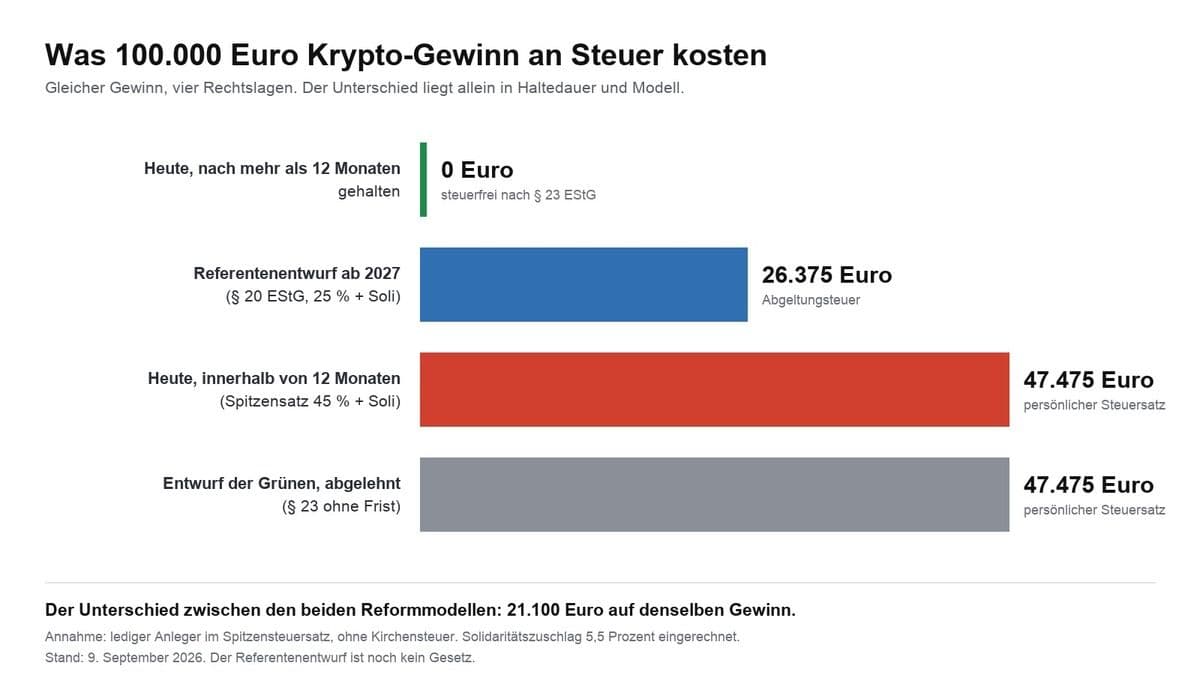
Crypto Tax in Germany: What Applies in 2026 and What Is Set to Change in 2027
Crypto gains are tax-free after twelve months; before that your personal tax rate of up to 45 percent applies. What triggers tax, how the holding period is calculated, what happens with staking and losses, and what the draft bill would change from 2027.
June 25, 2024 12:18 PM

After Bitcoin Crash, Will Altcoins Gains Reach 500%?
In the latest Bitcoin News today, and mainly after the Bitcoin Crash, crypto analysts predict a major shift towards altcoins with market corrections near the end and BTC dominance drop. Will the altcoins gain reach 500%?
September 27, 2026 4:32 AM

Hester Peirce Leaves the SEC: What Now Applies to Your Custody in Germany
The most crypto-friendly voice at the US securities regulator goes on October 2, 2026, and the commission shrinks to two members. For investors in Germany it is still the European rulebook that decides, and there a deadline falls in July 2027.
September 26, 2026 7:14 AM

Cardano Before the RealFi Launch on October 1: What ADA Holders Should Check on USDr, MiCA and Tax
On October 1, 2026 the stablecoin platform RealFi goes live on the Cardano mainnet, and ADA has gained 14.67 percent in a week. What is documented about the yield-bearing dollar token USDr, and what investors should settle beforehand.
September 24, 2026 10:38 AM

Fed Rate Hike in October: What to Check on Leverage, Liquidation and Holding Period After the PMI Jump
The flash US purchasing managers' index has jumped to 58.4 points, its highest level since July 2021, and input prices are rising at a pace last seen in October 2022. The futures market now prices a further Fed rate hike on October 28 at almost 70 percent, and the crypto market is falling broadly.
September 24, 2026 10:19 AM

Uniswap Falls 11.8 Percent After a 114 Percent Month: What to Check on Profit Taking, Holding Period and Leverage
UNI lost 11.75 percent on Wednesday morning but is still up 113.85 percent over the month. Anyone realising gains now almost certainly triggers a taxable disposal in Germany.
September 20, 2026 4:13 AM

Zcash Above $1,500: What ZEC Holders Should Check on Tax and Custody
Zcash rose above $1,500 on September 19 for the first time since 2016 and, after an intraday high of $1,590.80, trades back at around $1,474. For German holders three questions hang on that jump: the one-year holding period, the planned year-end cut-off and the EU anti-money-laundering regulation from July 2027.
September 19, 2026 1:38 AM

Uniswap jumps above $9: what UNI holders should check on the fee switch now
The UNI price gains 18.67 percent within 24 hours, driven by the active fee switch and a new exemption from the US securities regulator. What of that can be recalculated, what remains pure expectation, and which three things you should settle now as an investor in Germany.
March 15, 2025 5:40 PM

Bitcoin Price Prediction March 2025 with FOMC and TRUMP in Play
Bitcoin price prediction for March 2025 is one to expect, ahead of the upcoming FOMC meeting and Trump's strategic crypto reserve. What to expect for BTC price?
September 9, 2026 4:13 PM

Bitcoin 29 Percent Below Last Year: Which Crypto Losses You Can Still Use Before the One-Year Holding Period Expires
Nine out of ten major crypto assets trade lower today than exactly twelve months ago, Bitcoin alone by 29.2 percent. We measured the price series ourselves and show why the purchase date alone decides the tax value of your loss.
September 8, 2026 1:19 AM

Germany's Crypto Holding Period: What Happens Now Signing for Petition 201716 Closed on September 15
Recap as of September 27, 2026: the signature period for German parliamentary petition 201716, which asks for the one-year crypto holding period to be preserved, closed on September 15, 2026. This article explains what ended that day, how the petitions committee proceeds and why no investor has to sell because of it.
September 25, 2026 10:26 PM

Selling bitcoin privately: the tax in Germany and the records you need
A direct sale to a private individual falls under the same one-year rule as an exchange sale, but there is no tax report to go with it. This guide walks through the calculation, the 1,000 euro threshold and the records the tax office wants to see.
September 24, 2026 10:19 PM

Bitcoin for Retirement: What Applies from 2027 and What You Decide Now
Bitcoin is not permitted in any state-subsidised retirement product, including the new retirement savings account from 2027. Anyone who still wants to use crypto assets for their own pension goes through private assets, and there a cutoff date at the end of 2026 is shifting the tax rules right now.
More from CryptoTicker