
MiCA Register of Stablecoin Issuers: 23 Authorised Firms, 43 White Papers and Two Dead Links
The official ESMA register lists 23 authorised issuers of e-money tokens and 43 notified white papers. We called up every document address stored there ourselves and show where the record leads nowhere.




Which topics should we dive deeper into?
Select what genuinely interests you. Your picks feed directly into our editorial planning.
Crypto news that's actually worth your time.
Weekly. 60 seconds. Carefully curated by our editors: no hype, no promo flood, no spam.
Anyone who wants to issue a stablecoin in the EU that is pegged to an official currency needs authorisation for it. The supervisor keeps a public record of who holds one: the MiCA register of e-money tokens, maintained by the European Securities and Markets Authority, ESMA. It is the only place where you can check whether a supervised company stands behind the euro token in your wallet.
We downloaded this register on August 16, 2026 and counted it line by line. The result: 23 authorised issuers, 43 notified white papers, 13 member states. Along with a few places where the record delivers less than its official character suggests.
The MiCA Register for E-Money Tokens: What It Contains and What It Leaves Out
E-money tokens, called EMTs in the text of the regulation, are crypto assets designed to track the value of exactly one official currency. A euro token belongs in that category, and so does a dollar token. Anyone offering such tokens to the public in the EU must be authorised under MiCA either as an electronic money institution or as a credit institution, and must notify a white paper to the competent national supervisor.
ESMA brings the notifications from all national authorities together in a transitional register. What matters is what this register expressly does not deliver. ESMA itself points out that the listed white papers have been neither reviewed nor approved by any authority. Responsibility for the content lies with the issuer. The register answers the question of whether a company is authorised and has notified a document. It says nothing about whether that document is accurate.
The second point concerns how current the data is. The file is republished at weekly intervals. The version we evaluated was last modified on August 12, 2026. Between a notification to a national authority and its appearance in the European record there is therefore a lag of up to a week.
23 Issuers, 43 White Papers: The Result of the Count of August 16, 2026
This analysis was carried out by cryptoticker.io itself on August 16, 2026. Method: we retrieved ESMA's official register file as a CSV, grouped the entries into issuers via the legal entity identifier LEI, and then called up every white paper address stored in the register individually. We examined 43 register entries, 23 issuers and 30 different document addresses.
The basic figures at a glance. The register contains 43 notified white papers. Behind them stand 23 issuers, counted by unique LEI. One issuer can run several tokens and therefore several white papers, which is why the second figure sits well below the first. By type of authorisation, 39 entries are assigned to an electronic money institution and three to a credit institution, while for one entry the field carries the value "N/A".
The notifications are spread over time as follows: twelve white papers were notified in 2024, 17 in 2025 and 14 in the current year, 2026. The register keeps growing, though not in leaps.
Euro or Dollar? Why 23 Stablecoin Issuers Do Not Mean 23 Euro Stablecoins
One confusion is particularly easy to fall into here. The register covers e-money tokens in every currency, and euro stablecoins make up only part of it. Among the notified documents there are several dollar tokens alongside the euro ones, including white papers on USDC, on a token listed as eUSD and on USDCV.
The register itself contains no clean currency column. We could read the currency only off the document addresses and product pages, which makes it an inference rather than an official statement. If you want to know which currency a specific token is denominated in, you have to look into the white paper itself. That is exactly what the address in the register is there for.
In practice this means the headline doing the rounds about "23 authorised stablecoins in Europe" is inaccurate twice over. There are 23 companies rather than 23 tokens, and a substantial share of those tokens is denominated in something other than euros. If you are looking specifically for a euro stablecoin, the choice is smaller than the number suggests. Which trading venues carry these tokens at all is a separate question; you will find an overview of the platforms authorised in the EU in our comparison of regulated crypto exchanges.
AllUnity and BaFin: Why Only One Issuer in the MiCA Register Comes From Germany
Germany accounts for exactly one issuer in this register. AllUnity GmbH appears there with four notified white papers and BaFin as the competent authority. No other German company shows up in the list.
That is notable, because measured by population and financial centre Germany ranks among the largest markets in the Union. Authorisation as an electronic money institution is a demanding procedure, however, and an issuer can serve the entire single market from a single EU state. For you as an investor, one thing above all follows from this: the fact that a euro token comes from outside Germany says nothing about its authorisation. What counts is supervision in the home member state rather than a registered office in Frankfurt or Berlin.

France, the Netherlands, Malta: How the Authorisations Spread Across 13 Member States
By number of issuers, France leads with six companies, followed by Luxembourg with three and by Lithuania, Malta and the Netherlands with two each. Czechia, Germany, Denmark, Finland, Iceland, Latvia, Poland and Slovenia account for one issuer apiece.
Count the white papers instead and the picture shifts. The Netherlands then comes first with nine documents, ahead of France with eight and of Germany, Finland and Malta with four each. The reason lies in the differing breadth of product ranges: a single Dutch issuer accounts for six entries on its own.
Iceland stands out because it does not belong to the EU. As a member of the European Economic Area the country applies the MiCA rules regardless, with supervision resting with the Icelandic central bank.
 Regulated Crypto Exchanges Compared
Two Dead Links in the Official MiCA Register: Bridge Building and Newrails
The white paper is no accessory. It is the document in which an issuer discloses how the token is backed, what redemption rights exist and which risks it sees itself. The address in the register is the officially recorded route to it. We therefore called up all 30 different addresses.
28 of the 30 addresses served a page. Two led to an error page. The entries affected are that of Bridge Building S.A. from Luxembourg, with the address bridge.xyz/transparency/EURR, and that of Newrails, UAB from Lithuania, with a document address under newrails.xyz.
Important for context: in both cases the respective main domain itself is still online. What we found is not a company site taken down, but an address that held no document. We called up both addresses again with cookie storage and a browser user agent, with the same result.
No accusation follows from this. A document can have moved, an address can be out of date, a register line can simply have gone unupdated. Whether the white paper is reachable elsewhere is something we did not examine, and whether any obligation was breached would in any case be a question for the competent supervisor rather than for a newsroom. All that is documented is this: anyone following the officially recorded route on August 16, 2026 did not reach the document for these two entries.
Collective URLs Instead of Single Documents: 15 Entries Point to Four Addresses
The second finding is less conspicuous and touches more entries. 41 register lines carry a document address, yet there are only 30 different ones. The reason: several issuers record one and the same collective address for all of their tokens.
Specifically, six entries from one Dutch issuer point to a single resources page, four entries from the German issuer to a single white paper page, three entries from another Dutch provider to a shared product page and two entries from a Maltese issuer to a shared overview. Together that makes 15 of the 43 entries sharing four addresses.
Formally there is nothing to object to here, because the register requires an address and not a pinpoint landing. In practice it means that with these entries you arrive on an overview page and still have to hunt for the document covering your token. An HTTP code of 200 only tells you that a page responds. It does not tell you that the white paper you were looking for is in front of you.

Article 48(4) and (5): When an Authorised E-Money Token Is Not Offered to the Public at All
One column of the register rarely gets attention, although it explains a good deal. It records whether an issuer relies on the exemptions in Article 48(4) or (5) of the MiCA regulation. For one issuer with three entries, the answer given there is yes.
The register comment from this Czech issuer states the point itself: the token is issued under an exemption for limited networks, is not offered to the general public and is used exclusively within a clearly delimited, functionally restricted system.
The same record therefore holds tokens that anyone can buy alongside tokens never intended for the public at all. Read the list as a shopping list and it will lead you astray. The register serves supervision, and it was never built as a product overview.
What This Means for Finding a Euro Token
After these deductions, 43 entries turn into a considerably smaller set of euro tokens that are genuinely freely available. What has to come off are the dollar tokens, the entries under the exemption for limited networks and those cases where several entries fall to the same issuer and the same product family. We deliberately refrain from naming a firm final figure here, because the register does not carry the currency as a field of its own and any number would therefore rest on an inference.
 Crypto Tax Tools and Portfolio Trackers Compared
The MiCA White Paper Requirement: What the Document Has to Contain
Once you have found your way into the white paper, a few points are worth your attention. The MiCA regulation prescribes for e-money tokens, among other things, information on the issuer, on the token itself, on the rights and obligations of holders and on the risks.
Two points matter most in practice. First, redemption: e-money tokens must be redeemable by their holders at par value at any time. Second, backing, meaning the question of which assets the reserve is held in and where it is kept. Both are set out in the document, and both explain why an authorised e-money token is legally a different thing from a stablecoin without authorisation.
How such a token differs from the planned central bank digital currency is something we took apart in a separate piece on the difference between the digital euro and a stablecoin. And where you keep your tokens after buying them is your decision independently of the issuer; we set the common programs side by side in our software wallet comparison.
Limits of This MiCA Register Analysis: What the Record Does Not Answer
Four points remain open, and they belong to the analysis just as much as the figures do.
We did not check whether a listed token is actually tradable. The register says nothing about whether an exchange carries it or how much of it is in circulation. We also did not check whether the reachable documents are complete in substance; what we measured was availability, not quality. We did not check whether the two unreachable documents sit somewhere else. And we could not determine a token's currency from the register itself, because a corresponding field is missing.
On top of that comes an oddity we could not resolve: a Slovenian entry carries September 1, 2026 as its notification date, a date that lay in the future at the time of our retrieval. Whether this is a recording error or a notification entered in advance cannot be judged from outside. We also noticed that the Dutch supervisory authority appears in the register under two different spellings. Anyone grouping the file by authority name by machine ends up with one issuer too many. We therefore consolidated via the LEI and left the authority name aside.
Our earlier analysis of the register of authorised trading platforms, in which we found only 21 platforms, concerns a different record with different entries and stands independently of this one.
Checking a Stablecoin Authorisation: What You Take Away
Three steps follow from the count, and you can work through them in an evening.
- Check whether the issuer of your euro token appears in the register at all. What counts is the company behind the token and its LEI, and the token name will not get you there. If you cannot find it, the token is not authorised as an e-money token in the EU, which limits its availability on regulated platforms. Which trading venues hold an EU authorisation is shown by our comparison of regulated crypto exchanges.
- Call up the white paper and look at redemption and backing. If you land on an overview page, look for the document covering your token there. If the address leads nowhere, make a note of it and ask the issuer; a missing document is no proof of a problem, though it is not the state of affairs the regulation envisages either. Where you keep the token afterwards is settled by our software wallet comparison.
- Keep clean records of every swap. Swapping one stablecoin for another counts as a disposal for tax purposes, even when both are denominated in the same euro. Anyone changing token because of a migration creates an event that has to be documented. The common tools for that job are in our comparison of crypto tax tools.
(As of August 16, 2026. This article is not investment advice. Prices and fee structures change; check the terms with the provider before you buy.)
Transparency note: This article was produced with the assistance of artificial intelligence and reviewed by our editorial team before publication. All figures and claims were checked against the primary sources linked in the text. The feature image was generated with AI.
Related articles
- Open USD is live but absent from the EU register: what matters now for investors in Europe
- Revolut Launches the EURR Euro Stablecoin: Why Germany Is Not in the First Wave
- SoFi Settles Card Payments in Stablecoin: What Cardholders Should Check
- Stablecoin Reserves: Why the ECB Wants the Bank Deposit Rule Scrapped
- Digital Euro and Stablecoins: Why the Bank of England Is Testing Both Forms of Money in a Single Payment
Which topics should we dive deeper into?
Select what genuinely interests you. Your picks feed directly into our editorial planning.
Crypto news that's actually worth your time.
Weekly. 60 seconds. Carefully curated by our editors: no hype, no promo flood, no spam.

September 9, 2026 7:28 PM

Euro Stablecoin From 37 Banks Comes to Ethereum: What to Check on Your Euro Token Now
A consortium of 37 European banks confirmed on 8 September that it will issue its regulated euro stablecoin on the public Ethereum chain. What that means for custody, redemption and deposit insurance, and the six points you can check on your euro token right now.
September 25, 2026 10:22 AM
Fed Rules for Stablecoins: What to Check on Backing and the Redemption Right
The Federal Reserve put forward two proposed rules on backing, capital and redemption of payment stablecoins on September 24, 2026. For your holdings in Germany, however, MiCA is what counts, and different checks follow from it.
August 19, 2026 4:15 PM
Tether Audit by KPMG: What the Unqualified Opinion Means for USDT in the EU
Tether reported the first full audit of its financial statements by KPMG on August 13, 2026, with an unqualified audit opinion for the 2025 financial year. That changes nothing about whether USDT can be traded at authorised providers in the EU, because Article 48 MiCA decides that question.

September 26, 2026 7:14 AM

Cardano Before the RealFi Launch on October 1: What ADA Holders Should Check on USDr, MiCA and Tax
On October 1, 2026 the stablecoin platform RealFi goes live on the Cardano mainnet, and ADA has gained 14.67 percent in a week. What is documented about the yield-bearing dollar token USDr, and what investors should settle beforehand.
September 1, 2026 4:12 AM

USDT cashback and 7 percent on stablecoins: what the MiCA interest ban means for you
A new payment card advertises up to 10 percent cashback in USDT and up to 7 percent a year on the balance. Article 50 MiCAR explains why a provider licensed in the EU is not allowed to pay you exactly that.
September 29, 2026 10:33 AM
ESMA puts reverse solicitation on its 2027 watch list: what investors need to know about exchanges without an EU licence
ESMA presented its work programme for 2027 on September 28, 2026 and made reverse solicitation a supervisory priority. What that means if your coins sit with a provider without EU authorisation, and which three steps make sense now.

July 21, 2024 6:37 PM

MAJOR Ripple News: How Will These Developments Impact XRP Price?
New developments involving Ripple could have a huge impact on XRP price. What are they and how will XRP price react to this?
September 25, 2026 4:11 AM
Bitget Hack of $351 Million: What to Check at Your Crypto Exchange Now
Bitget reports unauthorised outflows of around $351.6 million and has suspended withdrawals. For existing customers in Europe, that closes the one route MiCA had left them.
August 30, 2026 10:38 PM

Crypto Cards: Where Your Card Balance Really Sits and What the August 28 Solana Exploit Reveals About It
An attack on a card balance contract on Solana took the loaded balance from 1,685 users while their wallets stayed untouched. The case shows why it matters whether your crypto card holds funds as e-money at a licensed institution or in a smart contract.
August 15, 2026 9:31 PM

Crypto Exchange Shutting Down: What to Do Before the Deadline Passes
Binance, BitMart, Luno and Revolut have ended or cut back their European business within seven weeks. This guide shows which deadline expires first, how a forced sale is treated for tax, and what to secure before the account closes.
October 2, 2026 7:30 AM

Revolut EURR Stablecoin: What the Launch in Three Markets Really Means
Revolut is testing the euro stablecoin EURR in Denmark, Poland and Portugal first. Whether it becomes usable in practice depends on access, liquidity, costs and acceptance.
September 15, 2026 4:12 PM

Digital Euro Holding Limit: What the Planned Cap Means for Your Account and Your Crypto
The digital euro is getting a cap, and the trilogue has yet to settle who fixes it and how high it goes. What the draft means for your current account, for euro stablecoins and for your crypto holdings.
August 6, 2026 3:05 PM
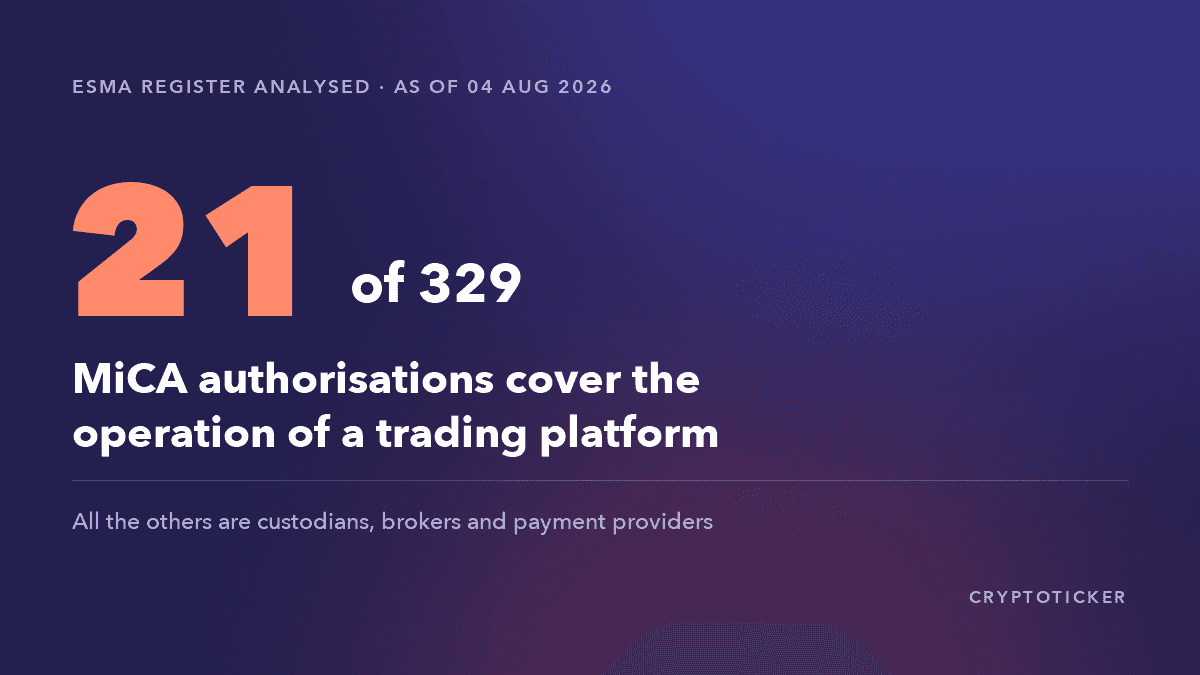
MiCA Register 2026: Only 21 of 329 Licences Are Real Exchanges
ESMA publishes the register of MiCA-authorised providers as an open file. We worked through all of it — and the result is not what the phrase “licensed crypto exchange” suggests.
July 7, 2025 8:12 PM
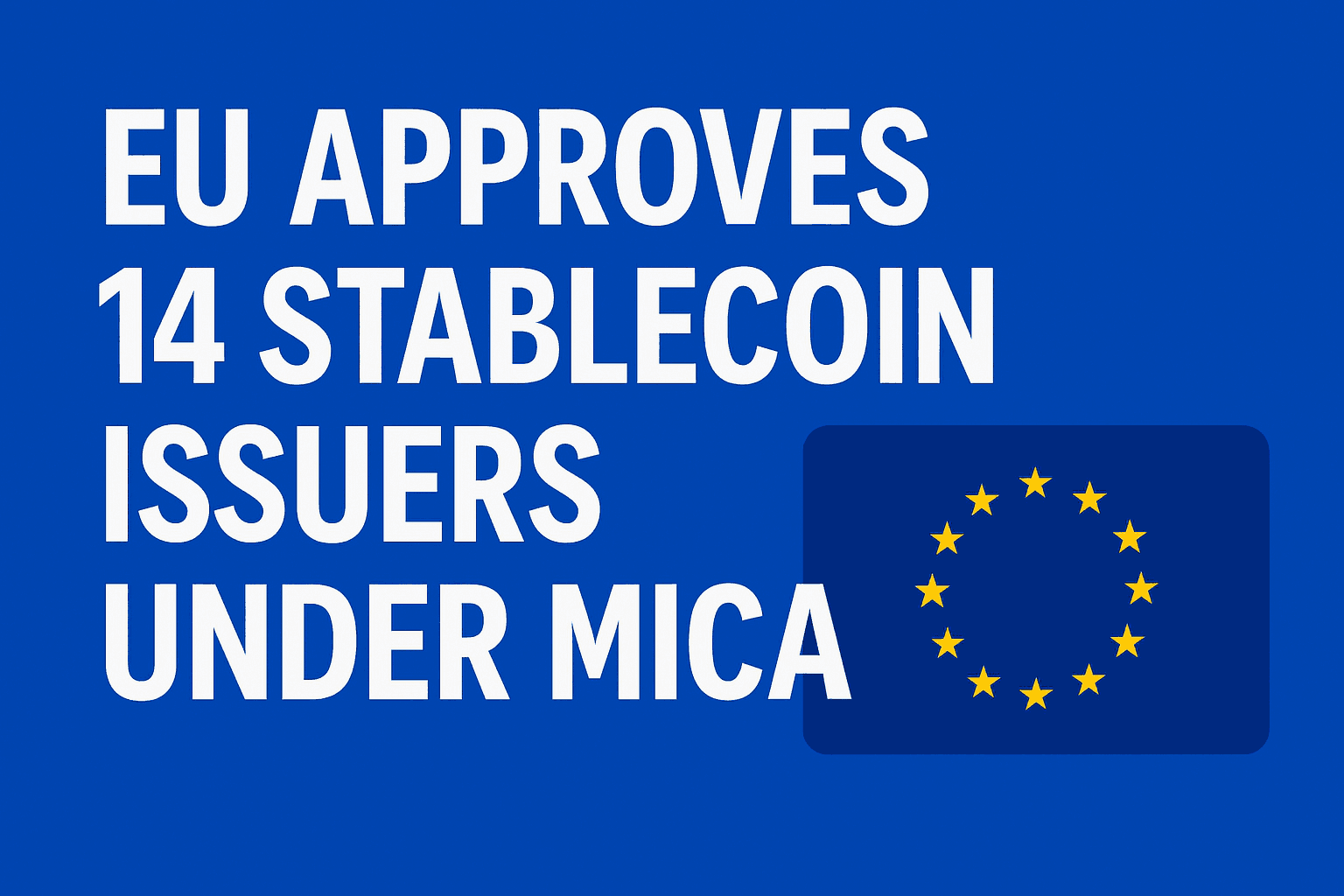
BIG Crypto News: EU Approves 14 Stablecoin Issuers Under MiCA
Six months into the MiCA rollout, Europe’s crypto regulatory landscape is taking shape. From authorized stablecoin issuers to licensed crypto service providers, here’s the full July 2025 update.
September 30, 2026 10:40 PM

ESMA Calls for Advertising Rules on Crypto Influencers: Six Changes Now Sitting With the EU Commission
The EU securities watchdog filed its response to the MiCA review on the final day of the consultation. Among the demands are disclosure on staking, a licensable DeFi gateway and the power to freeze crypto assets.
September 22, 2026 4:33 PM

Three of the 25 Largest Coins Have No Euro Pair: How to Check Your Buying Route Before the Order
Our own survey of five trading venues active in the EU, taken on September 22, 2026, shows that three of the 25 largest cryptocurrencies have no euro pair there at all, and four more only one. What that means for your next order and what the detours cost.
August 21, 2026 7:17 AM

Checking a MiCAR White Paper: What the First Published MiCA Penalty Against Bitpanda Means for Investors
Austria's FMA has fined Bitpanda GmbH 70,000 euros because a crypto-asset white paper was filed late and advertised before it had been published. We explain what rights this mandatory document gives you, and called up all 972 white papers held in the ESMA register to see whether they can be reached at all.
July 2, 2026 8:59 PM
Binance Is Out of the EU: How to Move to a MiCA-Regulated Exchange
Binance has left the EU market. Which exchanges hold a MiCA licence, how to verify an authorisation is real, and how to move your holdings across step by step.
October 3, 2026 10:24 AM

WhiteBIT Coin (WBT): 32,426 Tokens Burned on 1 October, Price 4 Percent Below the Record
WhiteBIT destroyed its own tokens again on 1 October 2026: 32,426 WBT worth 2,716,488 USDT. The price stands at $84.22, which is 4.2 percent below the all-time high of 21 September.

September 19, 2026 4:02 PM
Binance MiCA License: Did Lagarde Personally Block Binance From the EU?
The WSJ says ECB chief Christine Lagarde asked Greece not to approve Binance's MiCA license. Here is what happened, and why the ECB had no formal say.
May 12, 2025 9:05 PM

US-EU Trade Tensions Rise as US-China Conflict Cools Down
Just as the long-standing US-China trade war appears to ease, new tensions are emerging between the United States and the European Union. With Trump calling Europe “nastier than China,” are we about to witness a new transatlantic trade conflict?
October 4, 2026 10:42 AM

Sky (SKY) only 3.8 percent below its December 2024 record: the level that decides
Sky trades at $0.09669 and thus 3.8 percent below its record from December 2024, after a weekly gain of 25.8 percent. The USDS supply has reached $10 billion, the savings rate stands at 3.60 percent, and ESMA wants services around unauthorised stablecoins banned.
September 15, 2026 4:12 AM

Using Hyperliquid from Germany: What Applies to Your Funds Without a MiCA Licence
Hyperliquid is not entered in any EU register as an authorised crypto-asset service provider, and for perpetual futures a MiCA licence would be the wrong paperwork anyway. Here is what that means in concrete terms for your funds, your keys and your tax return.
September 13, 2026 4:33 AM

Your Volksbank's Crypto Licence: Why You Have to Check Custody Separately
14 of the 16 newest CASP entries in the ESMA register were German cooperative banks, and each one carries order execution only. Our count of the BaFin database shows that not one of the 21 cooperative institutions is registered as a crypto custodian.
August 19, 2026 10:26 PM

EU warning list for crypto providers: 167 entries, 165 of them from Italy, none from BaFin
ESMA maintains a Europe-wide register of non-compliant crypto providers. We counted it on August 16, 2026 and called up every web address stored in it. Three of 30 supervisory authorities supply any entries at all, and BaFin is not among them.
August 18, 2026 10:19 AM

BaFin Warnings 2026: 24 Crypto Platform Series With 639 Domains, and How to Check Your Provider
In 2026 BaFin is increasingly warning about entire series of near-identical crypto websites rather than about single providers. Our own count of the complete stock of warnings shows how large the phenomenon has become and which two register checks reliably vet a provider.
August 11, 2026 9:18 AM

Your Crypto Exchange Is Telling You to Withdraw: How to Spot Phishing After the MiCA Deadline
Unauthorised crypto providers now have to tell their EU customers to withdraw, which leaves fraudsters an easy run with faked requests. Here is how to check in two minutes whether the message is genuine.
More from CryptoTicker