
MiCA revision: France wants exchanges to be liable for clients' DeFi losses
In context: four French authorities want licensed crypto platforms to answer for certain client losses arising from DeFi access. What is documented so far is the submission to the MiCA revision, not a law.


Which topics should we dive deeper into?
Select what genuinely interests you. Your picks feed directly into our editorial planning.
Crypto news that's actually worth your time.
Weekly. 60 seconds. Carefully curated by our editors: no hype, no promo flood, no spam.
If your exchange routes you into a DeFi protocol and your money is lost there, the exchange should share the liability. That is what four French authorities demand in their joint submission on the revision of the EU regulation on markets in crypto-assets.
Here is what is documented so far: the Direction Générale du Trésor, the markets regulator AMF, the Banque de France and the banking supervisor ACPR have published a joint response to the European Commission's MiCA consultation, and it contains the sentence that service providers should answer for certain incidents where they actively facilitated access. Our own assessment follows further down: the proposal mainly shifts the burden of vetting, and it shifts it to where that burden is already cheapest to carry.
What the four French authorities submitted on the MiCA revision
The European Commission has put MiCA up for review and ran a public consultation on it. According to the French Treasury's publication, the procedure ran from May 20 to September 30, 2026. Among the submissions is a joint response from the four bodies named above, which the Treasury dates to October 20, 2026, while the AMF dates its own press release to October 21, 2026. The full paper sits on the Treasury's website as an English-language PDF of around 1.8 megabytes.
That four bodies sign jointly is the real news here. In France, crypto supervision and monetary policy are organised separately: the AMF oversees markets and service providers, the ACPR banks and insurers, the Banque de France the payment systems, and the Treasury is responsible for legislation. A submission carried by all four is not one regulator's opinion but a coordinated negotiating position of a large member state for the coming rounds in Brussels.
Liability for DeFi access: when a provider would have to answer under the proposal
The core for retail investors sits in the DeFi section. The authorities do not want to ban decentralised finance applications in Europe, but to fence them in. The AMF names as building blocks, in its own words, "clearly assigned responsibilities for intermediaries, appropriate due diligence obligations and protocol certification". The Treasury puts the same thought in French as "des responsabilités clairement attribuées aux intermédiaires".
In concrete terms, according to Cointelegraph's reporting on the paper, a licensed service provider should be liable for certain incidents affecting its clients where it actively facilitated access to a protocol. The wording quoted is that providers "should be liable for certain incidents affecting clients where they actively facilitated access". Which incidents exactly fall under that, the paper leaves open according to this report.
Two duties hang on this. First, the platform should vet a protocol before it lets clients anywhere near it. Second, it should keep monitoring that protocol afterwards, for vulnerabilities and for unusual activity. A provider that ignores a known security flaw and keeps access open should no longer be able to argue, under the proposal, that the protocol is somebody else's code.
Why MiCA currently exempts fully decentralised services
The proposal targets a gap that MiCA left deliberately. The regulation covers service providers that custody, exchange or transfer crypto-assets for others. Services provided in a fully decentralised way, without an intermediary, are carved out. A protocol that consists only of smart contracts on a blockchain and is operated by nobody therefore has no addressee that a supervisor could pursue.
In practice that borderline case has stayed rare. Most investors do not reach a protocol through their own software but through an app that builds in the access for them. That is exactly where the French proposal strikes: not at the protocol, but at the door. To see how far a given provider's licence reaches, the houses available in Germany are set out in the overview of regulated crypto exchanges.

Certification of protocols and smart contracts as a new vetting step
Instead of a ban, the authorities bet on a certificate. Protocols and smart contracts should be able to be audited and confirmed, and a platform that connects only certified protocols would have a solid basis for its due diligence. Who issues the certificate, and against which criteria, is not yet settled according to the reporting available.
What matters in practice is the back door the paper leaves open. A platform may also let its clients reach a protocol that is not certified, provided it carries out the vetting itself and flags the risks more prominently. That turns the certificate into something other than a market-access filter: it becomes a liability anchor, shifting the burden of proof over who had to know what when a loss occurs.
 Compare MiCA-regulated crypto exchanges
Self-custody wallets stay exempt from a certification duty
For holding your own keys, the proposal brings relief. The authorities come out against a blanket certification duty for developers of self-custody wallets, meaning software where the user alone holds the keys. They favour voluntary certification only where a wallet goes further and integrates advanced DeFi services.
Self-custody means the private keys to your crypto-assets sit on your device, not with a provider. That distinction has become the pivot of the European debate in recent months, because any duty on wallet developers would catch open-source software that nobody releases commercially. How separate custody can be handled with dedicated devices is shown in the hardware wallet comparison.
Tiered duties: large service providers carry the full load
The authorities do not want the new duties spread evenly. They should apply in full to significant service providers, called "significant CASPs" in the paper, meaning the large trading venues with many clients. For smaller providers the requirements should be tiered. What that tiering looks like, the report does not say.
The mechanism behind it is familiar from banking regulation: the bigger you are, the more intensively you vet and the more you document. For the market that means two things. The largest houses will either insure their DeFi offerings at greater cost or narrow them, while smaller providers might keep access open and attach more explicit warnings. For customers, that changes where the most convenient route into a protocol lies.
Stablecoins: a ban on services involving non-MiCA-compliant tokens
A second block of the paper concerns stablecoins, tokens pegged to a currency. The authorities explicitly call for service providers licensed in the Union to be barred from offering services on stablecoins that do not meet the MiCA requirements. Today that line is softer in daily practice than the regulation suggests.
There is also a push on so-called multi-issuance, the case where the same stablecoin is issued both in the EU and in a third country. The authorities want that construction regulated, through equivalence assessments of third-country supervision, through cooperation between supervisors, and through additional guarantees on reserves and on the right of redemption. Euro stablecoins and tokenised bank deposits, by contrast, they want to see move faster, especially in cross-border payments.

ESMA supervision and crypto conglomerates: competences would move upwards
Institutionally, the paper aims at a shift. The role of the European securities regulator ESMA should be strengthened, in supervising significant service providers and the crypto business of conglomerates, meaning corporate groups that run exchange, custody, issuance and lending under one roof.
Today each national supervisor grants its own licence, in Germany BaFin, and a licensed house may then operate across the entire EU. A stronger ESMA would place those licences for the largest providers under one shared supervisor. Which obligations a MiCA licence triggers today is set out in our overview of the MiCA duties for crypto companies.
Find the right exchange for your tokensStaking, lending and borrowing: the rules the authorities want clarified
A further point concerns services that have long been routine for investors. The authorities propose clarifying the rules for staking and for the lending and borrowing of crypto-assets. Staking means you lock up tokens to help secure a network and receive a reward for it. With lending you make tokens available as credit and receive interest.
Both fall only partly under MiCA today, depending on how a provider structures its product. That vagueness has produced very different offerings across the single market in recent months, as the interview with BTCS adviser Wojciech Kaszycki on crypto lending under MiCA on cryptoticker.io also shows. Until the rules are clarified, which counterparty you face when you lend out your tokens sits in each provider's fine print.
What the proposal changes for investors in Europe
Nothing changes today. A submission to a consultation is not a law, and MiCA continues to apply unchanged. The paper is nevertheless not without consequence, because providers plan their products with lead time. A liability rule that is seriously on the table shapes product design long before it takes effect.
In practice that means three things. First, check whether your provider offers DeFi access at all and what it calls it, because labels such as Earn, Vault or Swap often obscure whose code ends up holding your money. Second, look at who your counterparty is if something fails: the licensed service provider, or a protocol with no operator. Third, expect convenient in-app routes to disappear or to acquire additional warning screens if the liability question prevails in Brussels. Custody you can make independent of all this, by moving holdings you intend to keep for longer onto your own device.
From the September 30 consultation deadline to the Commission report
The timetable is the calm part of this story. The consultation closed on September 30, 2026, and the French response was published three weeks later. The submissions feed into a report from the Commission to the EU legislators, which according to Cointelegraph is due by June 30, 2027 and may contain proposals to amend MiCA. Only after that does the actual legislative procedure with Parliament and Council begin.
cryptoticker.io has already reported on the start of that procedure, back when the deadline for submissions to the MiCA consultation was still running. What was an open deadline then is a position on the table now. Between those two steps lie no changes to the law, but arguments.
Our assessment: the proposal shifts the vetting burden, not the risk
From the editorial desk's point of view this is the most honest part of the paper and at the same time its weak spot. In its favour: the authorities do not invent an addressee where there is none. The protocol remains untouched, and the party put under obligation is the licensed provider, which already has a licence, an address and a supervisor. The approach is documented by the AMF's quoted formula, which assigns responsibilities to intermediaries, and by the carve-out for self-custody developers, which shows the authorities know the difference between an operator and a tool.
Against it stands the fact that a smart contract does not become safer through certification. The risk stays in the code; it merely migrates into an audit report and an insurance premium. In our assessment that premium ends up with the customer, and anyone suffering a loss must still prove the platform breached its duty to vet. Which incidents are covered at all, the paper so far leaves open, and that is precisely where it will be decided whether the liability becomes a claim or a formula. None of this is investment advice, and with crypto-assets a total loss remains possible.
DeFi liability under MiCA: Brussels decides by June 30, 2027
- Check in your account which products your provider uses to offer DeFi access, and compare its licence with the other houses in the overview of regulated crypto exchanges.
- Separate holdings you intend to keep for longer from your trading accounts and move them to a dedicated device from the hardware wallet comparison.
- With interest and staking offers, read carefully who your contractual counterparty is, and line the terms up side by side in the lending comparison.
(As of October 22, 2026. This article is not investment advice. Prices and fee structures change; check the terms with the provider before you buy.)
Sources: AMF press release on the MiCA revision and publication by the Direction Générale du Trésor.
Frequently asked questions about DeFi liability under MiCA
Transparency note: This article was produced with the assistance of artificial intelligence and reviewed by our editorial team before publication. All figures and claims were checked against the primary sources linked in the text. The feature image was generated with AI.
Related articles
- Crypto exchanges without KYC: under MiCA, every licensed exchange asks for your ID
- Crypto futures in the EU: six licensed exchanges compared, all capped at 10x
- Binance Alternatives: 4 MiCA-Licensed Exchanges Compared
- CLARITY Act: what the US crypto law would do and where it stands in the Senate
- Revolut wins a crypto licence in Gibraltar, but your German account stays with Cyprus
Which topics should we dive deeper into?
Select what genuinely interests you. Your picks feed directly into our editorial planning.
Crypto news that's actually worth your time.
Weekly. 60 seconds. Carefully curated by our editors: no hype, no promo flood, no spam.

October 21, 2026 2:13 PM

Crypto lending under MiCA: BTCS Strategy Advisor Wojciech Kaszycki on the EBA's plans
The EBA wants crypto lending and access to DeFi brought under MiCA. Wojciech Kaszycki, Strategy Advisor at BTCS S.A., explains in this interview which part of the market stays in the EU and where the rules reach their limit.
October 21, 2026 7:16 AM

FinCEN crypto fraud report: what 33,904 filings and $12.7 billion actually show
FinCEN reviewed 33,904 suspicious activity filings covering $12.7 billion in activity. Why the data are a warning signal but not a confirmed loss statement.
October 19, 2026 7:51 AM

Euro balances on a crypto exchange: what to watch after the ESMA answer on MiCA article 70
The European securities regulator ESMA spelled out on October 16, 2026 where a crypto asset service provider may hold your euro balance. A payment service provider without a banking licence is only a staging post of at most one business day.

October 16, 2026 4:19 PM

NEAR gains 15.9 percent as the confidential SOL vault cites a 5.12 percent yield: what to watch now
NEAR trades at $5.27, 15.87 percent above yesterday's level. The day before, NEAR launched a deposit service for Solana that hides the wallet address and cites an example yield of 5.12 percent. What of it is substantiated, and which EU rules apply to investors in Germany.
October 16, 2026 1:35 PM

Kraken parent Payward buys Saldo Bank: the first crypto firm with a bank of its own in the EU
Payward, the parent of Kraken, agreed on October 14 to buy the Lithuanian Saldo Bank and would be the first crypto firm with a bank of its own in the EU. What is established, what stays open until the planned completion in 2027 and what may change for the protection of your euros.
October 13, 2026 10:37 PM

ESMA will supervise only 10 to 15 of 360 crypto firms: your exchange stays with its home regulator
On October 9, 2026 EU finance ministers agreed to place only the largest crypto service providers under direct ESMA supervision. For the vast majority of the roughly 360 authorised firms, the national authority stays in charge, in Germany BaFin.
October 13, 2026 7:19 AM

Financial Stability Board on 300 billion dollars in stablecoins: “untested in severe stress and insolvency”
The Financial Stability Board handed the G20 a status report on stablecoins on 12 October: a market worth 300 billion dollars, 99 percent of it pegged to the US dollar, and a supervisory structure that remains untested in severe stress and insolvency. Here is what the gaps it describes mean for holders in Europe, where MiCA already closes them and which ones stay open.
October 9, 2026 7:26 PM
Cryptomus and Heleket Hit the UK Sanctions List: What Matters Now
The United Kingdom sanctioned Cryptomus, Heleket and TokenSpot on October 8, 2026. For investors in Germany, only the EU list is binding, and a severed payment route reaches you without it.
October 6, 2026 10:36 PM

Buying Monero in Germany: six major exchanges no longer list XMR
On October 5, 2026, of eight trading venues checked only two still carry an XMR pair, and neither is open to German customers. MiCA Article 76(3) explains the delistings, and Article 79 of the anti-money-laundering regulation sets the tougher limit from July 10, 2027.
October 6, 2026 10:32 AM

FinCEN drops the reporting duty for withdrawals to private wallets: what matters now for European investors
The US anti-money-laundering agency FinCEN withdrew two proposals on October 5, 2026 covering the reporting duty for self-custodied wallets and for mixers. In the EU the development runs in exactly the opposite direction: proof of ownership from 1,000 euros today, a ban on anonymous accounts from July 2027.
October 2, 2026 10:28 PM

GENIUS Act stablecoin rules: what applies today and what stays open until 2027
The GENIUS Act creates the US framework for payment stablecoins. Which proposals are already on the table, why the OCC matters and what stays open until January 2027.
September 30, 2026 10:40 PM

ESMA Calls for Advertising Rules on Crypto Influencers: Six Changes Now Sitting With the EU Commission
The EU securities watchdog filed its response to the MiCA review on the final day of the consultation. Among the demands are disclosure on staking, a licensable DeFi gateway and the power to freeze crypto assets.
September 29, 2026 7:12 PM
MEXC Refunds $340,000: The Attacker's API Key Survived the Account Freeze
During an account takeover at MEXC, an attacker created an API key with withdrawal rights that the exchange did not revoke when it restored the account. Twenty-seven minutes after the withdrawal freeze expired, roughly $340,000 was gone.
September 29, 2026 10:33 AM

ESMA puts reverse solicitation on its 2027 watch list: what investors need to know about exchanges without an EU licence
ESMA presented its work programme for 2027 on September 28, 2026 and made reverse solicitation a supervisory priority. What that means if your coins sit with a provider without EU authorisation, and which three steps make sense now.
September 27, 2026 4:32 AM

Hester Peirce Leaves the SEC: What Now Applies to Your Custody in Germany
The most crypto-friendly voice at the US securities regulator goes on October 2, 2026, and the commission shrinks to two members. For investors in Germany it is still the European rulebook that decides, and there a deadline falls in July 2027.
September 25, 2026 4:13 PM

Crypto Exchange Protection Funds Recalculated: What Really Covers Your Balance After the Bitget Hack
The $351.6 million attack on Bitget would eat up three quarters of the exchange's in-house protection fund. We retrieved the protection promises of several exchanges ourselves and measured them against deposit insurance and MiCA liability.

September 20, 2026 4:13 AM

Zcash Above $1,500: What ZEC Holders Should Check on Tax and Custody
Zcash rose above $1,500 on September 19 for the first time since 2016 and, after an intraday high of $1,590.80, trades back at around $1,474. For German holders three questions hang on that jump: the one-year holding period, the planned year-end cut-off and the EU anti-money-laundering regulation from July 2027.
September 19, 2026 4:11 PM

MiCA Consultation Closes September 30: What to Check and Submit Before Then
The European Commission is reviewing the MiCA crypto regulation and will accept submissions until September 30, 2026 at 23:59 CEST. Staking, DeFi, lending, stablecoins and custody are all under examination, and you can take part without a lawyer.
September 19, 2026 7:17 AM

Chainlink Jumps Above $12: What LINK Holders Should Check Now
Chainlink trades at $12.34, 7.4 percent higher than yesterday. What part of the move is the broad market rally, what Chainlink itself contributes, and the three things you should check as a LINK holder.
August 20, 2026 10:24 PM

MiCA Review: What the European Commission Could Change About the EU Crypto Rules
The European Commission has reopened MiCA for review after barely two years and is asking 86 questions covering the stablecoin interest ban, staking, lending and DeFi. Brussels is taking responses until September 30, 2026.
August 6, 2026 3:05 PM
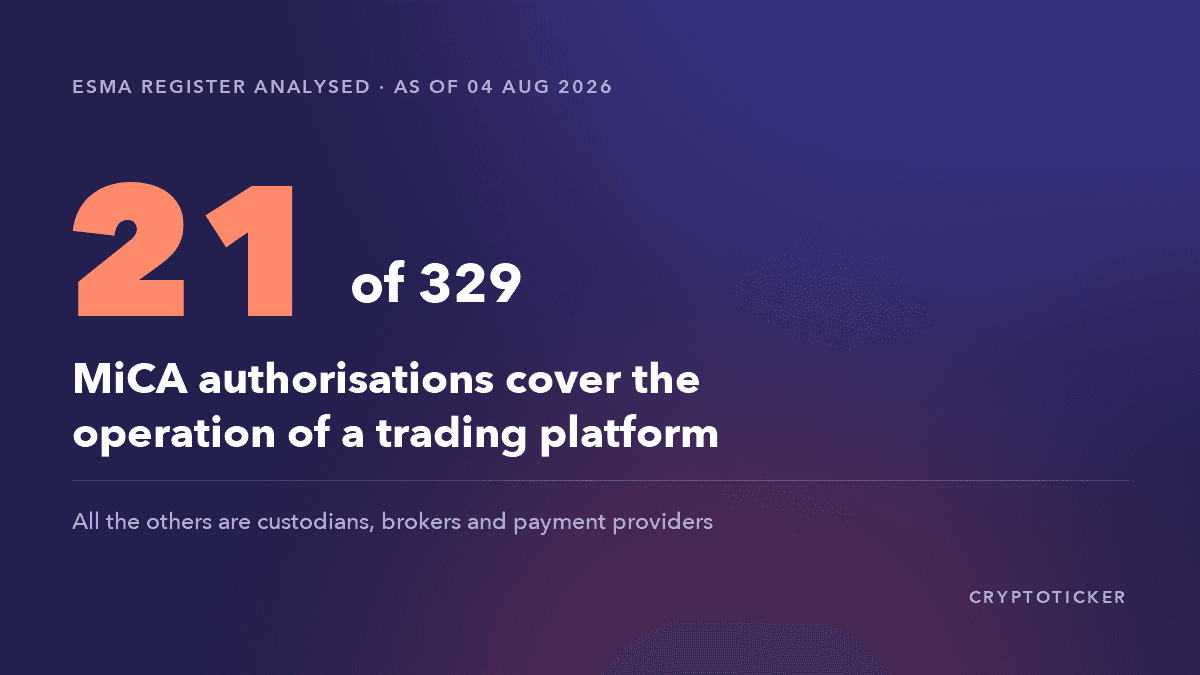
MiCA Register 2026: Only 21 of 329 Licences Are Real Exchanges
ESMA publishes the register of MiCA-authorised providers as an open file. We worked through all of it — and the result is not what the phrase “licensed crypto exchange” suggests.
July 10, 2026 10:30 AM
Binance Reveals Where Its EU Users Went After MiCA
Binance just revealed where most departing EU users moved their crypto after MiCA — and the answer is raising hard questions about the new rulebook.

July 9, 2026 10:12 AM
MiCA Wiped Out 92% of Europe's Crypto Firms: Here's Who Survived and Who's Cashing In
The July 1 deadline turned 3,000+ EU crypto firms into a few hundred. Binance is out, Tether's gone, and a handful of winners now own the market.
July 6, 2026 11:17 AM

XRP Just Got a Massive EU Green Light — But There's a Catch Nobody's Talking About
Ripple scored preliminary MiCA approval to run crypto services across all 30 EEA countries — and $XRP is up ~8% this week. Here's what it really means.
June 30, 2026 11:20 PM

How to Switch from Binance to a MiCA Regulated Crypto Exchange
Binance is winding down EU services after missing the MiCA deadline. Here's why it's happening and how to move your funds to a regulated platform safely.

More from CryptoTicker