
BaFin Crypto Knowledge Survey: Four Assumptions Owners Believe Are True
BaFin has measured what crypto owners know about their products: 57 percent of the answers were correct, 31 percent wrong. Four false assumptions come up especially often, and each of them changes your own investment decision.



Which topics should we dive deeper into?
Select what genuinely interests you. Your picks feed directly into our editorial planning.
Crypto news that's actually worth your time.
Weekly. 60 seconds. Carefully curated by our editors: no hype, no promo flood, no spam.
Germany's financial regulator BaFin published a survey on financial knowledge of crypto-assets on August 25, 2026, and the result is uncomfortable: anyone who owns Bitcoin or Ether knows more about these products on average than the rest of the population, yet still gets almost every third knowledge question wrong. Four assumptions come up especially often, and all four have consequences for how much money you put into which product.
The paper is titled "Knowledge gaps among crypto investors" and draws on a representative survey conducted in April 2026. It is no new rule and no warning about a single provider. It is a measurement, which is why you can read it as a checklist against your own assumptions. That is exactly how this article is built.
BaFin Survey on Crypto Knowledge: What the Regulator Measured
In April 2026 BaFin surveyed a thousand people and put sixteen knowledge questions on crypto-assets to them. Respondents could explicitly tick "don't know" on every question instead of having to guess. That matters methodologically: a survey that fails to record admitted ignorance separately confuses uncertainty with error.
Across all respondents, 36 percent of the answers were correct and 19 percent were wrong, while in 45 percent of cases participants said they did not know. Almost half the population, then, simply does not trust itself to judge crypto-assets. In itself that is no problem, as long as no purchase decision follows from it.
How Large the Group Concerned Is
According to the survey, around 13 percent of adults in Germany own crypto-assets, which is more than nine million people. A further 34 percent held shares, bonds or funds but no crypto-assets, and 53 percent owned none of these products. Anyone holding Bitcoin therefore belongs to a minority that stopped being a fringe in numerical terms long ago.
57 Percent Right, 31 Percent Wrong: How Crypto Owners Scored
Among owners themselves the picture looks different from the population as a whole. They answered 57 percent of the questions correctly and got 31 percent wrong. The share of openly admitted ignorance shrinks sharply, while the share of wrong answers rises markedly. Someone who has invested has engaged with the subject and trusts their own judgement; they simply get that judgement wrong in almost a third of cases.
This shift is the real finding of the survey. An investor who honestly says they do not know something seeks advice or leaves it alone. An investor who mistakes a false assumption for established knowledge does neither.
Inflation Protection: Why the Supply Cap Says Nothing About the Price
The most common false assumption in the survey: 54 percent of crypto-asset owners took Bitcoin to protect against inflation. The regulator classes that as an error.
The reasoning behind it is understandable. The number of Bitcoin is capped in the protocol at 21 million units, while a central bank can expand the money supply in circulation. A fixed number of units, however, does not produce a fixed value. The price in euros arises on trading venues out of supply and demand and can fall by a double-digit percentage within a few weeks. An asset meant to preserve purchasing power over a given period has to remain reliable across that period. Scarcity alone does not deliver that.
What Follows From This in Practice
If you hold crypto-assets as a hedge against the loss of monetary value, the best check is over what period that hedge is supposed to work and whether you could withstand a price drop of thirty or forty percent within it. For money needed in the foreseeable future the answer is as a rule no. This says nothing about the long-term development of the price. It says something about the function you assign to your holding.

Price Stability: Many Crypto Owners See Bitcoin as the Calmer Asset
More than a third of the crypto owners surveyed assumed the Bitcoin price to be more stable than that of newer coins. Stated in that generality, it is wrong. Bitcoin trades on a great many venues at the same time and reacts immediately to news and market sentiment.
There is something correct in the assumption that the survey does not measure: a very small, thinly traded token can swing more sharply on a single day than Bitcoin, because there a mid-sized order already moves the price. But "swings less than a micro-cap" quickly turns into "swings little", and that leap is the mistake. Anyone who knows the difference between the two statements plans their entries differently.
 Regulated Crypto Exchanges Compared
Stablecoin as a Savings Product: Value-Stable Does Not Mean Value-Growing
A stablecoin is a crypto-asset whose price is tied to a reference, usually the US dollar or the euro. The peg is the entire product promise: a euro stablecoin is supposed to be worth one euro, today and in a year's time.
Around half the owners surveyed considered stablecoins suitable for building wealth. That misreads the construction. A token that by design stays at its reference value throws off no return of its own. Anyone who wants a yield from it regardless has to lend the token out, put it into a protocol or accept an offered rate of interest, and then carries a credit or contractual risk on top. How to tell whether a stablecoin is fit to serve as a cash-like holding at all is set out in our checklist on the criteria for cash equivalence; this article deliberately does not repeat it.
Stablecoin as a Derivative: A Peg Is No Hedge
Just under half of respondents took stablecoins to be derivatives, that is, instruments with which sharp price swings in other crypto-assets can be hedged. That confuses two entirely different things.
A derivative takes its value from an underlying and moves inversely or with leverage to it. A stablecoin refers to a currency rather than to any underlying in the portfolio. It does not fall when Bitcoin rises, and it does not rise when Bitcoin falls. Anyone swapping a position in Ether into a stablecoin has sold that position and afterwards holds something dollar-like. That is a temporary exit and no hedging transaction. For tax purposes in Germany the swap counts as a disposal, which is easily lost if you picture it as mere protection.
Why the Classification Counts at All
42 percent of respondents knew that stablecoins are themselves crypto-assets, and 45 percent did not. The classification is no quibble over terms: under the European MiCA regulation, asset-referenced tokens and e-money tokens carry their own obligations for the issuer, from backing through to the right of redemption. Anyone who does not know which category their token falls into also does not know what rights they hold against whom. Which issuers are registered for this is listed by the regulator in public registers.
Wallet, Data Record, Price Formation: Where Respondents' Knowledge Held Up
The survey shows more than gaps. About half of respondents knew that the Bitcoin price arises out of supply and demand and is not set by any single body, and that crypto-assets sit in digital wallets. 35 percent were able to place Bitcoin, in simplified terms, as electronic data records.
The wallet point is the most practically important of this group, and it is often ticked off too early. Knowing that a wallet exists is one thing; knowing who holds the private key is another. If the holding sits with a provider, the provider holds the key, and you have a claim against a company. If it sits on a device of your own, you hold the key yourself and bear sole responsibility for securing it. Anyone who knows this difference makes a deliberate choice between a trading venue and their own hardware wallet instead of an incidental one.
MiCAR Authorisation: What BaFin Actually Examines for a Licence
A day after the survey, on August 26, 2026, BaFin published an interview with its expert Ruth Burkert that supplies the other half of the picture. Its key sentence: "A BaFin licence is seen in the market as a seal of quality."
The authorisation procedure examines, among other things, the IT systems of crypto-asset service providers. Added to that are requirements for the professional suitability and reliability of the managing directors, a check on the owners and a look at company processes, in particular at the precautions against money laundering. Supervision does not end with the permission, it begins there: the authority keeps watching authorised houses for breaches of the regulation. By its own account, BaFin has also authorised the first DLT trading and settlement system in the EU.
A Seal of Quality With Limits: What a Permission Does Not Vouch For
A permission says something about the company that holds your money and your crypto-assets in custody and executes your orders. It says nothing about the price of the product you buy there. An authorised provider may sell you a token that goes on to lose half its value; that is the market risk you have taken on, and no case for the supervisor.
Second, there is no deposit guarantee for crypto-assets along the lines of the current account. The statutory guarantee covers bank deposits up to 100,000 euros per customer and institution. Crypto-assets fall outside it. What happens in an insolvency depends on how the holding was kept in custody and whether it is held separately from the provider's own assets.
The two points together explain why the survey and the interview sit well side by side. The regulator can set the framework within which a provider works. Whether the product fits your plan remains your decision. An overview of trading venues with a European permission can be found in our comparison of regulated crypto exchanges.
 Hardware Wallets Compared
Search Engine Ranking Instead of Authorisation: How Many People Pick Their Provider
One observation from the interview translates directly into an action. According to BaFin, many German consumers still use the companies that appear particularly high up in search engines. A position in a results list, however, is no proof of a permission. It can be bought, and it is in any case independent of whether a European authority has ever examined the house.
For precisely this purpose BaFin keeps public registers: a company database with the supervised institutions and a continuously updated list of warnings about providers operating without permission. How fast that list grows is clear from a look at the past few weeks; on August 25 alone a warning about identity misuse in the crypto sector was added.
Three Checks That Take a Few Minutes
First: enter the full company name from the legal notice into BaFin's company database, not the brand name from the app. Second: check which authority in which member state granted the permission, because under MiCA it applies across Europe and the competent supervisor is often not based in Germany. Third: hold the name against the regulator's warning notices before any money moves. If a dispute with a supervised provider arises later, the route runs via a complaint to BaFin.
What Is Established and What Remains Interpretation
Established and backed by a date are the figures of the survey, its design with a thousand respondents and sixteen questions from April 2026, the publication date of August 25, 2026 as well as the statements from the interview of August 26, 2026. All information in this text comes from these two publications by the regulator.
Interpretation, and expressly no measurement, is the connection this article draws between the two texts: that a market in which half the owners misjudge a basic property of their product needs the provider framework more than a market with an experienced public. BaFin does not put it that way. It describes its role more cautiously and stresses that consumers for whom a purchase may be an option should inform themselves better about opportunities and risks, and that the authority supports them in doing so through various channels. This text makes no statement about the causes of the measured gaps; the survey supplies nothing on that.
Checking Your Crypto Knowledge: What to Take Away
- Take the four false assumptions one at a time. Inflation protection, price stability, stablecoin as savings, stablecoin as protection: ask of each whether it sits inside your own reasoning for an existing holding. If a reason falls away, the position does not yet fall with it, but you decide afresh and no longer on the old assumption. Where you buy belongs to the same decision: the overview of crypto exchanges shows the trading venues along with their fee models.
- Check your provider's permission before you add to a position. Company name from the legal notice, comparison against the regulator's company database, a look at the competent member state. Which trading venues can show a European permission is set out in the comparison of regulated crypto exchanges.
- Establish for your largest holding who holds the key. If it sits with the provider, it hangs on that provider's holdings and solvency; if it sits with you, it hangs on your own safeguards. Both are defensible, but only when chosen deliberately. The devices for this and the differences between them are set out in the hardware wallet comparison.
(As of September 1, 2026. This article is not investment advice. Prices and fee structures change; check the terms with the provider before you buy.)
Transparency note: This article was produced with the assistance of artificial intelligence and reviewed by our editorial team before publication. All figures and claims were checked against the primary sources linked in the text. The feature image was generated with AI.
Related articles
- “We have created the essential conditions …”: bitcoin.de has stood still for three months, the MiCAR licence is missing
- Deutsche Bank to Custody Bitcoin and Ether: Why Retail Clients Are Missing and What to Check in Your Own Custody
- Starting a crypto company in Germany: legal form, BaFin licence and capital
- Sparkasse Crypto Custody: Why You Get No Key to Your Bitcoin and What to Check First
- Wallet App Without BaFin Authorisation: When Holding Crypto-Assets Requires a Licence
Which topics should we dive deeper into?
Select what genuinely interests you. Your picks feed directly into our editorial planning.
Crypto news that's actually worth your time.
Weekly. 60 seconds. Carefully curated by our editors: no hype, no promo flood, no spam.

September 22, 2026 7:13 PM

CME Lists Bitcoin Cash and Uniswap Futures From October 19: What Retail Investors Must Check With Their Broker
CME Group brings futures on Bitcoin Cash and Uniswap to market on October 19, and BCH jumps 24 percent on the news. For retail investors in Germany, however, a BaFin order decides whether they may trade the contracts at all.
September 22, 2026 1:12 PM

Buying Bitcoin With PayPal in Germany: What Really Works and What It Costs
PayPal runs no crypto service of its own in Germany, but it works as a deposit route at regulated exchanges. What the detour costs, which withdrawal hold follows it and why buyer protection does not apply here.
September 12, 2026 7:13 AM

BaFin Warnings in September: How to Check in Three Minutes Whether a Crypto Provider Holds Authorisation
Twelve consumer notices in ten days, five of them on crypto-asset services and two with the entry point in WhatsApp or Telegram. We evaluated all twelve notices ourselves and show the check that takes you three minutes.
August 14, 2026 6:23 AM

Bitcoin Savings Plan and Tax: How the Holding Period, FIFO and the Exemption Limit Interact on Monthly Buys
Every savings plan instalment is a separate acquisition for tax purposes, with a holding period of its own. How the exemption limit, the order of disposal and record-keeping duties interact on monthly Bitcoin buys, with the sources from the statute and the Ministry of Finance circular.
September 22, 2026 1:27 AM
Bitcoin ATM in Germany: Fees, BaFin Authorisation and Tax
Bitcoin ATMs stand in kiosks and shopping arcades, and buying there costs a multiple of the online route. What BaFin demands of the operator, at what amount your ID becomes due, and how you evidence the purchase for tax.
August 24, 2026 10:29 AM
Buying More Bitcoin at $77,000: Savings Plan or Lump Sum
Bitcoin stands at $77,256 after gaining 22.78 percent in a week. This guide shows you how to buy more cleanly at this price and which method fits which starting position.
August 16, 2026 9:11 PM
Swapping Bitcoin for Stablecoins: Does Austria Charge Tax?
Anyone swapping bitcoin for USDT or another stablecoin usually pays no tax in Austria yet. When the swap does become taxable after all.
September 13, 2026 4:33 AM

Your Volksbank's Crypto Licence: Why You Have to Check Custody Separately
14 of the 16 newest CASP entries in the ESMA register were German cooperative banks, and each one carries order execution only. Our count of the BaFin database shows that not one of the 21 cooperative institutions is registered as a crypto custodian.

July 1, 2025 2:12 PM
Germany’s Banking Giants Go Crypto: Deutsche Bank and Sparkassen, the 2026 Launch Status
Deutsche Bank plans crypto custody for institutional clients by the end of 2026, the Sparkassen want to offer crypto trading in their app from mid-October. Where both plans stand.
March 27, 2025 5:00 AM
Bitcoin or Stablecoins: Which Is the Best to Hold in 2025?
GameStop adds Bitcoin to its treasury while Fidelity explores launching a new stablecoin. But what's in it for investors, and which is the best to hold in 2025?
September 1, 2026 4:12 AM

USDT cashback and 7 percent on stablecoins: what the MiCA interest ban means for you
A new payment card advertises up to 10 percent cashback in USDT and up to 7 percent a year on the balance. Article 50 MiCAR explains why a provider licensed in the EU is not allowed to pay you exactly that.
August 25, 2026 10:23 PM
bitcoin.de Stands Still: What the August 28 Shareholder Meeting Means for Your Balance
Trading and deposits at bitcoin.de have been suspended since June 12, while withdrawals continue to run according to the operator. On August 28, Bitcoin Group SE holds its annual general meeting: what the date changes for your balance, and how to tell whether the platform is coming back.
August 19, 2026 10:30 AM

The bitcoin.de Trading Halt: An Assessment of What the Standstill Means for Your Balance
Trading and deposits at bitcoin.de have been suspended since 12 June 2026, and no new start date has been named so far. This assessment separates the documented from the presumed and shows what you can check yourself for your balance today.

July 23, 2025 11:00 PM

Limited-Time Offer: Explore OKX and Earn up to 100€ in Bitcoin!
OKX is now live in Germany and Austria! New users can earn up to 100€ in Bitcoin by completing simple tasks. Here's how to claim your bonus.
September 24, 2026 10:19 PM
Bitcoin for Retirement: What Applies from 2027 and What You Decide Now
Bitcoin is not permitted in any state-subsidised retirement product, including the new retirement savings account from 2027. Anyone who still wants to use crypto assets for their own pension goes through private assets, and there a cutoff date at the end of 2026 is shifting the tax rules right now.
October 3, 2026 4:40 PM

Investing in Bitcoin With a Savings Plan or a Lump Sum: What the December 31 Tax Cut-Off Changes
Anyone putting money into Bitcoin now chooses between a lump sum, a monthly instalment and an ETN in a securities account. The German finance ministry’s draft bill would keep the one-year holding period only for holdings bought by December 31, 2026.
March 25, 2025 3:00 AM

BREAKING NEWS: Visa and OpenAI to Partner for Stablecoin Payments
With the Fed pivoting, the SEC softening its stance, and Visa exploring crypto wallets with Sam Altman, could Bitcoin hit $250K?
May 2, 2026 7:00 PM

Crypto Regulation News: Stablecoin Yield Rules Could Trigger the Next Bitcoin Move
New US stablecoin yield rules could reshape crypto regulation, stablecoin adoption, and Bitcoin’s next major market move.
January 14, 2026 2:47 PM
Crypto Markets on Edge on 14 January 2026: US PPI Surprise Ahead of the Tariff Ruling
Hot US producer prices and a pending Supreme Court tariff ruling kept crypto on edge on 14 January 2026. The ruling came on 20 February, and the Fed later raised rates.
September 1, 2026 12:19 PM
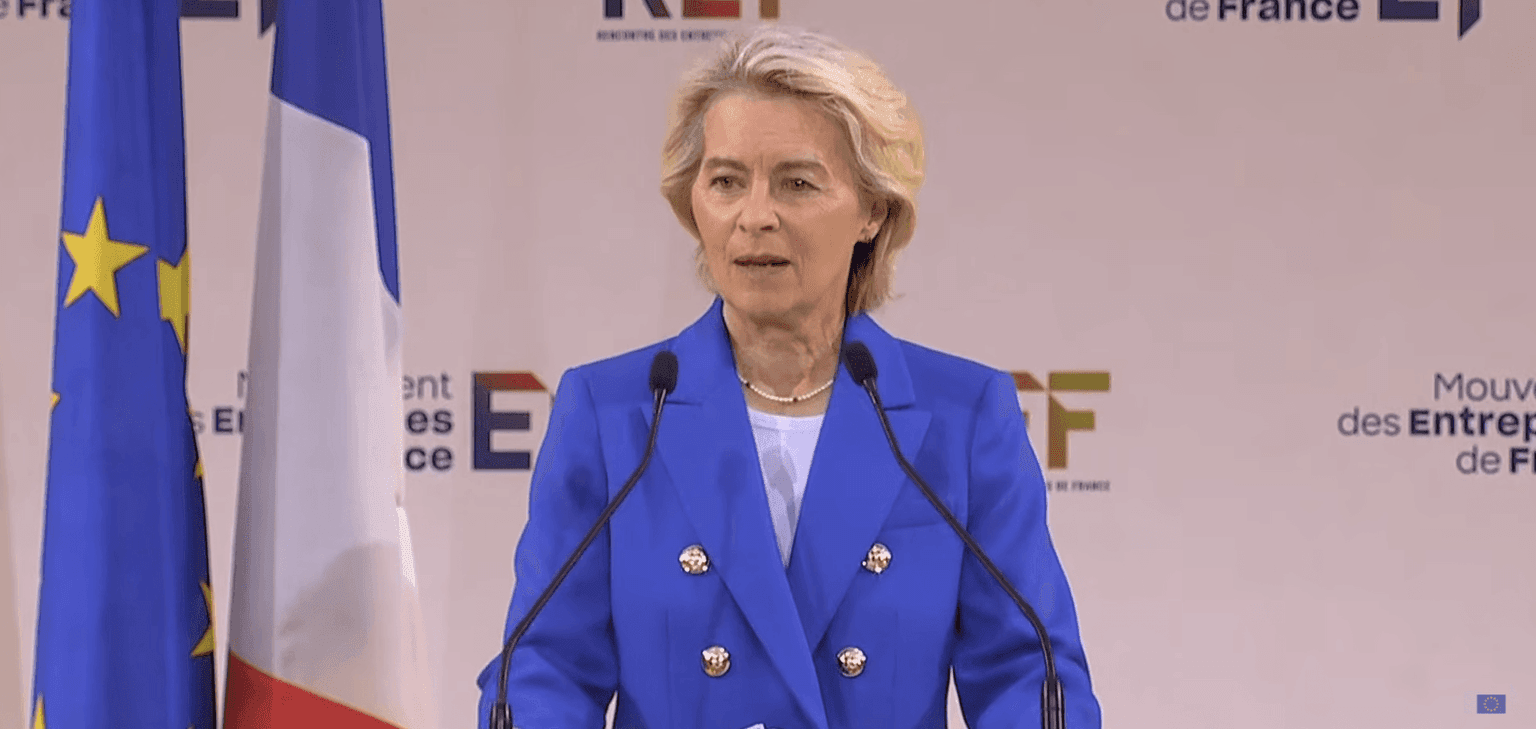
Von der Leyen Wants Your Bank Deposits: Here Is How to Keep Control of Them
Brussels wants Europe's 10 trillion euros in deposits funding its companies. What it means for savers, and why Bitcoin savings plans matter.
June 30, 2026 5:20 PM
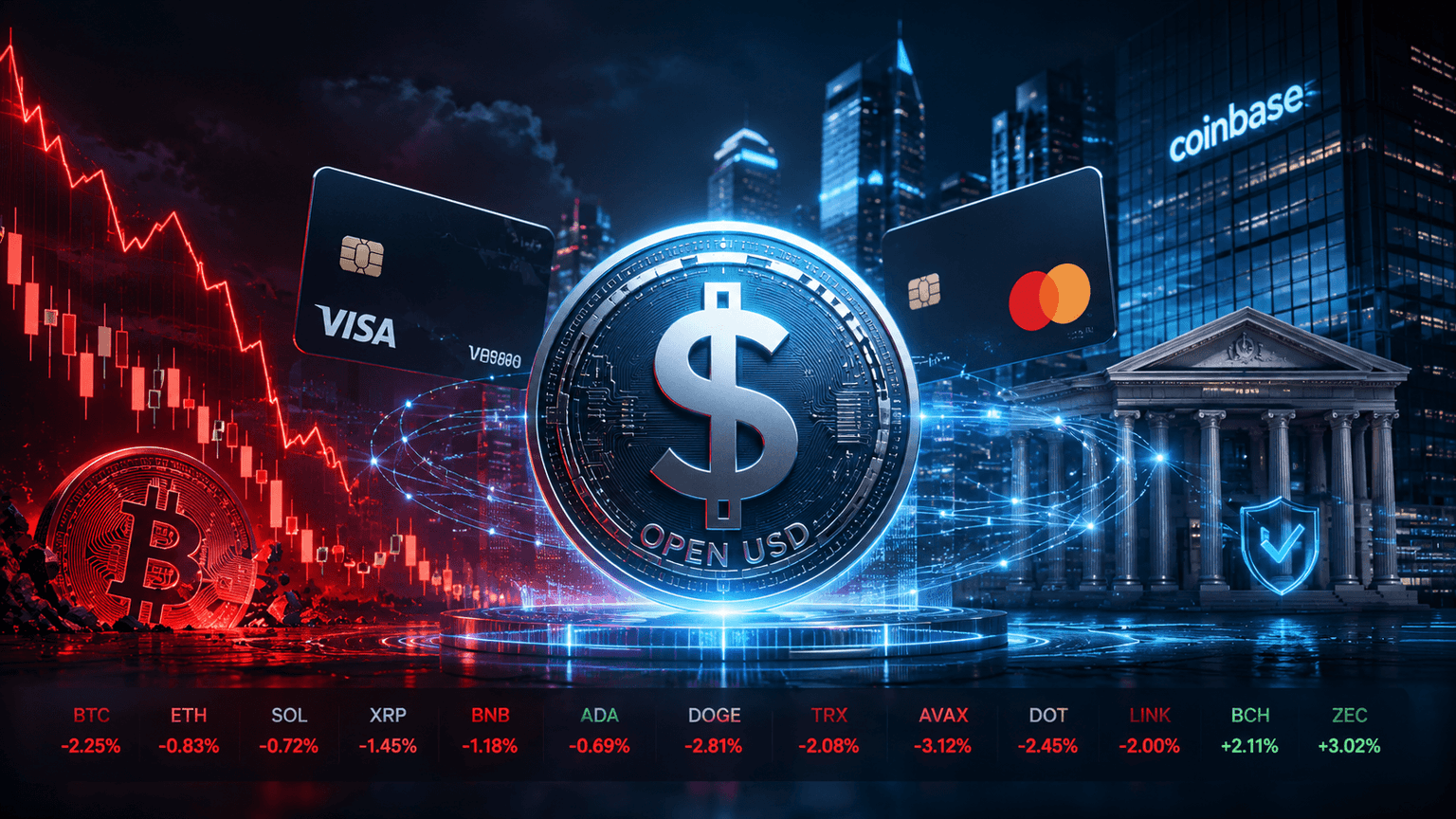
Stablecoin War Begins: Visa, Mastercard and Coinbase Launch Open USD as Bitcoin Crashes
Open USD launches with Visa, Mastercard and Coinbase as Bitcoin falls below $59K. Is this the real crypto story now?
March 27, 2026 3:41 PM

Oil Shock Is Crushing Crypto — Here’s the Hidden Link Investors Miss
Rising oil prices and war tensions are pressuring crypto markets. Discover how the global energy shock is driving Bitcoin and altcoins down.

June 18, 2026 9:43 AM

Oil Crashes 38% to a 3.5-Month Low — Why This Is Bullish for Crypto
Oil crashed 38% to $74, near pre-war levels. Lower oil means lower inflation and more rate-cut odds — and that's a tailwind for Bitcoin and crypto.
December 5, 2025 4:32 PM
Bitcoin Drops Below $90K — What Caused It, and What Comes Next?
Bitcoin fell below $90K after liquidation cascades, but cooling inflation, QT ending, and rising liquidity now point to a potential rebound.
December 5, 2025 3:22 PM
The New Bitcoin Cycle Has Arrived, And It’s Not What You Expect...
Bitcoin isn’t following the old 4-year cycle anymore. Liquidity, not halving dates, is driving the next bull run — and the setup points to a much longer rally.
June 30, 2025 10:44 PM

Bitcoin Price USD in June 2025: Musk’s Debt Bill Attack and the Sparkassen Crypto Plan
Snapshot from 30 June 2025: Musk attacked Trump’s $5T debt bill and Germany’s Sparkassen announced crypto trading. What Bitcoin did next, updated September 2026.
September 9, 2026 4:22 PM
Crypto Tax in Germany: What Applies in 2026 and What Is Set to Change in 2027
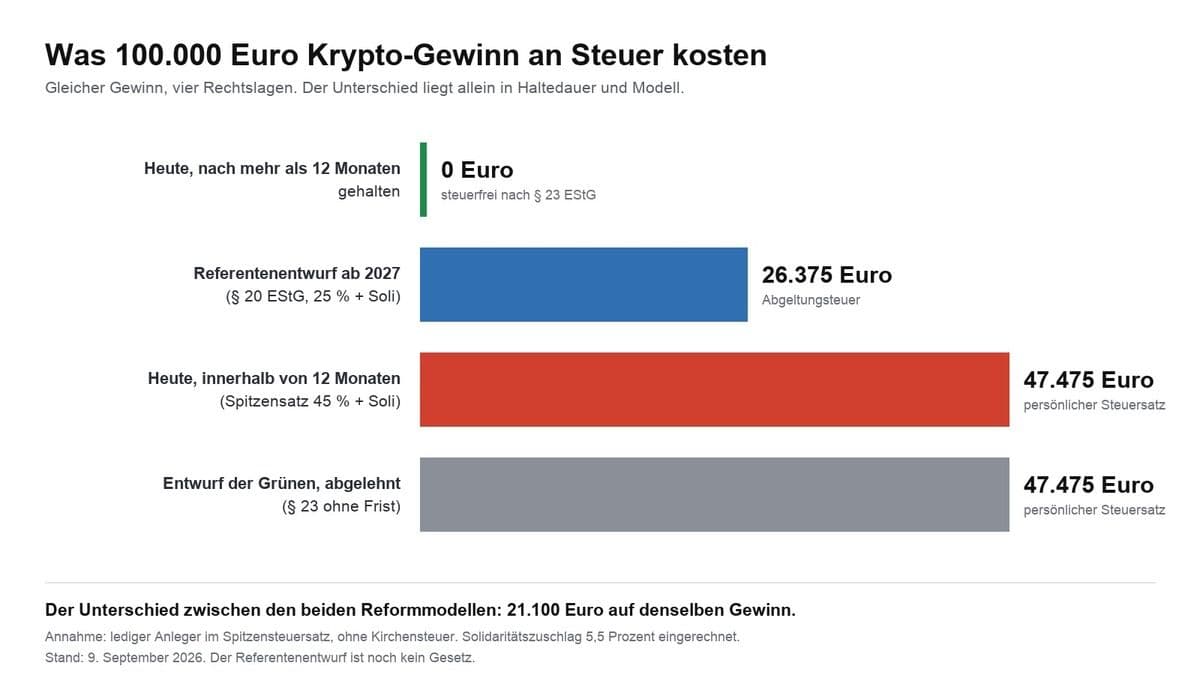
Crypto gains are tax-free after twelve months; before that your personal tax rate of up to 45 percent applies. What triggers tax, how the holding period is calculated, what happens with staking and losses, and what the draft bill would change from 2027.
More from CryptoTicker