
E-Evidence From August 18: Which User Data Investigators Can Request From Crypto Exchanges
From August 18, 2026 public prosecutors can request user data directly from service providers in other EU states, without the detour through mutual legal assistance. Article 2 of the regulation, however, contains a sector exemption for financial services, and the German implementing act limits the role of the tax authorities to criminal tax proceedings.





Which topics should we dive deeper into?
Select what genuinely interests you. Your picks feed directly into our editorial planning.
Crypto news that's actually worth your time.
Weekly. 60 seconds. Carefully curated by our editors: no hype, no promo flood, no spam.
On August 18, 2026 an EU regulation becomes applicable that for three years has occupied almost nobody outside specialist law firms. Regulation (EU) 2023/1543 on European Production and Preservation Orders for electronic evidence in criminal proceedings, E-Evidence for short, allows a public prosecutor to approach a service provider in another member state directly. For a share of cases, the route through mutual legal assistance between judicial authorities falls away.
In German-language crypto coverage the rule has recently arrived mostly in a sharpened form: from Tuesday, investigators could reach accounts at crypto exchanges without a detour. That does not survive a reading of the regulation. Article 2 contains a sector exemption that bites precisely here, and the German implementing act contains a second restriction that concerns the tax office.
This assessment rests on the text of the regulation at EUR-Lex and the German implementing act at gesetze-im-internet.de.
The E-Evidence Regulation from August 18, 2026: what takes effect that day
The regulation dates from July 12, 2023 and was adopted together with Directive (EU) 2023/1544. The regulation governs the orders themselves; the directive ensures that every service provider concerned has a reachable point of contact in the single market. The three-year transition period ends on August 18, 2026.
For providers already active in the EU on February 18, 2026, the deadline to name at least one addressee expires on the same day: an establishment or a legal representative in the EU on whom an order can be served. Anyone failing to name one risks fine proceedings.
The distinction between route and power matters here. What investigators may do in substance continues to follow the criminal procedure law of the issuing state. What is new is the route to it: a French prosecutor no longer has to go through a German court to reach data held by a provider based in Germany.
Production order and preservation order: the regulation’s two instruments
The regulation knows two orders that are often named in one breath although they achieve different things. The European Production Order requires the addressee to transmit specified stored data to the issuing authority. The European Preservation Order demands less and still often stands at the beginning in practice: the provider must keep existing data from deletion so that it can later be requested on a separate legal basis. Nothing changes on the customer’s account in the process.
Both orders are issued within a concrete criminal proceeding. A speculative bulk enquiry, in which an authority has an entire customer base screened, is not covered by the regulation.
Why dropping the mutual legal assistance route is the actual core
Mutual legal assistance between two member states frequently took months. With data deleted after weeks under a provider’s retention periods, an investigation therefore ran into the void. The price of the shortcut: judicial control by the state where the data sits falls away in part.
Article 2(3): the sector exemption for financial services
The decisive sentence for everyone holding crypto through a provider sits in the definitions. Article 2(3) defines a service provider as any person offering certain categories of service, and does so with the express words “excluding financial services as referred to in Article 2(2), point (b), of Directive 2006/123/EC”.
That exemption cuts an entire sector out of the scope. At the point referred to, the Services Directive 2006/123/EC excludes banking, credit, insurance, securities and payment services, and the E-Evidence Regulation takes over that catalogue.
What follows for a MiCA-authorised crypto exchange cannot be answered across the board. The reference points to a catalogue from 2006 in which crypto-asset services naturally do not appear. Whether a provider falls under the exemption is therefore a question of the individual case; the law firm Winheller, which specialises in crypto law, likewise considers a case-by-case assessment necessary in its analysis.
In practice that means two things. Trading, custody and payment processing point towards the exemption, because they stand closest to classic financial services. Ancillary functions with no connection to the financial business can be caught, such as an integrated chat, a user forum or a document store. The exemption attaches to the individual service rather than to the company sign. A regulated provider with European authorisation therefore does not stand outside the regulation automatically.

Subscriber data, traffic data and content data: three categories with three hurdles
Where a provider does fall within the scope, the data category determines the height of the hurdle.
Subscriber data are the master data of an account: name, address, registration details and whatever else is needed to identify the user. They can be requested for any criminal offence, regardless of its gravity. At a provider with anti-money-laundering duties, those are precisely the data from account opening.
Traffic data describe who communicated with whom and when, without revealing the content. Content data are the content itself. For these two categories the regulation requires that the offence be punishable in the issuing state by a custodial sentence of a maximum of at least three years, or that it belong to certain groups of offences listed in the regulation.
The identity behind an account is thus the most easily reachable information. Anything beyond it requires an offence of some weight.
 Regulated crypto exchanges compared
Ten days and eight hours: the deadlines for the addressee
Under a production order the addressee transmits the requested data directly to the issuing authority within ten days of receipt at the latest. In justified emergencies the deadline shortens to eight hours. A preservation order is to be implemented without delay.
Eight hours means round-the-clock availability for providers. For you as a customer, what counts above all is this: a few hours can lie between an order arriving and your data being transmitted. No advance warning is provided for, and while investigations are ongoing, notification of the person concerned can be deferred.
EBewMG and the Federal Office of Justice: how Germany implements the regulation
Germany implemented the directive with its act on European production and preservation orders for electronic evidence, EBewMG for short, promulgated in March 2026. Part 2, covering the naming of addressees, has applied since March 13, 2026; the remaining provisions enter into force on August 18, 2026.
How fresh this legal position is shows in a detail from the full text. On retrieval at gesetze-im-internet.de on August 16, 2026, sections 7 to 17, meaning the whole of Part 3 with the procedure, along with section 19, still carried the note “entering into force in future”. The procedural law to be applied from Tuesday was not yet officially designated as law in force on the Sunday beforehand.
The competent body is the Federal Office of Justice. As the central authority it supervises the duties of service providers and can penalise breaches as a regulatory offence; section 18 EBewMG contains the schedule of fines. Section 2(2) EBewMG makes clear that the powers of German investigating authorities in relation to domestic providers remain unaffected. For purely domestic matters little changes, then; the purpose is the cross-border case.
Tax office and criminal tax proceedings: why ordinary taxation stays outside
The second frequent confusion concerns the tax administration. The EBewMG does bring in the tax authorities, but only in a narrowly drawn role: where they conduct criminal tax proceedings independently. There the tax office acts as a prosecuting authority, and for that the Code of Criminal Procedure has long provided powers of its own.
In ordinary taxation procedure, meaning the review of your tax return, no new general investigative power arises. Anyone fearing that their case officer could call up trading history at an exchange in Ireland or Malta from Tuesday is confusing two types of procedure. The requirement remains an initial suspicion of a criminal offence.

DAC8 and E-Evidence: two routes that are regularly confused
Since January 1, 2026 crypto-asset service providers have been subject to new reporting and due diligence duties under DAC8 and the German crypto-asset tax transparency act. Both concern crypto, data and authorities; the mechanism, however, runs in opposite directions.
DAC8 is an automatic reporting route: the provider reports of its own motion, regularly, without any trigger and without suspicion, and the tax administrations exchange the data among themselves. E-Evidence is a trigger-based retrieval route: nothing happens as long as no authority requests something in a concrete criminal proceeding.
For your own records it follows that August 18 changes nothing about the duty to document. Anyone keeping their inflows and outflows in order anyway, for instance with one of the common tax and portfolio tools, is no more affected by the regulation than before.
 Crypto tax tools and portfolio trackers compared
Self-custody and software wallets: why there is no addressee there
The regulation addresses service providers and presupposes that somebody stores data for you and can be served with an order. With a wallet whose keys you hold yourself, that addressee is missing: no account data at a company, no registration details, no history a provider could hand over.
This observation is occasionally pushed too far. Self-custody does not withdraw holdings from investigation. Transactions on a public blockchain are visible to anyone, and the link between an address and a person arises as a rule exactly where a provider was involved after all: on buying or selling against euros. What changes is the number of places where your data sit bundled together. The technical differences are set out in the comparison of software wallets.
Limits of this assessment: what the text cannot document
Three points remain open. First, it cannot be said which specific crypto providers rely on the sector exemption and which have named an addressee. A public list of addressees was not findable at the time of research; from the outside the question cannot be answered provider by provider.
Second, on the question whether crypto-asset services are financial services within the meaning of the Services Directive there is, as far as can be seen, no case law yet. The assessment rests on the wording and on specialist literature and may change.
Third, this text deliberately names no figure for the level of possible fines: section 18 EBewMG contains the schedule, but a reliable amount could not be established from the primary source.
Putting the E-Evidence Regulation in context: what to take away
August 18, 2026 shortens an administrative route. It creates no new power of access to your account and does not turn the tax office into an investigating authority. Three steps put that in order for your own holdings.
- Check which services your provider runs alongside the financial business. Trading, custody and payment processing point towards the sector exemption under Article 2(3); an integrated chat or a document store does not. The providers with European authorisation are listed in the comparison of regulated crypto exchanges.
- Keep the reporting routes apart. What goes to the tax administration without any trigger is governed by DAC8. If you maintain your transaction history anyway, August 18 changes nothing about that; the suitable tools are listed in the comparison of crypto tax tools.
- Decide on custody according to your security needs. With self-custodied holdings there is no addressee for an order, but you carry the key risk alone. An overview of the devices: hardware wallet comparison.
Which provider deadlines are currently creating real pressure to act is set out in the overview of crypto exchange deadlines. The primary sources for further reading: the text of the regulation at EUR-Lex and the EBewMG at gesetze-im-internet.de.
(As of August 16, 2026. This article is not investment advice. Prices and fee structures change; check the terms with the provider before you buy.)
Transparency note: This article was produced with the assistance of artificial intelligence and reviewed by our editorial team before publication. All figures and claims were checked against the primary sources linked in the text. The feature image was generated with AI.
Related articles
- Crypto Withdrawal to Your Own Wallet: Ten Providers Checked, Three Will Not Let Your Coins Out
- Euro Deposit to a Crypto Exchange Rejected: Why the Transfer Fails and What You Can Do
- Coins Stolen in an Exchange Hack: What the German Tax Office Accepts as a Loss
- Bitpanda Launches Bitpanda Fusion 2.0: Here's What to Expect...
- Crypto Reporting Rules: What Your Exchange Reports to the Tax Office, and Why the Total Is Not Your Profit
Which topics should we dive deeper into?
Select what genuinely interests you. Your picks feed directly into our editorial planning.
Crypto news that's actually worth your time.
Weekly. 60 seconds. Carefully curated by our editors: no hype, no promo flood, no spam.

August 21, 2026 1:26 PM

Crypto Exchange Account Frozen: Why Nobody Tells You Why, and What Actually Helps
If you get no explanation after a freeze, it feels like arbitrary treatment. In fact the German Money Laundering Act forbids the provider from telling you. What happens in that time, which deadlines apply and which documents shorten the process.

November 21, 2023 11:55 AM

Binance to Pay $4B to end U.S Criminal Case
Discover how the U.S. Justice Dept's $4B case against Binance is reshaping the world of crypto regulation.

January 23, 2025 11:45 PM

TRUMP Crypto Executive Order to make America the Capital of AI and Crypto - Bitcoin Reserve Coming?
Following one of the most awaited Trump actions, the Trump crypto executive order, empowering AI, cryptos, and technology, what would be David Sacks role in this? Here is all you need to know...
August 14, 2026 6:18 PM

Bitcoin From a Foreign Exchange to Austria: Which Tax Data You Need
Transferring Bitcoin from a foreign exchange to an Austrian platform: which tax data can be missing for the withholding tax. And what investors need to watch out for.
May 18, 2026 8:15 AM
Bitget Review 2026: Is Bitget a Good Crypto Exchange? What You Need to Know
Explore the key insights and safety considerations of trading on Bitget. Make informed decisions before you start trading. Read the full review now!

May 26, 2025 11:00 PM
Inside Bitget: How COO Vugar Usi Zade Is Shaping the Future of Crypto Trading
From Bitget Seed and AI-powered tools to regulatory strategy and mass adoption, COO Vugar Usi Zade reveals how Bitget is building the next era of crypto trading.
September 22, 2026 4:37 AM

Crypto Tax Audit: What Evidence the Tax Office May Demand
If the tax office asks about your crypto gains, the only thing that counts is what you can produce. The German Fiscal Code governs what may be demanded and what happens when the documents are missing.
September 5, 2026 10:24 PM

Fake German Finance Ministry Letters: Why Nobody May Demand 19 Percent VAT on Your Crypto Purchase
Since September 1, 2026, Germany's Federal Ministry of Finance has been warning about forged letters that demand 19 percent VAT on cryptocurrency purchases while citing real transactions. That tax does not exist, and this is how to spot the forgery.
September 25, 2026 4:13 PM

Crypto Exchange Protection Funds Recalculated: What Really Covers Your Balance After the Bitget Hack
The $351.6 million attack on Bitget would eat up three quarters of the exchange's in-house protection fund. We retrieved the protection promises of several exchanges ourselves and measured them against deposit insurance and MiCA liability.
September 19, 2026 4:11 PM

MiCA Consultation Closes September 30: What to Check and Submit Before Then
The European Commission is reviewing the MiCA crypto regulation and will accept submissions until September 30, 2026 at 23:59 CEST. Staking, DeFi, lending, stablecoins and custody are all under examination, and you can take part without a lawyer.
January 21, 2025 6:44 PM

Banks Are READY Yet Awaiting Crypto Regulations Under Trump's Pro-Crypto Administration, Says Bank of America CEO
Bank of America CEO Brian Moynihan discusses Trump’s economic policies and the banking industry’s readiness to adopt cryptocurrency. But with no regulations to date, what about the future of Crypto?

August 22, 2019 9:55 AM

Here’s why you should skip Facebook’s Crypto: Instagram Data Breach
It’s practically similar to stating the sky is blue yet we have another Facebook Data Leak close by influencing a huge number of clients. This time around, it includes the contact data of in excess of 49 million Instagram Accounts […]
March 17, 2026 4:41 PM

Vietnam to Ban Foreign Crypto Exchanges as Local Banks Race for First Licenses
Vietnam is launching a pilot for local crypto exchanges while planning a ban on foreign platforms like Binance to control capital flows and boost adoption.
October 24, 2025 8:23 AM

Crypto 2025: Why Blockchain Became Mainstream
2025 marks crypto’s mainstream breakthrough as institutions adopt blockchain, stablecoins rival Visa, and regulation finally clears the path.
September 4, 2026 4:39 AM

Source of Funds at a Crypto Exchange: Why a Deposit Can Freeze Your Account for 15 Days
OKX chief Star Xu described on September 2 what an unusual deposit sets off: reviews of 15 days and longer, during which balances and account functions can be restricted. What that means for investors in Germany, and which documents you should keep to hand.
August 21, 2026 4:17 PM

Crypto Withdrawals to Your Own Wallet: Why Exchanges Demand Proof of Address Ownership Above €1,000
Above €1,000 your provider has to establish whether the destination address really belongs to you. Article 14(5) of the transfer of funds regulation, five permitted methods, and the reason a withdrawal stalls without this step.
March 3, 2021 7:07 PM

Breaking News – LiteBit exchange was HACKED, here’s what you Need to Know
In an email sent to its users, LiteBit announced that they were hacked. Repercussions were not very harsh, and the company reassured its users.

November 19, 2018 12:11 PM

Brazilian Crypto Investment Platform Atlas Quantum Hacked, Data Of 264,000 Users Leaked
Atlas Quantum, Brazilian crypto investment platform has been hacked and the data of more than 264,000 of its customers has been leaked.
September 14, 2026 7:40 PM

Bitcoin Order Before the Fed Decision: What Slippage Really Costs You
Two days before the US central bank's rate decision the euro order books are thin, and a market order pays the difference. We measured the order book depth of five exchanges ourselves: between the cheapest and the most expensive execution lay a factor of 31.
August 24, 2026 10:16 AM

Crypto Tax: Why You Have to Secure Your Transaction History Before the Exchange Closes Your Account
Deadlines run out at several crypto exchanges by early September, after which accounts close and holdings are sold off by force. Anyone who does not export the trading record beforehand faces the tax return with no proof of acquisition date and purchase price.
August 21, 2026 1:33 PM

Bitcoin With No Cost Basis: How Austria Taxes the Sale
Bitcoin purchase price no longer provable? How Austria works out the capital gains tax, when a flat-rate cost basis applies and what investors can do.
August 21, 2026 10:27 AM

Complaining About a Crypto Exchange: the Deadlines Article 71 MiCAR Sets and Why BaFin Will Not Decide Your Case
Authorised crypto providers have to run a formal complaints procedure, and Delegated Regulation (EU) 2025/294 sets a hard limit of two months for it. Our own analysis of the ESMA list shows at the same time that no complaints link is on file for Germany to this day.
August 11, 2026 4:35 PM

Russia Clears Bitcoin, Ethereum and USDT for Public Trading: What It Means for Prices
The Bank of Russia named BTC, ETH and USDT for public circulation on exchanges. Retail buyers face a $3,690 annual cap. Bitcoin barely moved.
August 6, 2026 3:05 PM
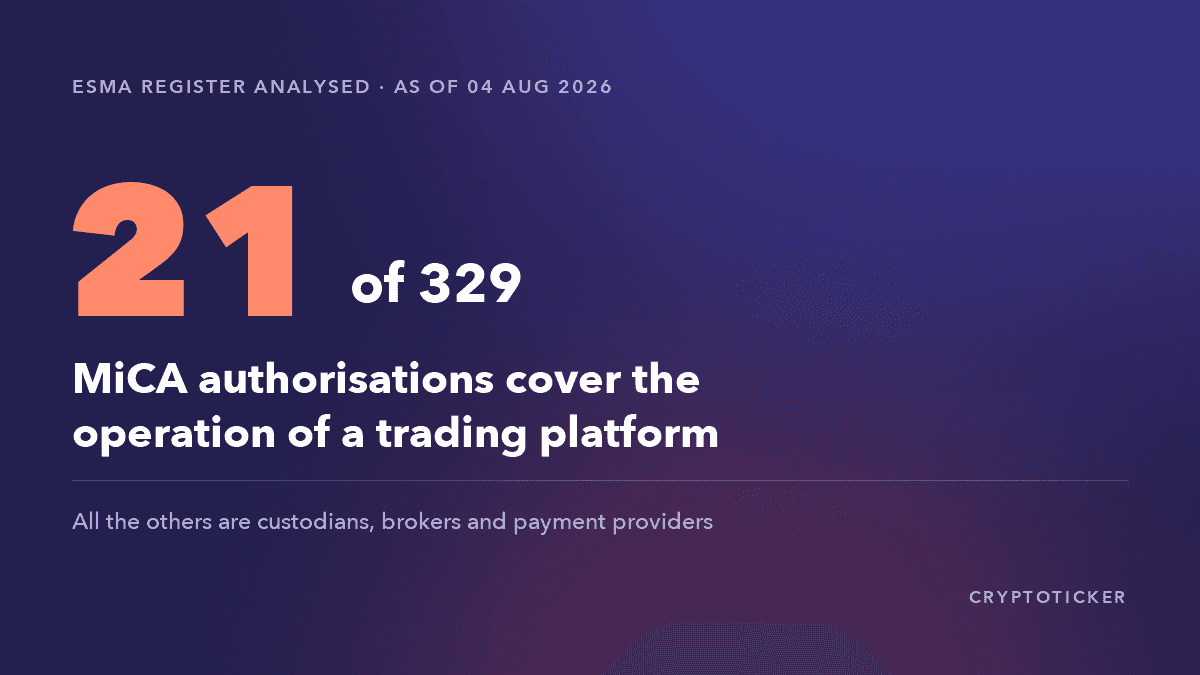
MiCA Register 2026: Only 21 of 329 Licences Are Real Exchanges
ESMA publishes the register of MiCA-authorised providers as an open file. We worked through all of it — and the result is not what the phrase “licensed crypto exchange” suggests.

July 28, 2026 5:16 PM
Russia Just Passed Its Own Crypto Clarity Act While the US Senate Keeps Stalling
Russia's crypto trading law is on its way to Putin's desk while the US CLARITY Act sits unvoted on a shelf. Here is what the split means for prices.


More from CryptoTicker