
OKX delists ICX, STORJ and ELF: by when you have to trade or withdraw
OKX is taking DORA, ICX, STORJ, ZEUS and ELF off the market. The euro pairs end on September 30, 2026, the USDT pairs on October 3, withdrawals only on December 23. We sort out the four deadlines and show, from our own measurement of the order book, why a hurried sale can turn expensive.



Which topics should we dive deeper into?
Select what genuinely interests you. Your picks feed directly into our editorial planning.
Crypto news that's actually worth your time.
Weekly. 60 seconds. Carefully curated by our editors: no hype, no promo flood, no spam.
OKX is removing five crypto assets from trading: DORA, ICX, STORJ, ZEUS and ELF. If one of them sits in your OKX account, one date matters above all, and it is not the one in the headline of the exchange’s notice. On September 30, 2026 at 08:00 UTC, that is 10:00 in central European summer time, the euro pairs ICX/EUR, STORJ/EUR and ELF/EUR come to an end. After that you can only sell via USDT, and even that only until October 3. You can withdraw for longer, until December 23, 2026. Anyone who does nothing at all will be left at the end of the year with a balance that can neither be traded nor paid out.
A delisting is the removal of a trading pair from an exchange: the pair disappears from the order book, the token itself continues to exist. That distinction alone decides whether you have to sell or merely to move. This piece sorts out the four deadlines, uses our own measurement of the order book to show why a hurried sale in the euro pair can turn expensive, and explains the tax fork between selling and withdrawing.
What OKX announced on September 23, 2026
The exchange published the notice on September 23, 2026 at 10:00 UTC. Five crypto assets and eleven trading pairs are affected. A trading pair is the combination of the token and the currency it is traded against, STORJ against the euro for instance. The same token can run in several pairs at one exchange and be removed from each of them separately.
As its reason, OKX states that the affected pairs no longer meet its own listing criteria. In its words, it is removing pairs that “do not fulfill our listing criteria”. Which specific metric was breached the notice does not say, and the exchange does not usually give reasons for individual removals. What can be evidenced is therefore only the fact of the removal along with the dates, not the assessment behind it.
These are the pairs affected:
- On September 30, 2026, 08:00 to 10:00 UTC: ICX/EUR, ICX/USDC, STORJ/EUR, STORJ/USDC, ELF/EUR and ELF/USDC.
- On October 3, 2026, 08:00 to 10:00 UTC: DORA/USDT, ICX/USDT, STORJ/USDT, ZEUS/USDT and ELF/USDT.
The sequence stands out. The euro pairs fall first, the USDT pairs three days later. For the German market that is the unfavourable order, because the euro is the currency most people here settle in.
The four key dates of the delisting at a glance
The notice carries four dates rather than a single one. These four hit different groups of readers, and three of them sit closer together than the headline suggests. All times in the notice are given in UTC; central European time is two hours later until October 25, and one hour later after that.
- September 23, 2026, 10:00 UTC (12:00 CEST): deposits of the five crypto assets have been stopped. This date has already passed.
- September 30, 2026, 08:00 UTC (10:00 CEST): trading halt for all euro and USDC pairs. On top of that, OKX is discontinuing the attached services from that moment, explicitly naming buying and selling via the express function as well as Convert, and doing so for every affected pair.
- October 3, 2026, 08:00 UTC (10:00 CEST): trading halt for the USDT pairs. That is the last moment at which any of the five assets can still be sold at OKX at all.
- December 23, 2026, 08:00 UTC (09:00 CET): withdrawals are suspended. In the exchange’s words: “Withdrawals for the affected crypto will be suspended.” After that the holding sits in the account with no way out.
The third date is the one many will overlook, because it looks like an extension. It is, however, tied to a condition that falls away three days earlier.
Why September 30 is the real deadline for you as a euro customer
At first glance, three days of trading remain after September 30. That is true, but it holds only for the bare order book of the USDT pairs. The convenient routes close earlier: the express function for buying and selling, and the Convert function that swaps one token directly into another without an order book, are both being discontinued by OKX on September 30 at 08:00 UTC, according to its own notice, for all affected pairs, the USDT pairs included.
In practice that means anyone unfamiliar with order books who has worked through Convert or the buy-and-sell screen until now does not have three extra days. For that group of users, everything ends on September 30 at 10:00 German time. The remaining 72 hours until October 3 are open only to those who can place an order into an order book in spot trading, and who have swapped their euro balance into USDT beforehand.
There is a second, unpleasant point on top of that: anyone selling via USDT after September 30 is making two transactions instead of one. Why that counts for tax purposes is set out further below.
Deposits have been blocked since September 23
The first key date has already passed, and it affects a group that features in no other delisting piece: people who are in the middle of sending tokens to OKX. Since September 23, 10:00 UTC, the exchange has accepted no further deposits of DORA, ICX, STORJ, ZEUS and ELF.
If you hold these five assets at another exchange or in your own wallet and intended to send them to OKX to sell, that route is closed. The notice does not say what happens to a transfer triggered regardless. So do not count on a credit still going through. Sell where the tokens already sit, or find another venue. A transfer that runs into the void is, at best, a support case dragging on for weeks.
A look into the order book: why a market order in ICX/EUR is dangerous
Now comes the part that appears in no exchange notice and that you should know before selling. On September 23, 2026 at 18:41 UTC we queried OKX’s public programming interface ourselves, once for daily turnover and once for the order books of the three euro pairs. The result explains why a panicky sale shortly before the deadline can be the most expensive route.
Three terms for clarity: the order book is the list of all open buy and sell offers for a trading pair. The spread is the gap between the highest bid and the lowest ask. A market order is executed immediately at whatever the best available counter-offer happens to be, whereas a limit order is executed only up to a price you set yourself.
Turnover in the euro pairs is very small
Measured over 24 hours, turnover in ICX/EUR came to around 30 euros, in ELF/EUR to around 368 euros and in STORJ/EUR to around 2,279 euros. For comparison: over the same period STORJ/USDT turned over about 640,600 USDT, ICX/USDT around 269,900 USDT and DORA/USDT around 799,200 USDT. Trading in these assets therefore takes place almost entirely in USDT, and the euro pairs have for some time been remnants rather than a market.
In ICX/EUR there is only a single bid in the book
The finding from the ICX/EUR order book is unambiguous: at the time of measurement there was exactly one bid on the buy side, namely 0.002 euros for 500 ICX. Together that comes to about one euro. The best ask stood at 0.03091 euros at the same moment. A market order to sell would therefore have executed in this book at 0.002 euros per ICX, while the price in the USDT pair converted to about 0.0126 euros. Anyone selling that way gives away most of the value without anyone having defrauded them.
For completeness: the other two euro pairs looked normal at the same moment. STORJ/EUR had a spread of 0.62 percent, ELF/EUR of 0.28 percent, with several thousand tokens on each side in both cases. The problem is therefore confined to ICX/EUR.
The last traded price is no help there either. ICX/EUR stood at 0.0261 euros at the time of measurement, twice as high as the converted USDT price. With daily turnover of 30 euros, a quotation like that comes from a single old transaction and says little about the price you could actually get.
The practical consequence: in these pairs, use a limit order, set the price at the converted USDT rate and give the order time. Anyone who only starts at nine in the morning on September 30 no longer has that time.
 Where to take the tokens? Exchanges compared
Sell or withdraw? The tax fork of Section 23 of the Income Tax Act
A delisting does not force you to sell, and that is the most important news for everyone holding their tokens for the longer term. In Germany, crypto assets held privately count as other economic assets, and selling them is a private disposal transaction under Section 23 of the Income Tax Act. Two things follow from that, and here they collide.
First: after a holding period of one year, the gain from a sale is tax-free. Within the year it is taxable, with an exemption threshold of 1,000 euros per calendar year. Exemption threshold means that with a total gain of one euro above it, the full amount counts and not just the excess.
Second: a transfer to your own wallet is not a sale. Only the place of safekeeping changes, and the holding period keeps running. Anyone who has held their STORJ for eighteen months loses nothing by withdrawing. Anyone who has held them for three months and now sells in a panic triggers a taxable transaction that would not have happened without the exchange’s deadline.
Swapping into USDT already counts as a disposal and is not treated as a mere intermediate step. Anyone selling via the USDT pair after September 30 therefore realises the gain with the swap into USDT, not only with the later exchange into euros. Anyone who has not completed the holding period and does not want to break it withdraws the tokens rather than converting them. How a change of exchange affects the holding period is something we set out in more detail in our piece on switching crypto exchange and the holding period of September 23, 2026.
One note that belongs here: this is the general legal position and not tax advice for your individual case. Anyone moving larger amounts or looking to offset losses should clear it with a tax adviser. You will need the documentation of your transactions yourself in any event, and before the exchange switches off the trading pair and the exports become hard to follow.
What “untradable assets” in the funding account means
For the case where you do nothing, OKX describes the process itself. Once the delisting is complete, holdings are consolidated into the funding account. At OKX, the funding account is the area for deposits and withdrawals, separate from the trading account where trading takes place. During this consolidation, withdrawal and internal transfer are temporarily blocked; afterwards you will find the holding again among the untradable assets.
Untradable in this state means: the holding is there, it is displayed, you can withdraw it, but you can no longer do anything with it inside the exchange. This state lasts from the trading halt until December 23, 2026. That is a generous window, and that is precisely why it is dangerous, because a date two and a half months out reliably disappears from memory.
So set yourself a reminder now if you are not acting immediately. After December 23, according to the notice, there is no route out any more, and what happens to the remaining holding then is not stated there.
Open orders and trading bots: why you should end them yourself
Two details of the notice concern people with more than a simple buy order in the system. Both cost money if they are overlooked.
Open orders in the affected pairs are cancelled automatically by the system as soon as the pair is switched off. OKX expressly advises doing this yourself beforehand, and puts the duration of automatic cancellation at one to three working days. During that time, the balance behind the order is tied up. Anyone still holding an old limit order in the book on September 30 who has other plans for the balance behind it may end up waiting into October.
For trading bots, meaning automated trading strategies that place orders independently, OKX writes that they will be closed in stages between 07:00 and 08:00 UTC on the respective delisting day. The exchange itself recommends stopping them manually beforehand if you want to avoid fees or price discounts from the automatic closure. Given the ICX/EUR order book, that warning should be taken seriously: an automatic closure is, in substance, a market order.
ICX holders face two deadlines at once on September 30
One group is hit twice on that day, and that has nothing to do with OKX. On May 25, 2026, the ICON Foundation set out the roadmap for the end of the ICON network: the migration from ICX to SODA becomes one-way from September 30, 2026, and from that day only conversions from ICX to SODA will be supported. The final cut-off for the migration is December 31, 2026, after which the network will be halted permanently and will remain in place as an archive for reference.
Anyone holding ICX at OKX is therefore watching two clocks at once on September 30. At 08:00 UTC the euro pair ends at the exchange, and on the same day the way back in the migration closes. Both have the same practical consequence: whatever needs doing belongs before that day, not on it. The details of the migration, including the question of what applies when assets are held at an exchange, are in our piece on the ICX-to-SODA migration and its deadlines. You can read the dates themselves directly at the ICON Foundation.
Where to take the tokens? Other venues and your own wallet
There are two directions for the move, and they answer different questions.
To another exchange if you want to sell
That route is only worth it if the destination venue lists the token at all and enough turnover takes place there. Check that in the destination’s order book beforehand, not after the transfer. Pay attention to authorisation as well: since the EU’s MiCA regulation, crypto service providers need a licence as a CASP, a crypto-asset service provider, to operate in the EU. OKX serves the European market through OKX Europe Limited under a licence granted by the Maltese regulator MFSA in January 2025. If you switch, do not switch by accident to a provider without that authorisation. Which houses are available and regulated in Germany is shown in our comparison of crypto exchanges.
Into your own wallet if you want to hold
Self-custody means the private keys sit with you and not with a company. For holding across deadlines, that is the clean route, because no external deadline decides over your holding any more. One point matters more here than the choice of wallet: before withdrawing, check which network the payout runs over and whether your wallet supports exactly that network. Several of the affected tokens can be withdrawn over different networks, and a withdrawal into a network the receiving address does not know is the most common way of losing a balance for good. Test the route with a small amount before you send the rest.
 Self-custody instead of leaving it on the exchange
Why ICX and STORJ are disappearing from one exchange after another
This delisting does not stand alone. On August 21, 2026 we reported on the removal of ICX, SCRT and STORJ at Binance, and on August 30 on the trading halt for STORJ and BADGER at Coinbase. Now OKX follows, and with the same two names in the package. Within five weeks, three large venues have therefore sorted out the same assets.
For OKX itself the process has become routine. On August 22, 2026 it was MAJOR and J, on September 9 GODS, PRCL and DUCK, as set out in our piece on the OKX delisting of GODS, PRCL and DUCK. This is the same exchange’s third round of removals in five weeks. Anyone holding older secondary assets there should subscribe to the exchange’s notices rather than rely on news sites: at the time of writing, no German-language outlet had picked the matter up.
On the cause, only one thing can be said from the data, and cautiously at that: turnover in the removed euro pairs is very small, as the measurement above shows. A trading pair turning over 30 euros a day costs an exchange more in surveillance and market maintenance than it brings in. Whether that was the reason in this particular case OKX does not say, and we therefore do not claim it either.
What a delisting does not mean
Finally, the context that is usually missing from excitable reports. A removal at one exchange is no verdict on the project behind the token. STORJ, ELF, DORA and ZEUS continue to trade at other venues, and the networks behind them carry on regardless. With ICX the situation is different, but not because of OKX: there the network itself ends at the turn of the year, on the strength of a decision by its own community.
Nor is a delisting a buy signal. Prices do sometimes swing sharply in such phases, because selling pressure meets thin order books. Deriving a forecast from that would be guesswork. What can be evidenced is solely the list of dates and the depth of the order books at the time of measurement. Everything beyond that you decide for yourself, and best of all before September 30.
And one last clarification on the order of your own steps: selling, withdrawing and doing nothing are three different decisions with three different deadlines. The mistake that costs money is almost never the wrong decision, but the late one.
The OKX delisting: what to take away
- Check today whether one of the five assets sits in your account. DORA, ICX, STORJ, ZEUS and ELF are affected, and deposits of these assets have been running into the void since September 23. If you want to change venue for the sale anyway, compare the available houses beforehand in our comparison of crypto exchanges.
- Decide between selling and withdrawing before September 30. Within the one-year holding period a sale triggers a taxable transaction, a transfer to your own wallet does not. If you want to keep track of acquisition dates and deadlines, you will find suitable tools in our comparison of crypto tax software.
- Sell with a limit rather than at market, and test the withdrawal with a small amount. The ICX/EUR order book carried a single bid worth around one euro at the time of measurement. For long-term safekeeping after the withdrawal, our comparison of hardware wallets will help.
The full list of dates including all eleven trading pairs is in the OKX delisting notice.
(As of September 23, 2026. This article is not investment advice. Prices and fee structures change; check the terms with the provider before you buy.)
Transparency note: This article was produced with the assistance of artificial intelligence and reviewed by our editorial team before publication. All figures and claims were checked against the primary sources linked in the text. The feature image was generated with AI.
Related articles
- Binance Delists ICX, SCRT and STORJ: From August 21, One Door Closes After Another
- IoTeX on Coinbase: What IOTX Holders Should Know After the September 23 Trading Halt
- Bitvavo Drops ICX on 2 October: The Forced Euro Conversion Follows on 12 October
- Coinbase Halts STORJ and BADGER Trading on September 28: What Holders Must Check Now
- BW-Bank Opens Bitcoin Trading Inside the Securities Account: What to Check Before Your First Buy
Which topics should we dive deeper into?
Select what genuinely interests you. Your picks feed directly into our editorial planning.
Crypto news that's actually worth your time.
Weekly. 60 seconds. Carefully curated by our editors: no hype, no promo flood, no spam.

September 29, 2026 10:40 AM
“We have created the essential conditions …”: bitcoin.de has stood still for three months, the MiCAR licence is missing
Bitcoin Group SE published its half-year report on September 29, 2026: trading on bitcoin.de has been idle since the end of June because the MiCAR authorisation is missing. The new platform is finished, but no launch date is set.
September 23, 2026 10:11 AM
Kraken: 45 coins are on cancel only, 21 were announced – what to check when trading pairs are blocked
On September 23, 2026 we counted the public market directories of three trading venues. At Kraken, 82 of 1,450 trading pairs are listed as cancel only, a state in which an order can only be cancelled and no longer executed. The 45 underlying assets affected include just 21 that appear in the delisting notice we reported on September 3.
August 18, 2026 4:26 PM
Binance Delisting on August 17: ACX, HFT, PIVX, PYR, VANRY and VIC Leave Spot Trading
Binance removes six tokens from spot trading entirely at 03:00 UTC on August 17, 2026. Anyone holding ACX, HFT, PIVX, PYR, VANRY or VIC has to choose between selling before Monday and withdrawing by October 17.
September 16, 2026 1:12 PM
Bitvavo Delisting of Kava, Nano and Ravencoin: What to Do Before Friday, 2 p.m.
Bitvavo drops KAVA, XNO and RVN on September 18, 2026, and three deadlines expire in a single afternoon. Nano has no withdrawal route at all, and the automatic euro conversion on September 28 counts as a sale for tax purposes.
August 21, 2026 1:42 PM

Writing Off a Total Crypto Loss: When the Tax Office Recognises Worthless Coins
A token that has collapsed only reduces your tax once you actually dispose of it. What applies to delisting, exchange insolvency and worthless holdings under Section 23 of the German Income Tax Act, and how you offset losses.
September 24, 2026 4:28 AM
Crypto Trading Bots and Tax: What Applies With Thousands of Trades a Year
A bot turns one investment decision into hundreds of disposals, and the tax office counts every single one. This guide explains the holding period, FIFO, the exemption limit and the record-keeping duties, and what to set up before the bot makes its first trade.

September 26, 2026 7:40 AM
The RAIN Token After the Enlivex Termination: What to Check on Access, Forced Sale and Holding Period
Enlivex terminated a share placement of 66,666,667 shares payable in RAIN tokens on September 22, 2026. The token sits 46.4 percent below its all-time high, and at Kraken the withdrawal deadline expired long ago.
September 24, 2026 4:16 AM
Trump-Xi Summit at the White House: The Crypto Positions to Check Before the Meeting
Xi Jinping is on a state visit to Donald Trump today, and the crypto market comes into the meeting carrying the gains of an exceptionally strong week. What to check on leverage, holding period and custody before the first headline runs.
August 24, 2026 4:22 AM

Selling XRP After a 53 Percent Week: What the Holding Period Costs
XRP trades at $1.51 after a weekly gain of a good 50 percent, yet your net proceeds are decided by the purchase date. This article works through the holding period, the exemption limit and FIFO at measured reference-date prices.
August 21, 2026 4:24 AM

Forced Sale on a Crypto Exchange: Which Moment Counts for the Holding Period and What You Must Document
At Luno, Kraken and Valour the deadlines are running out, after which the provider realises the remaining holding itself. For tax purposes that is a disposal, and what governs it is the exchange's timestamp.
October 3, 2026 4:40 PM

Investing in Bitcoin With a Savings Plan or a Lump Sum: What the December 31 Tax Cut-Off Changes
Anyone putting money into Bitcoin now chooses between a lump sum, a monthly instalment and an ETN in a securities account. The German finance ministry’s draft bill would keep the one-year holding period only for holdings bought by December 31, 2026.
September 24, 2026 10:19 PM
Bitcoin for Retirement: What Applies from 2027 and What You Decide Now
Bitcoin is not permitted in any state-subsidised retirement product, including the new retirement savings account from 2027. Anyone who still wants to use crypto assets for their own pension goes through private assets, and there a cutoff date at the end of 2026 is shifting the tax rules right now.
September 24, 2026 1:24 PM
NEAR Falls Almost 8 Percent After a 62 Percent Week: What to Check on Perps, Buying Route and Holding Period
NEAR Protocol loses up to 7.9 percent on September 24, 2026 and is still more than 55 percent higher over the week. The rally was carried by a confidential perp offering via Hyperliquid, which raises questions of its own on buying route, leverage and holding period in Germany.
September 4, 2026 10:32 AM
Crypto Deadlines This Autumn: Nine Cut-Off Dates Checked, and Only Three Leave You Time After Trading Ends
Nine running crypto deadlines, eleven provider pages, one query date: we counted how much time really lies between the end of trading and the withdrawal cut-off. In six of nine cases the stated date is the end of the line.
September 3, 2026 4:41 AM
Kraken Delists 21 Tokens: Trading End on September 11 Has Passed, Withdrawals Run Until December 10
As of September 27, 2026: Kraken had set the end of trading and deposits for 21 cryptocurrencies for September 11, 2026 at 14:00 UTC, and that date has passed. According to the exchange, withdrawals remain possible until December 10, 2026 at 15:00 UTC. Our September 3 survey showed that none of these tokens could be deposited at Bitvavo, Coinbase or Bitstamp.
September 22, 2026 1:28 PM
Selling Bitcoin and Cashing Out in Euros: How It Works in Germany
Between the sell order and the euros in your current account stand the exchange, your bank and the tax office. Knowing the order of events saves fees, waiting time and, in the best case, the entire tax on the gain.
September 8, 2026 10:21 PM
Crypto Holding Period and Grandfathering: Why December 31, 2026 Becomes the Cut-Off in Germany's Draft Bill
A ministerial draft bill from Germany's finance ministry names a cut-off date for the first time: crypto assets acquired after December 31, 2026 are to fall under the flat-rate withholding tax. What that means for legacy holdings, running savings plans and staking income, and why nothing has been decided yet.
September 27, 2026 7:22 AM
CoinEx Forced Conversion: Withdraw Non-USDT Balances by September 29
On September 29 at 02:00 UTC spot trading ends at CoinEx, and all holdings outside USDT are sold or delisted after that. What this means for your holding period, your tax bill and your withdrawal.
September 27, 2026 4:32 AM
Hester Peirce Leaves the SEC: What Now Applies to Your Custody in Germany
The most crypto-friendly voice at the US securities regulator goes on October 2, 2026, and the commission shrinks to two members. For investors in Germany it is still the European rulebook that decides, and there a deadline falls in July 2027.

September 26, 2026 10:12 AM
Canton Jumps 15.6 Percent to $0.13: What to Check on Trading Volume Before You Order
Canton (CC) gains 15.64 percent in 24 hours to $0.13443, making it the strongest mover in the top 25. Our own count shows that CC trades at just 0.94 percent of its market capitalisation, a fifth of the median.
September 25, 2026 7:14 PM
Chainlink Above the September High: What Open Interest, Funding Rate and Liquidation Risk Mean for LINK
Chainlink stands at $13.86, 11.2 percent higher than 24 hours ago. Our own query at OKX and Hyperliquid shows funding at the baseline rate, and what that means for leverage, buying route and tax.
August 19, 2026 10:30 AM

The bitcoin.de Trading Halt: An Assessment of What the Standstill Means for Your Balance
Trading and deposits at bitcoin.de have been suspended since 12 June 2026, and no new start date has been named so far. This assessment separates the documented from the presumed and shows what you can check yourself for your balance today.

December 3, 2019 8:28 PM
Top 3 Methods To Withdraw Bitcoin to Bank Account
Want to withdraw Bitcoin to your bank account? Or Did you know that you can Withdraw Bitcoin to Bank Account? Unlike Fiat currency, Bitcoin is much simple to withdraw, and you may not have to wait for days to obtain […]
September 26, 2026 1:19 AM
Germany’s Crypto Holding Period Is Wobbling: What to Check Before December 31
A CDU member of the Bundestag makes it plain: the coalition agreement does not guarantee that the one-year holding period for crypto assets will survive. What that means for purchases made before the planned cutoff date of December 31, 2026.
September 9, 2026 4:22 PM
Crypto Tax in Germany: What Applies in 2026 and What Is Set to Change in 2027
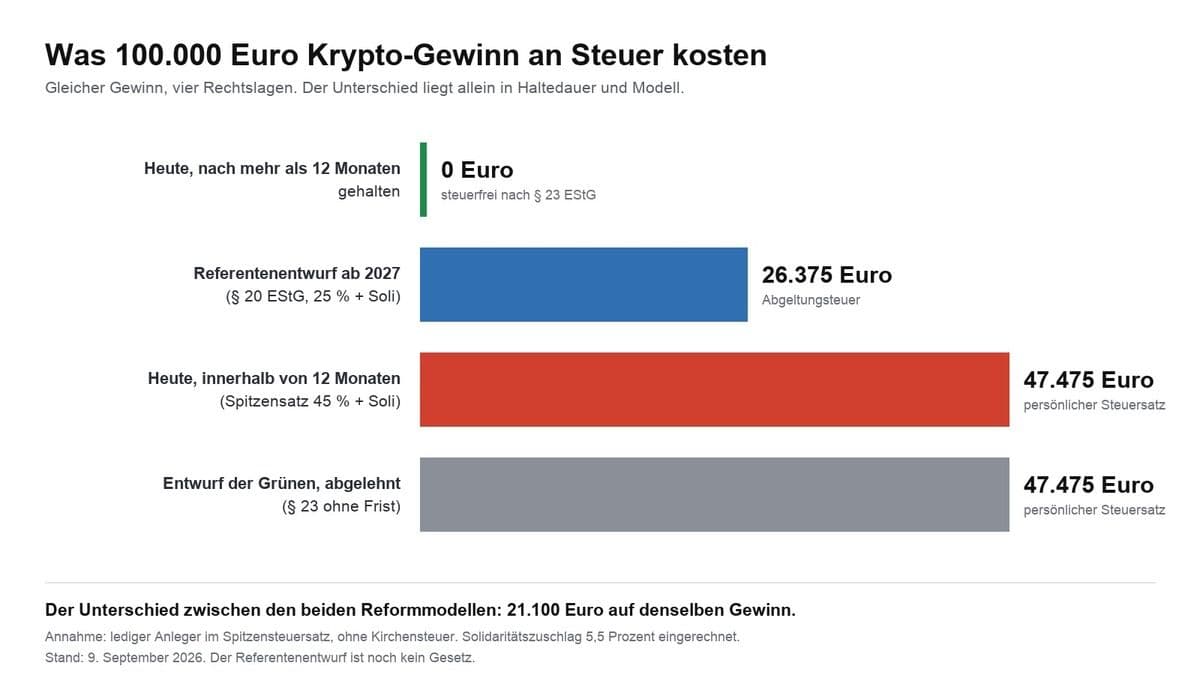
Crypto gains are tax-free after twelve months; before that your personal tax rate of up to 45 percent applies. What triggers tax, how the holding period is calculated, what happens with staking and losses, and what the draft bill would change from 2027.

August 30, 2025 11:00 PM

Bitcoin Robot That Trades for You Making Big Gains, Read On...
Here's how to start bot trading on OKX, the world’s leading crypto exchange. Automate your trades, save time, and unlock up to 60,000 USDC in rewards.
September 27, 2026 1:17 PM
Dogecoin Price: What to Check on Holding Period and Custody Before the Year End
The Dogecoin price stands at $0.0977 on September 27, 2026 and has barely moved in a day. That calm is exactly the moment to work through the holding period, the reporting duty from 2026 and custody without any time pressure.
More from CryptoTicker