
What are long and short positions in cryptocurrencies?
Long and short explained: how to bet on rising and falling crypto prices, what leverage and liquidation mean in euros, and what the long/short ratio reveals about market sentiment.


Which topics should we dive deeper into?
Select what genuinely interests you. Your picks feed directly into our editorial planning.
Crypto news that's actually worth your time.
Weekly. 60 seconds. Carefully curated by our editors: no hype, no promo flood, no spam.
Long and short describe the direction of a trade. Going long means you profit when the price rises; going short means you profit when it falls. In crypto, you usually go short through perpetual futures or margin trading, because only a derivative or borrowed coins let you earn from falling prices. This guide explains how both positions work, what they make or lose in euros with and without leverage, when an exchange liquidates them and what the long/short ratio says about market sentiment, using real data from November 14, 2026.
Long and short positions: key takeaways
- A long position gains when the price rises, a short position when it falls; with 10x leverage, every 1% price move changes your margin by 10%.
- With 10x leverage, the exchange liquidates a position after a move of roughly 9.5% against you, with 2x leverage after roughly 49.5%.
- On Binance's Bitcoin perpetual, longs paid funding at 89 of 90 settlements from October 16 to November 14, 2026, a total of 0.63%.
- Over the same period, the long/short account ratio rose from 1.50 on October 16 to 3.23 on November 14, 2026.
- On November 14, 2026, 76.4% of accounts with an open position were long.
- For retail clients in the EU, ESMA's CFD rules have capped leverage on crypto at 2:1 since 2018.
What is a long position? Going long is a bet on rising prices
A long position is the familiar way of investing: you buy an asset, such as a stock or a coin, and sell it later, ideally at a higher price. Buy low, sell high, as the saying goes. If you buy Bitcoin on an exchange and keep it in your wallet, you are long Bitcoin without calling it that. You make a profit on the difference between the buying and selling price, and without leverage the most you can lose is what you put in. A long stock position works exactly the same way.
In derivatives trading, going long means buying a contract whose value tracks the price of the underlying asset. You own no coin, only a claim on the price difference. If Bitcoin rises from 58,000 to 63,800 euros, a 10% move, a long position worth 1,000 euros gains 100 euros. If the price falls 10%, it loses 100 euros.
What is a short position? Short selling and going short explained
A short position reverses the order: sell first, buy back later. In the stock market this is called short selling, and the traders who do it are short sellers. You borrow shares through a margin account at a brokerage firm, sell them straight away at the current market price, buy them back later, ideally at a lower price, and return the borrowed shares to the lender. If the stock price has fallen in the meantime, you keep the difference. If it has risen, you lose money on the buyback, and because a price can in theory keep rising without limit, the potential loss on a short sale or any short stock position is open-ended.
The terms long and short come from traditional finance. They mean the same in crypto; only the way you open a short position is different.
How to go short in crypto: perpetual futures and margin
Most crypto shorts are opened with perpetual futures, or perps. A perp is a futures contract with no expiry date that stays close to the spot price through a regular payment between both sides, the funding rate. Selling a perp makes you short without borrowing a single coin, so you can sell short an asset you never owned: on the other side is a trader who bought the same contract. Every short position therefore has a long position of the same size. Our guide to crypto futures and perpetual futures explains these contracts in detail.
The second route is margin trading. Here you really do borrow coins from the exchange, sell them and buy them back later, just like shorting stocks. You pay interest on the borrowed amount, and the exchange requires collateral, the margin. Options are a third route, usually through a broker: a put option gains when the price falls, a call option when it rises.
Legally, perpetual futures and margin products are financial instruments. In the EU, only firms licensed under the MiFID II directive may offer them to retail clients, and ESMA's leverage limits for contracts for difference can also apply to perps. Our comparison of regulated crypto exchanges shows which platforms hold an EU licence.

 Find a crypto exchange with an EU licence
Long and short with leverage: profit and loss in euros
With leverage, you only put up part of the position's value as margin. At 10x, 1,000 euros of margin controls a position worth 10,000 euros. Profit and loss are calculated on the full position, but measured against your margin. The table shows what a 10% move up or down does to a 1,000 euro stake, before trading costs such as fees and funding.
| Position | Leverage | Position size | Price +10% | Price −10% | Liquidated after |
|---|---|---|---|---|---|
| Long (spot purchase) | none | €1,000 | +€100 | −€100 | no liquidation |
| Long | 2x | €2,000 | +€200 | −€200 | a fall of about 49.5% |
| Long | 10x | €10,000 | +€1,000 | −€1,000, liquidated | a fall of about 9.5% |
| Short | 1x | €1,000 | −€100 | +€100 | a rise of about 99.5% |
| Short | 2x | €2,000 | −€200 | +€200 | a rise of about 49.5% |
| Short | 10x | €10,000 | −€1,000, liquidated | +€1,000 | a rise of about 9.5% |
Two things stand out. Long and short mirror each other: what one side gains, the other loses. And leverage does not change the direction, only the force. At 10x, a move that Bitcoin can make on a volatile day is enough to wipe out the whole stake. For retail clients in the EU, ESMA capped leverage on contracts for difference on crypto at 2:1 back in 2018; higher leverage is mainly offered by platforms outside the EU. Margin and leverage tiers are covered in our guide to leverage trading in crypto.
Liquidation of long and short positions: when the exchange closes them
A leveraged position lives on its margin. If losses push the margin below the maintenance margin, the exchange closes the position by force. This is called liquidation. With isolated margin you lose the margin of that position, but no more. With cross margin, your whole account balance is at stake. Each exchange sets its own margin requirements, and some send a margin call first, asking you to add funds before they close the position.
As a rule of thumb, the distance to liquidation is 1 divided by the leverage, minus the maintenance margin. With a maintenance margin of 0.5%, that gives about 9.5% at 10x and about 49.5% at 2x. Take Bitcoin: the mark price of Binance's BTC perpetual stood at 64,109 dollars in the early hours of November 15, 2026, about 58,007 euros at the ECB reference rate of November 13. A 10x long would have been liquidated at about 52,496 euros, a 10x short at about 63,517 euros. At 2x, the levels would be about 29,293 and 86,720 euros.
The 1x short shows a special case: it is only liquidated if the price almost doubles. Without any liquidation level, as with a short sale of borrowed coins, the loss would be open-ended. To work out your exact liquidation price including fees and your exchange's maintenance margin, see our guide on how to calculate your liquidation price.
What long and short positions cost: funding, fees and interest
Besides trading fees, a perp position costs funding. When the contract trades above the spot price, longs pay shorts; when it trades below, the payment flows the other way. On Binance's Bitcoin perpetual, the funding rate was positive at 89 of 90 settlements from October 16 to November 14, 2026, with settlement every eight hours. Together that came to 0.63% of the position value in 30 days.
For the 10x long in the table, that means about 63 euros of funding on a 10,000 euro position over those 30 days, a little over 6% of the 1,000 euro margin. The short side received the same amount. If you short through margin trading, you pay interest on the borrowed coins instead of funding. Our guide to the funding rate shows how to calculate the cost of your own position, and our overview of the best perp DEXs compares trading fees.
 Find the right perp DEX for your trades
The long/short ratio: what the sentiment gauge shows
The long/short ratio compares the number of accounts holding a long position with the number holding a short position. A value of 1 means balance; a value of 3 means three long accounts for every short account. Exchanges publish the figure for their perpetual markets; Binance, for example, shows it in its Binance Futures trading data for all accounts with an open position.
On the BTCUSDT perpetual, the ratio rose from 1.50 to 3.23 between October 16 and November 14, 2026. On October 22 it briefly touched 1.02, close to balance, and on November 3 it stood at 2.57. By the end, 76.4% of accounts were long, up from 60.0% at the start. On 21 of the 30 days the value was above 2. Our Bitcoin long/short ratio chart shows the current reading and refreshes every few minutes.
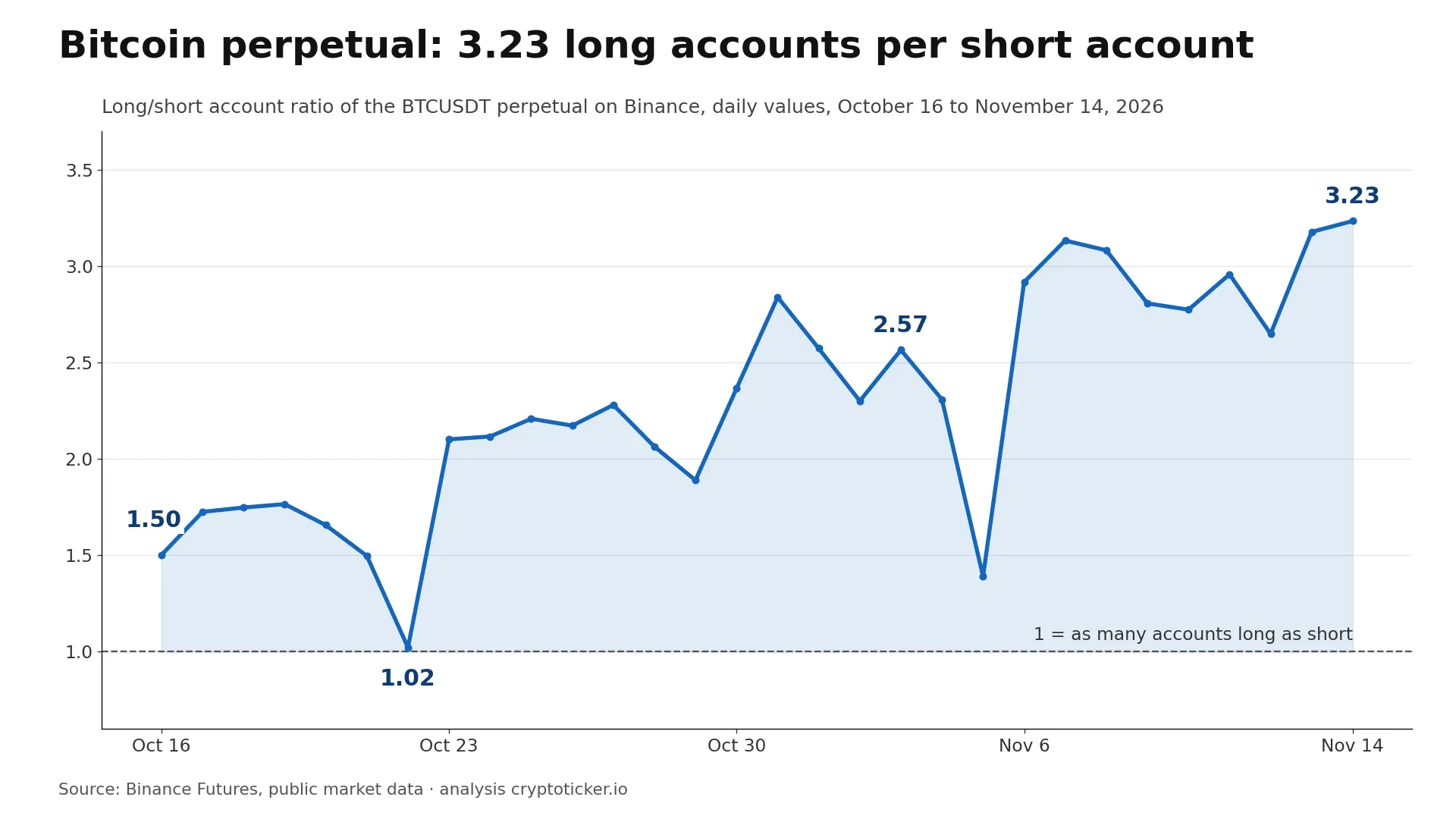
The striking part is the opposite trend: over the same period, the perpetual's mark price fell from 82,199 dollars on October 16 to 64,109 dollars in the early hours of November 15, down 22%. Most accounts therefore held or opened long positions into a falling market. Open interest, the total of all open contracts, dropped from 7.76 to 6.72 billion dollars at the same time.
The limit of the long/short ratio: accounts, not volume
The ratio counts heads, not money. Each account counts once, whether it holds 50 dollars or 50 million dollars. On a perpetual, every long position is matched by a short position of the same size, so in total longs and shorts are always equal. A ratio of 3.23 therefore only means that the short side is spread across far fewer accounts that hold larger positions on average.
Large shorts, for example from market makers, are not always a bet on falling prices, either. A trader who holds Bitcoin on the spot market and sells the perp at the same time is hedged against price swings and, with a positive funding rate, collects the payments from the long side. A high ratio mainly shows that many smaller accounts are betting on higher prices. On its own, it says nothing about the direction of the next move.
A one-sided long/short ratio: why it signals squeeze risk
Leverage is what makes a one-sided ratio dangerous. When many leveraged longs sit in the market with similar liquidation prices, a move lower can set off a chain reaction: the first liquidations are forced sales that push the price down further and trigger the next liquidations. This cascade is called a long squeeze. A short squeeze works the other way round, driving the price up when many shorts are forced to buy back at once.
A long/short ratio above 3 is therefore a reading of the market, not a forecast: it shows which side would come under the most pressure if the price turned. Whether and when that happens depends on news, liquidity and what the large accounts do. The figure becomes more telling alongside the funding rate and open interest: when all three rise together, new leveraged longs are entering and the pressure on that side grows.

Long and short trading: risk management starts with leverage
Going long or short is a view on the price. How much you put at risk depends on leverage: without it, your result moves in step with the price; at 10x, a move of less than 10% can cost the whole stake, and funding adds up day by day. If you are starting out with long and short positions, keep leverage low, match each trade to your trading strategy and current market conditions, work out your liquidation price before you open the trade, protect it with a stop-loss order and keep an eye on the long/short ratio as a gauge of sentiment. Leveraged derivatives are high-risk and can lead to the loss of all capital invested; this article is not investment advice.
More on leverage and squeezes: What is open interest and the funding rate explained.
Frequently asked questions about long and short
Partner links: some links on this page are partner links. If you become a customer through one of them, we may earn a commission at no extra cost to you. Selection, ratings and ranking are decided independently by our editorial team. Ethics and Independence · Ownership and Funding
Transparency note: This article was produced with the assistance of artificial intelligence. Figures and claims are based on the primary sources linked in the text. The feature image was generated with AI.
For later? Save this article and find it again in your profile.
Related articles
- Trade Anthropic stock: ANT perpetuals on Bitget, OKX and Kraken, long or short
- Spot trading explained: real coins without leverage and no liquidation price
- Dogecoin news: DOGE futures market shrinks by a quarter since early November as funding turns negative
- Crypto liquidations: $2 billion in 24 hours, mostly longs on bitcoin and ether
- Weekend crypto crash: leverage and crypto loans with bitcoin below $66,000
Which topics should we dive deeper into?
Select what genuinely interests you. Your picks feed directly into our editorial planning.
Crypto news that's actually worth your time.
Weekly. 60 seconds. Carefully curated by our editors: no hype, no promo flood, no spam.

November 15, 2026 12:58 AM
What Is Open Interest? Crypto Open Interest Explained
Open interest counts every open futures contract. What the metric shows for bitcoin, how it builds up and shrinks on perpetuals, how to read it with price and why it signals squeeze risk.

November 13, 2026 8:39 PM

Bitget Futures Trading: Your First Trade, Leverage and Risk
How to trade futures on Bitget step by step: USDT-M contracts, leverage up to 150x, how far Bitcoin can move before your margin is gone, what fees and funding cost per day and how a stop-loss protects you.

November 12, 2026 9:17 PM

Shiba Inu price prediction: funding turns negative as seven in ten accounts stay long
Analysis: funding in the SHIB futures market turned negative on Thursday evening, while seven in ten accounts are still betting on higher prices. What that means for Shiba Inu until Nvidia's results on November 17, and which levels count now.
November 7, 2026 1:12 PM

Shiba Inu price slips below $0.0000045 as SHIB falls twice as hard as Bitcoin
Analysis: Shiba Inu drops below $0.0000045 in thin Saturday trading and has lost twice as much as Bitcoin over 30 days. For buyers from November 2025, the one-year holding period expires at the same time.
November 5, 2026 9:28 PM

Dogecoin Price Hits Lowest Since August as OKX Traders Pile Into Longs
Analysis: Dogecoin fell with Bitcoin and chip stocks to as low as $0.0710, its lowest since August. On OKX, the ratio of long to short accounts rose to 5.41 in the process. What the positioning shows, which levels count and where leveraged positions tip over.
November 4, 2026 7:20 AM
Crypto futures in the EU: six licensed exchanges compared, all capped at 10x
As a retail trader in Germany, you can trade crypto futures legally on six exchanges with an EU licence, all capped at 10x leverage for retail clients. The comparison covers contract design, fees, collateral and what ESMA's February statement changes for you.
November 3, 2026 9:21 AM
Leverage trading in crypto: how margin and the liquidation price work
With leverage you move a larger crypto position than your stake would allow. We work through margin and liquidation price, show the leverage limits in the EU and which licensed providers offer leverage trading.
November 3, 2026 7:58 AM

Crypto futures trading: perpetual futures explained simply
Crypto futures and perpetual futures explained: how futures trading works, what the funding rate really costs and which exchanges are licensed for it in the EU.
November 3, 2026 1:12 AM
Polkadot at $0.94: 70 percent of accounts bet on a rise while funding turns negative
Analysis: Polkadot trades at $0.9385, 20.7 percent lower than 30 days ago. On OKX, 69.6 percent of accounts are long, yet the funding rate is negative, and 81 percent of Monday's liquidations hit long positions.

October 30, 2026 6:27 PM

$1.54 billion in crypto liquidations: the next step for leveraged traders
Within 24 hours the crypto market lost leveraged positions worth more than $1.54 billion, spread across 237,314 accounts. What triggered the drop and which rules in Germany cap the loss.
October 29, 2026 9:45 PM

How to Short Bitcoin in the Crash: Step by Step on Bitget and OKX
Bitcoin fell below $79,000 after the Binance hack. If you want to bet on falling prices or hedge, a short does exactly that. How it works on Bitget and, for EU readers, on OKX Europe, a worked example at tonight's price and the risks of shorting after a crash.
October 27, 2026 12:30 PM
Dogecoin funding rate at 7.4 percent a year: the next step
Analysis: long positions in Dogecoin have been paying funding costs again on OKX since Monday afternoon, annualised at 7.4 percent as of Tuesday morning. At the same time, almost five long accounts come for every short account while open interest shrinks.
October 22, 2026 10:13 PM

Solana price prediction: 2.57 long accounts per short as $12.9 million leaves the futures market
Solana's futures market lost $12.9 million in open interest within a day, yet the long ratio holds at 2.57 accounts per short. What that means for the $100 level, and how to work out your own liquidation distance.
October 21, 2026 4:14 AM

Pump.fun launches perpetual futures with 40x leverage: what to watch now
Pump.fun has traded perpetual futures on Bitcoin and Ethereum since October 16, 2026, with leverage of up to 40 times and Hyperliquid as the technical operator. At that leverage a 2.5 percent price move is enough for liquidation, and a MiCA licence for the EU market is missing.
October 16, 2026 1:28 PM
Dogecoin: four in five leveraged accounts are long, more one-sided than Bitcoin, Ethereum and Solana
On the OKX derivatives market there are 4.17 long accounts per short account in Dogecoin, more than in any other large coin. What our own Friday morning measurement says about the risk of a chain of forced closures.
October 15, 2026 7:40 PM

$257.4 million in SHIB futures against $77.5 million spot: EU leverage stops at 2:1
SHIB futures turned over $257.4 million in 24 hours against $77.5 million on the spot market. That is a factor of 3.3, and for leverage Germany applies a hard ceiling.
October 15, 2026 1:34 PM

$489 million in liquidations in one hour: where your leverage breaks first
Forced closures wiped out around $489 million within one hour on 15 October 2026, more than half the daily total of $942 million. Our analysis of OKX futures market data shows why Ether was hit harder than Bitcoin.
October 15, 2026 10:15 AM
XRP open interest down 29.7 percent, 360 long accounts per 100 short
Two moves are running against each other in the XRP derivatives market: open interest has fallen almost 30 percent since September 22, while there are now 360 long accounts for every 100 short accounts. What the thin positioning means for the $1.29 level, and which leverage caps apply in Germany.
October 9, 2026 10:25 PM

Dogecoin: 94 Percent of Liquidations Hit Long Positions, and How the Leverage Compares With Bitcoin
On the Dogecoin futures market $7.82 million was force closed within 24 hours, almost all of it on the long side. Our count of 106 contracts shows how much leverage really sits in the market and how much of it is open to retail investors in Europe.
October 3, 2026 4:23 AM

ESMA Places Perpetual Futures Inside the CFD Perimeter: 2:1 Leverage for Retail Clients in the EU
ESMA stated on February 24, 2026 that perpetual futures are likely to fall under the CFD measures, and with them under a leverage cap of 2:1 for retail clients. The Hyperliquid Policy Center wants that settled differently, and filed its case as the MiCA review closed on September 30.
October 1, 2026 1:34 AM

Shorting Quant: Where QNT Can Be Traded After Its Sixfold Run and What It Costs
Quant has almost sextupled within a week. Anyone wanting to bet on falling prices will find QNT futures on seven large exchanges, but is currently paying daily fees to the buyers. The routes, the costs and the biggest risk at a glance.
September 30, 2026 10:13 PM
Robinhood Announces Perp Futures With 10x Leverage for US Customers: “Markets don’t work without traders”
Robinhood plans to offer eligible US customers perpetual futures on eight cryptocurrencies, with up to 10x leverage on Bitcoin and Ethereum. Nothing is tradable yet, and a different leverage cap applies in Europe.
September 28, 2026 10:12 PM

Dogecoin Futures Hold $1.5 Billion in Open Leverage: What Investors Need to Know
The Dogecoin price fell 4.2 percent on Monday to $0.0932. What matters more is where it is set: $1.5 billion in leveraged positions sit open on the derivatives market, a good tenth of market capitalisation. What that means for leverage, liquidation distance and German tax.
September 26, 2026 1:11 AM
Funding Rate on Perpetual Futures: How to Calculate What Your Position Really Costs
The funding rate is the payment between the long and the short side of a perpetual future. This guide shows how to calculate it, what Bitcoin longs have just paid, and what the rate reveals about squeeze risk.
September 24, 2026 1:34 PM

Cardano Slides Below $0.24: What ADA Holders Should Check on Leverage, Liquidation and Holding Period
Cardano has given back its move above $0.25 and trades around seven percent below the high of the past 24 hours. What that means for leveraged positions, the holding period of your tranches and the buying route under MiCA.
September 22, 2026 4:12 AM

Open Interest Climbs After the Short Squeeze: Why the Longs Are Paying Now
The short squeeze of September 21 wiped out $648 million in bearish bets, yet open interest rose instead of falling. A survey of our own across four exchanges shows the funding rate is positive on 24 of the 25 largest bitcoin perpetuals.
September 11, 2026 4:13 PM
How to Calculate Your Liquidation Price: When the Exchange Closes Your Leveraged Position
The liquidation price is the level at which your exchange force-closes a leveraged position. Here are the formula for long and short, a worked example, and the cost items that squeeze the buffer tighter in practice than the arithmetic suggests.
More from CryptoTicker