
Swatch Sale: How a $400 Plastic Clock Exposes Our Toxic Overconsumption Obsession
Riots over plastic Swatch collaborations expose global overconsumption, drawing parallels to crypto's past speculative mania—and its real goal.


Which topics should we dive deeper into?
Select what genuinely interests you. Your picks feed directly into our editorial planning.
Crypto news that's actually worth your time.
Weekly. 60 seconds. Carefully curated by our editors: no hype, no promo flood, no spam.
The New Retail Warfare: When Plastic Sparks Violence
The line between enthusiastic consumerism and dangerous mob mentality has completely dissolved in Western retail. Recent product launches across Europe and North America have witnessed unprecedented chaos, sending shockwaves through cultural and financial analysts alike. What began as an aggressive marketing push by corporate watch giants has officially devolved into physical altercations, broken glass, and police-enforced evacuations at high-end shopping centers.
Shoppers in major European cities recently surged past security barriers, forcing retail staff to lock doors in fear for their safety. In some locations, local authorities had to intervene to disperse hostile crowds. The catalyst for this physical violence? A non-limited, $400 mass-produced timekeeping accessory made of “bioceramic”—a proprietary marketing term for engineered plastic.
Hype, Scarcity, and the Death of Reason
For those trying to understand why a low-cost, unserviceable quartz or basic mechanical watch can trigger a minor riot, the answer lies in manufactured psychological scarcity. The Swatch Group—which owns both accessible fashion brands and ultra-luxury powerhouses like Omega and Blancpain—has successfully engineered an artificial bottleneck.
By weaponizing high-profile brand collaborations (such as the historic MoonSwatch and subsequent dive watch collections) and refusing to sell them reliably online, the company forced thousands into physical queues. This deliberate distribution constraint, paired with aggressive secondary market flipping, transformed a simple retail release into a flashpoint of consumer desperation.
From Counter to Chaos: What Happened in the Swatch Incident
To fully grasp the gravity of the situation, it is necessary to examine how these retail events escalate from overnight camping to civil unrest.
The Psychology of Mass Desperation
When luxury aesthetics are democratized at a sub-$500 price point, it creates a toxic cocktail of consumer envy and opportunistic greed. The crowds gathered outside these boutiques generally consist of two distinct factions:
- The Hype-Driven Consumer: Individuals seeking the immediate social validation of wearing an iconic design silhouette (like the Omega Speedmaster or Blancpain Fifty Fathoms) without paying five-figure luxury prices.
- The Scalper/Flipper: Secondary market arbitrageurs looking to exploit early scarcity by reselling the items online for double or triple the retail MSRP.
The Breakdown of Retail Safety
Because the Swatch Group fundamentally underestimated—or intentionally leveraged—the initial viral velocity of these launches, physical boutiques were left entirely unequipped. In cities like Leidschendam and Singapore, crowd density reached critical thresholds. When technical issues or limited stock announcements disrupted the lines, the psychological barrier of civil behavior shattered. People pushed, fought, and trampled structures just to secure a plastic watch that cannot even be mechanically repaired at a standard horological workshop.
A Mirror to the Past: The Digital Hype of 2021
This chaotic physical phenomenon is far from unique; rather, it is a localized, offline translation of the digital hysteria that gripped the financial landscape exactly five years ago.
During the historic bull run of 2021, the world witnessed an identical psychological breakdown occur entirely on the internet. Instead of physical storefronts, the battlegrounds were decentralized exchanges, NFT minting portals, and meme-coin launchpads. Millions of retail participants, driven by intense Fear Of Missing Out (FOMO), rushed digital liquidity pools, crashing networks and bidding up digital assets to irrational heights.
| Feature | The Swatch Collaboration Hype | The 2021 Crypto Market Frenzy |
|---|---|---|
| The Asset Class | Physical Bioceramic (Plastic) Timepieces | Digital Tokens / Non-Fungible Tokens |
| Access Bottleneck | Limited brick-and-mortar boutique locations | Network congestion and high Ethereum gas fees |
| Primary Driver | Brand prestige and immediate resale arbitrage | Speculative mania and overnight wealth generation |
| The Ultimate Risk | Illiquid physical inventory / unrepairable movement | Sharp market corrections and illiquid digital floor prices |
The underlying human software remains unchanged. Whether standing in the freezing rain outside a European mall or staying awake for 48 hours to click "Mint" on a digital art profile picture, the modern consumer is hyper-vulnerable to gamified scarcity.
The Dark Reality of Modern Overconsumption
The escalation of violence over a commodity that serves no vital survival function is a stark indicator of where hyper-consumerism has brought global society. We live in an era where identity is heavily tied to the acquisition of temporary cultural signifiers.
Major corporations have perfected the art of behavioral modification. By combining the scarcity tactics pioneered by streetwear brands with the legacy heritage of Swiss horology, they have turned basic shopping into a high-stakes competitive sport. The fact that human beings are willing to risk injury, legal consequences, and public humiliation for a mass-produced product highlights a profound existential void in the modern economic landscape—one that falsely equates the accumulation of material goods with true personal value.
Should you Buy a Swatch Watch?
While retail speculators bruise themselves in physical lines for a transient cultural trend, savvy market participants are looking at the underlying financials. The hype surrounding these bioceramic collaborations has directly fueled corporate balance sheets, a reality clearly reflected in the public markets. Over the past year, The Swatch Group Ord Shs (UHR:SWX) has experienced a massive valuation surge, climbing by more than 36% to sit comfortably above CHF 201.00.
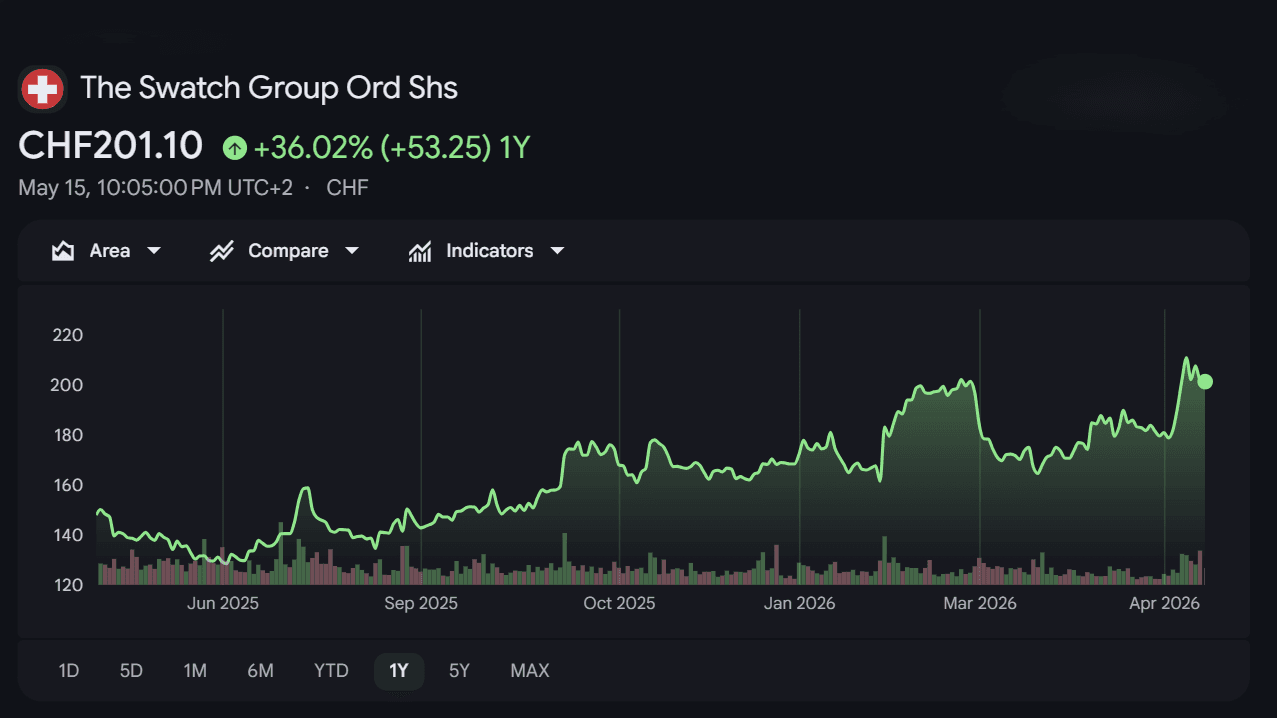
Investing in the parent company's equity presents a fundamentally stronger risk-to-reward ratio than purchasing the physical watch itself. Consumer trends are notoriously fickle; the secondary market premium on mass-produced fashion watches inevitably cools off as production caps scale up and novelty fades. Conversely, by holding the stock, you own a piece of the entire diversified empire—including luxury cash cows like Omega and Blancpain—capturing institutional value long after the storefront crowds have dispersed.
How to Buy Swatch Stock with Crypto
The modern digital asset ecosystem makes transitioning from crypto profits to legacy equity simpler than ever before. You no longer need to deal with traditional brokerage bureaucracies or restrictive funding hours to gain exposure to the Swiss stock market.
You can easily buy fractional shares of the Swatch Group without relying on complex, leveraged CFD structures. Utilizing platforms like Bitpanda allows you to maintain direct asset ownership, bridging the gap between decentralized wealth and traditional corporate equity effortlessly.
-> Check out our review on Bitpanda and get started here today.
The Crypto Evolution: From Speculative Mania to True Financial Sovereignty
While critics are quick to point out the clear similarities between the Swatch madness and the worst impulses of crypto’s historical bull markets, a critical ideological distinction must be made.
The internet-based financial mania of the past half-decade eventually paved the way for a deeper, institutional maturation. Unlike the dead-end consumerism of luxury fashion collaborations, the underlying infrastructure of the digital asset ecosystem was built as a direct antidote to societal dependency on legacy systems.
Crypto, at its core philosophical level, is not about buying digital collectibles to flex on social media; it is about establishing baseline financial freedom. Consider the systemic structural contrast:
- Independence from Physical Bureaucracy: For decades, everyday citizens have been forced to conform to the rigid schedules of traditional financial institutions. They stood in physical lines at legacy banks, filled out archaic paperwork, and waited days for local clearing houses to approve their own capital.
- Radical Autonomy: True decentralized protocols allow an individual to execute borderless, censorship-resistant transactions instantly, completely bypassing the gatekeepers who control physical real estate and domestic distribution networks.
The individuals fighting in line for a consumer watch are willingly subjugating themselves to a centralized corporate hierarchy for a product that holds them captive to a trend loop. Conversely, the true participants of the decentralized movement use digital networks to decouple themselves from centralized reliance entirely.
Partner links: some links on this page are partner links. If you become a customer through one of them, we may earn a commission at no extra cost to you. Selection, ratings and ranking are decided independently by our editorial team. Ethics and Independence · Ownership and Funding
For later? Save this article and find it again in your profile.
Related articles
- Why is crypto crashing? Here are 7 reasons bitcoin keeps falling
- Crypto Crash Prediction: Where Will 3 Major Coins Bottom Out?
- Weekend crypto crash: leverage and crypto loans with bitcoin below $66,000
- What Is Open Interest? Crypto Open Interest Explained
- Bitcoin on Friday the 13th: weekend panic builds as traders eye $60,000
Which topics should we dive deeper into?
Select what genuinely interests you. Your picks feed directly into our editorial planning.
Crypto news that's actually worth your time.
Weekly. 60 seconds. Carefully curated by our editors: no hype, no promo flood, no spam.

November 13, 2026 8:06 AM

Why Is Crypto Crashing? The 3 Reasons Behind This Brutal Sell-Off
Crypto is bleeding red and billions in leveraged bets just got wiped out. Here are the 3 forces behind the crash and where prices stand right now.

November 8, 2026 6:06 AM

Crypto News This Week: What Happened Since November 1 and the Key Dates for November 9 to 15
Midterms, bitcoin above $80,000 and back below $76,000, a hot jobs report and $1.28 billion in ETF outflows: what happened in crypto since November 1, where prices stand, which dates matter through November 15 and what the new Congress means for crypto rules.
November 7, 2026 5:00 PM

Crypto Fear and Greed Index at 28: What Happened Every Time the Market Hit Extreme Fear
The Fear and Greed Index has dropped to 28 after this week's crash. We look at every extreme fear episode since 2020 and what Bitcoin did in the months after.
November 7, 2026 9:46 AM

Crypto Crash: Why Bitcoin, Ethereum, XRP and Solana Fell This Week and What Comes Next
Bitcoin lost its post-election gains, ETH hit a 10-week low and XRP led the losses. The four drivers behind this week's crypto crash and the levels to watch.
November 7, 2026 9:16 AM

Russia Opens Crypto to Retail Investors on November 17: What Bitcoin, Ethereum and USDT Access Really Means
Russia's central bank lets ordinary investors trade Bitcoin, Ethereum and USDT from November 17. Caps, exclusions and why XRP didn't make the list.
November 6, 2026 1:20 PM

Crypto market cap explained: Bitcoin vs gold and Apple
Market capitalization shows how large a coin is valued in the market and exposes the fallacy of cheap unit prices. We explain the formula, Bitcoin dominance and FDV with current figures and show why Bitcoin, at $1.53 trillion, trails far behind gold.
November 6, 2026 5:32 AM

Bear market: what it means, how long it lasts and where stocks and Bitcoin stand in 2026
Bitcoin has been in a bear market since November 2025, and the Nasdaq 100 is closing in on the threshold. What a bear market is, how long it lasts on average, how to spot its end and what you can do now, worked out from 27 S&P 500 bear markets since 1928.
November 4, 2026 7:20 AM

Crypto futures in the EU: six licensed exchanges compared, all capped at 10x
As a retail trader in Germany, you can trade crypto futures legally on six exchanges with an EU licence, all capped at 10x leverage for retail clients. The comparison covers contract design, fees, collateral and what ESMA's February statement changes for you.
November 3, 2026 8:28 AM
Why Is Crypto Down Today? The 5 Reasons Behind the November 3 Sell-Off
Why is crypto down today? Bitcoin sits near $76,000 after the Binance hack, a hawkish Fed and a Nasdaq slide. The five drivers, explained.
November 3, 2026 5:30 AM

Crypto options in Germany: Kraken opens bitcoin and ether options, and the gate is a questionnaire
On October 26, Kraken opened options on bitcoin and ether to retail clients in the European Economic Area, with access tied to a derivatives account and a passed appropriateness assessment. For German tax purposes, the one-year holding period does not apply; Section 20 of the Income Tax Act taxes gains at 25 percent from the first euro.
October 29, 2026 9:49 PM

Is This the End? How Low Bitcoin Could Fall After the Binance Hack
About $2.8 billion left a Binance hot wallet and Bitcoin slid below $79,000. Whether this turns into a real crash depends on one question. Three scenarios, the key price levels for Bitcoin, Ethereum and Solana and what to do now.
October 29, 2026 9:45 PM

How to Short Bitcoin in the Crash: Step by Step on Bitget and OKX
Bitcoin fell below $79,000 after the Binance hack. If you want to bet on falling prices or hedge, a short does exactly that. How it works on Bitget and, for EU readers, on OKX Europe, a worked example at tonight's price and the risks of shorting after a crash.
October 22, 2026 1:45 PM

Cryptocurrency explained: how digital money works without a bank
A cryptocurrency is an entry in a public ledger that neither a bank nor a central bank controls on its own. This piece explains how that ledger works, what separates Bitcoin from the euro, and which rules apply in Germany to buying, custody and tax.
October 20, 2026 10:38 AM
Crypto Crash Today: Why Is Bitcoin Stuck Below $82,000?
Bitcoin can't hold $82K, Ethereum is down 20% in 2026 and ETF money keeps leaving. Here is what is really behind the crypto crash today.
October 8, 2026 5:06 PM

Crypto Crash Reason: Why Bitcoin Fell Below $81,000 and Altcoins Bled Even Harder
Bitcoin slid under $81,000 and Ethereum lost 9% in a week. Here is every crypto crash reason behind the October 2026 selloff explained.
October 8, 2026 4:38 AM

Crypto Market Slides: Bitcoin Loses 4.2 Percent and $651 Million of Long Bets Are Liquidated
Bitcoin has lost 4.2 percent since Tuesday afternoon, and ether and XRP more still. Three reasons can be documented: outflows from the US ETFs, $651 million of forcibly closed long bets and Fed minutes holding out the prospect of another rate rise. A crash it is not, and what to check before buying more is set out here.
October 7, 2026 7:18 AM

Certificate, Bitcoin ETN or the coin itself: what each route means for tax and custody
A Bitcoin certificate, an ETN and the coin itself all lead to the same price, but to three different tax treatments and three different risks. The comparison shows which route fits your portfolio and why December 31, 2026 becomes the cut-off date.
October 6, 2026 1:23 AM

50 euros a month in Bitcoin, 118 instalments since 2017: savings plan vs lump sum
118 monthly instalments of 50 euros since January 2017 add up to €5,900 paid in and around €54,500 today. The same instalment since January 2024 is up only 14.5 percent, and since October 2025 the savings plan beats the lump sum by almost 39 percentage points.

September 27, 2026 4:12 AM

Bitcoin ETF Inflows Turn 2026 Positive: How to Tell If the Demand Holds
US spot Bitcoin ETFs took in roughly $2.4 billion in the week to September 25, the strongest week since October 2025, and that turns the 2026 year-to-date balance positive. Why the daily inflow fell 87 percent within the same week, and what to check on buying route, holding period and custody.
September 25, 2026 10:26 PM

Selling bitcoin privately: the tax in Germany and the records you need
A direct sale to a private individual falls under the same one-year rule as an exchange sale, but there is no tax report to go with it. This guide walks through the calculation, the 1,000 euro threshold and the records the tax office wants to see.
September 17, 2026 10:22 PM

Selling Bitcoin at a Loss and Buying It Straight Back: What That Does to Your Holding Period
Germany has no wash sale rule: the loss stays deductible even if you buy back immediately. The buyback, however, restarts the one-year period for every new unit.
September 17, 2026 7:12 PM

Gifting Bitcoin to Children: Allowance, Holding Period and the Tax Office Report
Transferring Bitcoin to your child hands over your holding period and your entry price along with the coins. This guide sets out what really applies in Germany on the allowance, the reporting deadline, representation and custody.
September 17, 2026 4:23 PM

Top 5 Low Cap Altcoins to Watch Next Week Before Altseason Starts
Five low cap altcoins are deep in the red in 2026 but sit on tiny market caps. Here is what could make them reverse fast once altseason starts.
September 14, 2026 10:11 PM

Revolut Data Breach: Your Files Are Public, and Here Is What You Can Do
Since September 14, the ID copies, KYC selfies and account statements stolen from Revolut have been published. What a password change no longer achieves, which rights the GDPR gives you, and why your Bitcoin history is the most sensitive part of the package.


More from CryptoTicker