
Staking ETPs: Distribution, Accumulation and the Tax Question in Germany
Fidelity has filed with the SEC to stake the ether in its ETF and pay the proceeds out quarterly in cash. European staking ETPs, by contrast, keep the yield inside the product, and for you that difference decides the timing of the inflow, the fees and the tax.




Which topics should we dive deeper into?
Select what genuinely interests you. Your picks feed directly into our editorial planning.
Crypto news that's actually worth your time.
Weekly. 60 seconds. Carefully curated by our editors: no hype, no promo flood, no spam.
If you hold Ethereum, there are two ways to collect the staking yield: yourself, with your own wallet and your own access to a validator, or through an exchange-traded product. The second route is currently being widened. In the United States, Fidelity has filed to stake the ether in its fund and pay the proceeds out quarterly in cash. In Europe, staking ETPs have existed for longer, but most of them keep the yield inside the product.
That raises a question with concrete consequences for you as an investor in Germany: does the staking yield land as a payment in your settlement account, or does it grow quietly inside the price of the product? The answer determines when a taxable inflow arises and how much of the gross yield reaches you. Holding ETH through a security on Xetra is a different construction for tax purposes than holding the same quantity in your own wallet and generating rewards there.
What a staking ETP is and how it differs from staking with your own wallet
An ETP, or exchange traded product, is an exchange-tradable security that tracks the price of an underlying asset. With crypto ETPs that underlying is a cryptocurrency, which the issuer normally backs physically. You buy the paper through your ordinary securities account; no wallet or exchange account is required.
A staking ETP goes a step further. The issuer does not simply let the deposited coins sit there but makes them available as a stake in the proof-of-stake process through node operators. In return the product receives staking rewards, which increase the holding. What happens to that increase is the decisive question.
The difference from your own wallet in one sentence
When you stake with your own wallet, the coins and the rewards belong to you directly. With a staking ETP you hold a claim against an issuer who organises the staking and retains part of the yield as a fee.
The trigger: Fidelity files for staking and quarterly distribution in its ether ETF
Fidelity has filed an amended registration on Form S-3/A with the US Securities and Exchange Commission for the Fidelity Ethereum Fund, traded under the ticker FETH. The document carries the EDGAR filing date August 11, 2026 and was accepted on August 10, 2026 at 20:17 UTC. At that point the fund reported net assets of around $898 million.
In substance, the amendment provides that under normal conditions the fund may stake up to 100 percent of its ether, with no fixed minimum quota. Part of the holding stays available for redemptions, costs and other liquidity needs. Of the gross staking proceeds the fund retains 85 percent according to the filing; the remaining 15 percent goes to the sponsor, the custodians and the node operators. Blockdaemon, Figment and Galaxy are named. The net proceeds first cover the fund's costs and are then to be distributed quarterly in cash.
One qualification matters for the reading. This is a filing with the authority, not an approval, and it contains no start date. Anyone turning it into the statement that FETH now pays out staking proceeds is going beyond what the record supports. The step was made possible by a safe harbour bulletin from the US tax authority, the IRS, in November 2025, which allows qualified crypto trusts to stake without losing their tax status as a grantor trust. Grayscale and 21Shares have already added staking, while BlackRock took the route of a standalone product. The filing in the SEC's EDGAR system is publicly accessible.
Accumulating or distributing: where the staking proceeds end up inside the product
With an accumulating product the staking yield stays in the vehicle. The additionally earned coins raise the quantity backing each unit and are therefore reflected in the price. No money is transferred to you; your unit is simply worth more. That is how the staking ETPs traded in Europe predominantly work.
If the yield leaves the vehicle instead, the product is called distributing: the issuer holds cash or sells coins and transfers an amount to you, quarterly in the case of the Fidelity filing. The price then tracks the pure underlying again. Arithmetically this makes little difference to the pre-tax return, but it makes a considerable one to the timing of taxation and to your administrative effort.
A cash distribution also forces a decision on you that the accumulating product takes off your hands. Afterwards you hold money rather than crypto exposure and have to reinvest it if you want to stay invested.
The fee on the staking proceeds is the item many investors overlook
With conventional ETFs, investors watch the total expense ratio, the TER. With staking products a second, separate fee layer is added: a percentage deduction from the staking yield achieved. The Fidelity filing puts this at 15 percent of gross proceeds. With the European Bitwise Ethereum Staking ETP, traded under the ticker ET32, the staking yield stays inside the product, less a fee of 10 percent on the proceeds achieved to cover the staking costs.
This layer helps decide what reaches you out of the network return. If a network yields two to three percent a year gross, a deduction of 10 or 15 percent on top of that is a noticeable share of the return. Comparison only becomes meaningful once you look at both layers together.
 Staking platforms compared
European staking ETPs on Xetra: what 21Shares and Bitwise do differently
The US market is generally not accessible through an ordinary German securities account, because US funds do not meet European disclosure requirements. What matters for you, therefore, are the products issued in Europe.
21Shares runs the Ethereum Core Staking ETP under the ticker ETHC. It is physically backed with ether and listed on the SIX Swiss Exchange, on Xetra and on Euronext Amsterdam, among others. Bitwise offers the Ethereum Staking ETP under ET32, in which the staking yield remains inside the product and raises the value per unit. Both are accumulating and take the reinvestment decision off your hands.
Why the US move is nonetheless of interest to you
A large US provider intending to pay staking proceeds out in cash sets a market standard against which European issuers will be measured. Should distributing variants follow in Europe, the tax question in the next section will bear directly on your return. How strongly exchange-traded crypto products shape the market is shown by our analysis of the billion-dollar inflows into bitcoin and ethereum ETFs of August 9, 2026.
The delivery claim decides the taxation and is legally unsettled
For the taxation of crypto ETPs, the prevailing view holds that what matters is whether the product grants you a claim to delivery of the actual coins. If the paper is physically backed and such a delivery claim exists, it is treated for tax purposes like a direct investment. Section 23 of the German Income Tax Act then applies, with its one-year period, after which a disposal gain remains tax-free. If the delivery claim is absent, the ETP counts as an ordinary security: gains are subject to the flat-rate withholding tax of 25 percent plus the solidarity surcharge, some 26.4 percent in total, regardless of the holding period.
Clear as that division sounds, its foundation is uncertain. Writing in the NWB Experten-Blog, Markus Ertel points out that neither the finance ministry circular of May 10, 2022 on the income tax treatment of virtual currencies nor the Federal Fiscal Court ruling of February 14, 2023 under file number IX R 3/22 addresses crypto ETPs. Product information sheets do regularly state the classification as a private disposal transaction, but that is the provider's view and not a determination by the tax authorities. Ertel describes the position as considerable legal uncertainty. His analysis in the NWB Experten-Blog is freely available.
What that means for your tax certificate
In practice your custodian bank decides first how it reports the transaction. If your own classification differs, you have to be able to justify that in your tax return. Anyone using several trading venues quickly loses track of the allocation. Which tools map this automatically is shown by our comparison of crypto tax tools.
Why classification under Section 23 can also be a disadvantage
The one-year period counts as an advantage, and where there are gains it is one. But it works in both directions. If a loss arises after you have held the paper for more than a year, it goes just as unrecognised for tax purposes as a gain would have gone untaxed. Under the flat-rate withholding tax the same loss could have been offset against other investment income. Which classification works out better depends on how the position ends, and you do not know that when you buy.
Staking yourself instead of an ETP: lock-up periods, slashing and the custody question
Set against the ETP is the direct route. You hold the coins yourself and make them available as a stake through a provider or your own validator. The gross return is higher because no product layer earns from it. In exchange you carry tasks the issuer would otherwise take on: safekeeping the keys, selecting a reliable node operator and the risk that a validator loses part of the stake through misbehaviour, known in network jargon as slashing. On top come waiting times on entry and exit, during which you cannot sell.
For tax purposes the direct route is more demanding as well. Under administrative practice to date, staking rewards count as other income under Section 22 of the German Income Tax Act at the moment they accrue and are recognised at the market value applying then. Which obligations apply to providers under the European crypto regulation, and how rewards are to be classified within it, is set out in our article on staking under MiCA.
 Crypto tax tools compared
Issuer risk: an ETP is a debt security, not a segregated fund
One point regularly gets lost in the discussion about fees and taxes. A conventional fund under European law is segregated assets and stays separate from the creditors of the management company should it become insolvent. An ETP is legally a debt security, that is, a claim against the issuer. Physical backing and safeguards such as an independent trustee are meant to limit that risk, but they do not remove it.
For you that means the question of whom you entrust your money to belongs alongside price risk and fees. Anyone following that thought to its conclusion ends up at self-custody.
How to examine a staking product before you buy
Before you place an order, it is worth looking at the key information document. These details carry the decision:
- Use of proceeds: does it say accumulating or distributing, and if distributing, at what frequency?
- Two fee layers: the ongoing management fee on assets and the percentage deduction from the staking yield.
- Delivery claim: does the paper grant a claim to delivery of the coins? This detail governs the tax classification.
- Backing and custody: who holds the coins, and how is the cover evidenced?
- Node operators and slashing: who runs the validators, and who bears the loss?
If a detail cannot be found, that is information in itself. A product that does not clearly state what happens to its staking proceeds does not belong in a portfolio whose tax burden you will later have to explain.
Choosing a staking ETP: what to take away
- Settle the use of proceeds first, the price second. Whether a product accumulates or distributes decides the timing of the inflow and the reinvestment. Then add both fee layers together and set them against the terms in the comparison of staking platforms.
- Check the delivery claim before you buy. It is the lever for the tax classification, and the legal position on it is unsettled. If you would rather buy directly and hold the coins yourself, the overview of regulated crypto exchanges helps with the choice of trading venue.
- Document from the outset. Distributions, reinvestments and sales generate records you will need years later. A tool from the comparison of crypto tax tools takes the collecting work off your hands.
(As of August 14, 2026. This article is not investment advice. Prices and fee structures change; check the terms with the provider before you buy.)
Transparency note: This article was produced with the assistance of artificial intelligence and reviewed by our editorial team before publication. All figures and claims were checked against the primary sources linked in the text. The feature image was generated with AI.
Related articles
- 21Shares Pays Out Staking Income From Five Funds: US Distributions vs Xetra Accumulation
- XRP ETF, Solana ETF, Ethereum ETF: What You Can Actually Buy in Germany
- Bitwise Lighter Staking ETP Lists on Xetra: What to Check on BLIT Before You Buy
- NEAR Staking ETP Passes $100 Million: What to Check on Yield, Brokerage Account and Holding Period
- Ethereum Price Prediction: 1.6 Million ETH Face a 28-Day Wait for Activation, and What You Can Do Now
Which topics should we dive deeper into?
Select what genuinely interests you. Your picks feed directly into our editorial planning.
Crypto news that's actually worth your time.
Weekly. 60 seconds. Carefully curated by our editors: no hype, no promo flood, no spam.

September 22, 2026 7:20 PM

ETH Price Prediction: What to Check at the $2,800 Mark Now
Ether stands at $2,735.96 on September 22, 2026, right below the zone at which it has failed repeatedly. Instead of a target number, you get four checks that count before your next order: holding period, buying route, the staking line and the distance to liquidation.

August 10, 2026 5:15 PM

Bitcoin Lending in Austria: When Tax Falls Due
Lending Bitcoin and earning interest: when lending income is taxed at 27.5 percent in Austria and which exchange rate counts.
October 1, 2026 7:36 PM

Crypto tax and withholding at source from 2028: what to check now
The German Federal Ministry of Finance’s draft bill goes to cabinet on October 14, 2026. The underexposed part of it is the deduction of tax from 2028: which providers are to withhold the tax on investment income, why self-custody and foreign platforms stay exempt from it, and what you should document by December 31.
September 9, 2026 7:11 PM
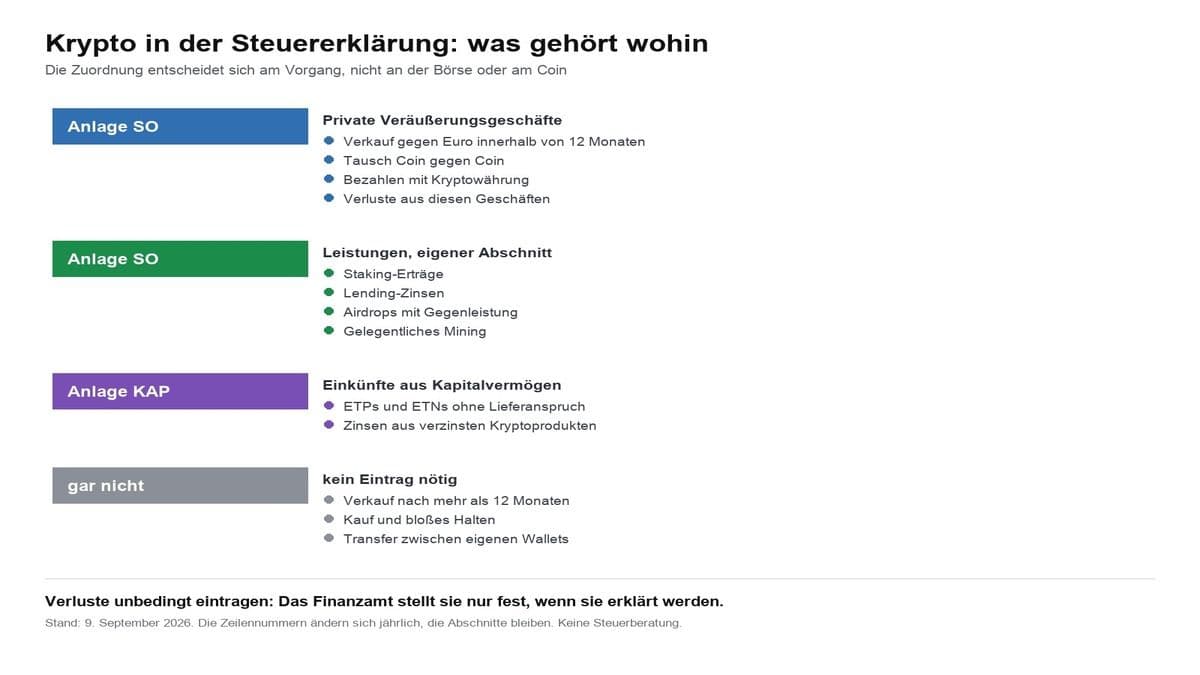
Crypto in Your Tax Return: Where Gains, Losses and Staking Go
Crypto belongs in Annex SO, but in two different sections. When you have to declare at all, where gains, losses and staking income go, and why line numbers from older guides lead you astray.

March 31, 2026 8:12 AM

Is Ethereum Insanely Undervalued? Bitmine’s $6.7 Billion Staking Bet Says Yes
Bitmine has staked 3.31 million Ethereum worth $6.72 billion. Here's why institutional giants are betting on ETH being undervalued and what it means for the price.
September 10, 2026 1:13 AM

Staking Taxes in Germany: The Inflow, the 256-Euro Threshold and the Holding Period
Staking is taxed twice: once when the reward arrives and once when you sell it later. This article explains both moments, the threshold of 256 euros, the separate twelve-month period and what applies to liquid staking, restaking and staking ETPs.
April 16, 2026 11:26 AM

Crypto News Today: Bitcoin Holds $74,000 as iShares Launches ETH Staking
Bitcoin eyes $75,000 while BlackRock's iShares partners with Coinbase for ETH staking. Explore the latest market shifts and SEC regulatory updates for April 2026.

March 7, 2023 12:20 PM

Best Crypto Tax Software 2023
Are you using Cryptocurrencies for trading purposes and worried about paying taxes? Check out the Best Crypto Tax Software options.
September 23, 2026 7:22 PM

Solana Price Holds $114: What Holders Check Five Days Before Alpenglow
SOL stands at $114.55 on September 23, after a 17.7 percent gain in seven days and a 2.2 percent loss on the day. Two deadlines matter more than the daily move: Alpenglow opens on September 28, and every purchase made this week starts a holding period of its own.
September 14, 2026 10:23 AM

Take Ethereum Profits or Wait Out the Holding Period? What the Price Jump Means for Your Tax Bill
Ether reached its highest level since the end of January on September 11, 2026, and many are asking whether to sell now. In Germany the answer hangs on the purchase date first: we work out which tranches are tax free and which of them are showing a gain at all.
August 29, 2023 6:51 AM

New Crypto Tax Reporting: READ THIS if you’re a US Citizen!
New crypto tax reporting: The Biden Administration has made significant strides to address the ambiguous domain of cryptocurrency taxation.
July 15, 2026 5:09 PM

Japan Recognizes Crypto as Financial Assets — Are Bitcoin ETFs and a 20% Tax Next?
Japan has passed a landmark crypto law. Could regulated Bitcoin ETFs and a lower 20% tax rate bring billions into the market?
September 23, 2026 1:12 AM

Zcash ETP: What to Check on Broker Access, Fees and Tax
The 21shares Zcash ETP (WKN A4AXHY) has traded on Euronext in Amsterdam and Paris since September 22, 2026. Here is what that means for your broker access, the running cost and the open tax question.
February 24, 2026 4:28 PM
Can Ethereum Price Crash to $0? Analyzing Ethereum Blockchain
Ethereum's price is under pressure as the crypto market faces a downturn. We analyze if ETH can truly hit $0 and what its ecosystem value means for the future.
October 2, 2026 5:02 PM

Bitcoin or Ethereum in the fourth quarter of 2026: the two largest crypto-assets compared
Bitcoin is scarce by protocol rule, Ethereum only as scarce as its utilisation, and on access and tax in Germany the paths part again. This comparison puts the verifiable figures on supply, usage, staking and purchase route side by side, without making a price call.
September 24, 2026 10:36 PM

Ethereum Price Prediction: What to Check on Staking, Leverage and Where You Buy After Three Attempts at $2,800
Ether stands at $2,700 and has bounced off the zone around $2,800 three times in thirty days, without a single daily close above it. What our own count shows, and the three things to settle before the next attempt.
August 21, 2026 7:30 AM

Crypto ETF Approval in the US: Why the SEC Is Rewriting Its Rules for Staking and Altcoin Funds
The US securities regulator has opened a proceeding that will help decide the next generation of crypto funds, and is putting 27 questions on the table. Anyone can file a comment until August 31, 2026, from Europe as much as from the United States.

September 26, 2026 4:28 AM
NEAR ETF NRR is approved: what you have to check in Germany instead
The SEC made the registration of the Bitwise NEAR ETF effective on September 24, and NYSE Arca approved the listing under the ticker NRR. The prospectus rules out distribution outside the United States, so these are the routes left to you in Germany.
September 24, 2026 1:34 PM

Cardano Slides Below $0.24: What ADA Holders Should Check on Leverage, Liquidation and Holding Period
Cardano has given back its move above $0.25 and trades around seven percent below the high of the past 24 hours. What that means for leveraged positions, the holding period of your tranches and the buying route under MiCA.
September 21, 2026 1:13 PM

Ethereum Rises While ETF Money Leaves: What ETH Holders Should Check Now
US ether funds lost $140 million in the week to September 18, ending four weeks of inflows. The ETH price still gained a good 5 percent.
August 28, 2024 10:33 PM
How to Migrate from MATIC to POL: Full Guide
How to update and migrate Polygon Tokens from MATIC to POL, when and why? Here is all you need to know...
July 24, 2024 11:05 AM

PEPE Price Prediction: A Jump By 15% in a Month Despite Experts Recommendations
While PEPE's recent 15% surge seems like the best crypto investment, experts recommend the Layer-2 derivative, PEPU, for significant returns. What is there more to know?
May 18, 2024 3:46 PM
After More Than a 10% SURGE, Will Ethena (ENA) PRICE Go Up To REACH $10?
After being among the top-performing Altcoins this week, will Ethena (ENA) continue to surge and potentially reach $10 with all news released by Ethena Labs or will it fall back to a new support level?

May 21, 2023 2:03 PM

Best Staking Tokens in 2023: Diversify Your Crypto Holdings
Explore the best staking tokens in 2023 besides Ethereum and diversify your crypto holdings. Discover top projects offering competitive yields and innovative features.
November 7, 2020 1:31 PM

Ethereum 2.0 Will Create The Next Economic Shift: Analyst Cochran
A report about the predictions made for Ethereum 2.0 by the prominent crypto-analyst Adam Cochran as to how it will cause the next economic shift.
November 7, 2020 1:29 PM

ConsenSys Ethereum 2.0 Staking Survey – 65% ETH Holders Plan To Stake
A report about the survey done by ConsenSys to determine various information about the Ethereum 2.0 staking from ETH holders.
July 15, 2020 3:18 AM

Ethereum 2.0 May Launch By Nov 2020 or Jan 2021, Core Devs Reveal
In an Ask Me Anything (AMA) session hosted by Ethereum core developers on Reddit on Jul 10, it was revealed that Ethereum 2.0 Phase 0 may launch either by Nov 2020 optimistically or Jan 2021 realistically. The timeframe has been […]
More from CryptoTicker