
Bitwise Lighter Staking ETP Lists on Xetra: What to Check on BLIT Before You Buy
Bitwise is bringing the first exchange-traded product on the LIT token of the derivatives platform Lighter to the Deutsche Börse today. It trades through an ordinary securities account, costs 0.85 percent a year, and the staking yield it is named after is not being paid yet.




Which topics should we dive deeper into?
Select what genuinely interests you. Your picks feed directly into our editorial planning.
Crypto news that's actually worth your time.
Weekly. 60 seconds. Carefully curated by our editors: no hype, no promo flood, no spam.
As of today, September 23, 2026, an exchange-traded product on the LIT token is trading on the Deutsche Börse in Frankfurt: the Bitwise Lighter Staking ETP, ticker BLIT, ISIN DE000A4AV9T5. You buy it through an ordinary securities account, you need neither a wallet nor an account at a crypto exchange, and you pay a total expense ratio of 0.85 percent a year. One point is worth knowing before you open the order screen: although the word staking appears in the product name, no staking income is flowing at present. Bitwise states on its own product page that the LIT holdings behind the product are currently not being staked.
This article sets out what the launch means for investors in Germany: what sits inside the product, what Lighter actually is, what buying through a securities account costs, who holds the tokens, and why the holding period is a different question for an ETP than it is for a directly held token.
Bitwise Lighter Staking ETP: the key facts from ticker to expense ratio
The issuer is Bitwise Europe GmbH, based in Germany. The product carries the ticker BLIT, the ISIN DE000A4AV9T5 and the German security number A4AV9T. It trades in euros on Xetra, the electronic trading venue of the Deutsche Börse. The minimum investment is one unit. The reference is the Kaiko Lighter Reference Rate, a price index on the LIT token.
One point matters for understanding the structure: in legal terms an ETP is a debt security issued by the provider, not ring-fenced fund assets. In a fund, your holding would be legally separated from the company’s own assets should the provider fail. In an ETP, the collateral protects you instead: Bitwise backs the notes with LIT tokens physically and in full. Both structures can work, but they work differently, and the distinction is one of the things a product name does not reveal.
The key facts at a glance:
- Name: Bitwise Lighter Staking ETP
- Ticker / ISIN / WKN: BLIT / DE000A4AV9T5 / A4AV9T
- Issuer: Bitwise Europe GmbH, Germany
- Venue: Deutsche Börse Xetra, trading currency euro
- Launch: September 23, 2026
- Total expense ratio: 0.85 percent a year
- Reference index: Kaiko Lighter Reference Rate
- Collateral: 100 percent physically backed with LIT tokens
- Custodian: BitGo Europe GmbH, cold storage
Why staking is in the name while no staking income is flowing yet
Staking means locking tokens in a blockchain network, for which the protocol pays an ongoing reward. That reward is exactly what BLIT is meant to pass on to investors later: according to the Bitwise announcement, the product is designed so that staking income is earned on the Lighter network and credited daily to the individual ETP units.
The conditional here is no accident. On its product page, Bitwise explicitly notes that the Bitwise Lighter Staking ETP does not currently stake its LIT holdings. The announcement adds that the staking function is intended to start once assets under management reach a sufficient size. The company gives no date for that.
For you this simply means that anyone buying BLIT today is buying pure price exposure to the LIT token for now, and paying 0.85 percent a year for it. The yield component the product is named after is an announcement, not a running feature. If the staking income were the reason for your purchase, that is an argument for waiting until it starts and checking the product page again from time to time.
What Lighter is: perpetual futures on Apple, Amazon and Tesla around the clock
Behind the underlying sits a trading venue that is still little known in Germany. Lighter is a decentralised derivatives platform settled entirely on the blockchain. Alongside cryptocurrencies, it also lists large equities as perpetual futures contracts, among them Apple, Amazon and Tesla.
A perpetual future, or perp, is a futures contract without an expiry date: it runs indefinitely for as long as the position is held and the margin is served. It is tied to the spot price through the funding rate, a payment exchanged between the long and the short side. The practical difference from conventional brokerage lies in the trading hours: a share trades on its home exchange only during market hours, while a perp on it can be traded around the clock.
Lighter says it charges retail clients no trading fees, earning instead through market making, liquidations and its own treasury. Technically the platform relies on zero-knowledge proofs. Founder and chief executive Vladimir Novakovski is quoted in the announcement as saying that Lighter enables institutional perpetual trading fully on-chain and delivers fair, verifiable execution without giving up speed. That is the provider’s account, not a verified property.
In the announcement, Bitwise explicitly positions Lighter as a fast-growing challenger to Hyperliquid, currently the best-known name in this product class. For how this market segment is set up overall, which platforms can be used from Germany, and how to tell a sound one from a risky one, see our overview of the best perp DEX platforms.
 Where to trade exchange-traded crypto products
How to buy BLIT through your securities account, and what can block the trade
The decisive advantage of the ETP wrapper is the route in. Because BLIT is a security with an ISIN listed on a German exchange, the purchase works exactly as it does for a share: open your account, put the ISIN into the search field, select Xetra as the venue, place the order. You need no wallet, no seed phrase and no registration at a crypto exchange, and the position appears in the same portfolio overview as your other securities.
Two things can still block the trade. First, not every bank offers every ETP: some branch banks and individual direct banks exclude crypto ETPs across the board, or release them only after a separate opt-in. The most reliable way to see whether your provider carries BLIT is whether the ISIN returns a tradable result in the securities search. Second, a freshly listed product is rarely liquid on day one. Until regular trading settles in, the spread between the bid and the offer can be noticeable.
In practice that means using a limit order rather than a market order, and setting the limit deliberately instead of being filled at any price. Trade within Xetra hours of 9:00 to 17:30 where possible, when the market makers are active. The LIT token itself trades around the clock; the ETP does not, and the exchange price catches up with overnight moves only at the open.
The reason the route runs through an ETP rather than a spot ETF lies in European fund regulation: a UCITS fund has to be diversified and therefore cannot track a single crypto underlying. For which exchange-traded crypto products are available in Germany and how they differ, see our guide to crypto ETFs and ETPs in Germany.
A 0.85 percent expense ratio: what the product actually costs you a year
The total expense ratio, usually shortened to TER, is the annual management fee taken continuously from the product’s assets. It is not billed separately; it reduces the value of your unit on a daily pro-rata basis. For BLIT it is 0.85 percent a year.
In numbers: on 5,000 euros invested that is roughly 42.50 euros a year, on 10,000 euros roughly 85 euros, in each case measured against the market value and therefore variable. On top come your broker’s order fees on the way in and out, plus the trading spread. There is no front-end load.
You give up those costs in exchange for something harder to put a number on: you do not have to secure private keys, manage a wallet backup or arrange access to a venue that lists the LIT token. Holding LIT directly costs no ongoing fee, but custody is then your own responsibility. Whether 0.85 percent a year is a fair price for that convenience depends on how much you invest and for how long; over a long holding period the ratio adds up noticeably.
Cold storage at BitGo Europe: who actually holds the LIT tokens
Custody of the tokens behind the product sits with BitGo Europe GmbH, and in cold storage: the private keys are kept offline, separated from the internet, which closes off the attack route over the network. This is the industry standard for institutional custody, and the reason you do not have to organise your own wallet security with an ETP.
The flip side: you never hold tokens yourself at any point. What sits in your account is a collateralised debt security, not LIT. According to the product documents, units can in principle be redeemed in kind, meaning you receive the underlying LIT, or in cash where delivery in cryptocurrency is not permitted for regulatory reasons. In practice this route is usually handled by authorised participants, not by retail investors through their custodian bank.
Assessing the risk therefore still requires a double look: at the creditworthiness and diligence of the issuer, and at the quality of the collateral. Full physical backing exists for precisely that purpose. It does not, however, replace the legal separation a fund would bring with it.
Holding period and tax: why an ETP is not certain to be treated like the token
This is where investors in Germany most often go wrong. For a directly held token the legal position is settled: cryptocurrencies count as other economic assets within the meaning of section 23 of the German Income Tax Act, and the Federal Fiscal Court has confirmed the tax authorities’ view. After a holding period of more than one year, a disposal gain is tax-free.
For a crypto ETP that read-across is precisely not automatic. If section 20 of the Income Tax Act applies instead, because the note is classified as a capital claim, withholding tax of 25 percent plus the solidarity surcharge and, where applicable, church tax falls due, regardless of the holding period. The argument for the more favourable treatment under section 23 rests on the full physical backing and the claim to delivery of the underlying. The question has not been settled conclusively for crypto ETPs; the tax literature continues to judge it differently.
Three things follow in practice. First, do not carry the one-year logic over from the direct investment to the ETP without checking. Second, document the purchase date, the number of units and the price from the outset, because you need those details under either reading. Third, settle the classification for your own case with a tax adviser before you sell, not afterwards. Once staking income actually starts to flow, a second question is added, namely how the daily credits are to be treated at ETP level. That one cannot be answered today, because the product is not yet staking.
 Staking directly instead of through the ETP wrapper
Slashing, lock-ups and liquidity: the risks Bitwise names itself
The product documents set the risks out openly, and they are worth a look of their own. They name price swings, liquidity risk, custody risk, regulatory risk, lock-up periods in staking, slashing risk and risks arising from changes to the underlying protocol.
Slashing is a penalty a blockchain network imposes on a validator that breaches its duties, through downtime or contradictory attestations for example. Part of the locked tokens is withheld in the process. This risk only reaches you once the product actually stakes, but it belongs in the assessment, because staking is exactly what has been announced. The same applies to lock-up periods: staked tokens cannot be moved freely again straight away, which can make redemption harder in a hectic market.
The most tangible risk from today’s vantage point is a different one: LIT is a young token with a comparatively thin market. The liquidity of an ETP can never be better than that of its underlying. If trading in the token becomes tight, the spread in the exchange price of the ETP widens too, and it does so precisely when many want to sell at once. That is not a design flaw but a property of niche assets.
ETP or LIT directly: when each wrapper suits you
Both routes lead to the same underlying, and neither is generally the better one. They differ in what they take off your hands and what they load onto them.
In favour of the ETP is access: a familiar securities account, an ISIN, settlement through your own bank, plus professional custody in cold storage and a counterparty based in Germany and subject to a prospectus regime. Anyone who could not otherwise buy LIT at all, because no accessible venue lists the token, gets a route in for the first time.
Against the ETP are the ongoing fee of 0.85 percent, the unsettled tax classification and the fact that the staking yield it is named after does not yet exist. Holding the token directly costs no management fee, allows you to stake yourself and leaves you on firmer ground on the holding period, but the key management and the risk of ending up at an unsuitable venue are then yours.
A sober rule of thumb: the larger the intended position and the longer the horizon, the more the fee and the tax question weigh. The smaller the position and the more you value settlement in a familiar account, the more the ETP wrapper carries.
Checking the Bitwise Lighter Staking ETP: what to take away
- First establish whether your account trades the note at all. Enter the ISIN DE000A4AV9T5 in the securities search and check whether Xetra is offered as a venue. If your provider does not carry crypto ETPs, it is worth looking at alternatives: our overview of the best crypto brokers shows which providers list exchange-traded crypto products and what trading costs there.
- Open the tax file before you buy, not in the following year. Record the purchase date, the number of units, the price and the fees, because the classification of the ETP between sections 20 and 23 of the Income Tax Act is not conclusively settled and you need the same evidence either way. For what records this cleanly and automatically, see our overview of crypto tax tools and portfolio trackers.
- Decide deliberately whether to wait for the staking yield. Today you pay 0.85 percent a year for pure price exposure, because the product does not yet stake. If running income is what you are after, compare that with what direct staking currently pays: our overview of the best staking platforms sets out the terms and the respective lock-up periods.
Sources: the Bitwise announcement of the Lighter Staking ETP launch of September 23, 2026 and the product page for the Bitwise Lighter Staking ETP, with fees, custody and a note on the current staking status.
(As of September 23, 2026. This article is not investment advice. Prices and fee structures change; check the terms with the provider before you buy.)
Transparency note: This article was produced with the assistance of artificial intelligence and reviewed by our editorial team before publication. All figures and claims were checked against the primary sources linked in the text. The feature image was generated with AI.
Related articles
- NEAR Staking ETP Passes $100 Million: What to Check on Yield, Brokerage Account and Holding Period
- 21Shares Pays Out Staking Income From Five Funds: US Distributions vs Xetra Accumulation
- NEAR ETF NRR is approved: what you have to check in Germany instead
- Zcash ETP: What to Check on Broker Access, Fees and Tax
- Bitcoin Cash Jumps by Double Digits: What the Grayscale ETF Filing Really Means for You in Germany
Which topics should we dive deeper into?
Select what genuinely interests you. Your picks feed directly into our editorial planning.
Crypto news that's actually worth your time.
Weekly. 60 seconds. Carefully curated by our editors: no hype, no promo flood, no spam.

September 28, 2026 7:17 PM
Polygon 2026: Polymarket Takes 84 Percent of the Fees With It to Its Own Chain
Polygon holds $765 million, and 83.6 percent of its fees come from a single protocol that has announced a move to its own chain. What is left of the ecosystem afterwards, what POL is still worth and what holders in Germany should watch.
October 1, 2026 7:36 PM

Crypto tax and withholding at source from 2028: what to check now
The German Federal Ministry of Finance’s draft bill goes to cabinet on October 14, 2026. The underexposed part of it is the deduction of tax from 2028: which providers are to withhold the tax on investment income, why self-custody and foreign platforms stay exempt from it, and what you should document by December 31.
August 19, 2026 4:24 AM

Staking ETPs: Distribution, Accumulation and the Tax Question in Germany
Fidelity has filed with the SEC to stake the ether in its ETF and pay the proceeds out quarterly in cash. European staking ETPs, by contrast, keep the yield inside the product, and for you that difference decides the timing of the inflow, the fees and the tax.
September 10, 2026 1:13 AM
Staking Taxes in Germany: The Inflow, the 256-Euro Threshold and the Holding Period
Staking is taxed twice: once when the reward arrives and once when you sell it later. This article explains both moments, the threshold of 256 euros, the separate twelve-month period and what applies to liquid staking, restaking and staking ETPs.

September 19, 2026 4:11 AM
WBT Hits All-Time High at $83.64: What WhiteBIT Token Holders Should Check Now
The exchange token WBT reached a new all-time high of $83.64 on September 18, 2026. What sits behind the rise, and the three points German investors should check now.

September 23, 2026 7:22 PM
Solana Price Holds $114: What Holders Check Five Days Before Alpenglow
SOL stands at $114.55 on September 23, after a 17.7 percent gain in seven days and a 2.2 percent loss on the day. Two deadlines matter more than the daily move: Alpenglow opens on September 28, and every purchase made this week starts a holding period of its own.
August 21, 2026 7:30 AM

Crypto ETF Approval in the US: Why the SEC Is Rewriting Its Rules for Staking and Altcoin Funds
The US securities regulator has opened a proceeding that will help decide the next generation of crypto funds, and is putting 27 questions on the table. Anyone can file a comment until August 31, 2026, from Europe as much as from the United States.
September 9, 2026 1:15 AM

Germany's Crypto Tax: 160 Million Euros for a 555-Billion Budget
The German finance ministry's draft bill puts a figure on the crypto tax for the first time: 160 million euros from 2028. What that number means in the 2027 federal budget, how 11.4 billion became 160 million, and what investors can read from it.
October 3, 2026 7:15 PM

Shiba Inu today: one ETP in Europe, 18 names on a US fund list, and what matters now in Germany
Shiba Inu has reached three regulated venues since this summer: a certificate in Sweden, a fund list on NYSE Arca and a Japanese approval. For a German brokerage account that means less than the headlines suggest, and precisely that gap is today's real story.
October 3, 2026 1:41 PM

Dogecoin Price Prediction: $0.10 as the Ceiling, and What to Watch at a 2.5 Percent ETP Fee
Dogecoin trades at $0.0927 on October 3 and therefore sits on its 200-day average. More important than the mark at $0.10 is the route question for German investors: a 2.50 percent fee in the Xetra ETP against the one-year holding period on a direct purchase.
September 22, 2026 4:12 PM

Nearly $1 Billion Into Bitcoin ETFs: What to Check on ETNs, Portfolio and Holding Period
US spot bitcoin ETFs took in a net $999 million on September 21, the third consecutive day of inflows. German investors cannot reach these funds: what ETNs, the holding period and your buying route mean for you.
September 14, 2026 7:12 PM

XRP ETF, Solana ETF, Ethereum ETF: What You Can Actually Buy in Germany
Spot ETFs on XRP, Solana and Ethereum trade in the United States, and your German broker does not carry them. This guide explains the two EU rules behind that, which security does the same job instead, and what to check on backing, delivery claim and costs.
September 21, 2026 10:12 AM

ZETA Moves to Solana: What Holders in Germany Must Check Now
ZETA holders have voted with 99.4 percent to move the token 1:1 to Solana as an SPL token and to shut down their own blockchain afterwards. There is no date yet, but your exchange decides for itself whether it takes part in the swap.
September 9, 2026 4:22 PM
Crypto Tax in Germany: What Applies in 2026 and What Is Set to Change in 2027
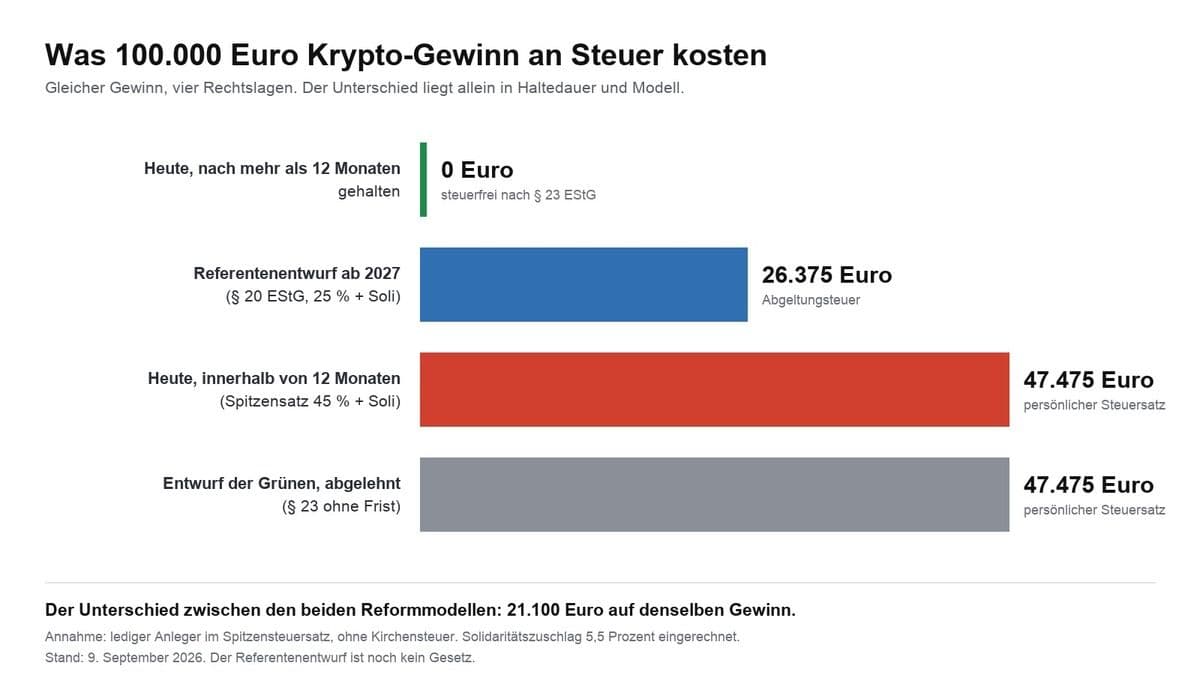
Crypto gains are tax-free after twelve months; before that your personal tax rate of up to 45 percent applies. What triggers tax, how the holding period is calculated, what happens with staking and losses, and what the draft bill would change from 2027.
September 26, 2026 1:19 AM
Germany’s Crypto Holding Period Is Wobbling: What to Check Before December 31
A CDU member of the Bundestag makes it plain: the coalition agreement does not guarantee that the one-year holding period for crypto assets will survive. What that means for purchases made before the planned cutoff date of December 31, 2026.
September 27, 2026 4:12 AM
Bitcoin ETF Inflows Turn 2026 Positive: How to Tell If the Demand Holds
US spot Bitcoin ETFs took in roughly $2.4 billion in the week to September 25, the strongest week since October 2025, and that turns the 2026 year-to-date balance positive. Why the daily inflow fell 87 percent within the same week, and what to check on buying route, holding period and custody.
September 25, 2026 1:12 PM

XRP Jumps to $1.56: What Holders Should Check on Buying Route, Holding Period and Leverage
XRP trades at $1.56 on September 25, 2026, up 6.85 percent on the day and 16.64 percent on the week. What the on-chain data and the US ETF inflows actually show, and what investors in Germany should check now on buying route, holding period, leverage and custody.
September 22, 2026 1:27 AM
Bitcoin ATM in Germany: Fees, BaFin Authorisation and Tax
Bitcoin ATMs stand in kiosks and shopping arcades, and buying there costs a multiple of the online route. What BaFin demands of the operator, at what amount your ID becomes due, and how you evidence the purchase for tax.
September 22, 2026 1:15 AM

Memecoin Rally: Why Memecoins Are Rising and What to Check Before You Buy
The memecoin sector stands 9.01 percent higher, the overall market only 2.90 percent. The arithmetic behind it shows that two tokens carry three quarters of the move and that the sector has no occasion of its own.
August 24, 2026 10:29 AM
Buying More Bitcoin at $77,000: Savings Plan or Lump Sum
Bitcoin stands at $77,256 after gaining 22.78 percent in a week. This guide shows you how to buy more cleanly at this price and which method fits which starting position.
August 19, 2026 4:15 PM
Tether Audit by KPMG: What the Unqualified Opinion Means for USDT in the EU
Tether reported the first full audit of its financial statements by KPMG on August 13, 2026, with an unqualified audit opinion for the 2025 financial year. That changes nothing about whether USDT can be traded at authorised providers in the EU, because Article 48 MiCA decides that question.

January 1, 2026 3:12 PM
Crypto Taxes 2026 in Germany: Automatic Reporting Under DAC8, What Applies Now
Since 1 January 2026 crypto providers in the EU must record their customers' transactions for the tax authorities. The first report for 2026 follows in 2027. What investors need to know.
August 10, 2026 5:15 PM
Bitcoin Lending in Austria: When Tax Falls Due
Lending Bitcoin and earning interest: when lending income is taxed at 27.5 percent in Austria and which exchange rate counts.
September 9, 2026 7:11 PM
Crypto in Your Tax Return: Where Gains, Losses and Staking Go
Crypto belongs in Annex SO, but in two different sections. When you have to declare at all, where gains, losses and staking income go, and why line numbers from older guides lead you astray.
August 31, 2026 10:30 PM

Taxing Crypto Lending: Your Personal Rate Instead of Withholding Tax, and the Right Federal Fiscal Court Case Number
According to the only tax court ruling so far, income from crypto lending falls under Section 22(3) of the German Income Tax Act and therefore under your personal tax rate. The appeal is pending at the Federal Fiscal Court under VIII R 22/25, not under the case number given in many professional articles.
September 8, 2026 10:21 PM

Crypto Holding Period and Grandfathering: Why December 31, 2026 Becomes the Cut-Off in Germany's Draft Bill
A ministerial draft bill from Germany's finance ministry names a cut-off date for the first time: crypto assets acquired after December 31, 2026 are to fall under the flat-rate withholding tax. What that means for legacy holdings, running savings plans and staking income, and why nothing has been decided yet.
May 12, 2025 9:05 PM

US-EU Trade Tensions Rise as US-China Conflict Cools Down
Just as the long-standing US-China trade war appears to ease, new tensions are emerging between the United States and the European Union. With Trump calling Europe “nastier than China,” are we about to witness a new transatlantic trade conflict?
More from CryptoTicker