
Robinhood Chain After September 29: What the End of Free Gas Changes for the Stock Chain
The Robinhood Chain holds $1.02 billion and more trading volume than Polygon, carried by a meme token launchpad. The gas subsidy ends on September 29, fees are already falling, and this is what the ecosystem of Pons, Uniswap and tokenised stocks really rests on.



Which topics should we dive deeper into?
Select what genuinely interests you. Your picks feed directly into our editorial planning.
Crypto news that's actually worth your time.
Weekly. 60 seconds. Carefully curated by our editors: no hype, no promo flood, no spam.
The Robinhood Chain is the broker's own layer-2 network, running on the Arbitrum Orbit toolkit, storing its data on Ethereum and settling gas in ETH. Since launching on July 1, 2026 it has become the costliest surprise of the year: $1.02 billion sits in its contracts, more than on Polygon, and $93.5 billion in volume has passed through its venues since the start. What has carried that so far is something few would have expected on a stock chain: meme tokens from a mass-market launchpad. On September 29 the start-up funding that paid for this growth falls away.
This overview takes the chain apart piece by piece, with figures cryptoticker.io collected itself from DefiLlama data on September 28, 2026, and with the wording Robinhood itself uses in its documents for the European market. It tells you what actually runs on the network, how you get there in practice, what the tokenised stocks are in legal terms and which points you should settle as an investor in Germany beforehand.
Robinhood Chain at a Glance: A Layer-2 Rollup on Arbitrum Orbit with Chain ID 4663
A rollup is a network that executes transactions itself but stores their data in bundles on a larger blockchain and draws its security from there. The Robinhood Chain is one such rollup: it uses the Arbitrum Nitro software on the Orbit framework, is EVM-equivalent, writes its data as blobs under the Ethereum standard EIP-4844 to Ethereum, and carries chain ID 4663. Without that identifier you cannot add the network in any wallet, which is why it comes first here.
The technical parameters are set out in the official developer documentation at docs.robinhood.com/chain and in the public network list chainlist.org/chain/4663. Gas is paid in ETH; there is no separate gas token. Data availability, meaning where the raw transaction data can be read permanently, is solved via blobs on layer 1. Because the chain is EVM-equivalent, the same smart contracts run as on Ethereum, and tokens follow the ERC-20 standard. Developers also have a testnet. That matters more for classification than it sounds: every movement on this chain consumes ether, and in Germany ether is an economic asset with its own tax consequences.
The purpose of the network is so-called stock tokens, that is, replications of share prices tradable on the blockchain, together with real world assets in the wider sense, meaning values from traditional finance represented on chain. What has become of that in practice is set out below.
Who Uses the Chain: $1.02 Billion in TVL, More Than Polygon
The usual yardstick for the use of a network is total value locked, or TVL: the sum of all value sitting in the network's contracts. On September 28, 2026 DefiLlama reported $1,020,163,244 for the Robinhood Chain. For comparison, on the same day: Polygon $765 million, Arbitrum $1.43 billion, Base $6.19 billion. A network not yet a quarter of a year old is thereby ahead of a chain that has been running since 2020.
On trading volume the gap is wider still. $55.28 billion passed through the chain's decentralised exchanges over the past 30 days, $9.65 billion over the past seven days and $947 million over the past 24 hours. Since launch that adds up to $93.50 billion. The fees all protocols on the chain take together stand at $373.11 million over 30 days and $694.40 million since launch. 207 protocols contribute to that.
These figures are impressive and at the same time misleading if read without the next section. They describe the past, and the trend inside them points down.
One question upfront, because it is asked often: the Robinhood Chain has no token of its own. There is therefore no market capitalisation, no all-time high and no price for the chain. Anyone who nonetheless finds a price page under this name should look closely: the name also appears on price pages as the label of a token issued on an entirely different network, which has nothing to do with the network described here. Payment on the chain is in ETH, and the prices of the represented securities are supplied by a price feed, a service that feeds market prices into the contracts.
The Gas Subsidy Ends on September 29, and Fees Are Already Falling
At launch on July 1, 2026 Robinhood covered transaction fees for 90 days, provided the transaction came from the Robinhood Wallet. That period expires on September 29, 2026. After it, every movement pays its own gas in ETH. A free transaction is the most effective tool for pulling users onto a new network, above all for small speculative amounts where a fee of a few cents makes trading unattractive. That tool is now going. Our report on the switch is in Robinhood Chain: The Free Gas Ends in Late September.
What the measurement on September 28 shows, a day before the deadline, is interesting. Fees across all protocols on the chain came to $373.11 million over the past 30 days, or $12.44 million a day. Over the past seven days they were $41.49 million, or $5.93 million a day. The weekly average is therefore less than half the monthly average. On trading volume the decline is milder: $1.84 billion a day on the monthly average against $1.38 billion on the weekly average.
The cooling has thus begun before the subsidy ends. That is a finding about the state of the chain, not a forecast of its price: anyone seeing a decline after September 29 cannot simply attribute it to the fee switch, because the move set in beforehand. How the values look after the deadline cannot, in the nature of things, be measured on September 28. Daily values also fluctuate sharply, because a day in progress can be incomplete at DefiLlama; the weekly and monthly windows are the reliable ones.
Is Robinhood Permitted in Germany?
Yes, through a European entity. On its EU site Robinhood names as the responsible entity Robinhood Europe, UAB, company identifier 306377915, based in Vilnius. The wording there is: "RHEU is authorized and regulated by the Bank of Lithuania as a financial brokerage firm and a crypto-asset service provider." The competent supervisor is therefore the Lithuanian central bank, not BaFin. An authorisation as a crypto-asset service provider in one EU state takes effect across the single market under the European crypto regulation MiCA, so German customers are served through this entity and not through a German branch.
In practice that means two things. First, complaints and questions of deposit protection run under Lithuanian law and that country's supervisor, not the German financial regulator. Second, the offering for the EU market is not the same as in the United States. German users have access to cryptocurrencies and to the stock tokens described below; no German securities account holding real shares arises in the process. If you would rather stay with a provider whose authorisation you can look up yourself, our comparison of crypto exchanges helps you line up the licences and the fees.
Stock Tokens and Real World Assets: Derivative Contracts, Not Shares
This is the point at which most accounts turn too vague. Robinhood describes its tokenised stocks on its own EU site in these words: "Classic Stock Tokens are derivative contracts between you and Robinhood. They are priced at the prices of the underlying securities without granting rights to them."
A derivative is a contract whose value is derived from another value. Everything else follows from that definition. You do not become a co-owner of the company. You have no vote at the annual general meeting. You have no direct claim to a dividend, at best a contractual replication of one. And on top of the price risk you carry the risk of your counterparty: if the provider fails, the claim fails with it, because the claim is against the provider and not against the exchange on which the share is listed.
In tax terms this is a category of its own. German income tax law treats cryptocurrencies as other economic assets, with the one-year holding period of Section 23 of the Income Tax Act. Derivative contracts instead fall under the rules for investment income, and there is no holding period there after which a gain becomes tax-free. How an individual contract is to be classified depends on how it is constructed; that is for a tax adviser to settle, not a line in an article. Anyone holding both in the same account should separate the entries early, or the tax return gets expensive. A tool that keeps the two types of entry apart saves you this work in the spring.
Pons: 646,000 Tokens Since July, and a Mountain of Fees That Is Melting
The chain's actual main application so far is a launchpad called Pons. A launchpad is a service that lets a new token be created in a few steps and made tradable immediately. At Pons that costs around one dollar in launch fees according to CoinDesk: enter a name, choose a ticker, done, and a market for it opens on the Robinhood Chain.
The success was extraordinary. CoinDesk reported on September 3, 2026 that Pons took around $5.95 million in fees in 24 hours, putting it fourth among all services tracked by DefiLlama, ahead of the chain it runs on. On September 2 just under 25,000 new tokens were created there in a single day, on $544 million of daily volume. Since July there have been around 646,000 tokens from more than 167,000 different creator addresses.
Our own measurement of September 28 shows how quickly that has cooled. Pons in its current version took $1.24 million in fees over 24 hours. Over seven days the launchpad comes to $14.83 million, or $2.12 million a day; over 30 days to $146.35 million, or $4.88 million a day. The peak day in early September was therefore not a level but a spike, and the weekly average is less than half the monthly average. Since launch Pons has taken $179.85 million in fees.
For placing meme tokens, what we describe in our overview of the meme coin section still applies: a token created for a dollar has no issuer liable for anything, no audit and as a rule no market once attention moves on. Of 646,000 tokens created, only a very small share is traded at all. Total loss is the normal case in this asset class, not the exception.
Where Swapping Happens on the Chain: Uniswap v3 and v4 Carry the Volume
The venues on the chain are decentralised exchanges, or DEXs: programmes that settle swaps directly between wallets without a company holding the balances. Measured by volume over the past 30 days, Uniswap version 3 leads with $24.02 billion and version 4 follows with $19.39 billion. Together that is around 78 percent of the chain's entire trading volume. Behind them, at a clear distance, come GMGN with $4.30 billion, Pons itself with $2.45 billion, Ramses with $1.90 billion, Fables with $1.68 billion and Uniswap version 2 with $1.26 billion.
What barely features on this chain so far are lending markets, meaning protocols for collateralised credit, and other quiet applications. By way of comparison, on Base, Coinbase's chain, usage spreads far more widely across lending and yield protocols. On these figures the Robinhood Chain is a trading venue and not yet financial infrastructure.
The second group stands out: trading apps. GMGN took $30.70 million in fees over 30 days, the wallet app fomo $17.64 million and Axiom $7.23 million. These applications are front ends for fast meme token trading and do not belong to Robinhood, even though they run on its chain. Anyone using such an app generally grants it far-reaching permissions over their balance. More on that in the section on risks below.
Adding the Network, the Bridge, the Explorer: The Practical Route onto the Chain
Anyone wanting to use the chain without the Robinhood app needs three things: the network entry in their own wallet, ETH for gas, and an explorer for looking things up.
The network entry consists of chain ID 4663 and the public access point rpc.mainnet.chain.robinhood.com. An RPC endpoint is the address through which your wallet talks to the network. Many wallets now add well-known networks themselves; if you cannot find the chain in yours, you can add it through the network list chainlist.org/chain/4663. Never enter an access point that somebody sent you in a message.
The gas comes across a bridge. A bridge locks an amount on the source network and credits it on the destination network. The official route runs through the Arbitrum portal at portal.arbitrum.io; a deposit of ether onto the chain takes about ten minutes there. The return journey takes considerably longer with rollups of this design, because a challenge period runs before the withdrawal is released. Anyone wanting out faster has to use a third-party provider and pay for it. Plan that time in before you move larger amounts across.
You can look everything up in the block explorer robinhoodchain.blockscout.com. An explorer is the network's public ledger search: every transaction, every address and every contract can be inspected there. Beware of imitators: after the launch several community-built sites appeared under names such as "RobinScan". None of them is the official explorer, and a site asking you to enter a recovery phrase is always an attack.
 Hardware Wallets Compared: Hold Your Own Coins
NFTs and Collectibles on the Chain: Marketplace Present, Liquidity Thin
An ecosystem only counts as complete once it also has trading in non-fungible tokens, or NFTs. On the Robinhood Chain that part exists, but it is narrow. The large marketplace OpenSea supports the chain, and collections have appeared that pick up the network's equity character. Volume and price formation remain far behind swap trading in tokens.
For valuation that is a sober finding: a collectible needs buyers, and where few trade, the last price paid is not a sound valuation of your own holding. If you want to look at the wider field, the established venues are in our comparison of NFT marketplaces.
Arbitrum: 10 Percent of Net Revenue Flows to the DAO
The chain has no token of its own. Anyone wanting to bet on its success therefore ends up at the token of the toolkit it runs on: Arbitrum, ticker ARB. The reason is a levy: the Robinhood Chain passes 10 percent of its net revenue to the Arbitrum ecosystem, of which, on the reporting, 8 percentage points go to the DAO's treasury and 2 percentage points into a developer fund. A DAO is an organisation whose use of funds is decided by votes of token holders.
Important for placing this: the money goes to the common treasury and not to holders. An ARB token conveys no claim to a distribution. The Arbitrum Foundation has reported that fees from the expansion programme accounted for 35 percent of DAO income in July. Our own measurement also shows how small the share is that reaches the chain's own sequencer: $39.31 million over 30 days, against $373.11 million across all protocols on the chain together. Most of the fees arise at applications, not at the network operator.
Analyst views on this differ widely and are to be read as views. According to a CoinDesk report of September 15, 2026, Standard Chartered named a price target of $10 for ARB and expressly pointed to revenue from the Robinhood Chain. On the other side stands an unlock date: in mid-October, on the reporting, around 92.6 to 92.7 million additional ARB become available, which increases supply. Our assessment of the coupling between chain and token is in Arbitrum up 150 percent in a month. A price target is not a promise, and we issue none.
Risks: One Sequencer, Old Approvals and Tokens Without a Market
Four points belong on the list before money goes onto this network.
Centralisation. Rollups of this design are run by a single sequencer, an instance that determines the order of transactions. If it fails or holds transactions back, the network stalls. The L2BEAT project collects assessments of such dependencies publicly; anyone entrusting larger amounts to a new chain should look there first.
Old approvals. Anyone working with trading apps and launchpads continually grants contracts permission to access balances. Such approvals persist until you revoke them, and a contract compromised later can use them. Go through the approvals you have granted regularly and remove what you no longer need.
Custody. Self custody means you hold your own keys and nobody else can dispose of your balance. It is the most effective protection against the failure of a provider and at the same time full responsibility for safekeeping. For longer-term holdings a device with separate key storage is the obvious choice, because the key never leaves the device.
Market risk of the tokens themselves. A launchpad with a one-dollar launch fee does not produce an audited investment product. For the great majority of these tokens there is no buyer left after a short time, and a price without buyers is not a value.
Tax in Germany: Every Swap on the Chain Is a Disposal
Here lies the part investors in Germany regularly underestimate. Under Section 23 of the Income Tax Act, swapping one cryptocurrency for another is a private disposal transaction. On a chain whose main application is a launchpad, exactly that happens continually: ETH for a new token, that token back for ETH, and again on the next attempt. Each of these steps is a separate transaction with its own acquisition date, its own price and its own holding period.
Three things follow. The one-year holding period starts afresh with every swap, which is why active trading practically never reaches it. Gains from such transactions stay tax-free only within the exemption limit of €1,000 per calendar year, and once it is exceeded the entire gain is taxable. The gas itself is also a transaction: paying with ETH means giving ETH away. While the subsidy ran, that question did not arise for transactions from the Robinhood Wallet; from September 29 it arises on every movement.
In practice that means: download your transaction history regularly while you have access, and store it outside the app. The chain is new, and so are the reporting channels between providers and the tax authorities. Missing records are for the investor to produce in the end, not the exchange.
Robinhood Chain: What to Take Away
In barely three months the Robinhood Chain has become one of the largest layer-2 networks by value deposited, carried above all by a meme token launchpad. The fee figures show that this wave had already flattened noticeably before the start-up funding ended on September 29. The tokenised stocks that were meant to be the point are, on Robinhood's own description, derivative contracts against the company and not shares.
- Settle the provider and the supervisor first. Who your counterparty is and which authority supervises it decides whom you turn to in a dispute. Set that beside the terms of the established venues in the exchange comparison.
- Separate play money from holdings. What goes onto a launchpad can be lost in full. What you want to keep belongs in custody you control yourself; the selection is in the hardware wallet comparison.
- Keep the tax file from the first transaction. Every swap is a separate transaction, and it can barely be reconstructed after the fact. A tool from the tax tool comparison takes the work off you.
(As of September 28, 2026. This article is not investment advice. Prices and fee structures change; check the terms with the provider before you buy.)
Transparency note: This article was produced with the assistance of artificial intelligence and reviewed by our editorial team before publication. All figures and claims were checked against the primary sources linked in the text. The feature image was generated with AI.
Related articles
- Robinhood Built a Blockchain for Stocks. The Cat Memecoins Took It Over.
- Robinhood Chain: The Free Gas Ends in Late September - the Stress Test for Its Memecoins
- Polygon 2026: Polymarket Takes 84 Percent of the Fees With It to Its Own Chain
- Sequans sells its last 314 bitcoin: what to check if you hold a treasury stock
- Germany's Crypto Tax: 160 Million Euros for a 555-Billion Budget
Which topics should we dive deeper into?
Select what genuinely interests you. Your picks feed directly into our editorial planning.
Crypto news that's actually worth your time.
Weekly. 60 seconds. Carefully curated by our editors: no hype, no promo flood, no spam.

September 21, 2026 4:19 PM

Arbitrum Up 150 Percent In A Month: Is Robinhood Carrying The Price?
ARB is the strongest performer of the past four weeks. Behind the advance sit Robinhood's own chain and trading in tokenised assets. Two dates decide whether the rally holds.

September 9, 2026 4:22 PM
Crypto Tax in Germany: What Applies in 2026 and What Is Set to Change in 2027
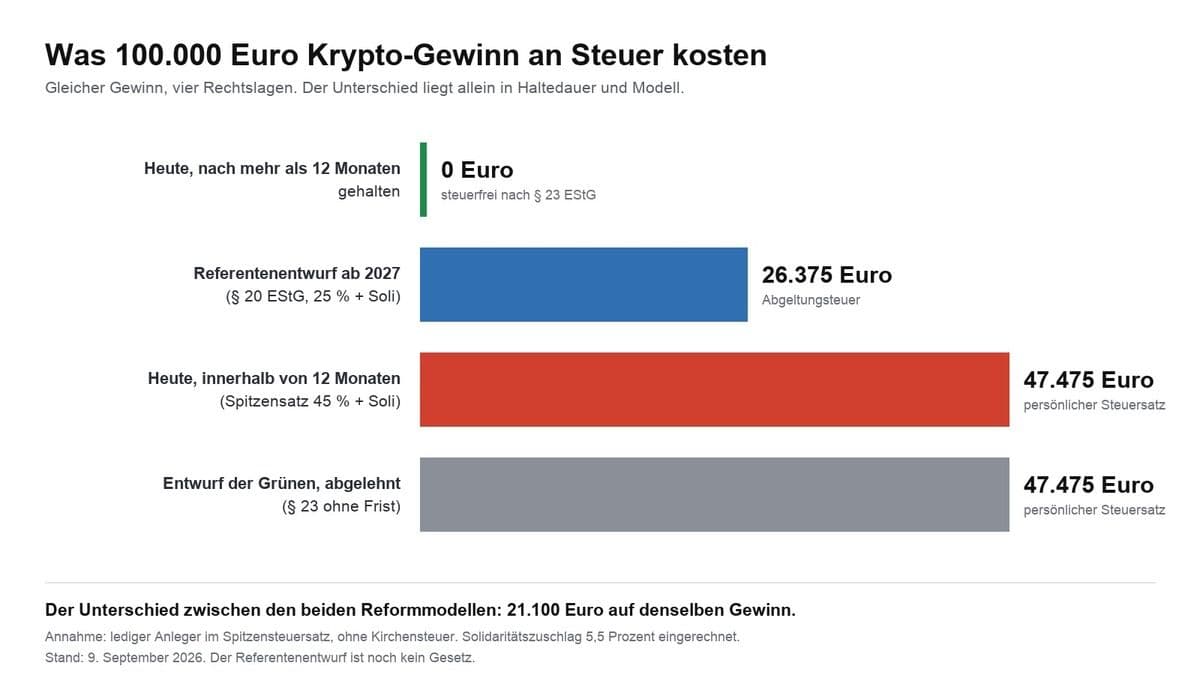
Crypto gains are tax-free after twelve months; before that your personal tax rate of up to 45 percent applies. What triggers tax, how the holding period is calculated, what happens with staking and losses, and what the draft bill would change from 2027.
September 26, 2026 1:19 AM
Germany’s Crypto Holding Period Is Wobbling: What to Check Before December 31
A CDU member of the Bundestag makes it plain: the coalition agreement does not guarantee that the one-year holding period for crypto assets will survive. What that means for purchases made before the planned cutoff date of December 31, 2026.

October 1, 2026 7:16 AM

Bitway (BTW) hits a record $1.43: 27 percent in a week while the market stood still
Bitway marked an all-time high of $1.43 on Monday and trades at $1.32 after a weekly gain of around 27 percent, while the broader market stood still. What carried the jump, when the incentive campaign ends, and what applies to circulating supply, authorisation and tax in Germany.
January 1, 2026 3:12 PM
Crypto Taxes 2026 in Germany: Automatic Reporting Under DAC8, What Applies Now
Since 1 January 2026 crypto providers in the EU must record their customers' transactions for the tax authorities. The first report for 2026 follows in 2027. What investors need to know.
October 1, 2026 7:36 PM

Crypto tax and withholding at source from 2028: what to check now
The German Federal Ministry of Finance’s draft bill goes to cabinet on October 14, 2026. The underexposed part of it is the deduction of tax from 2028: which providers are to withhold the tax on investment income, why self-custody and foreign platforms stay exempt from it, and what you should document by December 31.
August 31, 2026 10:30 PM
Taxing Crypto Lending: Your Personal Rate Instead of Withholding Tax, and the Right Federal Fiscal Court Case Number
According to the only tax court ruling so far, income from crypto lending falls under Section 22(3) of the German Income Tax Act and therefore under your personal tax rate. The appeal is pending at the Federal Fiscal Court under VIII R 22/25, not under the case number given in many professional articles.
September 8, 2026 10:21 PM

Crypto Holding Period and Grandfathering: Why December 31, 2026 Becomes the Cut-Off in Germany's Draft Bill
A ministerial draft bill from Germany's finance ministry names a cut-off date for the first time: crypto assets acquired after December 31, 2026 are to fall under the flat-rate withholding tax. What that means for legacy holdings, running savings plans and staking income, and why nothing has been decided yet.
September 5, 2026 10:24 PM

Fake German Finance Ministry Letters: Why Nobody May Demand 19 Percent VAT on Your Crypto Purchase
Since September 1, 2026, Germany's Federal Ministry of Finance has been warning about forged letters that demand 19 percent VAT on cryptocurrency purchases while citing real transactions. That tax does not exist, and this is how to spot the forgery.
September 26, 2026 7:29 PM
Coins Stolen in an Exchange Hack: What the German Tax Office Accepts as a Loss
After the attack on Bitget on September 24, a question the reports leave out arises for those affected in Germany: can a stolen balance be written off against tax? The answer hangs on a single term in the Income Tax Act, and it is decided by your records.
August 21, 2026 1:42 PM

Writing Off a Total Crypto Loss: When the Tax Office Recognises Worthless Coins
A token that has collapsed only reduces your tax once you actually dispose of it. What applies to delisting, exchange insolvency and worthless holdings under Section 23 of the German Income Tax Act, and how you offset losses.
September 18, 2026 10:13 AM

Bitcoin and the German Exit Tax: What Applies When You Move Abroad
Anyone emigrating with Bitcoin expects an exit tax on unrealised gains and finds nothing of the sort in the statute. Where the real risks sit is decided at four points: residence, the holding period, the legal form of your investment, and automatic reporting from 2026.
August 21, 2026 4:24 AM

Forced Sale on a Crypto Exchange: Which Moment Counts for the Holding Period and What You Must Document
At Luno, Kraken and Valour the deadlines are running out, after which the provider realises the remaining holding itself. For tax purposes that is a disposal, and what governs it is the exchange's timestamp.
August 11, 2026 9:13 PM

Germany's Crypto Holding Period Faces Abolition: What Petition 201716 and the Cabinet Decision Mean for Your Tax
Petition 201716 in the German Bundestag calls for the one-year holding period for crypto assets to be kept and has already passed the quorum of 30,000 signatures. This article sets out what the cabinet decision of July 6, 2026 provides for, how much of it is binding and which records you should be pulling together now.
September 16, 2026 7:12 PM

Borrowing Against Bitcoin Instead of Selling: When German Tax Still Applies
Posting Bitcoin as collateral for a loan is not a sale in Germany, because section 39 of the Fiscal Code keeps the coins attributed to you for tax purposes. Tax arises only when the collateral is liquidated, and then the one thing that decides the bill is how long you held the coins beforehand.
September 7, 2026 7:22 AM
German Crypto Holding Period Stays: The Income Tax Reform 2027 Leaves Section 23 Untouched
On September 2, 2026 the German federal cabinet adopted the draft of an Income Tax Reform Act 2027, and crypto assets do not appear in it. The one-year holding period under Section 23 of the Income Tax Act therefore continues to apply unchanged.
August 22, 2026 4:47 PM

Offsetting Bitcoin Losses Against Stock Gains in Austria
Offset bitcoin losses against gains on shares? Austria allows it in principle, but only under certain conditions and usually via the tax return.
September 19, 2026 7:26 AM

Offsetting Crypto Losses Against Share Gains: What Is Really Allowed in Germany
Crypto losses and share gains sit in separate loss buckets in Germany, and there is no offsetting between them. Where the line runs, why crypto derivatives are the exception, and how you can still use losses through carryback and carryforward.
August 16, 2026 6:14 AM
Crypto Credit Card Tax in Germany: Why Every Payment Is a Disposal
Paying with a crypto credit card means disposing of your coins for tax purposes. What that means for the holding period, the exemption threshold and your record-keeping duties, and which card design keeps the effort small.

July 31, 2026 10:59 AM

German Crypto Tax Return 2025: What You Should Know Now the July 31 Deadline Has Passed
Recap as of September 27, 2026: the deadline for the 2025 German tax return ended on July 31, 2026 at midnight. This article describes the situation on the day of the deadline: what crypto investors had to report and what happens if the deadline is missed.
October 2, 2026 4:39 AM
Donating bitcoin: when does the full market value count, when only the purchase price?
A bitcoin donation to a charitable organisation is deductible as a donation in kind, and the donation itself produces no taxable gain. The size of the deduction turns solely on whether a sale would have been taxable on the day of the transfer.
September 27, 2026 10:35 AM

Crypto Exchange Tax Report Wrong: How to Correct It Before the Tax Office Does
Missing acquisition costs, transfers booked as sales, holding periods restarted: your exchange's report is an aid and not proof. How to check it, how to correct it and which deadline is running.
September 24, 2026 1:13 AM
Solana DEX Trades Overtake the NYSE: What to Check on Swaps, Tax and Oversight
Solana's decentralised exchanges settled roughly 208 million trades in a single week and overtook the New York Stock Exchange for the first time. The figure is real, but it measures something other than the comparison suggests, and for German investors it carries tax duties that no provider takes on.
September 23, 2026 4:26 PM

Paid in Bitcoin: How to Tax Crypto Income as a Self-Employed Freelancer
A fee in Bitcoin is perfectly ordinary business income, valued at the euro price on the day it reaches you. The decisive trap comes afterwards: business assets carry no one-year holding period, so every later price move stays taxable.
September 17, 2026 10:22 PM
Selling Bitcoin at a Loss and Buying It Straight Back: What That Does to Your Holding Period
Germany has no wash sale rule: the loss stays deductible even if you buy back immediately. The buyback, however, restarts the one-year period for every new unit.
September 17, 2026 7:12 PM

Gifting Bitcoin to Children: Allowance, Holding Period and the Tax Office Report
Transferring Bitcoin to your child hands over your holding period and your entry price along with the coins. This guide sets out what really applies in Germany on the allowance, the reporting deadline, representation and custody.
August 24, 2026 10:16 AM

Crypto Tax: Why You Have to Secure Your Transaction History Before the Exchange Closes Your Account
Deadlines run out at several crypto exchanges by early September, after which accounts close and holdings are sold off by force. Anyone who does not export the trading record beforehand faces the tax return with no proof of acquisition date and purchase price.
More from CryptoTicker