
Binance Delisting on August 17: ACX, HFT, PIVX, PYR, VANRY and VIC Leave Spot Trading
Binance removes six tokens from spot trading entirely at 03:00 UTC on August 17, 2026. Anyone holding ACX, HFT, PIVX, PYR, VANRY or VIC has to choose between selling before Monday and withdrawing by October 17.





Which topics should we dive deeper into?
Select what genuinely interests you. Your picks feed directly into our editorial planning.
Crypto news that's actually worth your time.
Weekly. 60 seconds. Carefully curated by our editors: no hype, no promo flood, no spam.
At 03:00 UTC on Monday, August 17, 2026, every spot trading pair for six tokens disappears from Binance. The assets affected are Across Protocol (ACX), Hashflow (HFT), PIVX, Vulcan Forged (PYR), Vanar (VANRY) and Viction (VIC). If one of them sits in your Binance account, that is the moment you lose the ability to sell it there. After that, only a limited window remains to get it off the exchange at all.
Binance set out the move in its own announcement, naming three points in time that follow one another and mean different things. Confuse them and you miss either the sale or the access to your own balance. This article sorts the dates and shows which checks are still worth running before Monday.
Binance delisting on August 17, 2026: the six tokens affected
The announcement names six assets that will be pulled from spot trading in full. Individual trading pairs are not the unit here; all pairs for a token go at once. In the wording of the notice, "all spot trading pairs for the following token(s)" will be removed:
- Across Protocol (ACX)
- Hashflow (HFT)
- PIVX
- Vulcan Forged (PYR)
- Vanar (VANRY)
- Viction (VIC)
A delisting does not mean a project ceases to exist. The tokens keep running on their networks, and some of them trade on other venues. What ends is tradability at this exchange. That still matters, because for smaller assets a large share of trading volume often pools on Binance. Once that venue falls away, the remainder spreads across thinner markets, and the spread between bid and ask usually widens.
If you hold one of the six tokens, answer two questions separately: whether you want to keep the position, and where you will custody it from August 17. The second question applies even if you have no intention of selling.
Spot trading, deposits, withdrawals: the three Binance deadlines
The announcement staggers three dates across two months. Binance works in UTC; Germany is currently on summer time, which is UTC plus two hours.
| What happens | Time (UTC) | German time (CEST) |
|---|---|---|
| All spot trading pairs are removed | August 17, 2026, 03:00 | August 17, 2026, 05:00 |
| Deposits are no longer credited | August 18, 2026, 03:00 | August 18, 2026, 05:00 |
| Withdrawals are no longer supported | October 17, 2026, 03:00 | October 17, 2026, 05:00 |
The first date is the hard one: from early Monday you can neither buy nor sell the six tokens on Binance. The second concerns incoming transfers. Anyone sending one of these tokens to their Binance address after August 18 has to expect the credit to fail; the notice states that deposits will thereafter "not be credited to users' accounts". Moving coins to Binance is no longer a good idea, even though trading there formally runs until Monday.
The third date is the one most often underestimated, because it sits two months out. Until October 17, 2026, 03:00 UTC, you can withdraw the tokens from Binance. After that, the exchange says withdrawals will no longer be supported, and no regular route to the balance remains.
What happens to your open orders
Open spot orders on the affected pairs are deleted automatically when the pairs are removed, according to crypto.news. A sell order you placed well above the current price simply vanishes, without protecting you and without triggering a sale. If you are relying on an open order, check before the weekend whether it can realistically be filled.

Futures, margin and copy trading: what Binance has already wound down
The spot delisting is the last step of a wind-down that began a good week ago. According to the timeline from crypto.news, Binance first closed the peripheral products on August 7: Pool and Pay at 03:00 UTC, flexible loans and VIP loans at 07:00, margin positions at 10:00. For the futures, the sources differ. crypto.news dates the block on new positions to August 7 at 08:30 UTC and the automatic settlement to 09:00, while The Cryptonomist puts the completion at August 8, 09:00 UTC. The range therefore covers August 7 and 8; both accounts agree that the futures were settled ahead of spot trading. Spot copy trading ended on August 10 in both accounts.
That sequence is typical of an orderly delisting. Anyone holding a leveraged position gave up the decision long ago, because settlement happened automatically. For spot holdings it stays with you until early Monday.
 Regulated crypto exchanges compared
Why Binance is cutting: the monitoring tag and the exchange's review framework
Binance gives no per-token reason in the announcement. The exchange points to its general review framework, which by its own account covers liquidity, development activity, network security, team conduct, transparency, tokenomics and regulatory change. Which of these points tipped the balance for which token is not disclosed. A collective justification supports no verdict on any single project.
There was, however, a publicly visible run-up. Binance flags tokens under heightened observation with a so-called monitoring tag. Cryptobriefing puts that tag at May 22, 2026 for HFT, July 3 for PYR and VANRY, and July 24 for ACX; by the same account, PYR lost around 11 percent of its value after the July 3 tag. If you hold positions in smaller tokens, it is worth reading that flag as an early warning in future.
The special case of Vanar (VANRY)
For one of the six assets a more concrete reason is on record. According to The Cryptonomist, the removal of VANRY is connected to Binance not supporting a planned contract migration for the token. That has a practical consequence beyond the delisting: if you withdraw VANRY, check with the project itself before the transfer which contract address will apply in future and whether a later swap will be possible from a self-custody wallet.
Sell or withdraw: the two routes to October 17
There are no more than two options, and they carry different deadlines. The first route is selling on Binance before Monday, 03:00 UTC: convenient, because trade and settlement happen in one place, but with the shortest deadline. The second route is withdrawing to your own wallet or to another venue, and for that you have until October 17.
Which route fits depends less on the price than on what you intend to do with the position. If you want out, there is a lot to be said for selling before Monday, since otherwise you will have to find another venue. If you want to keep the token, moving it to an address of your own is the calmer solution.
In the second case, check where you are sending it first. A withdrawal to an exchange that has also dropped the same token ends in a dead end. If you are switching venues anyway, our comparison of the best regulated crypto exchanges lists the providers that operate under supervision in Germany. What matters most is verifying that the destination service supports exactly this token on exactly this network.

Tax on a sale: how the one-year holding period changes your bill
A sale under deadline pressure is the same event for tax purposes as any other sale. In Germany, crypto assets held privately count as other economic goods within the meaning of Section 23 of the Income Tax Act. Sell within a year of acquisition and the gain is a private disposal and taxable. If the purchase is more than a year back, the gain stays tax-free. On top of that, an exemption limit of 1,000 euros applies to the total of all private disposals in a year. That limit is not an allowance: exceed it and the entire gain becomes taxable, not merely the excess.
Two points are regularly overlooked. First, a swap into a stablecoin also counts as a disposal. Turning the position into USDT on Sunday evening to buy time already triggers the taxable event. Second, a plain withdrawal to your own wallet is not a disposal, because you remain the economic owner and only change where the asset is kept. Moving coins out before October 17 triggers no tax in itself.
Realising and offsetting losses
If your position is under water and the purchase is less than a year old, selling produces a loss from a private disposal. Under Section 23 of the Income Tax Act, such losses can only be offset against gains of the same kind, meaning other private disposals; a carry-back or carry-forward is possible on top of that. They cannot be netted against salary or against investment income from a share portfolio. Anyone who wants to use this needs clean documentation of the acquisition date and acquisition costs. So pull your trade history now, while it is still available at Binance.
 Crypto tax tools and portfolio trackers
Withdrawing to your own wallet: network, fee and the October date
If you opt for the withdrawal, almost everything hinges on choosing the right network. Several of the affected tokens exist on more than one chain. The receiving address has to match the network you select for the withdrawal; a transfer on the wrong network is the most common mistake in deadline moves like this one, and it cannot be reversed.
It is also worth looking at the withdrawal fee relative to the size of the position. On small residual holdings it can account for a noticeable share of the value, in which case selling before Monday is often the more economical choice.
Set yourself a reminder for the October date. Two months sit between August 17 and October 17, and the task easily slips your mind, because nothing appears to be happening in the account. That quiet stretch is exactly the trap: the position stays in your portfolio, can no longer be traded, and from October 17 can no longer be withdrawn either.
The 2026 delisting wave: what the case shows after Kraken and Revolut
The Binance case does not stand alone. Kraken has announced an extensive delisting with forced liquidation, which we broke down on August 11 in our analysis of the Kraken delisting; Revolut is dropping USDT on August 31, which for those affected means a forced conversion with tax consequences. Three providers, three procedures, one common denominator: the deadlines are short, and the responsibility sits with the investor.
One important difference concerns who triggers the sale. In a forced liquidation or a forced conversion the exchange decides, and the result counts as a disposal for tax purposes all the same. In the Binance case the decision stays with you, because the tokens remain withdrawable after the delisting. That is the more investor-friendly variant, and for exactly that reason it demands an active step.
Checking the Binance delisting: what to take away
- Check today whether one of the six tokens sits in your account. ACX, HFT, PIVX, PYR, VANRY and VIC are affected, and spot trading ends on August 17, 2026 at 03:00 UTC, which is 05:00 German time. If you want out, selling before that moment is the simplest route; if you need another venue for it, our comparison of the best regulated crypto exchanges helps.
- Settle the tax side before you sell. Within the one-year holding period the gain is taxable, the exemption limit is 1,000 euros a year, and a swap into a stablecoin counts as a disposal too. Pull your trade history now, while it is still available at Binance; the tools for that are in our overview of crypto tax tools and portfolio trackers.
- Put October 17 in your calendar if you want to keep the tokens. Until that day at 03:00 UTC you can withdraw them; after that, the exchange says withdrawals will no longer be supported. Check the network and the receiving address before the transfer; for long-term custody, the devices are in our hardware wallet comparison.
(As of August 14, 2026. This article is not investment advice. Prices and fee structures change; check the terms with the provider before you buy.)
Transparency note: This article was produced with the assistance of artificial intelligence and reviewed by our editorial team before publication. All figures and claims were checked against the primary sources linked in the text.
Related articles
- Kraken: 45 coins are on cancel only, 21 were announced – what to check when trading pairs are blocked
- IoTeX on Coinbase: What IOTX Holders Should Know After the September 23 Trading Halt
- Writing Off a Total Crypto Loss: When the Tax Office Recognises Worthless Coins
- Forced Sale on a Crypto Exchange: Which Moment Counts for the Holding Period and What You Must Document
- Binance Delists ICX, SCRT and STORJ: From August 21, One Door Closes After Another
Which topics should we dive deeper into?
Select what genuinely interests you. Your picks feed directly into our editorial planning.
Crypto news that's actually worth your time.
Weekly. 60 seconds. Carefully curated by our editors: no hype, no promo flood, no spam.

September 9, 2026 4:22 PM
Crypto Tax in Germany: What Applies in 2026 and What Is Set to Change in 2027
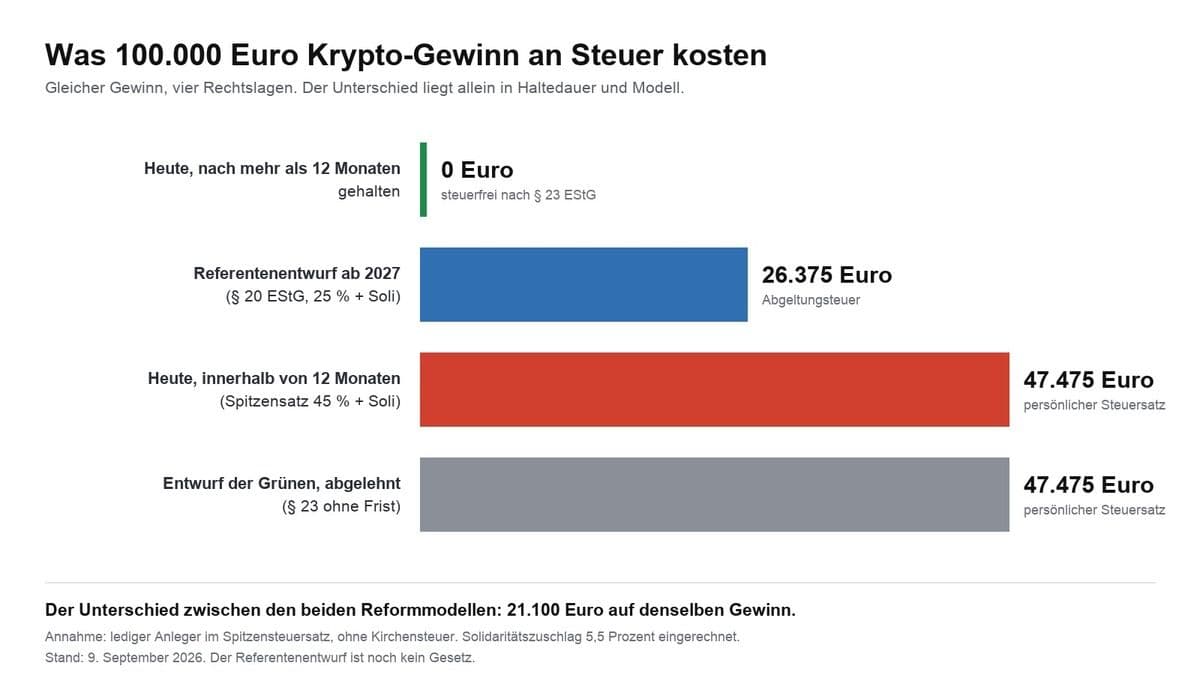
Crypto gains are tax-free after twelve months; before that your personal tax rate of up to 45 percent applies. What triggers tax, how the holding period is calculated, what happens with staking and losses, and what the draft bill would change from 2027.
September 24, 2026 4:28 AM

Crypto Trading Bots and Tax: What Applies With Thousands of Trades a Year
A bot turns one investment decision into hundreds of disposals, and the tax office counts every single one. This guide explains the holding period, FIFO, the exemption limit and the record-keeping duties, and what to set up before the bot makes its first trade.
September 26, 2026 1:19 AM

Germany’s Crypto Holding Period Is Wobbling: What to Check Before December 31
A CDU member of the Bundestag makes it plain: the coalition agreement does not guarantee that the one-year holding period for crypto assets will survive. What that means for purchases made before the planned cutoff date of December 31, 2026.

September 26, 2026 7:40 AM

The RAIN Token After the Enlivex Termination: What to Check on Access, Forced Sale and Holding Period
Enlivex terminated a share placement of 66,666,667 shares payable in RAIN tokens on September 22, 2026. The token sits 46.4 percent below its all-time high, and at Kraken the withdrawal deadline expired long ago.
September 8, 2026 10:21 PM

Crypto Holding Period and Grandfathering: Why December 31, 2026 Becomes the Cut-Off in Germany's Draft Bill
A ministerial draft bill from Germany's finance ministry names a cut-off date for the first time: crypto assets acquired after December 31, 2026 are to fall under the flat-rate withholding tax. What that means for legacy holdings, running savings plans and staking income, and why nothing has been decided yet.
September 23, 2026 10:19 PM
OKX delists ICX, STORJ and ELF: by when you have to trade or withdraw
OKX is taking DORA, ICX, STORJ, ZEUS and ELF off the market. The euro pairs end on September 30, 2026, the USDT pairs on October 3, withdrawals only on December 23. We sort out the four deadlines and show, from our own measurement of the order book, why a hurried sale can turn expensive.

September 22, 2026 4:12 PM

Nearly $1 Billion Into Bitcoin ETFs: What to Check on ETNs, Portfolio and Holding Period
US spot bitcoin ETFs took in a net $999 million on September 21, the third consecutive day of inflows. German investors cannot reach these funds: what ETNs, the holding period and your buying route mean for you.
September 8, 2026 1:19 AM

Germany's Crypto Holding Period: What Happens Now Signing for Petition 201716 Closed on September 15
Recap as of September 27, 2026: the signature period for German parliamentary petition 201716, which asks for the one-year crypto holding period to be preserved, closed on September 15, 2026. This article explains what ended that day, how the petitions committee proceeds and why no investor has to sell because of it.
September 9, 2026 1:15 AM

Germany's Crypto Tax: 160 Million Euros for a 555-Billion Budget
The German finance ministry's draft bill puts a figure on the crypto tax for the first time: 160 million euros from 2028. What that number means in the 2027 federal budget, how 11.4 billion became 160 million, and what investors can read from it.
September 18, 2026 10:13 AM

Bitcoin and the German Exit Tax: What Applies When You Move Abroad
Anyone emigrating with Bitcoin expects an exit tax on unrealised gains and finds nothing of the sort in the statute. Where the real risks sit is decided at four points: residence, the holding period, the legal form of your investment, and automatic reporting from 2026.
September 16, 2026 1:20 PM

Crypto Loss Carryforward in Germany: What Happens to Old Losses Under the 2027 Tax Plan
Losses from crypto sales land in a ring-fenced pot and can only be set against gains of the same kind. The draft bill for 2027 moves future gains into a different pot, and we show you what that means for your assessed carryforward and what your tax notice should say.
September 14, 2026 10:23 AM

Take Ethereum Profits or Wait Out the Holding Period? What the Price Jump Means for Your Tax Bill
Ether reached its highest level since the end of January on September 11, 2026, and many are asking whether to sell now. In Germany the answer hangs on the purchase date first: we work out which tranches are tax free and which of them are showing a gain at all.
September 9, 2026 4:13 PM

Bitcoin 29 Percent Below Last Year: Which Crypto Losses You Can Still Use Before the One-Year Holding Period Expires
Nine out of ten major crypto assets trade lower today than exactly twelve months ago, Bitcoin alone by 29.2 percent. We measured the price series ourselves and show why the purchase date alone decides the tax value of your loss.
August 14, 2026 6:18 PM

Bitcoin From a Foreign Exchange to Austria: Which Tax Data You Need
Transferring Bitcoin from a foreign exchange to an Austrian platform: which tax data can be missing for the withholding tax. And what investors need to watch out for.
September 16, 2026 7:12 PM

Borrowing Against Bitcoin Instead of Selling: When German Tax Still Applies
Posting Bitcoin as collateral for a loan is not a sale in Germany, because section 39 of the Fiscal Code keeps the coins attributed to you for tax purposes. Tax arises only when the collateral is liquidated, and then the one thing that decides the bill is how long you held the coins beforehand.
September 7, 2026 7:22 AM

German Crypto Holding Period Stays: The Income Tax Reform 2027 Leaves Section 23 Untouched
On September 2, 2026 the German federal cabinet adopted the draft of an Income Tax Reform Act 2027, and crypto assets do not appear in it. The one-year holding period under Section 23 of the Income Tax Act therefore continues to apply unchanged.
September 23, 2026 10:32 AM

Switching crypto exchange: what happens to the holding period and the tax when you transfer
A transfer to another exchange or to your own wallet triggers no tax and does not reset the one-year period. What does get lost is the acquisition data, and that is exactly what you need later as evidence.
September 16, 2026 1:12 PM
Bitvavo Delisting of Kava, Nano and Ravencoin: What to Do Before Friday, 2 p.m.
Bitvavo drops KAVA, XNO and RVN on September 18, 2026, and three deadlines expire in a single afternoon. Nano has no withdrawal route at all, and the automatic euro conversion on September 28 counts as a sale for tax purposes.
September 27, 2026 10:35 AM

Crypto Exchange Tax Report Wrong: How to Correct It Before the Tax Office Does
Missing acquisition costs, transfers booked as sales, holding periods restarted: your exchange's report is an aid and not proof. How to check it, how to correct it and which deadline is running.
September 17, 2026 7:12 PM

Gifting Bitcoin to Children: Allowance, Holding Period and the Tax Office Report
Transferring Bitcoin to your child hands over your holding period and your entry price along with the coins. This guide sets out what really applies in Germany on the allowance, the reporting deadline, representation and custody.
October 2, 2026 4:39 AM

Donating bitcoin: when does the full market value count, when only the purchase price?
A bitcoin donation to a charitable organisation is deductible as a donation in kind, and the donation itself produces no taxable gain. The size of the deduction turns solely on whether a sale would have been taxable on the day of the transfer.
September 24, 2026 1:13 AM

Solana DEX Trades Overtake the NYSE: What to Check on Swaps, Tax and Oversight
Solana's decentralised exchanges settled roughly 208 million trades in a single week and overtook the New York Stock Exchange for the first time. The figure is real, but it measures something other than the comparison suggests, and for German investors it carries tax duties that no provider takes on.
September 23, 2026 10:25 AM

Airdrop tax: when free coins are taxable in Germany
Whether you have to pay tax on an airdrop is decided by a single question: did you do something for the coins? This guide takes you through both cases, the valuation at the market price, and the records the tax office has demanded since the 2025 assessment period.
September 17, 2026 10:22 PM

Selling Bitcoin at a Loss and Buying It Straight Back: What That Does to Your Holding Period
Germany has no wash sale rule: the loss stays deductible even if you buy back immediately. The buyback, however, restarts the one-year period for every new unit.
August 24, 2026 10:16 AM

Crypto Tax: Why You Have to Secure Your Transaction History Before the Exchange Closes Your Account
Deadlines run out at several crypto exchanges by early September, after which accounts close and holdings are sold off by force. Anyone who does not export the trading record beforehand faces the tax return with no proof of acquisition date and purchase price.
August 24, 2026 4:22 AM

Selling XRP After a 53 Percent Week: What the Holding Period Costs
XRP trades at $1.51 after a weekly gain of a good 50 percent, yet your net proceeds are decided by the purchase date. This article works through the holding period, the exemption limit and FIFO at measured reference-date prices.
October 2, 2026 1:33 PM

Crypto tax before the cabinet on October 14: “Comments are only possible until October 6”
Germany's Federal Ministry of Finance sent the draft bill on crypto taxation to the associations on September 30, 2026, and the cabinet is to decide on October 14. For your holdings one date counts above all: December 31, 2026.
More from CryptoTicker