
Fetch.ai Bridge Exploit: What FET, AGIX and NTX Holders Must Check Now
A single call drained the FET liquidity of the SingularityNET bridge on September 19, and hundreds of millions of unbacked tokens were minted afterwards. What is affected, what Fetch.ai has halted, and what to check in your wallet, at your exchange and on tax.




Which topics should we dive deeper into?
Select what genuinely interests you. Your picks feed directly into our editorial planning.
Crypto news that's actually worth your time.
Weekly. 60 seconds. Carefully curated by our editors: no hype, no promo flood, no spam.
If you hold FET, AGIX or NTX, two things need to be kept apart right now. The tokens in your own wallet were not attacked. What was attacked is the bridge used to convert legacy AGIX holdings into FET. That conversion has been frozen since September 19, and anyone who still has it ahead of them cannot get through at the moment.
On the evening of September 19, 2026, the TokenConversionManagerV3 contract on Ethereum was drained of its entire FET liquidity. In the hours that followed, the same address minted hundreds of millions of new tokens belonging to three further projects. Here is the sequence, with the figures that can be evidenced, and what it means for you as an investor in Germany.
What happened in TokenConversionManagerV3 on September 19
The TokenConversionManagerV3 is the Ethereum side of the official SingularityNET bridge. A token bridge is a contract that collects tokens on one chain and releases a matching amount on the other. This bridge connected Ethereum with Cardano and also served to swap legacy AGIX holdings into FET.
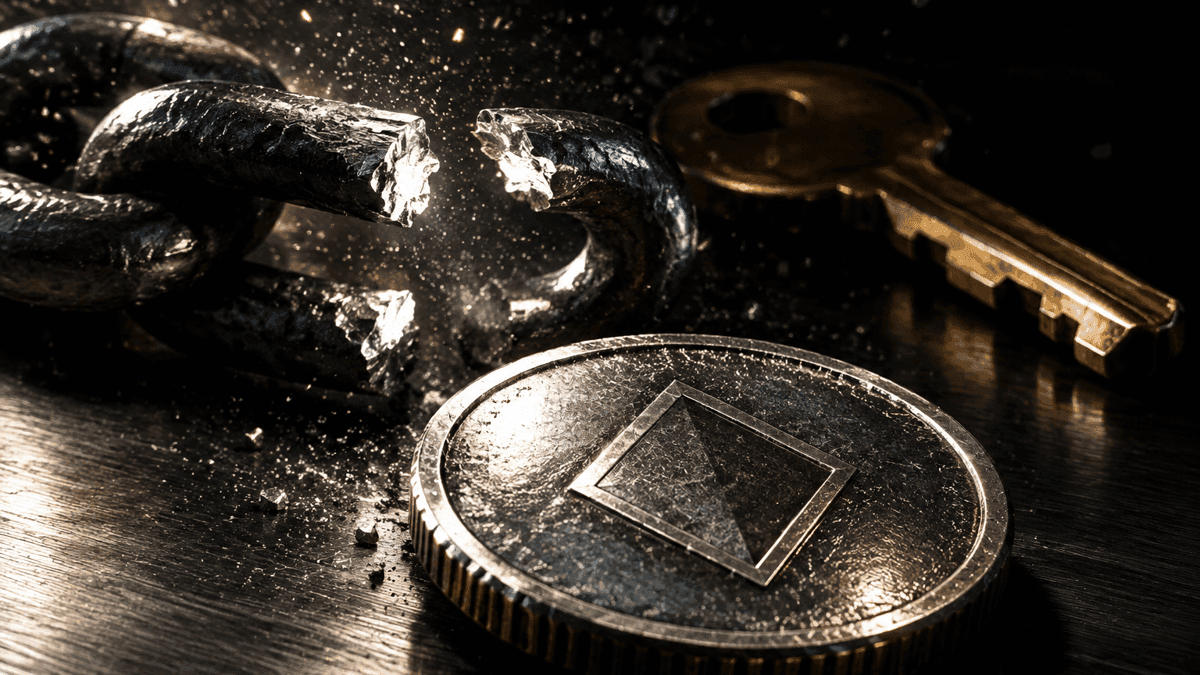
According to the available on-chain analysis, a single call to the conversionIn function went through at 20:21:47 UTC in block 26,013,913, paying out 8,721,530.40 FET to an address controlled by the attacker. Depending on the source, the value is put at roughly $1.53 million to $1.55 million. Less than half an hour later, at 20:50:11 UTC, came the minting of 408.53 million NTX, the token of the NuNet project, with a reported value of about $462,730.
One point matters for the interpretation: no wallet was cracked here and no seed phrase was harvested. The attacker used a valid authorisation signature. Analytics firm SlowMist concludes that the infrastructure's signing keys had been compromised.
Why a single signature was enough: the flaw in conversionIn()
The technical core is quickly told and worth understanding, because it recurs across bridges. On SlowMist's analysis, the conversionIn() function accepted the signature of a single external account as sole authorisation. An external account, an Externally Owned Account or EOA in the jargon, is an ordinary address with exactly one private key behind it. Whoever holds that key is, as far as the contract is concerned, the legitimate counterparty.
A second point is what made the damage large: the counterpart function conversionOut() checks an amount limit, and conversionIn() did not. There was therefore no ceiling to cap any single call. A compromised key plus a missing amount check add up to a drain in one step.
The comparison with earlier cases is close at hand. In the two perp DEX incidents on Arbitrum over the summer, the decisive question was likewise who holds the keys, rather than whether a protocol calls itself decentralised. A single trust assumption is enough to bring an otherwise cleanly built system down in one move.
Unauthorised minting: 408m NTX, 260m AGIX, 53.8m WMTx
On September 20 the incident widened. According to PeckShield, the same address additionally minted 260 million AGIX and 53.838 million WMTx on Ethereum. WMTx is the token of World Mobile Chain; the project has confirmed that WMTx was minted without authorisation via the SingularityNET bridge.
PeckShield put the attacker cluster's holdings at about $16.77 million as of September 20. The breakdown on that analysis: roughly 198.3 million AGIX worth about $14.42 million, 649 Ether worth about $1.67 million, and 33.538 million WMTx worth about $627,350. An analysis by Bitquery the same day arrived at roughly 2.3 billion units created without authorisation across AGIX, NTX, CGV and WMTx combined.
The gap between the two figures is not a contradiction but a question of what is being measured. The $16.77 million is a market value at a point in time; the 2.3 billion is a unit count. And a unit count out of nowhere means the same thing for every existing holder: the share their stack represents of total supply has shrunk overnight.

What Fetch.ai halted: AGIX-to-FET conversion and the Ethereum bridge
By its own account, Fetch.ai flipped two switches. First, the conversion of AGIX into FET was paused until further notice. Second, the Ethereum-side bridge was halted as a precaution, alongside the statement that there is no indication its own contract is vulnerable. In coordination with SingularityNET, affected wallets and contracts were disabled.
In practical terms for you: if you still hold legacy AGIX and have been putting off the swap into FET, you cannot execute it at the moment. No date has been given for when the conversion reopens. Anyone who has treated the deadline as open-ended should start watching the process rather than leaving it to sit.
 Keep long-term holdings safe
Are you affected? How to check your wallet and exchange in five steps
The honest answer for the large majority is: probably not directly. What is affected in the narrow sense is the bridge liquidity, not your holdings. Even so, there are five things that can be settled in a few minutes.
- Check what you actually hold. FET, AGIX, NTX, WMTx and CGV are the tokens in question. If none of them is in your stack, the case is a lesson for you rather than an event.
- Check for open conversions. If you hold AGIX that has not yet been swapped into FET, that route is closed for now.
- Check the status at your exchange. Trading venues routinely suspend deposits and withdrawals for individual tokens after incidents like this. It appears in the provider's status notice, not in the price window.
- Revoke old approvals. If you ever granted the bridge contract an unlimited token approval, it deserves a review. That is good practice independently of this incident.
- Expect phishing now. Every major incident is followed by fake reimbursement forms and supposed support channels. No reputable project will ask you by direct message to enter a seed phrase or connect a wallet for a refund.
FET, NTX and WMTx price reaction: what the numbers show
The prices reacted very differently, and the difference is instructive. FET was trading near $0.18 at the time of the drain and was quoted at $0.172 on September 20, down about 5 percent over 24 hours. For NTX the move was dramatic: the figures range from 65 percent to about 95 percent down, depending on the window and the source, with a reported all-time low of $0.00004075 on September 20. WMTx lost about 43 percent on the same analyses.
The reason for the spread lies in the mechanics. With FET, existing liquidity was withdrawn and supply stayed the same. With NTX, new tokens were created and supply grew abruptly. A drain costs confidence; an unauthorised mint costs confidence and dilutes every existing share on top. That is why smaller tokens are hit harder in such cases than an ecosystem's main asset.
Buying in Germany: FET, MiCA and regulated trading venues
Anyone trading from Germany has bought these tokens through licensed providers since the MiCA transition period expired. MiCA is the EU regulation on markets in crypto-assets; serving customers here requires a CASP licence. In practice that means the choice of trading venues has narrowed and status communication has as a rule become more binding. Which houses hold a licence is set out in our overview of regulated crypto exchanges.
Two things should be kept apart on the buying side. Whether a token is tradable on a regulated exchange says nothing about the security of the bridges its project operates. And suspended deposits or withdrawals are not a sign that your exchange was attacked, but as a rule a precaution while units minted without authorisation may be in circulation.

German tax: holding period, losses and loss offsetting on FET
Under current German law, crypto-assets held privately are private disposal transactions under Section 23 of the Income Tax Act. Three points follow that become practical in this situation.
If you sell at a loss within one year of acquisition, that loss can be used for tax purposes, but only against gains from other private disposal transactions in the same year, against a carry-forward or in a carry-back. If you hold the tokens for more than a year, a gain is tax free, and by the same token the loss is then irrelevant for tax. The exemption threshold for gains from private disposal transactions is 1,000 euros per calendar year; once it is exceeded, the entire gain is taxable.
Anyone now considering realising a loss and buying back shortly afterwards should know the side effects: the repurchase restarts the holding period for the new units. So if you want to buy back in the short term, you are pushing out the point from which a later gain would be tax free again. And regardless of that: document acquisition dates and unit counts cleanly, because the burden of proof is on you.
 Trade licensed, not on hope
Custody after a bridge hack: what self-custody really protects
One uncomfortable lesson can be drawn from this incident. A hardware wallet would have protected nobody here who swapped via the bridge, because the target was not the user keys but the infrastructure's signing keys. Self-custody protects your holdings for as long as they sit with you. The moment you hand tokens to someone else's contract, that contract's security level applies, and no longer yours.
In practice: separate holdings you are keeping from holdings you are moving. A hardware wallet for the long-term stack and a separate address for contract interactions cost little effort and limit the damage to what you actually put at risk. For day-to-day interaction a properly set up software wallet is often enough, as long as only small amounts sit there.
Putting bridge risk in context: what this case shows about token bridges
Bridges have been the most vulnerable part of the token landscape for years, and the reason is structural. A bridge has to collect something on one side and release something on the other. In between sits an authority that authorises the process. The narrower that authority, the greater the leverage when it falls. A single signature with no amount cap is the narrowest conceivable end of that scale.
For assessing a project, that means asking a question that rarely appears in the marketing: who may authorise a payout, how many keys are needed for it, and is there a ceiling per transaction? Where the answer is "one key, no cap", that is a risk that exists independently of the quality of the rest of the technology. This is not a statement about the integrity of the people involved, but about architecture.
The question of what comes afterwards matters just as much. Projects able to identify and freeze units minted without authorisation limit the damage. Projects that cannot carry it in circulation permanently. That distinction will be readable off the three affected tokens over the coming weeks.
Fetch.ai exploit check: what to take away
- Settle your own holdings before you look at the price. Check whether you hold FET, AGIX, NTX, WMTx or CGV, whether a conversion is open on your side, and whether your trading venue has suspended deposits and withdrawals. Where you can trade under a licence in Germany is shown by our comparison of crypto exchanges.
- Separate your long-term stack from contract interaction. What you intend to hold for years belongs on an address that has granted no approvals to third-party contracts. Which devices cover that is set out in the hardware wallet comparison.
- Decide on tax deliberately, not in a hurry. Before selling, check whether your units sit inside or outside the one-year period, and what a repurchase does to that period. Clean records of those dates spare you the discussion with the tax office later; tools for it are listed under crypto tax software.
Sources on the incident: the analysis of the mints and the cluster holdings at The Crypto Times, and the account of the compromised signing keys and the official statement at Cryptopolitan.
(As of September 23, 2026. This article is not investment advice. Prices and fee structures change; check the terms with the provider before you buy.)
Transparency note: This article was produced with the assistance of artificial intelligence and reviewed by our editorial team before publication. All figures and claims were checked against the primary sources linked in the text. The feature image was generated with AI.
Related articles
- Wave of Crypto Hacks and Exploits Hits Influencers and Memecoins: WATCH OUT!
- LayerZero Security Alert: Is Your Crypto Safe After the $292M KelpDAO Exploit?
- Cetus Hack on Sui Network: What Happened and Why SUI Price Is Crashing
- DeFi Hack: Aave and LayerZero Hit by Sophisticated DPRK Attack
- Symbiosis Hack: How to Check Whether Your Bridged Bitcoin Can Still Get Out
Which topics should we dive deeper into?
Select what genuinely interests you. Your picks feed directly into our editorial planning.
Crypto news that's actually worth your time.
Weekly. 60 seconds. Carefully curated by our editors: no hype, no promo flood, no spam.

June 9, 2026 11:55 AM

Humanity Protocol H Token Crashes 90% Following $31 Million Key Compromise
Humanity Protocol ($H) has plummeted 90% after a compromised private key led to a $31 million exploit, erasing over $1 billion in market capitalization.
August 16, 2026 9:05 AM
Crypto Weekly Recap: Bitcoin Slips Below $63,000 as CPI Relief Never Arrives
Bitcoin sits near $62,990 and down 2.7% on the week, ETF flows turned negative and XRP broke $1. Your Sunday crypto recap.

August 6, 2026 1:00 PM

$42 Million in Eight Days: Why ‘Decentralised’ Stopped Protecting Perp DEX Traders
Ostium and AFX were drained inside eight days – both times through keys, not smart contracts. The seven questions you must answer before any deposit.
December 26, 2025 1:50 PM

Breaking: Trust Wallet Chrome Extension Hack Drains $7M, Full Reimbursements Promised
A supply-chain attack hit Trust Wallet’s Chrome extension, draining $7M from users. Binance’s CZ says all victims will be reimbursed.
September 13, 2026 10:12 PM
Chainflip Hack on Tron: How to Check Whether Your USDT Swap Is Still Stuck
An attacker drained 736,442 USDT through Chainflip's Tron rail on September 12, 2026, and trading has been at a standstill ever since. On September 13 we measured for ourselves which functions of the protocol are switched off and which are still running.
September 10, 2026 9:13 AM
Trezor Hack Scare: That STM32 Entropy Email Is a Phishing Attack
Trezor users received a fake STM32 entropy warning sent from a real Trezor address. Here is what happened and what to do if you clicked.
April 21, 2026 11:15 AM

Breaking: Arbitrum Security Council Freezes $71M in ETH Linked to KelpDAO Exploit
The Arbitrum Security Council has frozen 30,766 ETH tied to the KelpDAO hack, sparking a fierce debate over decentralization and emergency powers in DeFi.
February 22, 2025 3:49 PM
Here's How AI Tokens Are Changing Crypto Fundraising...
Kaito AI’s massive $1B+ token launch skipping traditional venture capital, signals a new era. But is this innovation or just another way to offload risk onto retail investors?
May 11, 2025 3:06 PM
Top 5 AI Agents Coins to Buy in May 2025
With AI tokens averaging a 20% price surge in the past week, AI Agent Tokens have become the hottest narrative in the market. Here are the top 5 coins to watch this May.
February 21, 2025 9:55 PM

Bybit Hack Revealed: Here's the Mastermind Behind the $1.46 Billion Theft
The Bybit hack has been traced back by the blockchain investigator ZachXBT, with conclusive evidence linking the hackers to the $1.46 billion theft. Full details revealed...
September 21, 2026 4:29 PM

Render Jumps 19 Percent: What Really Drives The AI Tokens
Render gains around 19 percent, placing it directly behind Sui. The whole group of AI cryptocurrencies is rising as a block. Three network metrics show why capital is landing here.
June 28, 2026 8:12 PM

Polymarket Hack: $3.1M Stolen as Prediction Market Hype Faces Its Biggest Test
Polymarket hack shocks prediction markets as $3.1M is stolen from 11 wallets. Is the sector ready for mainstream adoption?

May 4, 2019 5:44 PM

Microsoft Hackers Stole Crypto Using Victims Emails
Another batch of crypto users have lost money recently through an unlikely breach. Recently, Microsoft services such as Hotmail, MSN, and Outlook have been hit by a breach. It was later learned that the breach was due to an employee’s […]
October 2, 2026 7:16 AM

$1.26 Billion in Three Months: Crypto Hacks Hit Their 2026 High
The security firm CertiK counts around $1.26 billion in damage from 247 incidents for the third quarter of 2026. September was the worst month of the year with 99 cases, and this is the background and what it means for your custody.
September 21, 2026 7:12 PM

Bittensor Price Up 14 Percent: A Rally Without News
TAO climbs to $287 with no single piece of news behind it. Why that is itself information, how the network works and which number sets Bittensor apart from the other AI tokens.
August 13, 2026 4:59 PM

Trezor Data Breach: First 13,689 Customers, Then Roughly 67,000 More Exposed
A breach at Trezor shipping partner ShipMonk exposed names, phone numbers and home addresses of 13,689 customers in August; in September Trezor reported roughly 67,000 more in the US. Devices are safe, phishing risk is not.
June 5, 2026 3:00 PM
Zcash Crash: ZEC Coin Falls 40% After AI Bug Scare — Here Are the Next Supports
Zcash crashes over 40% as AI-linked bug fears, whale shorts, liquidations, and weak crypto sentiment hit $ZEC.
September 29, 2026 7:12 PM
MEXC Refunds $340,000: The Attacker's API Key Survived the Account Freeze
During an account takeover at MEXC, an attacker created an API key with withdrawal rights that the exchange did not revoke when it restored the account. Twenty-seven minutes after the withdrawal freeze expired, roughly $340,000 was gone.
September 15, 2026 10:14 PM
AI Crypto Crime: How Scams Are Getting More Convincing
AI is sharpening fake support, deepfakes and phishing across the crypto space. Why the data still needs a careful reading and which security routines protect a wallet.
March 15, 2026 1:15 PM

Top 5 Crypto Gainers This Week as Bitcoin Reclaims $71.5K
As Bitcoin climbs back to $71,500, Decentralized AI and Governance tokens lead the charge. Discover the top 5 altcoin gainers of the week.
December 28, 2024 12:21 PM

Virtuals Protocol (VIRTUAL) Soars in 2024: Can It Sustain Momentum in 2025?
Virtuals Protocol (VIRTUAL) soared over 23,000% in 2024, fueled by AI hype and adoption. But can it maintain its momentum in 2025? Find out the key opportunities and challenges for VIRTUAL in the coming year.

January 27, 2022 11:03 AM

How to Avoid Crypto Scams? Don’t be a Victim of Squid Tokens in 2022
In this article, we will be looking at the new SQUID token and how traders can avoid rug pulls while investing in digital assets.
September 30, 2026 10:24 PM

$766 Million Lost to Crypto Hacks in One Month: What It Means for Your Custody
CertiK counts around $766.4 million in damage for September 2026, the highest monthly figure of the year. Two incidents carry more than 92 percent of it, and both hit a place where your balance could be sitting too.
August 23, 2026 7:24 PM

SAND Bridge Exploit at The Sandbox: Why Not to Trade SAND on Base and BNB Chain Now
An attack on The Sandbox's cross-chain bridge created unbacked SAND tokens on Base and BNB Smart Chain on August 22, 2026. Bridging is halted; holdings on Ethereum and Polygon are unaffected, according to the studio.
January 20, 2025 1:50 PM

Ethereum Price Prediction with Vitalik Buterin New Leadership after ETH Price Struggles in Bitcoin's Shadow
ETH price struggles with Bitcoin’s dominance, Trump’s crypto moves, and the Solana blockchain surge. As Vitalik Buterin announces leadership changes to reshape Ethereum’s future, what to expect for Ethereum price and blockchain?


More from CryptoTicker