
Crypto Trading for Beginners: Order Types, Charts and Risk Explained
Trading is a different exercise from buying and holding. This introduction explains the three order types, what a chart really shows, how position size is calculated and what trading triggers for your taxes.

Which topics should we dive deeper into?
Select what genuinely interests you. Your picks feed directly into our editorial planning.
Crypto news that's actually worth your time.
Weekly. 60 seconds. Carefully curated by our editors: no hype, no promo flood, no spam.
Most people who own cryptocurrencies bought them and then left them alone. That is not trading, it is investing, and for the vast majority it is the better route. Trading means something else: you try to make a profit from price moves within hours, days or weeks. It is a different activity, with different tools, different risks and a different tax position.
This piece explains the basics without telling you what to do. It sets out which order types exist and what they are for, what a chart actually displays, how position sizes are calculated, and where most beginners lose money. By the end you will know whether trading suits you. Either answer is a good result.
What is crypto trading and how does it differ from buying?
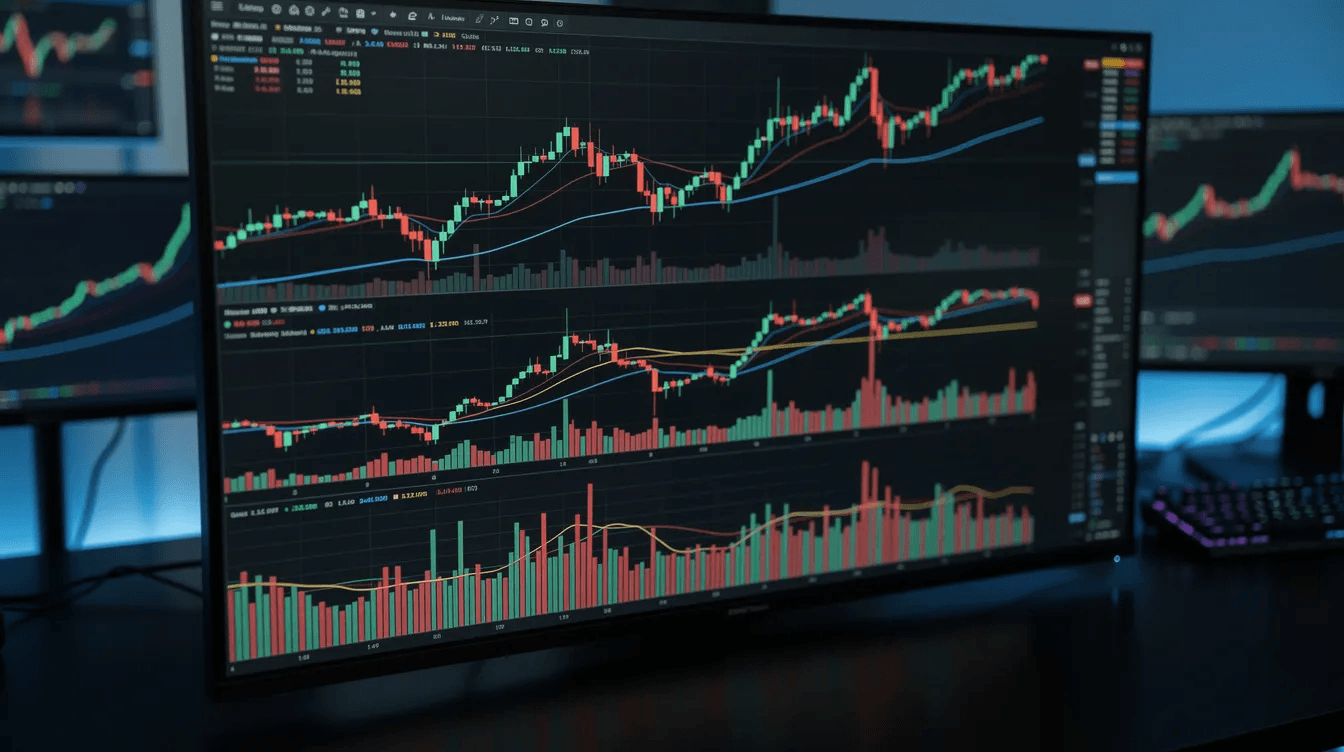
When you invest, you buy because you believe in the value. When you trade, you buy and sell because you expect a move. The difference lies in the holding period and in what decides the outcome; the market is the same one.
An investor needs a view that spans years. A trader needs a view that spans days, plus a rulebook for the case where that view turns out to be wrong. Beginners tend to lack exactly this rulebook, which is why the most common mistake is rarely the wrong forecast. It is the missing reaction to it.
Three terms mark out the usual styles:
- Day trading: positions are opened and closed on the same day. High time commitment, plenty of fees, a heavy demand on discipline.
- Swing trading: positions run for days or weeks. Less screen time, but longer stretches in which you have to sit with an open position.
- Position trading: weeks to months. The line to investing blurs here, and for private investors in Germany the one-year holding period is the decisive tax question.
That last point is rarely mentioned and it is expensive. Anyone who trades frequently gives up the tax exemption that arrives after twelve months and attaches to every single purchase. Every sale within a year counts as a private disposal and is charged at your personal income tax rate.
Which order types exist in crypto trading?
Three order types cover almost everything: a market order buys immediately at the next available price, a limit order buys only at the price you name, and a stop-loss order sells automatically once a loss reaches a set boundary.
The differences sound technical and decide the outcome in practice:
- Market order: it executes at once, though not necessarily at the price you saw. In quiet markets the deviation is tiny; in hectic ones it can become noticeable. That deviation is called slippage.
- Limit order: you name the price at which you are willing to trade. It executes when the market reaches that level, and otherwise not at all. The price is certain, the execution is not.
- Stop-loss: it sits below your entry and triggers a sale once the price reaches it. It offers no protection against every loss, because in a fast falling market the execution can land below the mark.
A fourth variant appears on almost every exchange: the stop-limit order. It combines the two, triggering at one mark and then executing only up to a limit. That guards against poor execution and carries the risk that nothing is sold at all.
Which order types your exchange offers, and what it charges for them, varies considerably. The exchange comparison lists the fees and the feature range of the regulated providers.
 Crypto exchanges compared
What does a crypto chart actually show?
A candlestick chart shows four values per time period: the opening price, the highest price, the lowest price and the closing price. Everything else drawn on a chart is a calculation based on those values.
That is the most important sentence for beginners, because it puts the indicators in their place. A moving average is the mean of the last closing prices, nothing more. The 200-day average is so widely watched simply because many market participants look at the same line and react to it in similar ways. The number 200 carries no special power of its own.
Three tools are enough to start with:
- Moving averages: they smooth the path and show the direction. Above the line the trend points up, below it the trend points down. They say no more than that.
- Volume: how much was traded in a given period. A move on high volume has more participation behind it than one on low volume.
- RSI: a number between 0 and 100 that measures how strong the recent upward moves were against the downward ones. Above 70 counts as overbought, below 30 as oversold. Both are clues rather than signals.
What a chart cannot do: it says nothing about the future. It describes what has happened, in a form that makes patterns visible. Whether a pattern repeats is for the market to decide.
Spot or leverage: where does the difference lie?
In spot trading you buy the coins and own them. In leveraged trading you borrow capital to move a larger position than your balance supports. Leverage magnifies gain and loss to the same degree.
An example with round numbers: with 1,000 euros of capital and five times leverage you move 5,000 euros. If the price rises by 10 percent, you gain 500 euros instead of 100. If it falls by 20 percent, your stake is gone entirely. That point is called liquidation, and it arrives sooner than most people expect.
For beginners this leads to a simple boundary: anyone who has yet to master the order types has no business on the leverage market. Spot trading maps the same moves, only without the option of losing everything in a single night.
How large should a position be?
The most widespread rule says that no single trade risks more than one to two percent of total capital. The position size follows backwards from that figure, and it is never estimated.
The calculation is short. Suppose your capital is 5,000 euros and you risk one percent of it, so 50 euros. Your stop-loss sits 5 percent below the entry. Then the position may be 1,000 euros in size, because 5 percent of that amount is exactly the 50 euros you are prepared to lose.
This calculation is the real difference between trading and gambling. It answers before the entry what a failed trade costs. Skip it, and you find out afterwards.
Where can you practise trading without risking money?
A demo account or a trading game reproduces the mechanics without a loss costing real money. What it does not reproduce is how a loss feels, and that is where most people come unstuck.
That is no small matter. It is the core of the problem: someone who loses 500 euros in a demo account simply clicks on. Someone who loses 500 real euros takes the next decision differently. Practice is still worthwhile, because it clears away the manual errors before they cost money: the accidental market order in place of the limit order, the forgotten stop-loss, the miscalculated position size.
Most regulated providers offer a demo account, and CryptoTicker is working on its own trading game in which you trade against others with a starting balance. The prices in it are real, the money is not. Only one thing matters here: practise with the same position size you would genuinely use later on. Playing with ten times the amount in a demo account trains the opposite of what you need.
Which mistakes cost beginners the most money?
Four mistakes turn up in almost every beginner's story, and none of them has anything to do with a wrong forecast.
- No stop-loss. The position is held because it might recover. Sometimes it does. The one case in which it does not costs more than all the others brought in.
- Averaging down into losses. The entry price is lowered, the position grows, and the risk grows with it. A small mistake turns into a large one.
- Too many positions at once. With five open trades, none of them gets proper attention. The market punishes inattention more reliably than it punishes wrong opinions.
- Ignoring fees. At twenty trades a month, 0.2 percent per side adds up to 8 percent over a year before anything at all has been earned. A look at the broker fee overview pays off before the first trade, not after the twentieth.
What does trading mean for your taxes?
In Germany, every sale within a year is a private disposal transaction under section 23 of the Income Tax Act. The gain is charged at your personal income tax rate rather than at the flat withholding tax rate.
For traders that is the least comfortable feature of German law: active trading forfeits, on every position, the tax exemption that would have arrived after twelve months of holding. There is an exemption limit of 1,000 euros per calendar year, and it is reached quickly.
Then there is the documentation duty. Every single trade needs a date, a price and a quantity, and with several hundred trades a year that can no longer be managed by hand. Which tools take this over and what they cost is set out in the comparison of tax tools.
Whether the one-year holding period survives is currently open: the budget draft of July 6, 2026 provides for a reclassification, while the Income Tax Reform Act 2027, adopted by the cabinet on September 2, 2026, contains nothing on the subject. We track the state of play in our article on the crypto holding period.
Learning crypto trading: what to take away
Trading is a skill with a flat learning curve at the start and a very steep one after that. The mechanics are understood in an afternoon: three order types, a chart with four values per candle, one calculation for the position size. What takes years is the discipline to stick to your own rulebook when a position runs against you.
Anyone who wants to start needs three things before the first trade runs: an exchange whose fees and order types they know, a rule for the position size, and an idea of what trading triggers in tax terms. Everything else comes with practice.
(As of September 9, 2026. This article is not investment advice. Prices and fee structures change; check the terms with the provider before you buy.)
 Document your trades properly
Partner links: some links on this page are partner links. If you become a customer through one of them, we may earn a commission at no extra cost to you. Selection, ratings and ranking are decided independently by our editorial team. Ethics and Independence · Ownership and Funding
Transparency note: This article was produced with the assistance of artificial intelligence. Figures and claims are based on the primary sources linked in the text.
For later? Save this article and find it again in your profile.
Related articles
- German customs law: crypto over €100,000 can be seized without a criminal case
- Spot trading explained: real coins without leverage and no liquidation price
- Crypto Crash and Taxes: Can Your Losses Cut Your Tax Bill?
- Crypto Crash Prediction: Where Will 3 Major Coins Bottom Out?
- How to read a candlestick chart: what 999 daily bitcoin candles reveal about the hammer and the doji
Which topics should we dive deeper into?
Select what genuinely interests you. Your picks feed directly into our editorial planning.
Crypto news that's actually worth your time.
Weekly. 60 seconds. Carefully curated by our editors: no hype, no promo flood, no spam.

November 10, 2026 3:16 PM

US inflation runs hot: Bitcoin at $73,600 with stops in focus before December 9
Analysis: US consumer prices rose 0.4 percent in October, more than expected, and a Fed rate hike on December 9 now looks certain. Bitcoin slips to around $73,600 and trades just above its 200-day moving average.

November 10, 2026 9:25 AM

Pig butchering: FATF traces $100 million of victims' money into a single scam compound
Pig butchering combines romance fraud with crypto investment fraud: scammers build trust over weeks and then steer their victim onto a fake trading platform. A FATF report of November 5, 2026 traces more than $100 million of victims' money in a single case; this guide sets out the phases, the warning signs and where victims in Germany can turn.

November 8, 2026 5:20 PM
November 2025 buyers of Dogecoin are sitting on a 58 percent loss as the tax window closes
Analysis: Dogecoin trades at $0.0712 on Sunday evening and is heading for a fifth straight lower weekly close. For purchases made in November 2025, the one-year holding period under German tax law expires from Monday, and with it the chance to offset the loss against other gains.
November 8, 2026 3:21 PM

Swing trading crypto: in Germany every euro counts once annual gains reach €1,000
Swing trading means holding cryptocurrencies for a few days to a few weeks to capture a single price move. We explain strategies, indicators and stop-losses, work through the fees per trade and show why in Germany every gain becomes taxable once the €1,000 exemption limit is reached.
November 8, 2026 1:15 PM

Eurojust raid on fake trading platforms: more than 100 servers seized, seven arrests
Investigators from seven countries, led by the public prosecutor's office in Itzehoe, have taken down an alleged supplier of fake trading platforms and seized more than 100 servers. We explain how the scheme works and how to check a provider before your first transfer.
November 8, 2026 7:23 AM

Margin trading explained: how trading with borrowed money works
Margin trading means trading a larger position with borrowed money. We work through profit and loss at 2x, 3x and 5x leverage, explain margin level, margin call and liquidation, and show where you can trade with a licence in the EU.
November 7, 2026 9:58 PM
Coin of the future: Which cryptocurrency should you buy for 2030?
A great deal can happen in the crypto market over the coming years. Which cryptocurrency should you buy with 2030 in mind?
November 7, 2026 11:29 AM
PnL in Trading: Realised Gains Count for Tax, Unrealised Ones Only on Screen
PnL shows how much a trading position gains or loses. What matters is the difference between realised and unrealised PnL, because only the realised gain after fees counts for your account and for the tax office.

November 7, 2026 9:16 AM
Russia Opens Crypto to Retail Investors on November 17: What Bitcoin, Ethereum and USDT Access Really Means
Russia's central bank lets ordinary investors trade Bitcoin, Ethereum and USDT from November 17. Caps, exclusions and why XRP didn't make the list.
November 6, 2026 1:40 AM

Crypto arbitrage: a €10 price edge loses out to trading fees
Bitcoin costs slightly different amounts on every exchange, and crypto arbitrage lives off exactly that. Our calculation using real order books from four euro exchanges shows why the price advantage disappears into fees for retail investors.
November 3, 2026 1:30 PM
Raiffeisenbank crypto trading: four coins, no securities account, no deposit protection
Raiffeisenbank Schwaben Mitte has switched on crypto trading in the VR Banking app and, according to the Augsburger Allgemeine, is the seventh Bavarian cooperative bank with BaFin approval. Four crypto assets, a settlement account instead of a securities account, an external custodian and no statutory deposit protection: that is what applies at your bank once it switches on.
November 3, 2026 9:21 AM
Leverage trading in crypto: how margin and the liquidation price work
With leverage you move a larger crypto position than your stake would allow. We work through margin and liquidation price, show the leverage limits in the EU and which licensed providers offer leverage trading.
November 3, 2026 7:58 AM

Crypto futures trading: perpetual futures explained simply
Crypto futures and perpetual futures explained: how futures trading works, what the funding rate really costs and which exchanges are licensed for it in the EU.
November 3, 2026 5:41 AM

Transferring crypto ETNs to a new broker in Germany: the loss pot only moves on request
If you move your securities account to another bank in Germany, crypto ETNs take more with them than just a security. Acquisition data, the loss offset pot and the tax exemption order follow three different rules, and one of them runs out on December 15.
October 22, 2026 1:26 AM

Two €1,000 limits for crypto ETNs, and only one works on its own
Crypto ETNs in a securities account generate investment income, and there the bank withholds tax from the first euro without an exemption order. Directly held coins run through a different section of the law, where the same €1,000 works by entirely different rules.
October 19, 2026 7:16 PM

Only 1.59 percent of Shiba Inu trading runs in euros: SHIB vs Bitcoin in the order book
A proprietary analysis of the hundred largest SHIB trading pairs on October 19, 2026 shows the euro carrying 1.59 percent of turnover and the Turkish lira 6.54 percent. Between the cheapest and the most expensive euro pair, the bid-ask spread differs 30-fold on the same day.
October 19, 2026 4:34 PM

Loss certificate for crypto ETNs: “must reach the paying agent by December 15 of the current year”
Anyone holding crypto ETNs in a securities account at a German bank and sitting on a loss there has until December 15 to request the loss certificate. After that the loss stays in that one account, even when gains are waiting at a second bank.
October 16, 2026 1:40 PM
Learning day trading for beginners: position size, fees and a practice plan with play money
Day trading can be learned in weeks, but almost nobody can live off it. How to calculate position size and fees, when Bitcoin is traded most and how to practise for four weeks with play money.
October 15, 2026 4:32 AM
Which cryptocurrency to buy? Five criteria that matter before the coin
22,260 cryptocurrencies are on sale across 1,504 trading venues, and most guides start with the name. We reverse the order and set out the five criteria, from market capitalisation to the holding period, that come before the coin.
October 12, 2026 1:17 AM

$25.09 billion market capitalisation, $106,017 of daily volume: how to proceed before you buy
Four of the 25 largest cryptocurrencies turn over less than 0.32 percent of their market capitalisation in a day, one of them without a single listed trading venue. What the ranking leaves out, and how to spot a thin market before you buy.
October 4, 2026 1:42 AM
Five crypto apps for beginners: costs and custody compared
Fee-free rarely means free of charge with crypto apps: between 0.15 and 2.49 percent per purchase lies a factor of ten. What five apps cost German beginners, who holds the coins and which app permits a transfer to your own wallet.
September 29, 2026 1:39 PM
Crypto Paper Trading: Practise Free Without Signing Up, and Where the Simulation Falls Short
Paper trading lets you trade crypto at real prices without real money. What the simulation reveals about your strategy, where it flatters you and how to start without an account.
September 26, 2026 10:12 AM
Canton Jumps 15.6 Percent to $0.13: What to Check on Trading Volume Before You Order
Canton (CC) gains 15.64 percent in 24 hours to $0.13443, making it the strongest mover in the top 25. Our own count shows that CC trades at just 0.94 percent of its market capitalisation, a fifth of the median.
September 23, 2026 10:11 AM
Kraken: 45 coins are on cancel only, 21 were announced – what to check when trading pairs are blocked
On September 23, 2026 we counted the public market directories of three trading venues. At Kraken, 82 of 1,450 trading pairs are listed as cancel only, a state in which an order can only be cancelled and no longer executed. The 45 underlying assets affected include just 21 that appear in the delisting notice we reported on September 3.
September 20, 2026 7:20 PM

Coinbase Fees: What a Purchase Really Costs, and Where the Spread Is Hidden
The fee Coinbase shows you before a purchase is not the whole price. Alongside it sits the spread, built into the rate, and limit orders add another percent on top. We read the current terms at the source and show the four places where the exchange earns.
September 12, 2026 1:11 AM
Bitcoin ETP Trading Hours Before the Fed Decision: When Your Venue Is Really Open
Forty-five percent of Bitcoin's price movement falls into hours when German securities trading is closed. Our own survey across 720 hours shows where the gaps open up and which three settings to check in your brokerage account.
August 22, 2026 4:30 AM
Setting Crypto Order Types Correctly: Market, Limit and Stop-Loss Compared
A market order buys immediately, a limit order only at your price, and a stop-loss triggers only at a set level. This guide shows which order type fits which situation, and where spread, slippage and the fee model shift your entry price.
More from CryptoTicker