
Bybit's Counterparty List Runs to Over 50 Names: What to Check on Balances, Withdrawals and Custody
Bybit has published a list of more than 50 platforms, services and organisations whose involvement can, under its own rules, lead to an account freeze. What decides the outcome is not your next trade but the payment history you already have.





Which topics should we dive deeper into?
Select what genuinely interests you. Your picks feed directly into our editorial planning.
Crypto news that's actually worth your time.
Weekly. 60 seconds. Carefully curated by our editors: no hype, no promo flood, no spam.
Bybit has published a list of counterparties whose mere involvement is enough, under the exchange's own rules, to have a customer account frozen. According to an analysis by the industry portal coin-turk, the so-called Restricted Counterparty List names more than 50 platforms, payment services, mixing providers, darknet marketplaces and sanctioned organisations. Anyone who sends funds to one of these addresses, receives from one, or comes into contact with one by any other route is in breach of the exchange's terms of use, on Bybit's reading. For you as a user, that means the decisive check concerns not the future but your payment history as it already stands.
The list is both things at once: a protective instrument for the exchange, and a risk for customers who have never documented where their own funds came from.
What Bybit's Restricted Counterparty List actually is
A restricted counterparty list is a register of counterparties whose payment traffic an exchange will not tolerate from its customers. The term counterparty covers every address, every account and every service at the other end of a transaction. Unlike a state sanctions list, the decision here rests with a private company, and it is taken at that company's discretion.
According to coin-turk's analysis of September 26, 2026, the register breaks down into several groups. Among trading venues, Bybit names Garantex, Bitzlato, EXMO, Payeer, Nobitex, Bitpapa, Chatex, Cryptex, Grinex, Rapira, WhiteBird, OMPFinex, Ramzinex and Wallex, among others. The payment services and marketplaces include names such as Tetherland, Bit24 and QvaPay. Added to these are mixing services and darknet marketplaces, and finally organisations subject to international sanctions, among them the Lazarus Group.
What is notable is that, according to the same report, the list also covers trading venues that operate as regular businesses in other regions. Bybit is thus taking a commercial risk decision about what payments it will accept. Inclusion on a private list carries no assessment of those venues by any authority, and that distinction matters for the context.
What Bybit reserves the right to do after a hit
The names are the eye-catching part of this publication. The consequential part sits in the legal consequences. Where the exchange identifies a connection to a listed entity, it reserves four steps, according to the reporting: freezing or terminating accounts, restricting access to balances, liquidating affected open positions, and reporting the incident to supervisory authorities.
The liquidation of open positions deserves particular attention. If a screening hit occurs during a running leveraged position, your exit price is set by the moment the measure is taken; how the market moves plays no part. A loss arising that way is a realised loss for tax purposes. You need a set of records for it consisting of timestamp, execution price and the exchange's settlement statement, and after the fact those are often available only on request.
The report to the supervisor is the point users most often underestimate. For payment service providers and crypto custodians, that step is a statutory duty as soon as a suspicion of money laundering arises. Such a report runs without your involvement, and as a rule you do not learn of it.
Why an indirect connection is enough for screening
The word everything hangs on is indirect. A screening system does not merely check whether your withdrawal went directly to a listed address. It follows the chain across several intermediate stops and assesses how many steps lie between you and a tainted address. Two to five levels is the industry norm, with each exchange setting its own threshold and none of them publishing it.
In practice that means: you buy Bitcoin through a peer-to-peer trade, the seller withdrew those coins from a listed venue a few weeks earlier, and the hit lands on your account. You have done nothing prohibited, yet the burden of proof is yours. How the price is developing in this environment is covered in our Bitcoin price prediction; on September 27, 2026, Bitcoin stood at around 84,535 dollars according to CoinGecko data at 05:47 UTC.
Anyone wanting to keep this risk small pays attention to their venue's licensing. An exchange authorised in the European Union is subject to a defined complaints procedure and must give reasons for its decisions. Our overview of regulated crypto exchanges shows which providers meet that framework and where each company is based.
Garantex and Grinex: where Bybit's rule becomes actual EU law
For some of the venues named, the matter goes beyond the will of a single exchange: the European Union has placed them under sanctions. For you as an investor that is the decisive difference, because EU sanctions apply directly and regardless of which exchange you trade on.
The EU sanctioned Garantex in February 2025. In March 2025 the United States, Germany and Finland shut down the platform's infrastructure in a joint operation, seized the main domain and, according to the authorities involved, froze more than 26 million dollars in crypto assets. Germany was therefore itself party to that operation.
The business then shifted to the successor platform Grinex, registered in Kyrgyzstan. The United States, the United Kingdom and the EU sanctioned Grinex in August and October 2025. In April 2026 Grinex ceased operations after unknown parties drained balances from its wallets; estimates of the amount range from around 13 to 13.7 million dollars. The analytics firm Chainalysis has documented the episode.
Which individuals, companies and bodies currently appear on the EU lists is published by the European Commission in its overview of restrictive measures. That is the authoritative source, not any single provider's list.
 Regulated crypto exchanges compared
How to check the origin of your balance yourself
The only check that helps you now is the backward-looking one. Download the full transaction export for your account, at Bybit as at any other exchange, and work through it from the oldest deposit onwards. You are looking for three things: deposits from peer-to-peer trades, deposits from platforms you can no longer identify today, and inflows from periods in which you used services designed to obscure transactions.
Each of these entries belongs in your files with supporting evidence: the trade confirmation, the bank statement for the transfer, the dated chat log of the peer-to-peer trade, the transaction hash. Assembling that is tedious, and in an emergency it is the difference between a week of clarification and a permanently frozen balance.
If your account really is frozen, the exchange will require a self-declaration on the source of funds. Which questions are standard there, and which formulations make your position worse, is set out in our piece on the self-declaration after an account freeze.
What MiCA and anti-money-laundering law require of exchanges
Bybit is not acting out of high spirits. Since the Markets in Crypto-Assets Regulation, MiCA for short, providers need authorisation to do business with customers in the EU, and with that authorisation come duties to monitor payment traffic. On top of it sits the EU anti-money-laundering regulation, which requires obliged entities to monitor transactions continuously and to report suspicious cases.
The practical consequence is uncomfortable: the more thoroughly a provider discharges its duties, the more often screening also catches uninvolved customers. A venue that freezes nobody has no functioning system.
What an account freeze means for withdrawals and tax
A freeze hits you in three places at once. Access to the balance falls away, open positions can be closed, and the clarification takes time. Where a hit is sanctions-related, a release without an official decision is often not possible at all, because the provider would otherwise be in breach of the sanctions rules itself.
For tax purposes a frozen balance remains your property. A forced sale by the exchange is a disposal, and whether it occurred inside or outside the one-year holding period decides the tax liability. So document the time and price of every forced closure immediately, while you still have access to the view.
When switching venues is the better answer
Anyone holding their entire balance at a provider whose compliance rules they cannot influence carries a concentration risk. The obvious answer is to spread it across more than one venue, at least one of them authorised in the EU. When switching, though, the tax consequences need watching, because a transfer between your own wallets is not the same as a sale. What matters is whether ownership changes. If you move coins to an address that belongs to you, there is no disposal and the one-year holding period continues to run; you do have to carry the acquisition data with you, though, because the new exchange does not know it.
In September 2026 the exchange had already set deadlines when delisting two tokens, forcing customers to act. The pattern is similar: the announcement comes, and implementation follows faster than most users can get their records together. Anyone who starts searching only once the hit lands is negotiating from the weaker position.
Custody in your own hands: limits and price
The most reliable protection against an account freeze is whatever is not sitting in the account. No exchange can freeze coins held in your own custody, and that is precisely why self-custody gains ground after every major incident. A hardware wallet is a device that keeps your private keys offline and releases transactions only after confirmation on the device itself. Which models meet the requirements and what they cost is set out in our hardware wallet comparison.
The price of that independence is responsibility. A lost recovery phrase means final loss, and nobody can reset it. On top of that, self-custody does not solve the provenance problem: tainted coins stay tainted, and the next time they pass through an exchange the same hit appears again.
Why mixing services make things worse
A mixing service blends transactions from several users to make attribution harder. From the point of view of the analytics tools, however, such blending is itself a feature that flags a chain. Anyone moving a balance through such a service after a freeze makes clarification practically impossible and additionally draws the supervisor's attention.
 Hardware wallets compared
What to watch with Nobitex, Rapira and the remaining names
For some of the names, the relevance to European users is obvious; for others it is not. Platforms focused on Iran or Russia play no part for most investors here. They become relevant through peer-to-peer trading and through acquaintances who pass on balances from there.
So check specifically whether any of your deposits originates from the orbit of one of these platforms. If you find a hit, gather the evidence before you initiate a larger withdrawal. A withdrawal is the moment when screening works with particular attention, and an account with no pending withdrawal request can be cleared up calmly.
Checking the counterparty list: what to take away
- Export your payment history and flag three categories. Work through your deposits from the oldest onwards and mark peer-to-peer trades, inflows you cannot attribute, and amounts from the orbit of listed platforms. File supporting evidence for each entry. Whether your provider holds an EU authorisation at all can be checked in the overview of regulated crypto exchanges.
- Spread your balance across more than one venue. A single provider with the power to freeze is a concentration risk. For the second account, pay attention to the company's domicile and licence; the candidates are in our crypto exchange comparison.
- Move the holdings you intend to keep into your own custody. What sits on your own hardware cannot be frozen by any exchange. Store the recovery phrase separately from the device; the devices are set out in the hardware wallet comparison.
(As of September 27, 2026. This article is not investment advice. Prices and fee structures change; check the terms with the provider before you buy.)
Transparency note: This article was produced with the assistance of artificial intelligence and reviewed by our editorial team before publication. All figures and claims were checked against the primary sources linked in the text. The feature image was generated with AI.
Related articles
- Source of Funds at a Crypto Exchange: Why a Deposit Can Freeze Your Account for 15 Days
- MEXC Refunds $340,000: The Attacker's API Key Survived the Account Freeze
- Ripple Cannot Freeze 83 Million Dollars in Stolen XRP: What to Check in Custody and Deposits
- Binance Is Out of the EU: How to Move to a MiCA-Regulated Exchange
- Inactivity Fees at Crypto Exchanges: How to Check Whether Your Dormant Account Loses Money Every Month
Which topics should we dive deeper into?
Select what genuinely interests you. Your picks feed directly into our editorial planning.
Crypto news that's actually worth your time.
Weekly. 60 seconds. Carefully curated by our editors: no hype, no promo flood, no spam.

September 26, 2026 4:14 PM
Bitget Withdrawals Resume on September 28: What to Check on a Residual Balance Now
Bitget is releasing the withdrawals frozen after the September 24 incident in four stages from September 28. For a residual balance held from Germany that is a deadline, not a reason to wait.
September 25, 2026 4:11 AM
Bitget Hack of $351 Million: What to Check at Your Crypto Exchange Now
Bitget reports unauthorised outflows of around $351.6 million and has suspended withdrawals. For existing customers in Europe, that closes the one route MiCA had left them.
August 19, 2026 7:16 AM

Crypto Exchange Deadlines in August: What Still Applies Now the Seven Cut-Off Dates to August 31 Have Passed
Recap as of September 27, 2026: between August 17 and August 31, 2026, deadlines expired at seven providers that affected investors in Germany. We had recorded the dates ourselves on August 16. Only the withdrawal of the six tokens delisted by Binance remains open, possible until October 17, 2026 at 03:00 UTC.
August 23, 2026 1:26 AM

EU Transaction Ban From August 23: These 14 Crypto Platforms Are Blocked
From August 23, 2026, EU citizens and EU companies may no longer do business with eleven listed crypto platforms, among them HTX, EXMO and BitPapa. Anyone still holding a balance there should withdraw it before the deadline.
August 11, 2026 9:18 AM

Your Crypto Exchange Is Telling You to Withdraw: How to Spot Phishing After the MiCA Deadline
Unauthorised crypto providers now have to tell their EU customers to withdraw, which leaves fraudsters an easy run with faked requests. Here is how to check in two minutes whether the message is genuine.
August 6, 2026 3:05 PM
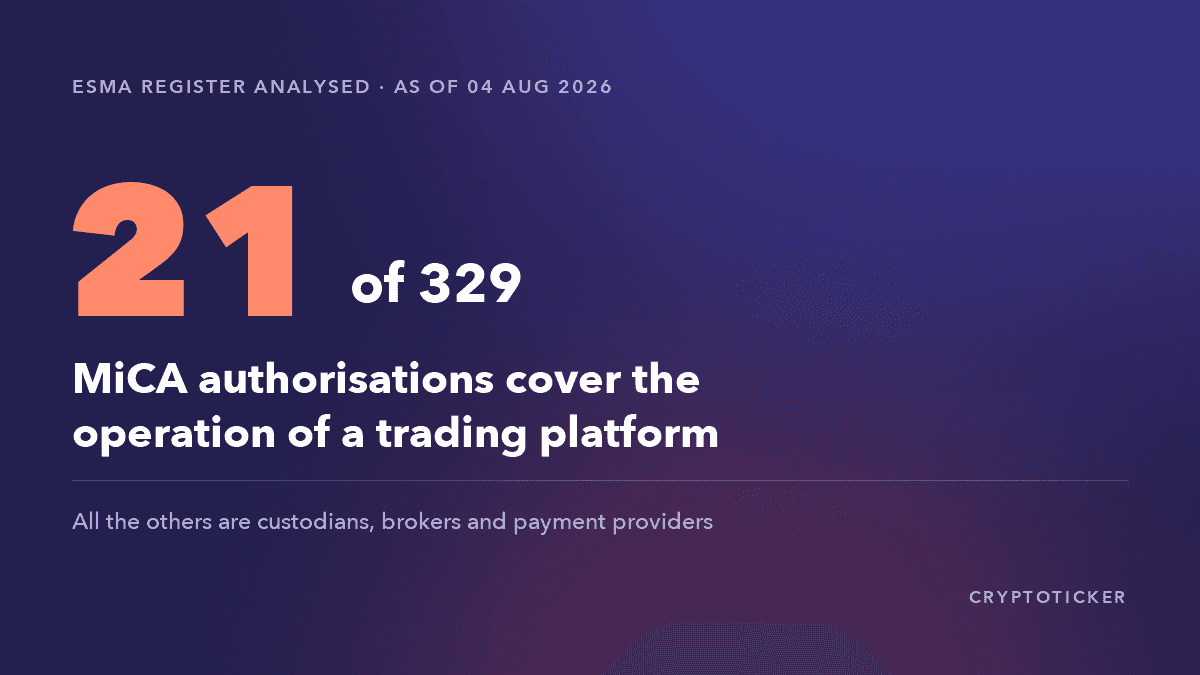
MiCA Register 2026: Only 21 of 329 Licences Are Real Exchanges
ESMA publishes the register of MiCA-authorised providers as an open file. We worked through all of it — and the result is not what the phrase “licensed crypto exchange” suggests.

June 30, 2026 11:20 PM

How to Switch from Binance to a MiCA Regulated Crypto Exchange
Binance is winding down EU services after missing the MiCA deadline. Here's why it's happening and how to move your funds to a regulated platform safely.
September 10, 2026 1:21 AM
Crypto Exchanges Head to Head: Which Pairing Is Cheaper Where
Before opening an account, the question is rarely which exchange is best overall, but whether it should be this one or that one. This article sorts through the most searched head-to-heads, puts the cost per 1,000 euros side by side and explains the most expensive mix-up: one provider with two interfaces and a factor of seventeen between them.
September 25, 2026 4:13 PM
Crypto Exchange Protection Funds Recalculated: What Really Covers Your Balance After the Bitget Hack
The $351.6 million attack on Bitget would eat up three quarters of the exchange's in-house protection fund. We retrieved the protection promises of several exchanges ourselves and measured them against deposit insurance and MiCA liability.
September 20, 2026 4:19 AM

Russia Sanctions and Crypto: Why October 18, 2026 Becomes the Deadline
The signature under H.R. 5334 starts a 30-day clock: by October 18, 2026 the US administration has to set how high the tariffs against Russia will be. What the act says, by what route it reaches Bitcoin, and what you can check before then.

July 7, 2025 8:12 PM
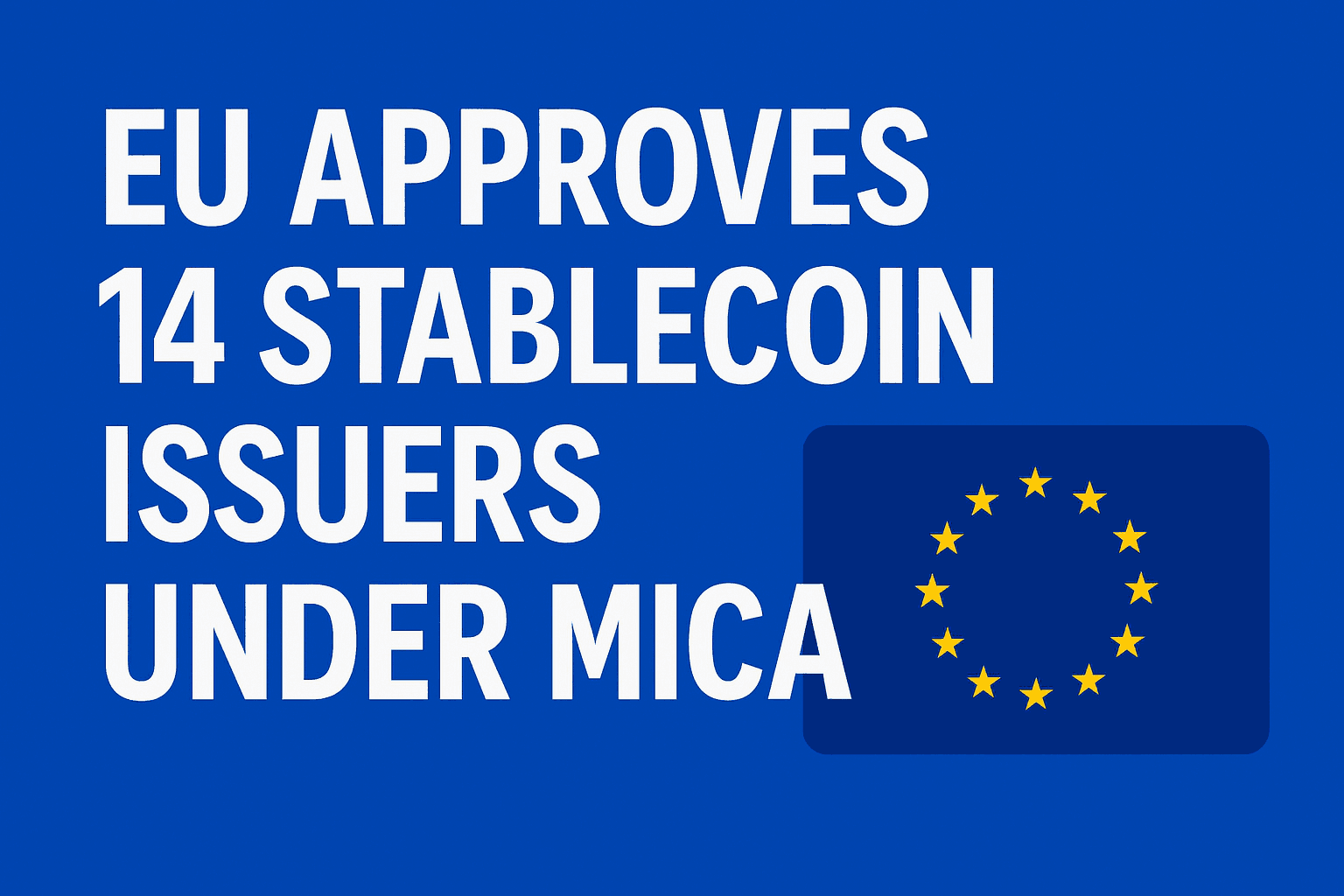
BIG Crypto News: EU Approves 14 Stablecoin Issuers Under MiCA
Six months into the MiCA rollout, Europe’s crypto regulatory landscape is taking shape. From authorized stablecoin issuers to licensed crypto service providers, here’s the full July 2025 update.
October 2, 2026 10:46 AM
3 Details Are All It Takes: How SIM Swapping Reaches Your Crypto Account
Fraudsters have a new SIM card activated in your name at the mobile operator and intercept every SMS code with it. How the attack on your crypto account unfolds and which settings make it run into the void.
September 29, 2026 10:33 AM
ESMA puts reverse solicitation on its 2027 watch list: what investors need to know about exchanges without an EU licence
ESMA presented its work programme for 2027 on September 28, 2026 and made reverse solicitation a supervisory priority. What that means if your coins sit with a provider without EU authorisation, and which three steps make sense now.
August 27, 2026 7:29 AM
Dust Attack on Kraken: Why 12,000 Tiny Deposits Froze Customer Accounts
Between August 17 and 24, Kraken received almost 12,000 tiny amounts from wallets that analytics services attribute to the sanctioned exchange HTX. The automated sanctions screening then froze the accounts of customers who had nothing to do with it.
July 10, 2026 10:30 AM
Binance Reveals Where Its EU Users Went After MiCA
Binance just revealed where most departing EU users moved their crypto after MiCA — and the answer is raising hard questions about the new rulebook.
June 26, 2026 5:35 PM
Binance Is Leaving the EU on July 1 — What It Means for Your Funds
Binance will stop serving EU customers from July 1 after failing to secure a MiCA licence. Here's what it means for your funds and your next move.

September 26, 2026 7:40 AM
The RAIN Token After the Enlivex Termination: What to Check on Access, Forced Sale and Holding Period
Enlivex terminated a share placement of 66,666,667 shares payable in RAIN tokens on September 22, 2026. The token sits 46.4 percent below its all-time high, and at Kraken the withdrawal deadline expired long ago.
September 26, 2026 4:21 AM
Operation Herakles disconnects 13,888 phone numbers: what to check on crypto investment calls
Six authorities have disconnected 13,888 phone numbers used by investment fraudsters to call their victims in Operation Herakles, 9,304 of them in the past three months alone. What the Federal Network Agency now requires of telecoms providers and which three checks protect you from the scheme.
August 21, 2026 10:27 AM
Complaining About a Crypto Exchange: the Deadlines Article 71 MiCAR Sets and Why BaFin Will Not Decide Your Case
Authorised crypto providers have to run a formal complaints procedure, and Delegated Regulation (EU) 2025/294 sets a hard limit of two months for it. Our own analysis of the ESMA list shows at the same time that no complaints link is on file for Germany to this day.
August 15, 2026 9:31 PM

Crypto Exchange Shutting Down: What to Do Before the Deadline Passes
Binance, BitMart, Luno and Revolut have ended or cut back their European business within seven weeks. This guide shows which deadline expires first, how a forced sale is treated for tax, and what to secure before the account closes.
October 3, 2026 1:56 PM

Stellar Drops a Good 5 Percent, Altcoin Exchange Deposits at Their Highest Since October 2025: Why XLM Is Falling
Stellar falls to around $0.214 on October 3, 2026, without any bad news of its own. The documented background is a wave of deposits to trading venues that CryptoQuant puts at the highest level since October 2025.
October 1, 2026 4:21 AM

Velocity Replaces Drift After the 285 Million Dollar Hack: What Changes for Investors in Germany
The Solana perp DEX Drift is back as Velocity, and since September 29, 2026 a new team has been running it. What the overhaul after the outflow of 285 million dollars means for your deposits, for settlement in USDT and for the legal position in Germany.
September 29, 2026 10:14 AM
387.5 million dollars at Bitget: the attack ran through a bought-in security product, what to watch now
Bitget has disclosed how the attackers reached its withdrawal systems on September 24: through a previously unknown flaw in a security product it had bought in. The second stage of the withdrawal schedule opens today at 08:00 UTC, and for the balance you keep on any exchange the case changes the arithmetic.
September 24, 2026 1:11 PM
Stellar Becomes a Payment Rail at Mastercard's BVNK: What XLM Holders Should Check on Buying Route, Memo and Holding Period
BVNK has switched on Stellar as a payment rail for business customers in more than 130 countries. On the same trading day XLM falls by around seven percent — we separate what the news means from what the pullback means for your portfolio.
September 24, 2026 10:12 AM

XRP Falls 9.7 Percent: What to Check on Holding Period and Buying Route
XRP is down around 9.7 percent on the morning of September 24, twice as much as the typical large crypto asset. Our count of 18 coins shows who the pullback hits and which three things hold true regardless of the price.
September 22, 2026 4:33 PM

Three of the 25 Largest Coins Have No Euro Pair: How to Check Your Buying Route Before the Order
Our own survey of five trading venues active in the EU, taken on September 22, 2026, shows that three of the 25 largest cryptocurrencies have no euro pair there at all, and four more only one. What that means for your next order and what the detours cost.
September 15, 2026 10:12 AM
CoinEx Is Shutting Down: The Deadline to Withdraw Your Balance
Crypto exchange CoinEx is winding down and the withdrawal channel closes on December 22, 2026. Our own measurement on the day of the first wind-down stage shows which 37 currencies cannot be withdrawn right now and why the chain you pick decides a double-digit percentage of your residual balance.
More from CryptoTicker