
Bitget Withdrawals Resume on September 28: What to Check on a Residual Balance Now
Bitget is releasing the withdrawals frozen after the September 24 incident in four stages from September 28. For a residual balance held from Germany that is a deadline, not a reason to wait.




Which topics should we dive deeper into?
Select what genuinely interests you. Your picks feed directly into our editorial planning.
Crypto news that's actually worth your time.
Weekly. 60 seconds. Carefully curated by our editors: no hype, no promo flood, no spam.
When a crypto exchange halts withdrawals, the question that matters to you is rarely how the attack worked in technical terms. What matters is when your balance can move again, and in which order. Since September 26, 2026 there is an answer: Bitget has published a staggered schedule that begins on September 28 with Bitcoin and ends on October 2 with fiat money and the remaining tokens.
For investors in Germany a second circumstance applies, and it barely features in the international coverage: Bitget has not served the German market on a regular basis since January 2026 and lists Germany as a restricted country in its own terms of use. Anyone who still holds a residual balance there gets a window with this schedule, and it is worth knowing about.
Bitget Withdrawals from September 28: The Schedule by Network and Time
The exchange has split the resumption into four stages, each starting at 08:00 UTC, which is 10:00 in German summer time. Bitcoin goes first, on the Bitcoin network, on September 28. Ether follows a day later, across the Ethereum, BNB Smart Chain, Arbitrum, Base and Optimism networks. USDT is released on September 30, via Ethereum, BNB Smart Chain, Solana and Tron. Last, on October 2, come the remaining tokens, fiat withdrawals and peer-to-peer trading.
A network here is the transfer route a balance uses to leave the exchange. The same coin can run over several networks, and each has its own fees, its own address formats and its own confirmation times. The staggering therefore means more than waiting for a calendar day: your preferred transfer route may only arrive in a later stage.
Trading and deposits continued throughout the freeze, according to the exchange; withdrawals alone were affected. Bitget also states that account balances remained unchanged and that the freeze was purely a security measure. That is the company's own account, and it becomes verifiable only once the first stage actually runs.
What Happened on September 24: $387.5 Million and a Spoofed Authorisation Path
On September 24, 2026 crypto assets left several of the exchange's wallets without authorisation. The company dates detection to 18:31 UTC. The damage was first put at around $351.6 million and later revised upwards to $387.5 million; both figures are in circulation side by side, depending on the state of the analysis. According to the company, hot and warm wallets were affected, while the holdings kept offline remained untouched.
A hot wallet is a wallet whose keys stay permanently connected to the internet so that withdrawals can run automatically. That availability is exactly where its risk lies. Chief executive Gracy Chen told CoinDesk that private keys had not been compromised; instead the attackers had taken over a wallet backend, spoofed transaction data and thereby triggered the exchange's regular release process. Ten crypto assets across several networks were affected, among them XRP, Ether, USDT, Zcash, USDC, BNB, Avalanche and TRX. The largest single item, according to the breakdown, was around 102.93 million XRP.
The exchange states that the underlying vulnerability has been confirmed and fixed. Mandiant, Google's security arm, and SlowMist are involved in the forensic work, according to the company. Bitget has also announced a bounty programme: five percent on funds successfully frozen and five percent on funds successfully recovered, with measures ordered by courts or authorities excluded. Chief executive Chen has announced a public question-and-answer session for September 28 at 07:30 UTC.
Why Bitcoin Is Released First and Fiat Money Last
The order looks arbitrary, yet it follows technical complexity. Bitcoin runs over a single network with a single address format and no smart contracts. A release can be switched back on there and observed with a manageable amount of checking. Ether and USDT hang off several chains at once, each with its own contract code and its own signature logic. Fiat withdrawals, finally, run through banking partners whose review processes the exchange does not control on its own.
In practice: the further back your asset sits in the schedule, the longer it stays exposed to the risk that the opening gets postponed. If you can choose which asset to pull out first, factor that order into your planning instead of waiting for the one stage that serves your favourite network.
 Licensed crypto exchanges at a glance
Germany Is a Restricted Country at Bitget: What That Means for Your Residual Balance
This point decides whether you need to act. Bitget closed new registrations for users resident in Germany on January 16, 2026, and the company's terms of use, last updated on September 15, 2026, list Germany as a prohibited country. You cannot open a new account there in any case. The schedule is therefore relevant to one particular group: everyone holding a legacy account with a residual balance who has not cleared it yet.
For that group the resumption is a deadline rather than good news. A provider that itself lists your country of residence as restricted is no place to leave a balance permanently. The action here is to use the release and pull the holding out. Waiting for normal operations to return is the weaker course. If you need a new trading venue anyway, it is worth looking at our overview of the best crypto exchanges beforehand, because you should have the destination address ready before September 28 and not once the window is already open.
No MiCA Licence: Why the European Liability Rule Does Not Apply Here
MiCA is the European regulation on markets in crypto assets. It requires a provider serving customers in the EU to be licensed for it, and it ties liability for customer assets held in custody to that licence. The sentence that matters to you: this liability hangs on the licence. Where the licence is absent, so is the claim the regulation would otherwise grant.
As of September 25, 2026 Bitget is not entered in the relevant European register. The company has filed an application with the Austrian financial market authority through its EU entity and confirmed this on July 2, 2026. An application, however, is not a permission. The transition period during which providers in the European Economic Area were allowed to continue without a licence of their own expired on July 1, 2026. What the duties of a licence involve in concrete terms is something we have set out in our overview of the MiCA obligations for crypto companies.
None of this amounts to a judgement about the company's intentions. It does amount to a sober reading of your position: if something goes wrong at an unlicensed provider, you depend on its voluntary undertaking, with no European liability claim behind you. Enforcement would, in case of doubt, have to be pursued where the company is based.
The Protection Fund Covers the Damage, but Is Largely Used Up by It
Bitget points to an in-house protection fund and states that it covers the financial consequences of the incident. On September 24 the fund was put at more than $464 million. Set against the revised damage figure of $387.5 million, this single incident claims around 84 percent of the cushion.
Such a fund is a voluntary promise by the company. It is not a statutory deposit guarantee. The German deposit guarantee of up to 100,000 euros applies to bank balances; crypto assets on a trading platform fall outside it. How robust protection promises of this kind are across the industry is something we calculated for several exchanges in a survey of our own on September 25. The short version: a fund held in crypto assets shrinks in exactly the market conditions in which it is needed.

Preparing a Bitget Withdrawal: Check Network, Address and Fees Before September 28
The stages open at 08:00 UTC, and experience suggests the rush is heaviest in the first hours. Three things should be done beforehand, because there will be no calm moment to sort them out once the window is open.
First, the destination address. It has to match the network released in your stage. A withdrawal over a network your destination wallet does not support is the most common way to lose a balance permanently. Second, the verification of your account: if two-factor protection sits on an old device or an identity check is outstanding, that costs you exactly the time you do not have. Third, the fees, which differ markedly between networks and which on small holdings can decide the route you take; how withdrawal fees and network fees differ is something we have broken down elsewhere.
One note on scale: on September 26, 2026 Bitcoin was trading at roughly $84,100, Ether at roughly $2,690 and XRP at roughly $1.55 (source: CoinGecko). Knowing what your residual holding is worth makes it easier to judge whether a withdrawal over an expensive network is worth it at all.
 Hardware wallets compared
Self-Custody or Another Trading Venue: Where the Balance Goes After the Release
There are two serious options for the destination, and they differ less in effort than in the question of who holds the key. With self-custody the private key is yours, and so is sole responsibility: if the backup is lost, nobody can help you. In exchange there is no longer an operator whose wallet backend someone could take over. Which devices are suitable and how they differ is shown in our hardware wallet comparison.
The second option is a trading venue licensed for the German market. The advantage sits in the legal framework: at a licensed provider the duties arising from MiCA genuinely stand on your side. Convenience has little to do with it. Anyone who wants to keep trading after the withdrawal will be doing so on a different footing than before.
A third variant, simply leaving the balance where it is and waiting, is the weakest option at a provider without a licence for your country of residence. It relies on everything going well, with no claim to fall back on if it does not.
Tax in Germany: Why Moving to Your Own Wallet Does Not Break the Holding Period
A widespread misconception keeps people from moving their balance. The one-year holding period under section 23 of the German Income Tax Act attaches to the moment of acquisition. Where the asset is stored does not enter into it. A transfer from an exchange to your own wallet is no disposal, so it neither triggers a taxable event nor restarts the period. Selling on the exchange in order to have euros paid out is a disposal, with all the tax consequences that follow.
In practice: simply pulling your holding out is unproblematic for tax purposes. Documentation does matter, though. When an exchange suspends withdrawals and later merges data retrospectively, the acquisition date and acquisition cost are not always cleanly traceable from the export history. Download your account's transaction history before you move the balance, and not months afterwards.
Marks and Thresholds: How to Tell Whether the Schedule Holds
Three observable points tell you more than any announcement. The first is September 28 at 08:00 UTC: if the Bitcoin stage starts on time and without a further interruption, that is a solid sign the remaining stages will follow. The second is September 30 with USDT, because stablecoin outflows are typically the largest and put the heaviest demand on liquidity. The third is October 2 with fiat money and peer-to-peer, because banking partners have to play their part there.
If one of these stages is postponed or opened only partially, with amount caps for instance, that is the information that counts. A cap does not break the promise, but it does extend your wait, and it indicates how tight liquidity actually is. In the other direction: a stage that starts without caps and without delay defuses the obvious worry that the withdrawal freeze was more than a security measure.
Checking Bitget Withdrawals: What to Take Away
- Check today whether you still hold anything there at all. Log in, look at the balance and the status of your two-factor protection, and download the transaction history. If you then need a new trading venue, pick one before September 28 from our overview of the best crypto exchanges.
- Set up the destination address before your network is released. Address and network have to match; test them with a small amount as soon as your stage is open. For storage outside an exchange over the long term, our hardware wallet comparison helps with the choice of device.
- Document the process for your tax return. The transfer to your own wallet is no sale, but you do have to be able to carry the acquisition date and acquisition cost forward. A tool from our overview of crypto tax tools and portfolio trackers takes the merging off your hands.
Further reading: the schedule with all stages and networks at The Crypto Times, and the chief executive's account of the attack route at CoinDesk.
(As of September 26, 2026. This article is not investment advice. Prices and fee structures change; check the terms with the provider before you buy.)
Transparency note: This article was produced with the assistance of artificial intelligence and reviewed by our editorial team before publication. All figures and claims were checked against the primary sources linked in the text. The feature image was generated with AI.
Related articles
- 387.5 million dollars at Bitget: the attack ran through a bought-in security product, what to watch now
- MEXC Refunds $340,000: The Attacker's API Key Survived the Account Freeze
- Crypto Exchange Shutting Down: What to Do Before the Deadline Passes
- Bitget Hack of $351 Million: What to Check at Your Crypto Exchange Now
- Kraken: 45 coins are on cancel only, 21 were announced – what to check when trading pairs are blocked
Which topics should we dive deeper into?
Select what genuinely interests you. Your picks feed directly into our editorial planning.
Crypto news that's actually worth your time.
Weekly. 60 seconds. Carefully curated by our editors: no hype, no promo flood, no spam.

August 30, 2026 10:38 PM
Crypto Cards: Where Your Card Balance Really Sits and What the August 28 Solana Exploit Reveals About It
An attack on a card balance contract on Solana took the loaded balance from 1,685 users while their wallets stayed untouched. The case shows why it matters whether your crypto card holds funds as e-money at a licensed institution or in a smart contract.
August 20, 2026 4:20 AM

Crypto Exchange Delisting: What Happens to Your Tokens When Trading and Withdrawals Close
A delisting runs in four stages, and only one of them is genuinely dangerous: the end of the withdrawal deadline. Using two live OKX dates as the example, we show what happens at each stage and how to tell whether it affects you.
September 5, 2026 10:33 AM
ZIL Withdrawals Frozen: Why Your Zilliqa Balance Is Stuck After the Hard Fork
The Zilliqa hard fork of September 2, 2026 moved the ZIL balances of ten exchanges to new addresses. Three days later, deposits and withdrawals were still halted at the three venues we checked: what that means for your balance, what self-custodians are waiting for, and why the announced compensation is not a decision yet.
September 3, 2026 4:41 AM
Kraken Delists 21 Tokens: Trading End on September 11 Has Passed, Withdrawals Run Until December 10
As of September 27, 2026: Kraken had set the end of trading and deposits for 21 cryptocurrencies for September 11, 2026 at 14:00 UTC, and that date has passed. According to the exchange, withdrawals remain possible until December 10, 2026 at 15:00 UTC. Our September 3 survey showed that none of these tokens could be deposited at Bitvavo, Coinbase or Bitstamp.
September 16, 2026 7:39 PM
Deutsche Bank to Custody Bitcoin and Ether: Why Retail Clients Are Missing and What to Check in Your Own Custody
Deutsche Bank will custody Bitcoin, Ether and three stablecoins, but addresses corporates and institutions only. What the launch under supervisory reservation means, and the four questions you should put to any custody arrangement.
September 16, 2026 1:28 PM
Crypto Withdrawal to Your Own Wallet: Ten Providers Checked, Three Will Not Let Your Coins Out
Seven of ten providers available in Germany offer a payout to a wallet address you control yourself; three do not. Our survey of September 16, 2026, shows how to spot the difference before you buy, and why the question matters right now.
August 11, 2026 9:18 AM

Your Crypto Exchange Is Telling You to Withdraw: How to Spot Phishing After the MiCA Deadline
Unauthorised crypto providers now have to tell their EU customers to withdraw, which leaves fraudsters an easy run with faked requests. Here is how to check in two minutes whether the message is genuine.
August 21, 2026 4:17 PM

Crypto Withdrawals to Your Own Wallet: Why Exchanges Demand Proof of Address Ownership Above €1,000
Above €1,000 your provider has to establish whether the destination address really belongs to you. Article 14(5) of the transfer of funds regulation, five permitted methods, and the reason a withdrawal stalls without this step.

July 10, 2026 10:30 AM
Binance Reveals Where Its EU Users Went After MiCA
Binance just revealed where most departing EU users moved their crypto after MiCA — and the answer is raising hard questions about the new rulebook.
September 27, 2026 4:11 PM
Ripple Cannot Freeze 83 Million Dollars in Stolen XRP: What to Check in Custody and Deposits
The attacker from the Bitget incident has moved around 83 million dollars in XRP, and Ripple has no technical means to stop it. What can be frozen, what cannot, and why an account freeze also hits investors with no connection to the case.
September 25, 2026 4:13 PM
Crypto Exchange Protection Funds Recalculated: What Really Covers Your Balance After the Bitget Hack
The $351.6 million attack on Bitget would eat up three quarters of the exchange's in-house protection fund. We retrieved the protection promises of several exchanges ourselves and measured them against deposit insurance and MiCA liability.
August 21, 2026 4:27 PM

Wallet App Without BaFin Authorisation: When Holding Crypto-Assets Requires a Licence
On 19 August 2026 BaFin published two consumer notices on wallet offerings. Who controls the means of access decides whether an authorisation is needed.
September 30, 2026 10:24 PM

$766 Million Lost to Crypto Hacks in One Month: What It Means for Your Custody
CertiK counts around $766.4 million in damage for September 2026, the highest monthly figure of the year. Two incidents carry more than 92 percent of it, and both hit a place where your balance could be sitting too.
September 29, 2026 10:28 PM

Customers Pull $463 Million From Bitget: The Consequences for Reserves and Custody
After the attack of September 24, customers pulled around $463 million out of Bitget within a day, the largest single-day outflow since DefiLlama began tracking reserves. The user protection fund fell from $464 million to below $200 million in the process.
October 2, 2026 4:32 AM
NEAR Intents halts withdrawals after a $3.8 million exploit: here are the reasons
NEAR Intents confirms an exploit of more than $3.8 million and holds deposits and withdrawals on eleven networks. Reimbursement is promised, a date for it is not.

July 2, 2026 8:59 PM
Binance Is Out of the EU: How to Move to a MiCA-Regulated Exchange
Binance has left the EU market. Which exchanges hold a MiCA licence, how to verify an authorisation is real, and how to move your holdings across step by step.
September 30, 2026 4:15 PM
Zcash today: 2,746 ZEC from the Bitget hack vanish into the Ironwood pool
Wallets from the Bitget break-in pushed 2,746 ZEC into Zcash's Ironwood pool on Wednesday morning, roughly $3.9 million. What the shielding means for tracing, and what applies to your exchange account from July 2027.
September 27, 2026 4:32 AM
Hester Peirce Leaves the SEC: What Now Applies to Your Custody in Germany
The most crypto-friendly voice at the US securities regulator goes on October 2, 2026, and the commission shrinks to two members. For investors in Germany it is still the European rulebook that decides, and there a deadline falls in July 2027.
September 20, 2026 10:11 PM
Kraken Review: Fees, MiCA Licence and Withdrawals in Euro
A purchase through Kraken's standard interface costs 1 percent plus spread; on Kraken Pro it is 0.40 to 0.80 percent. What deposits, trading, withdrawals and tax records really cost at the crypto exchange, with the numbers from the official fee schedule.
September 7, 2026 7:26 PM
Stolen Keys Beat Code Flaws: Why the Private Key Is the Way In for 2026 Crypto Hacks
Compromised private keys overtook smart contract code flaws as the most common attack route for the first time in 2026. What sits behind the shift, and how to check your own setup for its single point of failure.
September 4, 2026 10:26 PM

Pocket Bitcoin Data Breach: When Name, Home Address and Bitcoin Address Circulate Together
The Swiss Bitcoin service Pocket Bitcoin closed its investigation on September 3, 2026: 5,411 people affected, and for 291 of them the Bitcoin addresses they used along with copies of identity documents. Why this one data pairing has lasting effect, and what you should check with your own provider.
September 4, 2026 10:17 AM
Cypher Shutdown on September 6: What Users Should Know Now the Withdrawal Deadline Has Passed
Recap as of September 27, 2026: Cypher had announced it would take its app, dApp and withdrawal window offline on September 6, 2026 and end the token protocol. This article describes the situation before the deadline, how the payout worked and what our own measurement showed at the time about what was left of the CYPR token.
August 23, 2026 4:25 AM
Crypto Exchange Closure: What Happens to Your Residual Balance and When the Fee Starts
When a crypto exchange stops operating, trading ends on a set date but the account does not. Anyone leaving a residual balance behind now pays a monthly fee at the wind-downs currently under way.
August 22, 2026 10:37 PM
Transferring Delisted Tokens: 16 of 21 Kraken Assets Have No Fallback Exchange
On 27 August at 14:00 UTC Kraken closes withdrawals for 21 delisted tokens, and from 1 September the exchange sells the remainder itself. Our count of 34 tokens against six venues shows which assets still have a transfer destination at all.
September 7, 2026 10:11 PM
Withdrawals suspended: what 136 incidents on nine crypto exchange status pages reveal about your coins
Between August 1 and September 7, 2026, nine status pages run by crypto exchanges and wallet providers reported 136 disruptions, and almost every second one involved deposits or withdrawals. Fourteen suspensions are still running, the oldest since August 10.
August 6, 2026 3:05 PM
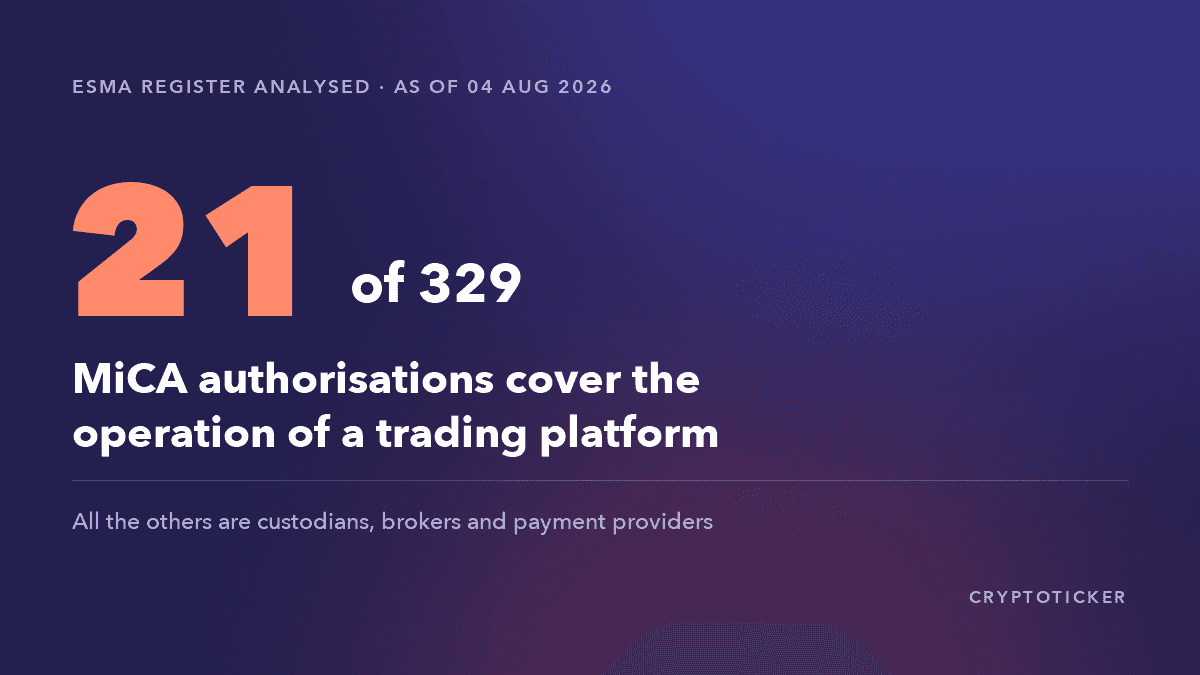
MiCA Register 2026: Only 21 of 329 Licences Are Real Exchanges
ESMA publishes the register of MiCA-authorised providers as an open file. We worked through all of it — and the result is not what the phrase “licensed crypto exchange” suggests.
September 27, 2026 4:20 PM

Bybit's Counterparty List Runs to Over 50 Names: What to Check on Balances, Withdrawals and Custody
Bybit has published a list of more than 50 platforms, services and organisations whose involvement can, under its own rules, lead to an account freeze. What decides the outcome is not your next trade but the payment history you already have.
More from CryptoTicker