
Binance Buys Into Circle: What the USDC Deal Means for Your Balance
Binance is taking a $100 million stake in Circle and extending the USDC agreement by five years. For investors in Germany, the sum matters less than the question of who earns money from stablecoins left sitting idle.




Which topics should we dive deeper into?
Select what genuinely interests you. Your picks feed directly into our editorial planning.
Crypto news that's actually worth your time.
Weekly. 60 seconds. Carefully curated by our editors: no hype, no promo flood, no spam.
Binance has taken a $100 million stake in Circle, the company behind the stablecoin USDC, and extended the cooperation between the two firms by five years. Circle announced the move on September 22, 2026 in its own pressroom. For you as an investor in Germany, this changes neither the price of your holdings nor the route by which you buy them. Something else has shifted: who earns money from stablecoins sitting idle.
Binance and Circle: what the $100 million stake actually involves
The transaction consists of two separate parts published on the same day. The first is an equity investment: Binance subscribed for Class A shares in Circle through a private placement, around 1.24 million of them at $80.84 each according to CoinDesk. Circle’s own statement puts the purchase price 5 percent below the market price of the share before completion. The sale closed on September 17, 2026, five days before the public heard about it.
The second part is a five-year supply and marketing agreement. It replaces two earlier arrangements between the two companies dating from November 2024 and August 2025. Binance may not resell, pledge or hedge its shares for up to two years; Circle cites the customary industry exceptions, such as transfers within the group.
Jeremy Allaire, co-founder and chief executive of Circle, speaks in the statement of using USDC to broaden access to the dollar and to reach people and businesses in emerging markets. Richard Teng, co-chief executive of Binance, puts it this way: a stable, reliable digital dollar should not be a privilege but should be open to anyone who owns a phone. Both sentences promote the same goal, and neither says anything about what the contract means commercially.
The monthly incentive fee: why Circle pays for USDC balances
The commercial core sits in the filing with the US Securities and Exchange Commission that CoinDesk quotes. Under it, Circle pays Binance a monthly incentive fee calculated as a percentage of the USDC held through Circle’s wallet service. The more digital dollars sit idle in that environment, the more money flows to the trading platform.
Behind this lies a business model that many stablecoin users underestimate. An issuer such as Circle holds backing for every USDC in issue in short-dated US government bonds and bank balances. The interest on that is kept by the issuer. The holder of the token receives none of it; what the holder receives is stability, not a return. Part of that interest stream is now passed on to whoever gathers the balances.
The sober conclusion for you: a stablecoin sitting in an exchange account is a source of income for the exchange. That is neither disreputable nor new, but it explains why trading venues advertise so persistently for balances to be left with them between two trades.
USDC against USDT: how market shares stand in September 2026
A look at the relative sizes puts the deal in context. According to CoinGecko data from September 22, 2026, USDC had a market capitalisation of around $74.8 billion on daily turnover of some $20.8 billion. At the same moment Tether stood at around $183.4 billion in market capitalisation and roughly $81.7 billion in daily turnover. USDT therefore remains a good two and a half times the size of USDC.
That gap is precisely why Circle is prepared to pay for distribution reach. Binance is the largest trading venue in the industry, and in many emerging markets access to the dollar runs through platforms of this kind rather than through banks. Whoever sets the standard there sets it for years.
For a sense of scale: Bitcoin traded at $86,263 on the same reference date and reached a market capitalisation of around $1.73 trillion. The entire USDC supply therefore amounts to roughly 4 percent of what sits in Bitcoin.

Buying USDC in Germany: which routes MiCA leaves open
This is where the news and your own reality part company. Binance has withdrawn from retail business in the European Union; the new agreement with Circle expressly targets emerging markets rather than Europe. For an investor resident in Germany, the route to a purchase therefore remains unchanged.
In practice that means you obtain USDC through trading venues and brokers authorised for the European market. The Federal Financial Supervisory Authority maintains registers of authorised providers, and authorisation under the EU regulation on markets in crypto-assets has been the entry ticket since the German transition period ended. Which firms actually hold that authorisation is shown in our comparison of regulated crypto exchanges.
Check three points before your first purchase: whether the provider appears in the register of the competent supervisor, which currency the account is settled in, and what spread between the buying and selling price you are charged when converting euros into USDC. In practice the third point often costs more than the stated trading fee.
 Regulated crypto exchanges compared
The MiCA interest ban under Article 50: why you earn no interest on USDC
The incentive fee Circle pays Binance would not be possible in this form towards a European retail customer. EU Regulation 2023/1114 on markets in crypto-assets expressly prohibits, in Article 50, issuers of e-money tokens and crypto-asset service providers from granting interest to holders of such tokens. For asset-referenced tokens the same prohibition sits in Article 40.
E-money tokens are, under that regulation, crypto-assets intended to maintain a stable value by referencing a single official currency. USDC falls into this group because it is pegged to the US dollar.
The ban is addressed to issuers and service providers, not to a counterparty in wholesale business. A payment from Circle to a trading platform is not interest paid to a token holder. So the position for you stands: within the authorised European framework there is no stablecoin variant on which anyone may pay you a running yield. How providers try to work around this ban through reward and cashback schemes is something we took apart using the example of the USDT cashback card.
If you come across an offer quoting a fixed percentage on stablecoin balances, read up on who the counterparty is and where it is based. As a rule the service is then provided not by the issuer but by a company outside the European supervisory framework, and your balance is lent out in return.
Tax on stablecoins: what Section 23 EStG triggers when you swap USDC
A widespread misconception holds that a stablecoin is cash for tax purposes. It is not. From the perspective of German tax law, USDC is another economic asset, and every swap is a disposal within the meaning of Section 23 of the Income Tax Act.
Three things follow for your records. First: if you swap Bitcoin into USDC, you realise a gain or a loss at that point, even though you never saw a euro. Second: if more than a year lies between acquisition and disposal, the gain remains tax-free. Third: an exemption limit of 1,000 euros applies to the total of all private disposal transactions in a year; once it is exceeded, the entire amount is taxable, not merely the excess.
The dollar exchange rate against the euro runs alongside all of this. Holding USDC over months means carrying a currency risk that shows up in the euro result even though the token stays stable against the dollar. The only way to keep this clean is a gapless record of every swap.
Issuer risk and custody: what happens if the issuer fails
A stablecoin is a claim. Its value depends on the issuer maintaining the backing and redeeming the token at par at any time. In March 2023, USDC briefly lost its peg to the dollar because part of the reserves sat at a US bank in difficulty. The price recovered within days, yet the episode remains the clearest lesson available in what issuer risk means.
The MiCA regulation drew conclusions from it and requires issuers of e-money tokens to hold the backing separately and to deposit part of it with credit institutions. How contested the precise design of that reserve duty currently is can be seen in the running debate about the bank deposit requirement for stablecoin reserves.
For your own arrangements, the question that remains is where the token sits. In an exchange account you additionally carry the platform risk; in a self-managed wallet you carry responsibility for the key. Both have a price, and both should be a deliberate decision rather than a state of affairs that simply came about.

Binance without EU access: why the deal does not change how you buy
The reach Circle is buying lies outside Europe. Binance no longer serves European retail customers on the former scale, and the five-year agreement names emerging markets expressly as its target. Anyone holding USDC in Germany will notice nothing of this partnership day to day.
Indirectly the step still matters. A stablecoin lives on liquidity: on there being counterparties everywhere willing to take it at par. If USDC keeps growing through the world’s largest trading venue, it also becomes tradable in greater depth on European venues, because market participants balance globally. That is a slow effect rather than an event that shows up in the price on any single day.
 Keep your crypto tax under control
Three markers that will show you what happens next
A stablecoin has no price to point the direction. The matter can still be watched, and it comes down to three figures.
The first is the market capitalisation of USDC, around $74.8 billion as of September 22, 2026. A marked rise over the coming months would mean the distribution agreement has worked. The second is the gap to Tether, currently around $183.4 billion; if it narrows, the industry is shifting. The third is the deviation from the dollar: USDC traded at $0.9999 on the reference date. A lasting discount of more than half a percent would be the signal that genuinely deserves attention.
All three figures come from CoinGecko and can be looked up there at any time. For the European part of the story, the list of authorised providers says more than any price: who gains authorisation and who loses it decides where you will still be able to buy in a year’s time.
Checking the USDC deal: what to take away
The news itself requires nothing of you. The episode does serve as an occasion to look at three things that are due anyway.
- Check where your stablecoin sits and who earns from it. If the balance sits permanently in a trading account between two trades, you carry the platform risk and the venue takes the income. Whether your provider is authorised for the European market is shown in the overview of crypto exchanges.
- Put your records for Section 23 EStG in order. Every swap into and out of USDC is a disposal with an acquisition date of its own. Reconstructing that in the spring usually costs money; a suitable tool can be found in the comparison of crypto tax software.
- Decide on custody deliberately. For amounts you will not move for some time, self-custody is the more sober choice, provided you are confident handling the key. Which devices are up to the job is set out in the hardware wallet comparison.
Sources for further reading: the Circle statement of September 22, 2026 and Regulation (EU) 2023/1114 in full text on EUR-Lex.
(As of September 22, 2026. This article is not investment advice. Prices and fee structures change; check the terms with the provider before you buy.)
Transparency note: This article was produced with the assistance of artificial intelligence and reviewed by our editorial team before publication. All figures and claims were checked against the primary sources linked in the text. The feature image was generated with AI.
Related articles
- SoFi Settles Card Payments in Stablecoin: What Cardholders Should Check
- Revolut Delists USDT: Forced Conversion on August 31, 2026 Counts as a Sale
- Solana DEX Trades Overtake the NYSE: What to Check on Swaps, Tax and Oversight
- Circle Lends Against Bitcoin via cirBTC: Why the Wrapper Can Cost You the German Holding Period
- Tokenized Stocks and Tax in Germany: When the One-Year Holding Period Applies and When the Flat Tax Bites
Which topics should we dive deeper into?
Select what genuinely interests you. Your picks feed directly into our editorial planning.
Crypto news that's actually worth your time.
Weekly. 60 seconds. Carefully curated by our editors: no hype, no promo flood, no spam.

June 7, 2025 12:19 PM
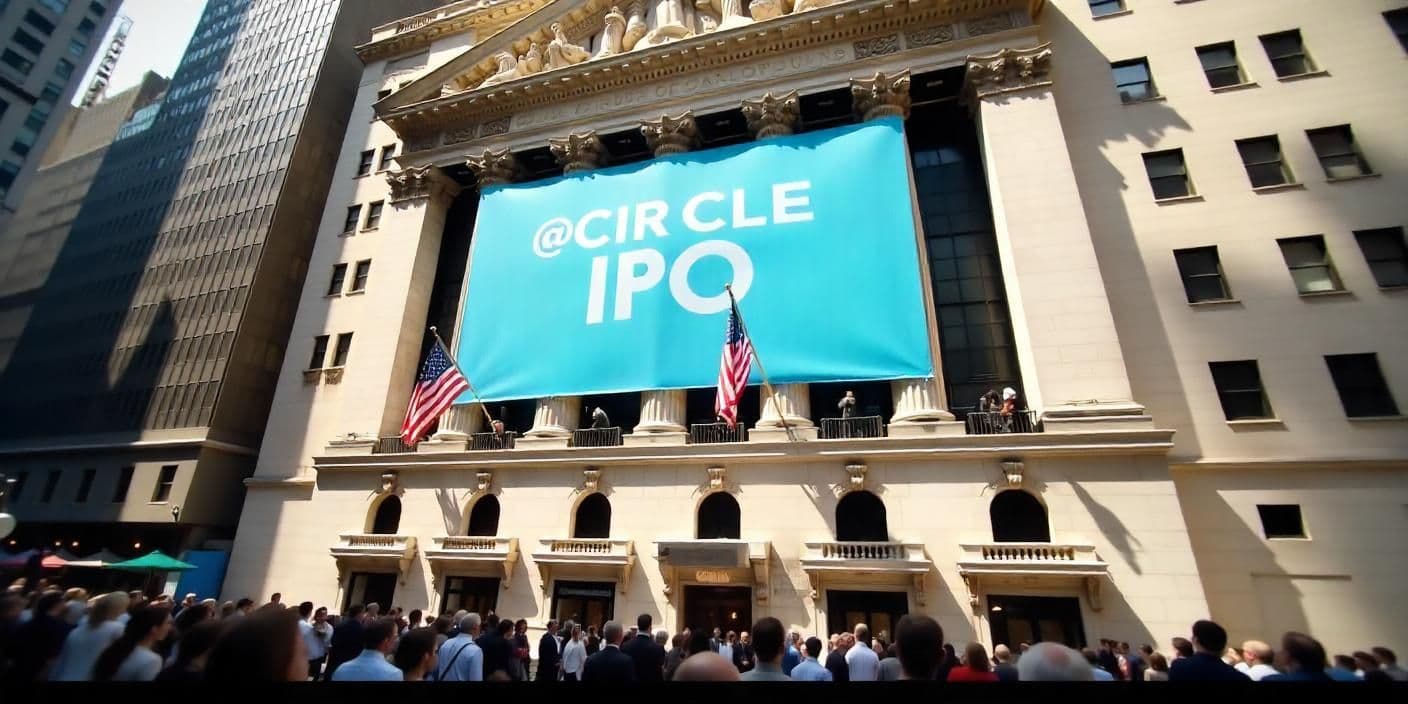
Circle Stock Explodes After IPO: What’s Behind USDC's Wild Debut?
Circle, the company behind USDC, just made Wall Street history. After pricing its IPO at $31, the stock soared to over $100. But what’s driving the hype—and is it sustainable?

September 8, 2026 10:21 PM

Crypto Holding Period and Grandfathering: Why December 31, 2026 Becomes the Cut-Off in Germany's Draft Bill
A ministerial draft bill from Germany's finance ministry names a cut-off date for the first time: crypto assets acquired after December 31, 2026 are to fall under the flat-rate withholding tax. What that means for legacy holdings, running savings plans and staking income, and why nothing has been decided yet.
August 11, 2026 9:13 PM

Germany's Crypto Holding Period Faces Abolition: What Petition 201716 and the Cabinet Decision Mean for Your Tax
Petition 201716 in the German Bundestag calls for the one-year holding period for crypto assets to be kept and has already passed the quorum of 30,000 signatures. This article sets out what the cabinet decision of July 6, 2026 provides for, how much of it is binding and which records you should be pulling together now.
September 15, 2026 4:12 AM

Using Hyperliquid from Germany: What Applies to Your Funds Without a MiCA Licence
Hyperliquid is not entered in any EU register as an authorised crypto-asset service provider, and for perpetual futures a MiCA licence would be the wrong paperwork anyway. Here is what that means in concrete terms for your funds, your keys and your tax return.
September 7, 2026 7:22 AM

German Crypto Holding Period Stays: The Income Tax Reform 2027 Leaves Section 23 Untouched
On September 2, 2026 the German federal cabinet adopted the draft of an Income Tax Reform Act 2027, and crypto assets do not appear in it. The one-year holding period under Section 23 of the Income Tax Act therefore continues to apply unchanged.
September 29, 2026 10:15 PM

Citi Becomes the Bank Behind Coinbase's Stablecoin Accounts: What Changes for Investors in Europe
Citi and Coinbase announced two products on September 28, 2026 that tie stablecoin payments to a global bank: dedicated payment accounts at Coinbase and stablecoin acceptance for Citi clients. Both launch in the United States. For your balance in Europe, MiCA, the Article 50 interest ban and Section 23 of the German Income Tax Act apply.
September 19, 2026 7:26 AM

Offsetting Crypto Losses Against Share Gains: What Is Really Allowed in Germany
Crypto losses and share gains sit in separate loss buckets in Germany, and there is no offsetting between them. Where the line runs, why crypto derivatives are the exception, and how you can still use losses through carryback and carryforward.
September 8, 2026 1:19 AM

Germany's Crypto Holding Period: What Happens Now Signing for Petition 201716 Closed on September 15
Recap as of September 27, 2026: the signature period for German parliamentary petition 201716, which asks for the one-year crypto holding period to be preserved, closed on September 15, 2026. This article explains what ended that day, how the petitions committee proceeds and why no investor has to sell because of it.
August 19, 2026 4:15 PM
Tether Audit by KPMG: What the Unqualified Opinion Means for USDT in the EU
Tether reported the first full audit of its financial statements by KPMG on August 13, 2026, with an unqualified audit opinion for the 2025 financial year. That changes nothing about whether USDT can be traded at authorised providers in the EU, because Article 48 MiCA decides that question.
August 16, 2026 6:14 AM
Crypto Credit Card Tax in Germany: Why Every Payment Is a Disposal
Paying with a crypto credit card means disposing of your coins for tax purposes. What that means for the holding period, the exemption threshold and your record-keeping duties, and which card design keeps the effort small.

September 27, 2026 1:17 PM
Dogecoin Price: What to Check on Holding Period and Custody Before the Year End
The Dogecoin price stands at $0.0977 on September 27, 2026 and has barely moved in a day. That calm is exactly the moment to work through the holding period, the reporting duty from 2026 and custody without any time pressure.
September 25, 2026 10:26 PM

Selling bitcoin privately: the tax in Germany and the records you need
A direct sale to a private individual falls under the same one-year rule as an exchange sale, but there is no tax report to go with it. This guide walks through the calculation, the 1,000 euro threshold and the records the tax office wants to see.
September 9, 2026 4:13 PM

Bitcoin 29 Percent Below Last Year: Which Crypto Losses You Can Still Use Before the One-Year Holding Period Expires
Nine out of ten major crypto assets trade lower today than exactly twelve months ago, Bitcoin alone by 29.2 percent. We measured the price series ourselves and show why the purchase date alone decides the tax value of your loss.
September 1, 2026 4:12 AM

USDT cashback and 7 percent on stablecoins: what the MiCA interest ban means for you
A new payment card advertises up to 10 percent cashback in USDT and up to 7 percent a year on the balance. Article 50 MiCAR explains why a provider licensed in the EU is not allowed to pay you exactly that.
September 26, 2026 1:19 AM
Germany’s Crypto Holding Period Is Wobbling: What to Check Before December 31
A CDU member of the Bundestag makes it plain: the coalition agreement does not guarantee that the one-year holding period for crypto assets will survive. What that means for purchases made before the planned cutoff date of December 31, 2026.
August 27, 2026 7:21 AM
Crypto Gains 2026: Why the September 10 Advance Tax Payment Decides Your Interest Bill
The third income tax advance payment falls due on September 10, yet for most crypto investors none was ever set. We checked four provisions in full text and show when the interest period for 2026 starts and how you can shrink it yourself.
March 24, 2026 4:06 PM
Circle (CRCL) Stock Plummets 17% on Stablecoin Yield Crackdown Fears
Circle Internet Group (CRCL) shares dropped 17% today following reports of a potential legislative crackdown on stablecoin yields. USDC remains pegged to $1 (for now).
March 2, 2026 11:30 AM
How to Generate a Steady Income During Crypto Market Volatility
Crypto market crashing hard? Learn how to use stablecoins to generate a reliable income while protecting your capital from market swings.
September 26, 2026 7:29 PM

Coins Stolen in an Exchange Hack: What the German Tax Office Accepts as a Loss
After the attack on Bitget on September 24, a question the reports leave out arises for those affected in Germany: can a stolen balance be written off against tax? The answer hangs on a single term in the Income Tax Act, and it is decided by your records.
September 18, 2026 10:13 AM

Bitcoin and the German Exit Tax: What Applies When You Move Abroad
Anyone emigrating with Bitcoin expects an exit tax on unrealised gains and finds nothing of the sort in the statute. Where the real risks sit is decided at four points: residence, the holding period, the legal form of your investment, and automatic reporting from 2026.
August 21, 2026 4:24 AM

Forced Sale on a Crypto Exchange: Which Moment Counts for the Holding Period and What You Must Document
At Luno, Kraken and Valour the deadlines are running out, after which the provider realises the remaining holding itself. For tax purposes that is a disposal, and what governs it is the exchange's timestamp.
September 25, 2026 10:22 AM
Fed Rules for Stablecoins: What to Check on Backing and the Redemption Right
The Federal Reserve put forward two proposed rules on backing, capital and redemption of payment stablecoins on September 24, 2026. For your holdings in Germany, however, MiCA is what counts, and different checks follow from it.
September 16, 2026 7:12 PM

Borrowing Against Bitcoin Instead of Selling: When German Tax Still Applies
Posting Bitcoin as collateral for a loan is not a sale in Germany, because section 39 of the Fiscal Code keeps the coins attributed to you for tax purposes. Tax arises only when the collateral is liquidated, and then the one thing that decides the bill is how long you held the coins beforehand.
August 20, 2026 10:24 PM

MiCA Review: What the European Commission Could Change About the EU Crypto Rules
The European Commission has reopened MiCA for review after barely two years and is asking 86 questions covering the stablecoin interest ban, staking, lending and DeFi. Brussels is taking responses until September 30, 2026.

September 19, 2026 4:11 AM
WBT Hits All-Time High at $83.64: What WhiteBIT Token Holders Should Check Now
The exchange token WBT reached a new all-time high of $83.64 on September 18, 2026. What sits behind the rise, and the three points German investors should check now.

More from CryptoTicker