
What is Aave? The largest DeFi lending market, with $28 billion in deposits
Aave lends crypto assets without a bank: depositors earn interest, and borrowers post more collateral than they borrow. This profile explains the technology, the AAVE token, the risks and what applies to investors in Germany.


Which topics should we dive deeper into?
Select what genuinely interests you. Your picks feed directly into our editorial planning.
Crypto news that's actually worth your time.
Weekly. 60 seconds. Carefully curated by our editors: no hype, no promo flood, no spam.
Aave is a decentralised lending protocol: you lend cryptocurrencies for interest or borrow crypto assets against collateral you post, without a bank in between. Instead of a loan officer, smart contracts decide: programs on the blockchain that enforce the rules for interest, collateral and liquidations automatically. The associated token is also called AAVE and is used mainly for governance of the protocol.
Measured by deposits, Aave is the largest lending market in DeFi. According to the data service DefiLlama, around $16.2 billion sat unused in the pools in early November 2026, and a further $11.8 billion was lent out to borrowers. Anyone who wants to understand how interest arises in decentralised finance cannot avoid Aave. This profile explains the technology, the token, how it is used and the risks, and sets out what applies to investors in Germany.
Aave explained simply: a lending platform without a bank
Aave is a liquidity protocol. The term describes a system in which many users pay their capital into shared pools from which other users take out loans. Lenders and borrowers do not know each other, and they do not need to trust each other either. Open code replaces trust: Aave is open source, and anyone can read and audit the contracts.
The project started in 2017 under the name ETHLend. Its founder is the Finnish lawyer Stani Kulechov. ETHLend initially matched individual lenders and borrowers directly, a model that suffered from a lack of demand on both sides. In January 2020 the protocol relaunched as Aave, now with shared pools instead of individual contracts. The old LEND token was swapped into AAVE the same year at a ratio of 100 to 1.
Aave originally ran only on Ethereum. Today version 3 is live on 21 networks, according to DefiLlama, including Base, Arbitrum, Avalanche, Polygon and Optimism. By far the largest share of deposits, however, is still held on the Ethereum blockchain: around $13.4 billion of $16.2 billion.
How do liquidity pools and aTokens work on Aave?
Every approved asset has its own pool, for example ETH, USDC or USDT. If you deposit 1,000 USDC, you receive 1,000 aUSDC in return. An aToken is a receipt that represents your share of the pool. Its balance in your wallet grows continuously, because the borrowers' interest is distributed directly to depositors.
The rate is variable and follows utilisation. If 90 percent of a pool is lent out, borrowing rates rise sharply so that new deposits come in and loans are repaid. If little is lent out, they fall. How much this can move was shown in October by a proposal to raise the USDT borrowing rate to 4.19 percent. The parameters are set by the Aave DAO, the community of token holders, on the recommendation of specialised risk service providers.
For depositors the model has a catch that many underestimate: if a pool is fully lent out, you cannot withdraw your balance immediately. You have to wait until borrowers repay or new depositors add funds. That is exactly what happened to stablecoin pools in April 2026, as described in our article on the Aave liquidity crisis with USDC and USDT. Our crypto lending comparison gives an overview of which platforms pay interest on crypto and how they differ.

Over-collateralisation and health factor: when Aave triggers a liquidation
Aave does no credit checks. Anyone who wants to borrow has to post collateral worth more than the loan. This over-collateralisation is the core of the system. Each asset has two thresholds: the loan-to-value ratio sets the maximum you may borrow, and the liquidation threshold determines the point at which your position can be forcibly unwound.
An example with round numbers: you deposit ETH worth $10,000. With a loan-to-value of 80 percent, you may borrow up to $8,000 in stablecoins. If the liquidation threshold is 83 percent, things get serious as soon as the value of your ETH falls below about $9,640, provided you have used the full limit. The actual values differ by asset and market and are adjusted regularly.
The distance to liquidation is measured by the health factor. It compares your collateral, weighted by the liquidation threshold, with your debt. Above 1, all is well. If it falls below 1, so-called liquidators may repay part of your debt and take over your collateral at a discount in return. That discount is your loss. If you stay only just above 1, a price drop of a few percent can be enough to trigger liquidation. Experienced users therefore keep a substantial buffer.
 Interest on crypto: lending platforms compared
Flash loans: uncollateralised loans repaid in the same block
One feature that Aave made famous is the flash loan. A flash loan is an uncollateralised loan that has to be taken out and repaid within a single transaction. If repayment fails, the entire transaction is reversed as if it had never happened. That leaves Aave with no default risk.
Flash loans are used mainly by developers and automated programs: for arbitrage between exchanges, for refinancing a position from one protocol to another or for swapping collateral in a single step. For retail investors they play practically no role, because they require programming skills. The technique does have a dark side, though: attackers have repeatedly used flash loans in the past to exploit weaknesses in other DeFi protocols with borrowed capital.
The AAVE token: 16 million units, governance and Umbrella
AAVE is a governance token. Holders can vote on changes to the protocol: new assets, interest rate curves, fees, budgets for service providers. Total supply is capped at 16 million tokens, of which around 15.44 million were in circulation on November 9, according to CoinGecko. The price that day was €117.48, equivalent to a market capitalisation of just over $2 billion. Over the previous 30 days AAVE had lost almost 25 percent, and around 34 percent over the year. The token is a long way from its record high of $661.69 in May 2021.
For a long time AAVE also served as a safety cushion. In the old Safety Module, holders could stake their tokens to step in if the protocol suffered losses, and received new AAVE as a reward. This module is being replaced by Umbrella. With Umbrella, users deposit aTokens such as aUSDC and use them to insure specific markets. If a loss occurs there that exceeds an initial protocol buffer, the staked balances are cut. This cut is called slashing.
Buybacks were another building block: the DAO continuously bought AAVE back on the market with protocol revenue. After an incident involving the restaking token rsETH in April 2026, the buybacks were suspended from April 19, as a proposal in the Aave forum records. Since then the community has been arguing about when and to what extent they should restart.
GHO stablecoin and Aave V4: what has changed in the Aave protocol
Since 2023 Aave has issued its own stablecoin, GHO. It is pegged to the US dollar and is created when users borrow it against posted collateral. According to DefiLlama, around 698 million GHO were in circulation in early November. That makes it small compared with USDT or USDC, but it is a separate source of income for the DAO, because the interest flows directly to the protocol.
The most important technical change is Aave V4. The new version went live on Ethereum on March 30, 2026. V4 separates liquidity (the hub) from the markets in which users borrow and lend (the spokes). Each spoke can have its own collateral, risk parameters and liquidation rules, but draws on the same pool of capital. That makes it possible, for example, to admit tokenised securities or new types of collateral in ring-fenced markets without putting the whole pool at risk. V4 is still small: according to DefiLlama it held just over $0.8 billion in early November, compared with $15.1 billion in V3.
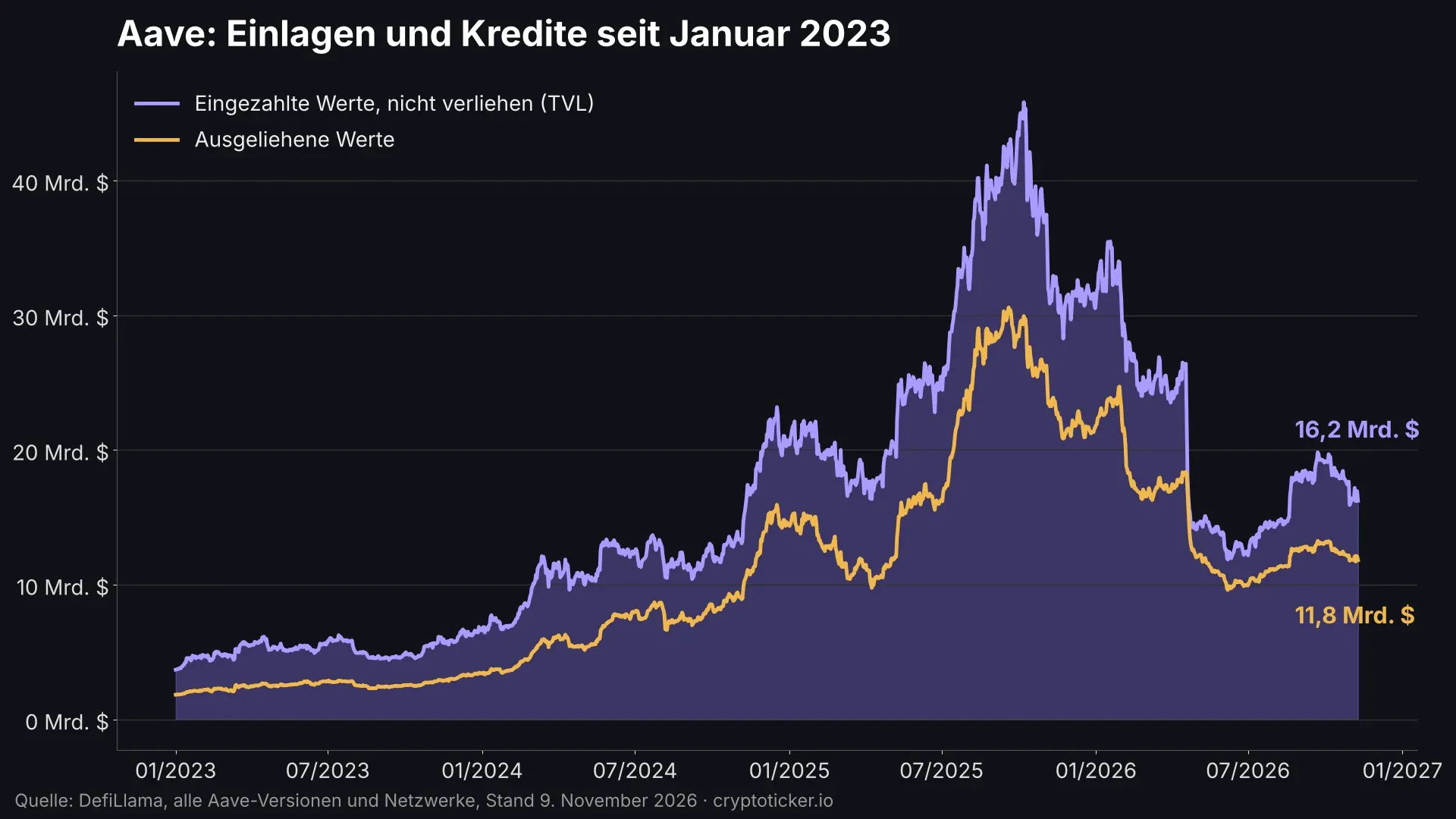
Aave in numbers: $16.2 billion in deposits and $11.8 billion in loans
The chart shows two figures. The purple line is total value locked (TVL): the capital sitting in the pools that is not currently lent out. The yellow line shows outstanding loans. Together they make up total deposits, around $28 billion in early November.
Aave reached its peak on October 7, 2025, with $45.8 billion in TVL and almost $30 billion in loans. Since then the total has more than halved. The fall in crypto prices explains part of this, because when the price of ether falls, so does the dollar value of the ETH deposited. The biggest drop in the chart, however, came in April 2026: between April 18 and 25, TVL fell from $26.4 billion to $14.3 billion. The trigger was the rsETH incident mentioned above, after which many depositors withdrew their capital.
Aave is still at the top nonetheless. DefiLlama lists Aave V3, with $15.1 billion, as the largest lending market, ahead of Morpho Blue with $10.7 billion and SparkLend with $4.7 billion.
 Buy AAVE: crypto exchanges compared
Aave risks: smart contracts, liquidations and bridges
Aave is regarded as one of the most thoroughly audited DeFi protocols. It is not risk-free. For depositors and borrowers, five points matter most:
- Smart contract risk: bugs in the code can cost money, including in add-on modules. In early October, 114.09 ETH were drained from two Safe multisigs through an Aave loop module.
- Risk from third-party collateral: if Aave accepts a token as collateral that is compromised elsewhere, the damage ends up in the pool. That is what happened in April 2026, when unbacked rsETH reached several V3 markets after an attack on a bridge route.
- Liquidation risk: in sharp price moves your collateral is sold at a discount, often within minutes.
- Liquidity risk: if a pool is fully lent out, you cannot get at your balance immediately.
- Stablecoin and price risk: if a stablecoin loses its peg or the AAVE price falls, the value of your position drops, however well the protocol works.
On top of that, there is no deposit protection. If something goes wrong at Aave, no state and no guarantee fund steps in, only the protocol's own buffers.
Aave in Germany: MiCA, BaFin and buying AAVE
The Aave protocol itself has no BaFin licence and, on the current reading, does not need one: the EU's MiCA crypto regulation expressly exempts services provided in a fully decentralised way. In practice, that means you have no investor protection in the traditional sense when you use it through your own wallet.
The picture is different for Aave Labs, the company behind its development. Its Irish subsidiary Push received a licence as a crypto-asset service provider under MiCA from the Central Bank of Ireland in November 2025, as Aave announced. The licence covers only exchanges between euros and stablecoins, not the lending protocol. What such a licence covers is explained in our overview of MiCA licensing obligations for crypto companies.
You can buy the AAVE token itself on many exchanges and crypto apps operating in Germany. Make sure the provider holds a MiCA licence. If you want to use Aave actively to earn interest or to borrow, you also need your own wallet, because the protocol works only with self-custodied coins.
Tax on Aave interest and AAVE gains in Germany
For tax purposes, two cases need to be kept apart. Gains from selling AAVE tokens are private disposal transactions. If you hold the tokens for more than a year, the gain remains tax-free. Within a year, an exemption limit of €1,000 applies to all private disposal gains combined.
Interest you receive as a depositor on Aave is generally treated by the tax authorities, according to their guidance on crypto assets, as other income. This income is subject to your personal tax rate, with a separate exemption limit of €256 a year. Our guide to paying tax on crypto lending describes how to proceed and where the points of dispute lie. It has not been finally settled whether depositing funds in exchange for aTokens is already a taxable swap. If you move larger amounts, you should clarify this with a tax adviser and document every transaction in full.
Aave in 2026: over-collateralisation protects the protocol, not your position
Aave connects lenders and borrowers through open code, but demands discipline in return: over-collateralisation, a watchful eye on the health factor and the knowledge that no guarantee fund will help. If you want to get started, it is best to proceed in three steps:
- Compare yields: check what Aave offers compared with other options, for example in the comparison of staking and rewards platforms.
- Choose regulated access: buy ETH, stablecoins or AAVE from a provider with a MiCA licence, for example from our comparison of regulated crypto exchanges, and transfer them to your own wallet.
- Document tax from the start: record deposits, interest and repayments with a suitable program from the comparison of crypto tax tools.
(As of November 9, 2026. This article is not investment advice. Prices and fee structures change; check the terms with the provider before you buy.)
Frequently asked questions about Aave
Partner links: some links on this page are partner links. If you become a customer through one of them, we may earn a commission at no extra cost to you. Selection, ratings and ranking are decided independently by our editorial team. Ethics and Independence · Ownership and Funding
Transparency note: This article was produced with the assistance of artificial intelligence. Figures and claims are based on the primary sources linked in the text. The feature image was generated with AI.
For later? Save this article and find it again in your profile.
Related articles
- Euro Stablecoins: What EURC, EURCV and Other E-Money Tokens Are, How Big the Market Is and Where to Buy Them
- Cardano news: COTI will shut down the DJED stablecoin on December 31, with 0.9 million tokens left
- Shitcoin meaning: what the term covers and why 53 percent of tokens fail
- Pump.fun explained: memecoins in one click, and 98.6 percent of tokens end up nearly worthless
- What is Render Coin? The GPU network burned $834,000 worth of tokens in October
Which topics should we dive deeper into?
Select what genuinely interests you. Your picks feed directly into our editorial planning.
Crypto news that's actually worth your time.
Weekly. 60 seconds. Carefully curated by our editors: no hype, no promo flood, no spam.

November 16, 2026 3:42 PM

What is Ultra (UOS)? The gaming blockchain after a 99.98 percent price collapse
Ultra set out to rival Steam with its own blockchain, game store and the UOS token. After staff cuts, a frozen store and a delisting, this profile shows what is left of the project in 2026.
November 15, 2026 11:17 PM

What is a DAO? Token holders vote on a shared treasury through smart contracts
A DAO replaces the board with votes by token holders and rules written into a smart contract. We explain governance tokens, quorum and multisig, the 2016 hack and the unresolved question of liability.
November 15, 2026 3:53 PM

TradFi vs DeFi: $71 billion in smart contracts against the banking system
TradFi is the traditional financial system of banks and supervisors, while DeFi replaces the intermediary with smart contracts on the blockchain. Where the differences lie in security and regulation, and how tokenised funds connect the two worlds.

November 15, 2026 12:58 AM

What Is Open Interest? Crypto Open Interest Explained
Open interest counts every open futures contract. What the metric shows for bitcoin, how it builds up and shrinks on perpetuals, how to read it with price and why it signals squeeze risk.
November 13, 2026 5:28 AM

DeFi wallet explained: signature phishing cost users $83.85 million in 2025
A DeFi wallet gives you the key to decentralised applications, and full responsibility for them. What happens when you connect, sign and grant token approvals, and which EU rules apply.
November 12, 2026 12:48 AM

CBDCs explained: 146 countries are exploring central bank digital currency, three have issued one
A CBDC is central bank digital currency, a liability of the central bank itself. We explain how it differs from stablecoins and bitcoin, where it already exists and when the digital euro is due.
November 10, 2026 11:36 PM

Crypto crash live: Solana and Aave lead the sell-off as markets price a December Fed hike
Hot US inflation data turned a slow slide into a flush: Bitcoin touched its lowest level since August, Solana has lost a quarter of its value in 30 days and Aave fell almost three times as hard as Bitcoin. The live timeline, the reasons and the levels that matter now.
November 10, 2026 9:30 PM

What is Bittensor (TAO)? A market for AI computing power with 21 million tokens
Bittensor pays for AI work from subnets with its TAO token, distributed according to validators' scores. This profile explains Yuma Consensus, alpha tokens, the halving and what applies when buying in Germany.
November 8, 2026 9:40 AM

What Is Sui? The Layer-1 Blockchain With an Object Model and Ten Billion SUI
Sui is a layer-1 blockchain from Mysten Labs that stores data as objects instead of account balances and processes transactions in parallel. This profile explains the technology, the SUI token, staking, risks and what applies to buying and tax in Germany.
November 6, 2026 1:34 AM

What Is Shiba Inu? SHIB, Shibarium and 410 Trillion Burned Tokens
Shiba Inu is a memecoin on Ethereum that has spawned its own layer-2 blockchain and three side tokens. This profile explains supply, burns, Shibarium and the risks, and sets out what applies to buying, storing and taxing SHIB in Germany.
November 3, 2026 9:25 AM

DefiLlama explained: how to read the DeFi data correctly
What DefiLlama measures and how to read TVL, fees, revenue, stablecoins and yields correctly: a guide with our own data analysis and six common reading mistakes.
November 3, 2026 1:33 AM

Polkadot (DOT): the network behind 2.1 billion tokens and its parachains
Polkadot links independent blockchains under a shared security umbrella, and since 2026 the DOT supply has been capped at 2.1 billion tokens. This profile explains the relay chain, Asset Hub, coretime and the 28-day lock-up for staking.
October 30, 2026 9:39 AM

NEAR Protocol explained: how sharding and 2.5 percent staking work
NEAR Protocol is a layer-1 blockchain that spreads its work across sections running in parallel and is secured by stakes. What the NEAR token does, how staking and custody work and what to check before you buy.
October 26, 2026 3:16 AM

What is Chainlink? Oracles, the LINK token and why banks use the network
Chainlink gives smart contracts the data a blockchain cannot see on its own. What the oracle network does, what the LINK token is paid for and what applies when you buy in Germany.
October 25, 2026 3:35 AM

Kaspa: why the KAS block reward drops to 1.945 on November 4
Kaspa works as a proof-of-work BlockDAG with around ten blocks per second, and 96.8 percent of all KAS are already in circulation. On November 4, 2026 the reward per block falls from 2.060 to 1.945 KAS. What the network delivers, where you can trade KAS in euros and what the tax office requires.
October 23, 2026 1:35 PM
What is Tether (USDT)? The stablecoin explained: 182 billion tokens without EU authorisation
With 182.8 billion tokens in circulation, Tether is the largest stablecoin in the world and settles two out of every three crypto dollars traded. In the EU it lacks authorisation as an e-money token, and from January 8, 2027 authorised providers may no longer offer services around it.
October 23, 2026 4:21 AM
What is Solana? The blockchain behind SOL: no supply cap, 589 million tokens in circulation
Solana settles payments in milliseconds and swapped out its voting mechanism on October 21, 2026. What the network is, what SOL is needed for, and what applies in Germany for buying, custody and tax.
October 22, 2026 1:45 PM
Cryptocurrency explained: how digital money works without a bank
A cryptocurrency is an entry in a public ledger that neither a bank nor a central bank controls on its own. This piece explains how that ledger works, what separates Bitcoin from the euro, and which rules apply in Germany to buying, custody and tax.
October 22, 2026 1:36 PM

What is an issuer? Meaning, examples and issuer risk
Context: who the issuer is in the case of a share, an ETF, an ETN, a certificate, a stablecoin and a stock token, what MiCA and prospectus law understand by it, and what an issuer insolvency leaves of 10,000 euros. With tables and a worked example.
October 21, 2026 7:15 PM

What is Hyperliquid? Its own blockchain, the HYPE token and access from Germany
Hyperliquid ranks 11th with a market value of $18.12 billion and runs its order book on a layer-1 blockchain of its own. What HyperCore, HyperEVM and the HYPE token do, what trading costs, and what applies to access from Germany.

October 15, 2026 7:49 PM

Aave (AAVE) 13 percent below its weekly high, Babylon applies for native Bitcoin as collateral in V4: what matters now
Babylon Labs wants to bring native Bitcoin into Aave V4 as collateral, without wrapping and without a custodian. The first $500,000 of annual revenue goes entirely to the Aave DAO.
October 11, 2026 10:20 PM

QNT token: a £100 Overledger licence a year, 14.88 million supply cap
The QNT token pays the annual licence for Overledger and is to carry the fee for gas and execution in the Fusion Rollup. What it does, where the cap sits and why circulating supply differs by 2.47 million tokens depending on the source.
September 21, 2026 7:20 PM

Morpho Stands Out: 33 Percent Below Its High
Morpho gains about 12 percent. A different number is more striking: the token sits only 33 percent below its all-time high, while the day's other winners stand 80 to 90 percent below theirs. What lies behind it.
September 18, 2026 7:26 PM

$3.5 Million Against $550,000 of Collateral: How to Check Which Tokens Your DeFi Lending Market Accepts
One manipulated price was enough to borrow 3.5 million US dollars from the Nostra Finance money market on Starknet — backed by a token worth half a million dollars. Four figures from the documentation show you whether your own lending market has the same gap.
September 12, 2026 4:57 AM

sUSDe Yield Against the Aave Borrow Rate: Why the USDe Loop No Longer Pays
Aave has raised the base rate for USDe to 6 percent. Our own measurement on September 12 shows borrow rates between 6.02 and 6.39 percent against a 5.01 percent sUSDe yield, and how to work the difference out yourself.
August 31, 2026 4:27 PM

More Markets Exploit: How a Liquid Staking Token and E-Mode Pulled $9.3 Million Out of a Lending Market
Around 15.5 million WFLOW drained from the lending market More Markets on August 31, 2026, roughly $9.3 million by Blockaid's estimate. The route ran through a liquid staking token used as collateral and through E-Mode, and both building blocks sit in protocols you know.
August 30, 2026 1:22 AM

Ajna Exploit: $775,400 Drained and No Pause Button in the DeFi Lending Protocol
Between August 28 and 29, 2026 roughly $775,400 drained out of seven Ethereum pools of the lending protocol Ajna v2. Because the contract is immutable and has no governance, there is no pause button: users have to withdraw themselves.
More from CryptoTicker