
Stock Tokens: How to Check Whether Yours Carries Real Shareholder Rights
The SEC allows US trading venues to handle tokenized stocks only if the token carries the same rights as the original. That condition does not automatically apply to the stock token you buy here, so here is how to check what is inside yours.




Which topics should we dive deeper into?
Select what genuinely interests you. Your picks feed directly into our editorial planning.
Crypto news that's actually worth your time.
Weekly. 60 seconds. Carefully curated by our editors: no hype, no promo flood, no spam.
The short answer first: whether your stock token carries voting rights and a dividend does not depend on the company name shown in the trading interface, but on how the token is built in legal terms. Since September 17, 2026 there is an official yardstick for this for the first time. The US Securities and Exchange Commission has granted a time-limited exemption allowing trading venues to handle tokenized US stocks, and it has tied that permission to one condition: the token must embody the same rights as the real share. The condition binds venues under US supervision. It does not automatically cover the token you buy in Germany through a provider based outside the United States. That gap is exactly where you have to look for yourself.
A stock token is a tradable entry on a public blockchain intended to mirror the economic value of a real share. Tokens like these are not on the shelf at your high-street bank. You find them at crypto exchanges and crypto brokers, you usually pay for them with a stablecoin, and you keep them in the same wallet as the rest of your crypto holdings. That makes this your business as a crypto investor: custody, fees, your tax return and, in the worst case, insolvency protection all run through the crypto side of your portfolio, not the securities side.
What the SEC decided on September 17, 2026
The SEC has granted what it calls an innovation exemption, a time-limited and conditional exemption from the definition of an "exchange" under the US Securities Exchange Act of 1934. The beneficiaries are trading venues the regulator refers to as tokenized securities venues, or TSVs. A TSV brings together buyers and sellers of tokenized US stocks without having to be registered as an exchange, and it may use approved liquidity pools and automated market makers to do so. An automated market maker is a trading mechanism in which a liquidity pool sets prices according to a fixed formula, rather than matching buy and sell orders against each other in an order book.
The exemption runs for five years, and the SEC has explicitly invited comment on possible changes. The details are set out in the SEC announcement of September 17, 2026; a reading of the conditions, including a quote from an SEC spokesperson, is available at Unchained.
One point matters for understanding the whole construction: an exemption from the definition of an exchange is not a licence to operate as one. The venue is permitted to work without an exchange licence for as long as it meets the conditions. If a condition falls away, the permission falls away with it. That is what separates this exemption from a permanent market authorization, and it is why the conditions matter more to you as an investor than the permission itself.
Equal rights as a condition: why the token must carry the same shareholder rights
The condition that matters most to investors is equality of rights. A token may only trade on such a venue if it embodies the same rights as the underlying share. That includes the dividend, the voting right and access to proxy voting. The trade publication Ledger Insights points out that the exemption even permits an unrelated third party to tokenize a company's shares, but only with the full set of rights attached.
This is notable, because until now the rights question around tokenized stocks has usually been answered with a no. In many of the structures available on the market you hold a claim against an issuer who in turn keeps the share in custody somewhere. What you actually own in that case is something we took apart in our analysis of tokenized stocks and issuer risk.
What "the same rights" covers in detail
- Dividend: the payout reaches you as the holder of the token, not just the custodian in between.
- Voting right: you can vote at the annual general meeting, either in person or through a representative.
- Proxy access: access to proxy voting, meaning the route by which a shareholder casts a vote without attending in person.
- Corporate actions: subscription rights, stock splits and reverse splits feed through to your token.
- Information rights: you receive the documents a shareholder receives, such as meeting invitations and reports.
Does the condition apply to the stock token you buy in Germany?
This is the point the German-language coverage of the decision has so far left out. The exemption covers NMS stocks on venues under US supervision. NMS stocks are those regularly listed on US exchanges and covered by the National Market System. The equal-rights condition therefore binds the US venue. A provider based outside the United States is not caught by it, and that is precisely where many German investors buy their stock tokens today.
In practice that means nothing follows for your own portfolio from the headline that the regulator now demands full shareholder rights. It may well be that your token still carries no voting rights and that this is entirely compliant, because your provider never fell under the exemption in the first place. What does emerge is a new benchmark against which you can measure your provider's terms. How to recognize a provider and the structure behind it is something we set out step by step in our guide to identifying stock token issuers.

Synthetic stock tokens stay outside the rules
With the same decision, the SEC drew a dividing line. Synthetic stock tokens do not fall under the exemption. A synthetic stock token is not backed by real shares; it replicates the price through a derivative or through an agreement with the provider. According to Unchained, an SEC spokesperson said such products could stay "out in the wilds". That statement describes the regulator's view of the scope of the rules, not an assessment of the products themselves.
For you this is the most useful dividing line in the entire decision, because you can trace it at your own provider. If a real, custodied share sits behind the token, there is a custodian, a backing ratio and, as a rule, evidence of it. If a derivative sits behind it, the terms will name a counterparty whose solvency you are buying along with the product. If you want to work through the difference between a replicated price and a backed holding in practice, our crypto broker comparison sets the models side by side, including the question of who becomes your counterparty.
The issuer's right to object: 30 days, and silence counts as consent
The third condition is the one that settles the longest-running dispute. If a venue wants to tokenize the shares of a company it does not control, it must notify that company in writing beforehand and wait 30 days. If the company objects within that window, the token may not be traded on that venue. If it stays silent, that counts as consent.
Whether companies should be given such a right of objection was an open question before the decision, and the industry answered it in opposite ways. Trading venues argued that a share is freely tradable once bought and that the issuer does not get to dictate where it trades. Companies and registrars countered that a token carrying a promise of voting rights reaches into their shareholder structure. The regulator came down in favour of a right to object with a deadline.
For you this has an awkward side effect worth planning for: a stock token can disappear from a venue because the company objected, not because anything is wrong with the token. What happens to an open position in that case is not covered by the SEC decision. It is covered by your provider's terms. Check there whether a redemption at net asset value is provided for, or a forced liquidation at whatever the market price happens to be.
How to check your stock token's rights yourself
The sequence below works regardless of where your provider is based. You do not need legal advice for it, only patience with the documents.
The terms first, the marketing page second
Search the issuance terms or the key information document for the words voting right, dividend and general meeting. If you cannot find them, that is already your answer. The product page showing the share price is the wrong place to look, because it describes the price history and not the legal position.
Then the custody chain
Establish who holds the real share and in what ratio it stands to the token. What matters is whether there is a named custodian, whether one-to-one backing is promised and whether evidence of it is published.
Finally, the cross-check against a corporate action
The hardest test is the past. If the company paid a dividend or carried out a split in the past year, look through your transaction history to see whether and how it reached you. A token that has never passed on a dividend carries no dividend right, whatever the description says.
- Search the terms and the key information document for voting right, dividend and general meeting.
- Identify the custodian, the backing ratio and the proof of backing.
- Name the counterparty: whose solvency carries the token if things go wrong?
- Cross-check a past dividend or corporate action against your own transaction history.
- Read the venue's rulebook on suspension and on the unwinding of a position.
- Write the result down with the date, because terms can change without notice.
Why the rights question also concerns your tax office
This is where the exercise becomes practical, because in Germany this precise question determines your tax bill. The classification turns on the legal structure of the token. If it certifies a claim to repayment in cash against an issuer, the gain counts as investment income under section 20 of the German Income Tax Act. The flat withholding tax of 25 percent then applies, plus the solidarity surcharge and, where applicable, church tax, and it applies regardless of how long you have held. If there is no such claim, classification as another economic asset comes into play, and with it the one-year holding period for private disposals under section 23 of the Income Tax Act.
The difference is substantial. In the first case you pay on every gain, even after five years. In the second, a gain is tax-free after a holding period of one year, while a shorter holding period is taxed at your personal rate. Which of the two applies to your token is not something you can read off the price display, but you can read it off the issuance terms. Classification in an individual case is a job for a tax adviser; the groundwork you can do yourself.

What the five-year limit means for your holding period
The exemption expires after five years. Until the order is printed in the Federal Register, the official gazette, the end date is not fixed to a particular day, because the deadline runs from that publication. What counts for you is the order of magnitude: the framework such a venue operates under is set for a limited time and will be revised within it, since the regulator is collecting comments.
Anyone who wants to treat tokenized stocks as a long-term building block in their portfolio should factor that in. A ten-year holding period meets a legal framework whose current version ends after five. That is not a reason to stay away, but it is a reason to know the exit route in advance and to read the terms repeatedly rather than only once at the point of purchase.
A security under MiFID II: how BaFin classifies a stock token
The SEC has no authority over the German legal framework, but the question of which rights are embodied arises here just the same, only against a different yardstick. Germany's financial regulator BaFin classifies tokenized investments as securities where they are tradable in a way that resembles an exchange in practice. The concept of a security comes from Directive 2014/65/EU, known as MiFID II, and it requires three features at once: transferability, tradability on financial markets, and the embodiment of securities-like rights in the token.
That last feature is the rights question again. A token embodying shareholder rights therefore moves into the territory of securities law, and with it into the remit of the securities regulator, bringing prospectus and authorization duties for the provider. The European crypto regulation MiCA expressly does not apply here, because it carves out financial instruments; those are governed by MiFID II. With the Future Financing Act, Germany has additionally created the option of issuing shares electronically as central register shares and as crypto shares. How such a register works, and why the registrar is the decisive point, is settled at the level of register administration and the transfer agent, meaning the body that maintains the shareholder register.
Both legal orders produce the same test pattern for you. The more genuine shareholder rights a token carries, the more it is treated like a security, with the duties and the level of protection that come with that. The fewer it carries, the more it remains a crypto product with a counterparty in the background.
The case for and against tokenized stocks in a portfolio
Supporters of these products argue that they open up trading beyond exchange hours, that fractions of expensive shares become accessible and that settlement runs faster than through the classic securities chain. The US regulator itself gives as the purpose of its exemption the wish to enable innovation while gathering experience.
Against a large portfolio allocation stand the points this article works through: issuer and custody risk, the open rights position outside US venues, the unclear tax classification in individual cases and the time limit on the framework. This weighing up is no substitute for advice and is deliberately not a recommendation for any single provider. The list shows which questions you want answered before money goes into a product of this kind.
Checking a stock token: what to take away
- Check your own token, not the headline. The SEC's equal-rights condition binds US trading venues. Search your issuance terms for voting rights and dividends, and record the result with the date. Which venues operate under supervision at all is set out in our overview of regulated crypto exchanges.
- Settle the tax question before you sell, not after. Whether section 20 with its flat withholding tax or section 23 with its one-year holding period applies depends on how your token is structured. Collect the records as you go; the tools in our comparison of crypto tax software and portfolio trackers will help.
- Separate the access route from the investment decision. If all you want is exposure to the price, you do not need a token with an unclear rights position to get it. Check instead which venues offer the stock directly, and compare the total cost using our overview of the best crypto exchanges.
(As of September 17, 2026. This article is not investment advice. Prices and fee structures change; check the terms with the provider before you buy.)
Transparency note: This article was produced with the assistance of artificial intelligence and reviewed by our editorial team before publication. All figures and claims were checked against the primary sources linked in the text. The feature image was generated with AI.
Related articles
- Tokenized US Stocks: What the SEC Exemption Changes for You in Germany
- Tokenized Stocks: Why You Do Not Own a Share and Which Risk Hangs on the Issuer
- Stock Tokens: Who Actually Issues Them and What the SEC Wants to Change by November 3, 2026
- Tokenized Stocks: Who Owns the Share When the Register Sits on a Blockchain
- You Can Now Trade Tesla and Apple on Kraken... Here's How
Which topics should we dive deeper into?
Select what genuinely interests you. Your picks feed directly into our editorial planning.
Crypto news that's actually worth your time.
Weekly. 60 seconds. Carefully curated by our editors: no hype, no promo flood, no spam.

August 12, 2026 6:24 PM

Tokenized Stocks and Tax in Germany: When the One-Year Holding Period Applies and When the Flat Tax Bites
If you buy a tokenized stock, you often apply the crypto rule: hold for a year, then the gain is tax-free. For these products that assumption usually does not hold, and this article shows from the wording of the law which feature decides the tax regime and how to find it in the issuer documents.

June 1, 2026 1:17 PM
Binance Launches US Stock Trading with Upcoming bStocks Tokenization on BNB Chain
Binance has introduced zero-commission US stock and ETF trading for non-US users, with plans to launch tokenized on-chain equities via bStocks.
May 4, 2026 6:15 PM

DTCC Tokenized Securities: Is Wall Street About to Bring Stocks On-Chain?
DTCC plans tokenized securities trades in July 2026, signaling Wall Street’s next major step toward blockchain-based financial markets.
August 27, 2026 10:32 AM

A Securities Account at the Crypto Exchange: Why Capital Gains Tax and Anlage KAP Are on You
On August 18, 2026 Kraken opened trading in more than 7,000 US stocks to customers in the European Economic Area, provided by a Cypriot investment firm. That puts the securities account abroad, and German capital gains tax, loss offsetting and the saver’s allowance now run through your own tax return.
August 21, 2026 10:16 AM

24-Hour Trading on US Exchanges: What the SEC Roundtable Means for Tokenized Stocks
The US Securities and Exchange Commission takes up the path to round-the-clock trading on American equity markets on September 17, 2026. For tokenized stocks on Kraken and Binance, that puts their most important selling point back on the table.
September 30, 2026 4:45 PM
CFTC Registers Coinbase Clearing for Fully Collateralised Derivatives: What Matters for Investors in Europe
The US regulator CFTC registered Coinbase Clearing as a clearing house on September 28, but only for fully collateralised contracts without leverage. For investors in Europe another decision counts for more: ESMA's CFD classification of perpetual futures.
September 19, 2026 7:19 PM

Binance Launches FX Perpetuals With 100x Leverage: What Is Allowed in Germany
Binance launches a perpetual future on the US dollar and the Brazilian real with up to 100x leverage on September 21. For German retail investors, what counts is less the announcement than the question of which leverage is permitted here and which tax rule applies to futures transactions.
August 6, 2026 1:00 PM

Robinhood Built a Blockchain for Stocks. The Cat Memecoins Took It Over.
$13 million in tokenised equities, memecoins worth ten times that: what Robinhood Chain is, why CASHCAT flooded it, and how investors actually get access.
June 13, 2026 11:45 AM
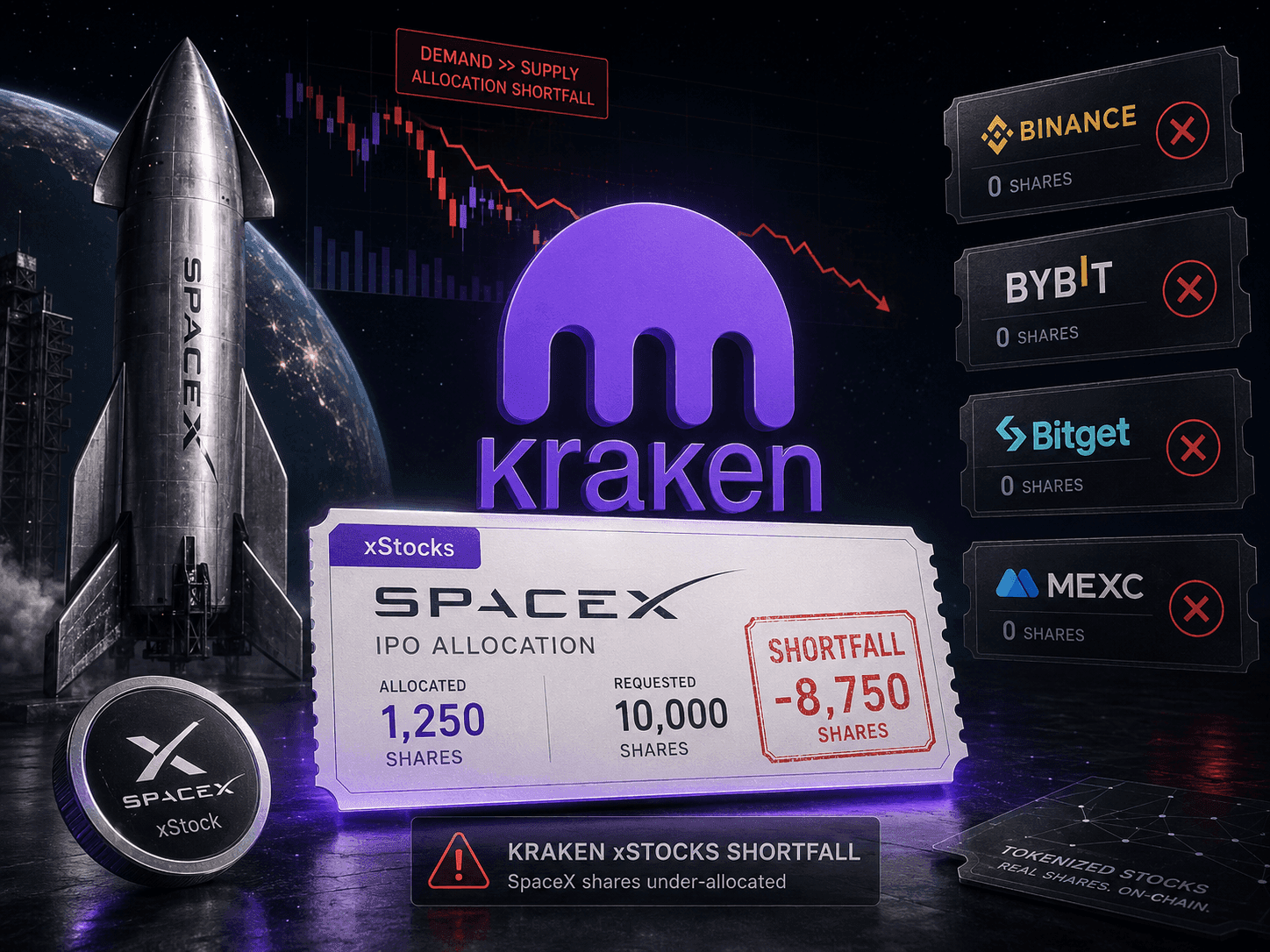
Why Binance, Bybit and Bitget Got Zero SpaceX Shares: Kraken's xStocks Came Up Short
xStocks — Kraken's own tokenized-equity arm — couldn't source SpaceX shares, leaving Binance, Bybit, Bitget and MEXC with zero. Here's why.
May 12, 2026 9:19 AM
Senate Banking Committee Unveils 309-Page Crypto Clarity Act Draft
The US Senate Banking Committee released a 309-page Crypto Clarity Act draft. It defines SEC and CFTC roles while adding strict stablecoin yield rules.

September 17, 2024 6:38 PM

Breaking News: More than 50 Crypto Tokens including ADA, LUNA, and TRX Now Considered Securities by the US SEC
US SEC has declared over 50 tokens, including ADA, LUNA, and TRX, as securities. Let's take a look at these crypto tokens as securities.
May 15, 2024 10:37 AM
Ripple Leads the Tokenization Revolution with XRP
Ripple is leveraging XRP to lead the tokenization revolution, transforming the future of finance with innovative cross-border payment solutions.
October 3, 2024 1:01 PM
Ripple News Today: Bitwise XRP ETF Filing Amid Ripple SEC Lawsuit
Bitwise XRP ETF filing amid Ripple SEC lawsuit was a major development today since the future of XRP remains uncertain... Why now?
August 20, 2024 3:00 PM

New US Senate Proposal Submitted For Crypto Tax Exemption
The US Senate has recently submitted a new proposal to exempt crypto transactions from federal taxes. Here are more details of this submission, and a list of exempted countries it could be joining...

October 4, 2026 1:23 AM

Avalanche adds $266 million in new RWA in 30 days, price at $11.11: What to watch now
Avalanche took on more tokenised stocks in September than any other chain, and the price stands at $11.11. Nearly half of the increase, however, traces back to a single issuer.
September 28, 2026 4:15 AM
NEAR Rises More Than 29 Percent in Seven Days: Why Ondo Stocks and Zcash Trading Are Driving the Price
NEAR gains 29.23 percent within seven days and is the strongest of the 25 largest cryptocurrencies on September 27. Two documented drivers sit behind the move: the launch of tokenised US equities and ETFs from Ondo on the chain, and growing Zcash trading through NEAR Intents.
September 25, 2026 10:14 PM
Sequans sells its last 314 bitcoin: what to check if you hold a treasury stock
Semiconductor maker Sequans has wound down its bitcoin reserve completely, 15 months after setting a target of one hundred thousand coins. What the case reveals about treasury stocks, and which tax rule applies to the share and to the coin.
May 22, 2025 9:58 PM

Stocks vs. Crypto: Where Should You Invest Right Now?
With traditional stocks showing mixed signals and Bitcoin breaking new records, investors are torn: stick with equities or ride the crypto wave? Here’s a breakdown of what’s moving the markets.
October 7, 2024 6:01 PM
As Ripple vs SEC Deadline For Appeal Ends Today, What Comes Next For XRP Price?
What comes next for XRP price, as the Ripple and SEC legal battles continue, along with other major news for Ripple and its XRP Ledger? Let's find out...
June 1, 2024 12:17 PM
XRP SEC Lawsuit Update: A "Fire Gensler" Campaign & A Biden Veto
Ripple CEO Brad Garlinghouse calls on President Biden to replace SEC Chair Gary Gensler...Biden uses his veto right to the latest standalone legislation... Is Biden's veto decision good for Ripple?
July 8, 2026 12:35 PM
Bitpanda Launches 20x Margin Trading on Real Stocks and ETFs — a First for Europe
Bitpanda just went live with leveraged trading on 875+ real stocks and ETFs at up to 20x — no CFDs, no synthetic contracts, just direct exposure.
April 4, 2025 10:54 PM
3 Crypto Stocks That Crashed Hard in the Wake of Market Turmoil
The global crypto market crashed hard. But while crypto took a hit, U.S. crypto-related stocks suffered even more severe losses. With the stock market in chaos, here are three crypto stocks that crashed hard recently.
September 7, 2026 7:22 AM

German Crypto Holding Period Stays: The Income Tax Reform 2027 Leaves Section 23 Untouched
On September 2, 2026 the German federal cabinet adopted the draft of an Income Tax Reform Act 2027, and crypto assets do not appear in it. The one-year holding period under Section 23 of the Income Tax Act therefore continues to apply unchanged.
August 22, 2026 4:47 PM

Offsetting Bitcoin Losses Against Stock Gains in Austria
Offset bitcoin losses against gains on shares? Austria allows it in principle, but only under certain conditions and usually via the tax return.

June 13, 2026 10:33 AM

SpaceX IPO Recap: SPCX Closes +19% in a Record Debut, While Tokenized Stocks Stumble
SPCX jumped 19% to a $2T+ valuation on day one — but the tokenized SpaceX trade split in two, and the difference is the real lesson.

More from CryptoTicker