
Tokenized US Stocks: What the SEC Exemption Changes for You in Germany
On September 17, 2026 the SEC cleared trading in tokenized US stocks for five years, capped at 75 symbols per venue and only with full shareholder rights. What the decision regulates, what it leaves open and the four points you should check as an investor in Germany.



Which topics should we dive deeper into?
Select what genuinely interests you. Your picks feed directly into our editorial planning.
Crypto news that's actually worth your time.
Weekly. 60 seconds. Carefully curated by our editors: no hype, no promo flood, no spam.
On September 17, 2026, the US Securities and Exchange Commission cleared trading in tokenized US stocks for five years, but only under tight conditions and only for trading venues based in the United States. The supply is therefore being created over there, while the questions of access, taxation and custody arise for you here. This article sets out what the decision regulates, what it expressly leaves open and which points you should check before you buy such a token.
What the SEC's Innovation Exemption decided on September 17
The Innovation Exemption is a time-limited exemption with which the SEC releases certain trading venues for tokenized stocks from the requirement to register as an exchange. The regulator issued it on September 17, 2026 as an order with the number 34-106402. The relief runs until September 17, 2031, exactly five years; after that it lapses, unless the SEC has created a permanent rule by then.
Legally, two exemptions are involved. First, the platforms concerned are no longer classified as an exchange under the US Securities Exchange Act of 1934. Second, market participants who provide capital in these platforms' liquidity pools do not, under certain conditions, have to register as securities dealers. Together, the two remove precisely the hurdles on which tokenized stocks have so far snagged in the United States.
The SEC combines the decision with a request for comment. In parallel, then, the regulator is collecting feedback on what a permanent arrangement should look like. SEC Chairman Paul Atkins described the exemption on the same day, in a statement of his own, as a bridge to later, durable rulemaking. That is not a throwaway line: anyone buying a token today buys it within a framework designed from the outset as an interim measure.
Tokenized Securities Venue: what a TSV is and what it is not
The order creates a new category of market participant, the Tokenized Securities Venue, or TSV. A TSV is an organization that brings together buyers and sellers of tokenized US stocks by providing so-called AMM liquidity pools and determining who gets access. An automated market maker, or AMM, is a program on a blockchain that calculates buying and selling prices from the ratio of two deposited holdings instead of matching order against order.
What matters is what a TSV is not. It is not an exchange within the meaning of US law, it is not a broker in the classical sense, and it is not a custodian within the meaning of the German Banking Act. It is a trading venue with special status for a limited time. For you as an investor that means the protective mechanisms you know from a regulated exchange apply here only to a limited extent; a catalog of conditions takes their place.
Those conditions include that the smart contracts must be publicly visible and auditable and must run on a public, permissionless blockchain. A smart contract is a program that sits on a blockchain and executes its rules automatically. If trading in the underlying stock is halted on its home exchange, the TSV must likewise halt trading in the token. It must also report trading data publicly and in US dollars.

75 symbols and 0.25 percent of daily volume: the Tier 1 caps
The exemption is capped by volume, in two tiers. In Tier 1, which covers stocks from the S&P 500 and the Russell 1000, a trading venue may list no more than 75 symbols. Per stock, trading volume is limited to 0.25 percent of the average daily share volume of the previous month. In Tier 2, which covers the remaining US stocks, the figures are a maximum of 250 symbols at 2.5 percent of average daily volume. These numbers come from the order and from its analysis by law firms and trade media.
The limits apply on an aggregated basis across affiliated trading venues. An operator therefore cannot create more room for itself by placing several TSVs side by side. If a venue breaches the volume limit in a stock a second time, it must suspend trading in precisely that stock for three months. If it exceeds the number of permitted symbols, it loses the exemption altogether.
For you, one thing above all can be read from this: what is emerging here is a deliberately small-scale pilot operation, not a second, fully fledged stock market. The caps are set so that tokenized trading cannot dominate price formation on the established exchanges. Anyone working with large amounts should factor in that a venue may reach its capacity in a popular stock and suspend trading temporarily.
 Regulated crypto exchanges compared
Dividend, voting right, liquidation proceeds: which rights the token must carry
The order's toughest substantive condition concerns not the technology but the law. A token may only be traded under the exemption if it gives the holder the same rights and benefits as the conventional share. Named are the economic participation, the entitlement to dividends, the voting right and the claim to liquidation proceeds if the company is wound up.
That excludes an entire product class which has been travelling under the label of tokenized stock in recent years: replications that track the price without actually depositing the share. Synthetic constructions and derivatives are expressly not covered by the exemption. A product that merely delivers the price movement to you is not a tokenized security under this order.
There is also a say for the companies concerned. If a third party tokenizes a company's shares, the trading venue must inform the company. The company then has 30 calendar days to object. Trading may not begin before that period has expired. This is an answer to a real point of contention in recent months, in which stakes in companies not listed on an exchange were tokenized without their involvement.
Why synthetic stock tokens and CFDs remain outside
The distinction from synthetic products is worth a look of its own, because in practice it makes the difference for you. A CFD, a contract for difference, is an agreement between you and a provider about the difference between the opening and closing price of an underlying; you acquire no ownership of the underlying. Many tokenized price replications work in a similar way: you hold a claim against an issuer, not the share itself.
Such products are not inadmissible as such, they simply do not fall under this exemption and remain subject to the rules that apply to them in any case. For you as an investor the distinction is nevertheless decisive, because it determines what you hold in the event of insolvency. With a genuine, deposited share you have a claim to a security. With a replication you have a receivable, and its value depends on the issuer's ability to pay.
We have set out the differences between the two designs, and the question of who owns the paper if things go wrong, in more detail in a separate article on ownership and issuer risk with tokenized stocks. The SEC's order changes nothing about that basic distinction; it merely turns it into an admission criterion.
MiFID II instead of MiCA: which law a tokenized security falls under in the EU
This is where the German part of the story begins. In the EU, crypto-assets have been governed since 2024 by MiCA, the Markets in Crypto-Assets Regulation. The regulation governs the authorization and duties of crypto service providers. Its boundary is decisive: a token that is a financial instrument within the meaning of the financial markets directive MiFID II falls outside MiCA and under securities law.
That is precisely the case with a token carrying a share's dividend, voting right and liquidation claim. Such an instrument is a security in the EU, and trading in it is an investment service. A provider arranging that for you in Germany needs authorization for securities business; a pure crypto license is not sufficient.
In practice this means the SEC order creates not a single new route of access in Europe. The decision is a US decision for US trading venues. Whether a European provider offers such a token is governed by European law and by its own license, not by the order from Washington.
Access from Germany: why a US trading venue does not automatically take you on
The order requires the trading venue itself to be a US person, and it binds the venue to the sanctions requirements of the US authority OFAC. Access to the liquidity pools is also subject to permission, so the venue determines who may trade. According to the analysis available, the order contains no general ban on investors outside the United States; but neither does it establish any entitlement to access.
For you this produces a sober checking step: whether you can take part is decided by the respective operator in its terms of use, not by the regulator. Before you move money, you should if in doubt clarify in writing whether residence in Germany is accepted, what identity check is required and what happens to your holdings if the operator changes its terms. For the regulated purchase of common crypto-assets from Germany, the route still runs through the established platforms that we compare in our comparison of the best crypto exchanges.
A second point concerns trading hours. For many, the appeal of tokenized stocks lies in being able to trade outside US trading hours. But the order ties the token to the home exchange when trading there is suspended. Round-the-clock pricing is therefore no substitute for round-the-clock liquidity, and in quiet hours in particular the spread between the bid and ask price can widen noticeably.
 Crypto brokers compared
Tax in Germany: why the one-year holding period does not apply to tokenized stocks
In Germany, the tax classification follows the economic substance, not the technical packaging. If a token genuinely securitizes a share with all its rights, there is much to suggest treating it as a capital investment. Gains from a sale then count as investment income and are subject to the flat-rate withholding tax of 25 percent plus solidarity surcharge and, where applicable, church tax. The saver's allowance of 1,000 euros for single filers and 2,000 euros for jointly assessed couples reduces the tax base.
The rule familiar from crypto-assets, under which a gain remains tax-free after a holding period of one year, comes from the taxation of private disposal transactions and is not applicable to capital investments such as shares. Anyone assuming that a tokenized security can be sold tax-free after twelve months risks a nasty surprise. We have worked through the details and the still open points of this classification in our article on tokenized stocks and German tax.
There is also a practical difference that many underestimate. A German broker withholds the flat-rate tax automatically. A foreign trading venue does not. If your transaction runs through a platform abroad, you have to declare the income yourself in the KAP annex of your tax return, and for that you need robust documentation of every single transaction. In this constellation, a conversation with a tax adviser is as a rule the cheaper option.
Issuer risk and custody: who owns the token in an insolvency
The order requires the token to carry the same rights as the share. That settles what the token promises, but not who stands behind it if things go wrong. Between you and the share there is usually a custodian holding the real paper and an issuer putting out the tokens. If one of those links fails, the relevant insolvency law decides whether your holding can be separated out or falls into the estate.
You can check this in three places. First: who holds the deposited shares, and is that body supervised? Second: are client holdings segregated from the operator's own assets, and is that checked regularly? Third: where is your private key, and who can initiate transactions? If the trading venue holds custody for you, you additionally bear its default risk.
There is no deposit guarantee here in the sense of protection for bank balances. EU investor compensation applies to investment services only under certain conditions and only with providers authorized in the EU. With a US trading venue without European authorization, you cannot count on it.
What can actually be expected in the coming months
The exemption creates legal certainty for operators that have hesitated so far. It is therefore realistic that first platforms will launch in the United States in the coming months and will start with a few large stocks, because the Tier 1 limit permits no more. How quickly European providers follow, and whether they do at all, is open and depends on their own license, not on the SEC.
What happens after five years is also open. The order ends on September 17, 2031. By then the SEC must either create a permanent rule or extend the exemption. For you that means that with a long-term commitment you are also buying a regulatory end date that nobody can fill in today. Valuations of individual providers, let alone price targets, cannot be derived from this, and anyone claiming so today is going beyond the evidence.
The direction, by contrast, is not in dispute: for the first time, a major supervisory authority has attached clear conditions to trading in shares on public blockchains instead of merely tolerating or prohibiting it. That is the real news value of this decision, and it holds regardless of how many tokens end up actually being traded.
Checking tokenized US stocks: what to take away
- First check what you are actually buying. Ask the provider whether the token securitizes the share with dividend, voting right and liquidation claim, or merely tracks its price. Only the first variant is covered by the SEC exemption. If you would rather stay with regulated crypto-assets, you will find the authorized providers in our comparison of regulated crypto exchanges.
- Settle the tax consequences before you buy, not afterwards. With a genuine tokenized security, reckon with the flat-rate withholding tax rather than the one-year holding period, and set up complete transaction documentation from the start. Which tools automate that is shown in our comparison of crypto tax tools.
- Check the route of access before you transfer money. Have it confirmed whether residence in Germany is permitted, who holds the deposited shares in custody and how you get your holdings back out. If you prefer to trade shares through a supervised route, our comparison of the best crypto brokers will help you choose.
The order in full and the accompanying statement are on the site of the US Securities and Exchange Commission; an analysis of the conditions including the deadlines can be found at Crowdfund Insider.
(As of September 19, 2026. This article is not investment advice. Prices and fee structures change; check the terms with the provider before you buy.)
Transparency note: This article was produced with the assistance of artificial intelligence and reviewed by our editorial team before publication. All figures and claims were checked against the primary sources linked in the text. The feature image was generated with AI.
Related articles
- Stock Tokens: How to Check Whether Yours Carries Real Shareholder Rights
- Tokenized Stocks: Why You Do Not Own a Share and Which Risk Hangs on the Issuer
- Stock Tokens: Who Actually Issues Them and What the SEC Wants to Change by November 3, 2026
- Tokenized Stocks: Who Owns the Share When the Register Sits on a Blockchain
- You Can Now Trade Tesla and Apple on Kraken... Here's How
Which topics should we dive deeper into?
Select what genuinely interests you. Your picks feed directly into our editorial planning.
Crypto news that's actually worth your time.
Weekly. 60 seconds. Carefully curated by our editors: no hype, no promo flood, no spam.

August 12, 2026 6:24 PM

Tokenized Stocks and Tax in Germany: When the One-Year Holding Period Applies and When the Flat Tax Bites
If you buy a tokenized stock, you often apply the crypto rule: hold for a year, then the gain is tax-free. For these products that assumption usually does not hold, and this article shows from the wording of the law which feature decides the tax regime and how to find it in the issuer documents.

June 1, 2026 1:17 PM
Binance Launches US Stock Trading with Upcoming bStocks Tokenization on BNB Chain
Binance has introduced zero-commission US stock and ETF trading for non-US users, with plans to launch tokenized on-chain equities via bStocks.
May 4, 2026 6:15 PM

DTCC Tokenized Securities: Is Wall Street About to Bring Stocks On-Chain?
DTCC plans tokenized securities trades in July 2026, signaling Wall Street’s next major step toward blockchain-based financial markets.
August 27, 2026 10:32 AM

A Securities Account at the Crypto Exchange: Why Capital Gains Tax and Anlage KAP Are on You
On August 18, 2026 Kraken opened trading in more than 7,000 US stocks to customers in the European Economic Area, provided by a Cypriot investment firm. That puts the securities account abroad, and German capital gains tax, loss offsetting and the saver’s allowance now run through your own tax return.
August 21, 2026 10:16 AM

24-Hour Trading on US Exchanges: What the SEC Roundtable Means for Tokenized Stocks
The US Securities and Exchange Commission takes up the path to round-the-clock trading on American equity markets on September 17, 2026. For tokenized stocks on Kraken and Binance, that puts their most important selling point back on the table.
September 30, 2026 4:45 PM
CFTC Registers Coinbase Clearing for Fully Collateralised Derivatives: What Matters for Investors in Europe
The US regulator CFTC registered Coinbase Clearing as a clearing house on September 28, but only for fully collateralised contracts without leverage. For investors in Europe another decision counts for more: ESMA's CFD classification of perpetual futures.
September 19, 2026 7:19 PM

Binance Launches FX Perpetuals With 100x Leverage: What Is Allowed in Germany
Binance launches a perpetual future on the US dollar and the Brazilian real with up to 100x leverage on September 21. For German retail investors, what counts is less the announcement than the question of which leverage is permitted here and which tax rule applies to futures transactions.
August 6, 2026 1:00 PM

Robinhood Built a Blockchain for Stocks. The Cat Memecoins Took It Over.
$13 million in tokenised equities, memecoins worth ten times that: what Robinhood Chain is, why CASHCAT flooded it, and how investors actually get access.
June 13, 2026 11:45 AM
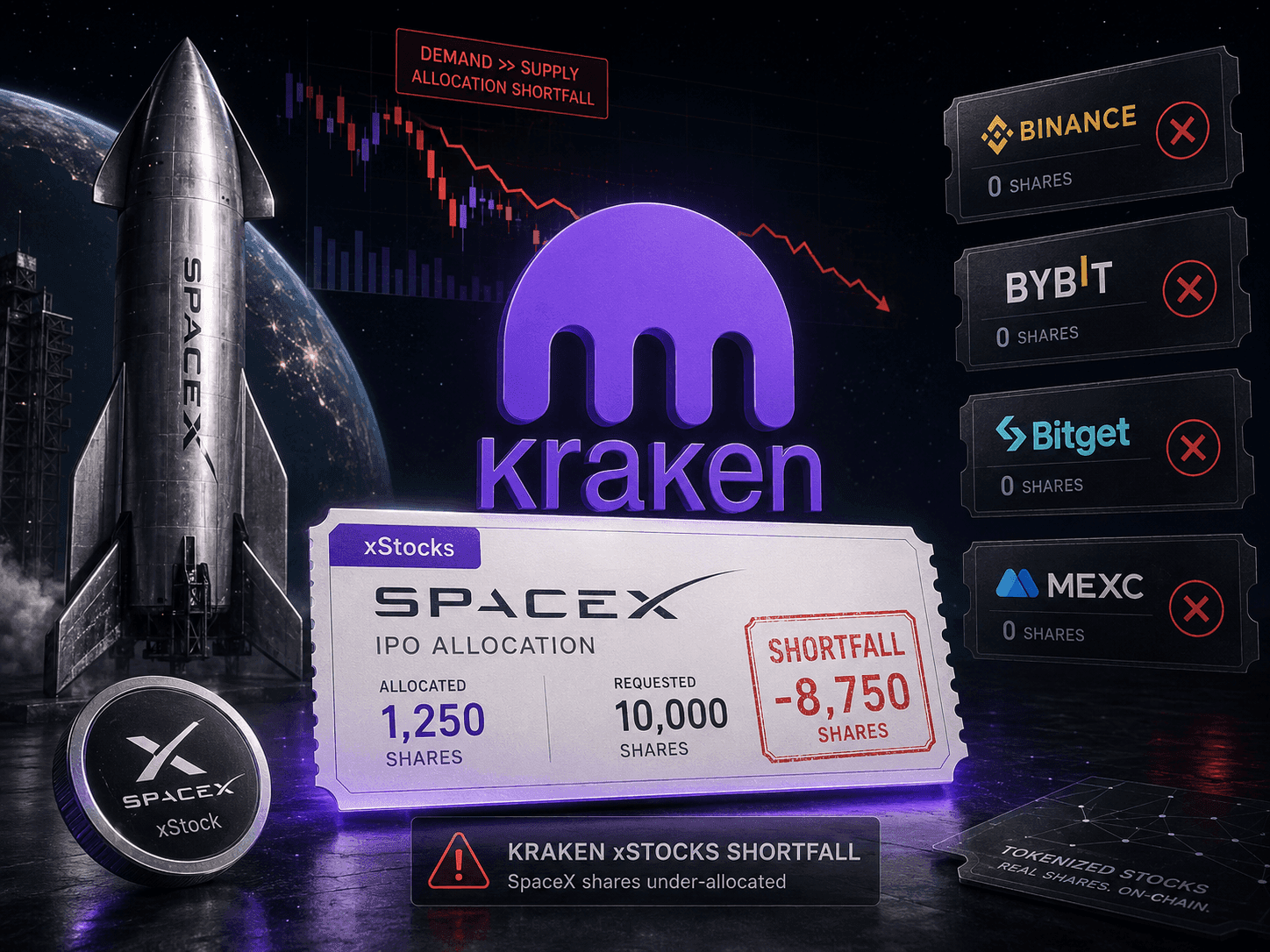
Why Binance, Bybit and Bitget Got Zero SpaceX Shares: Kraken's xStocks Came Up Short
xStocks — Kraken's own tokenized-equity arm — couldn't source SpaceX shares, leaving Binance, Bybit, Bitget and MEXC with zero. Here's why.
May 12, 2026 9:19 AM
Senate Banking Committee Unveils 309-Page Crypto Clarity Act Draft
The US Senate Banking Committee released a 309-page Crypto Clarity Act draft. It defines SEC and CFTC roles while adding strict stablecoin yield rules.

September 17, 2024 6:38 PM

Breaking News: More than 50 Crypto Tokens including ADA, LUNA, and TRX Now Considered Securities by the US SEC
US SEC has declared over 50 tokens, including ADA, LUNA, and TRX, as securities. Let's take a look at these crypto tokens as securities.
May 15, 2024 10:37 AM
Ripple Leads the Tokenization Revolution with XRP
Ripple is leveraging XRP to lead the tokenization revolution, transforming the future of finance with innovative cross-border payment solutions.
October 3, 2024 1:01 PM
Ripple News Today: Bitwise XRP ETF Filing Amid Ripple SEC Lawsuit
Bitwise XRP ETF filing amid Ripple SEC lawsuit was a major development today since the future of XRP remains uncertain... Why now?
August 20, 2024 3:00 PM

New US Senate Proposal Submitted For Crypto Tax Exemption
The US Senate has recently submitted a new proposal to exempt crypto transactions from federal taxes. Here are more details of this submission, and a list of exempted countries it could be joining...

October 4, 2026 1:23 AM

Avalanche adds $266 million in new RWA in 30 days, price at $11.11: What to watch now
Avalanche took on more tokenised stocks in September than any other chain, and the price stands at $11.11. Nearly half of the increase, however, traces back to a single issuer.
September 28, 2026 4:15 AM
NEAR Rises More Than 29 Percent in Seven Days: Why Ondo Stocks and Zcash Trading Are Driving the Price
NEAR gains 29.23 percent within seven days and is the strongest of the 25 largest cryptocurrencies on September 27. Two documented drivers sit behind the move: the launch of tokenised US equities and ETFs from Ondo on the chain, and growing Zcash trading through NEAR Intents.
September 25, 2026 10:14 PM
Sequans sells its last 314 bitcoin: what to check if you hold a treasury stock
Semiconductor maker Sequans has wound down its bitcoin reserve completely, 15 months after setting a target of one hundred thousand coins. What the case reveals about treasury stocks, and which tax rule applies to the share and to the coin.
May 22, 2025 9:58 PM

Stocks vs. Crypto: Where Should You Invest Right Now?
With traditional stocks showing mixed signals and Bitcoin breaking new records, investors are torn: stick with equities or ride the crypto wave? Here’s a breakdown of what’s moving the markets.
October 7, 2024 6:01 PM
As Ripple vs SEC Deadline For Appeal Ends Today, What Comes Next For XRP Price?
What comes next for XRP price, as the Ripple and SEC legal battles continue, along with other major news for Ripple and its XRP Ledger? Let's find out...
June 1, 2024 12:17 PM
XRP SEC Lawsuit Update: A "Fire Gensler" Campaign & A Biden Veto
Ripple CEO Brad Garlinghouse calls on President Biden to replace SEC Chair Gary Gensler...Biden uses his veto right to the latest standalone legislation... Is Biden's veto decision good for Ripple?
July 8, 2026 12:35 PM
Bitpanda Launches 20x Margin Trading on Real Stocks and ETFs — a First for Europe
Bitpanda just went live with leveraged trading on 875+ real stocks and ETFs at up to 20x — no CFDs, no synthetic contracts, just direct exposure.
April 4, 2025 10:54 PM
3 Crypto Stocks That Crashed Hard in the Wake of Market Turmoil
The global crypto market crashed hard. But while crypto took a hit, U.S. crypto-related stocks suffered even more severe losses. With the stock market in chaos, here are three crypto stocks that crashed hard recently.
September 7, 2026 7:22 AM

German Crypto Holding Period Stays: The Income Tax Reform 2027 Leaves Section 23 Untouched
On September 2, 2026 the German federal cabinet adopted the draft of an Income Tax Reform Act 2027, and crypto assets do not appear in it. The one-year holding period under Section 23 of the Income Tax Act therefore continues to apply unchanged.
August 22, 2026 4:47 PM

Offsetting Bitcoin Losses Against Stock Gains in Austria
Offset bitcoin losses against gains on shares? Austria allows it in principle, but only under certain conditions and usually via the tax return.

June 13, 2026 10:33 AM

SpaceX IPO Recap: SPCX Closes +19% in a Record Debut, While Tokenized Stocks Stumble
SPCX jumped 19% to a $2T+ valuation on day one — but the tokenized SpaceX trade split in two, and the difference is the real lesson.

More from CryptoTicker