
NEAR Intents at $169 Million: What to Check Before a Cross-Chain Swap
NEAR rises by almost 18 percent to $4.23 on September 20, 2026, while the NEAR Intents swap layer holds between $167.6 million and $169.1 million. What an intent is, how it differs from a bridge, and what applies to you in Germany.



Which topics should we dive deeper into?
Select what genuinely interests you. Your picks feed directly into our editorial planning.
Crypto news that's actually worth your time.
Weekly. 60 seconds. Carefully curated by our editors: no hype, no promo flood, no spam.
Anyone wanting to move a balance from one blockchain to another has until now mostly used a bridge, and has had to answer two questions themselves: which route the money takes, and who owns it along the way. NEAR takes a different path with its swap layer, NEAR Intents. You describe only the result you want to hold at the end, and several service providers bid against each other for the execution. Between $167.6 million and $169.1 million currently sits in that layer, and the NEAR price has risen by almost 18 percent within 24 hours. This piece separates the documented figures from the expectations and shows what to check before your first swap through this layer.
NEAR price on September 20, 2026: these figures are documented
Retrieved from CoinGecko on September 20, 2026: NEAR trades at $4.23. That is 17.76 percent more than the previous day, 67.5 percent more than the previous week and 103.5 percent more than 30 days ago. Market capitalization stands at $5.53 billion, and trading volume over the past 24 hours at $1.70 billion. That places NEAR 21st in the ranking by market capitalization.
An important point for context: this is an ongoing move and not a finished one. The price has roughly doubled within a month, and a considerable part of that rise falls in the past seven days. Anyone buying in at levels like these is not buying into a quiet market. Experience says the counter-move after a doubling turns out just as forceful, and nobody can tell you when it begins.
On September 18 we already assessed the preceding jump, triggered back then by the launch of confidential perpetuals and an incentive programme with a price condition. If that part of the story interests you, it is in our analysis of the NEAR price jump and the NEAR@3.33 incentive programme. This piece is about something else, namely the swap layer itself and the questions it raises for you as a user.
What an intent is: ordering the result instead of programming the route
An intent is a bindingly stated intention: you set out which result you want to achieve and leave it to others to find the way there. The project's documentation puts it in one sentence: an intent expresses what you want to achieve, and not how you get there.
An example makes the difference tangible. Classically you swap one ether on Ethereum for USDC on Arbitrum in several steps. You look for a trading venue, you pick a bridge, you wait for confirmations, you pay fees at every station and you carry a separate risk at every station. Phrased as an intent, the same process shrinks into a single order: one ether on Ethereum in, USDC on Arbitrum out. Which liquidity is used for it, and which stations it passes through, is no longer your job.
Why this is more than a convenience
The shift changes who carries the execution risk. In the classic version you carry it yourself, because every step you pick is your decision. With an intent the service provider commits to a result and has to work out for themselves how to reach it. For you that means you no longer have to assess the route; instead you have to assess whom you leave the route to, and what happens if they fail.
NEAR Intents in numbers: $169 million across 26 chains
The current figures come from two analyses that differ slightly. DefiLlama reports a locked value of $167.55 million for the swap layer, while an analysis via Dune Analytics arrived at $169.05 million on September 16. The reliable statement is therefore a range of roughly $167.6 million to $169.1 million rather than a single round number. DefiLlama puts growth at 77.2 percent over 30 days.
This capital is spread across 26 chains, though by no means evenly. The NEAR chain itself accounts for around 52 percent, some $87.23 million. Ethereum follows with about $45.89 million. The remainder is spread across networks such as Tron, Bitcoin and BSC. Two chains therefore carry roughly four fifths of the total value, while the other 24 share the small remainder.
Figures are also available on the revenue side. Over the past 30 days, around $5.87 million in fees accrued according to the same analysis, of which $1.29 million remained as protocol revenue. Crypto Briefing published these values on September 19, 2026, citing DefiLlama and Dune.
What these numbers do not say
Locked capital is a stock measure and says nothing about how well any single swap works out for you. A high value means liquidity is there, and liquidity is the precondition for a tight price. It is no guarantee of a good price in an individual case. What counts for you in the end is the difference between the quote you are offered and the reference price on a liquid market.
Solvers, quotes and verifier: who actually executes your swap
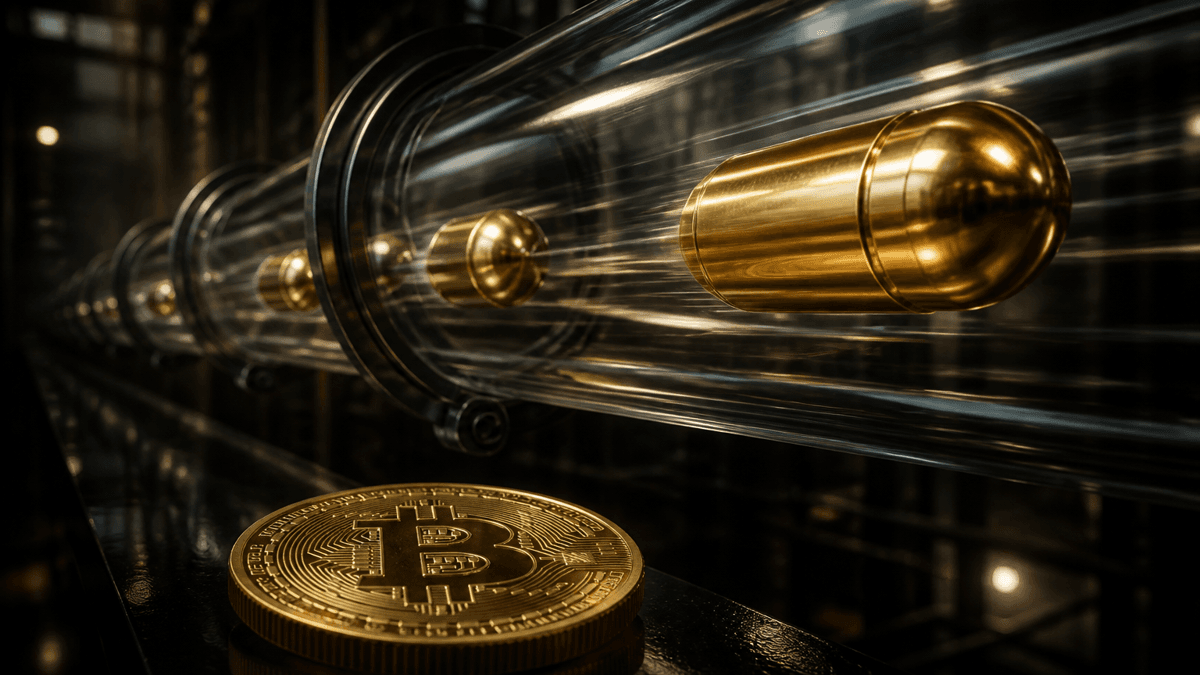
A solver is a market participant who provides liquidity and commits to filling your order at the quoted price. In the documentation they are called market makers. As soon as you submit an order, several of them bid on it and, according to the project, compete on price, speed and execution quality.
That competition is the core of the model. On a classic decentralized exchange you trade against a liquidity pool at whatever price that pool's formula currently yields. Here you collect several quotes and take the best one. The mechanism resembles a tender more than a vending machine.
Settlement is handled by a contract the project calls the verifier contract. It checks whether all conditions are met and executes the result atomically. Atomic means the swap either goes through in full or not at all. The documentation phrases it as your swap either completing in full or you automatically receiving a refund. A state in which your money hangs half-swapped somewhere is, by construction, not meant to exist.
Technically the layer runs under the name Defuse, and the connection for applications goes through an interface the project calls the 1-Click API. You will come across these names when reading the documentation; for actually using the service they are irrelevant.
 Where to buy NEAR under EU regulation
Intent or bridge: why the difference matters after this year's exploits
A classic bridge locks your balance on the origin chain and hands you a stand-in on the destination chain, which is supposed to be backed by the locked balance. That backing is the weak point. If the contract holding the original is drained, an unbacked stand-in is left on the destination chain, economically worthless even though your wallet still displays it.
This is not grey theory but the experience of this year. In the bridge exploit at The Sandbox, SAND holdings on Base and BSC were left unbacked for exactly that reason. Comparable cases occurred around the shutdown of the TON bridge and in the exploit of Maya Protocol.
An intent swap avoids that state, because no stand-in is created at the end. On the destination chain you receive the genuine asset the solver already holds there, and in return they receive your asset on the origin chain. No backing relationship arises that could later fall apart. That removes an entire class of failure.
What is not removed is every risk. It moves. In place of the backing risk comes the risk that the settlement contract itself contains a flaw. September showed exactly how expensive a flaw in verification logic can be: in the break-in at Liquid Network, the damage arose not from stolen keys but from an error in checking proofs. An atomic contract is therefore precisely as reliable as its code and the review of it.
Custody during the swap: when you hand over control
The documentation describes the model as non-custodial and states that you keep control of your balances throughout the process and do not hand them to a third party. That is the decisive difference from an exchange, where you deposit first, then trade, then withdraw.
In practice that means two things for you. First, the key remains the actual security anchor, which keeps the question of where that key sits an important one. If you are moving larger amounts, it belongs on a device that is not connected to the internet. Second, the checking moves forward in time: you sign an intention, and what you sign is what applies.
The three details you read before signing
Before you confirm, you read the confirmation screen for three details. Which asset goes out on which chain. Which asset comes in on which chain, and what minimum amount is guaranteed with it. How long the quote is valid. The third detail is often overlooked and is the most important one in moving markets, because a quote several minutes old reflects a market that no longer exists.
Confidential Intents: what confidential execution achieves against MEV
Part of the attention of recent days goes to an extension the project calls Confidential Intents. It routes orders through a shielded sub-chain, so that the size, timing and direction of a trade are not publicly visible until settlement.
MEV describes the profit third parties extract from being able to influence the order of transactions. Anyone who sees your order in the public waiting area before it is executed can place themselves in front of it and leave you with a worse price. If the order stays hidden until settlement, that opportunity disappears.
On September 17, confidentially locked capital passed $70 million according to the project, triggering the first distribution of the NEAR@3.33 incentive programme, in which 333,333 tokens go to users with more than $100 in confidential holdings and an active swap history. Different figures circulate on its reach: the analysis of locked capital names 26 chains, while the project speaks of more than 30 connected blockchains for confidential execution. The two numbers do not measure the same thing, and we have no clean delineation available.
One point for context, because it often gets lost in the debate: confidentiality towards other market participants is a different thing from anonymity towards the authorities. Your tax obligations do not change because of it, and an incentive token that reaches you is income like any other.
MiCA and the interface: what to look up in the ESMA register
Since 2024, the European regulation on markets in crypto-assets has governed which providers may offer crypto-asset services in the EU and which duties come with that. For you in Germany the practical question is not how a protocol should be classified, but who stands opposite you when something goes wrong.
As a rule that question is decided at the interface through which you trigger the swap, meaning the website or the app. If it is operated by a company based in the EU and authorized as a crypto-asset service provider, duties on information, complaints and organization apply. If no authorized provider is involved, those routes are not open to you, and an unwinding through a supervisory authority is out of the question.
You can look this up yourself. ESMA maintains a public register of authorized providers, and BaFin maintains a database of companies supervised in Germany. Which duties attach to such an authorization is something we have written up in our overview of the MiCA licensing duties for crypto companies. If going through a supervised provider matters more to you than the last bit of price advantage, you will find the trading venues authorized in the EU in our comparison of the best crypto exchanges.
Tax on a cross-chain swap: why the holding period starts again
Here lies the point at which the convenience of the procedure most easily turns into an expensive misunderstanding. A swap feels like moving house from one chain to another. For tax purposes it is not.
Under German law, crypto assets count as other economic goods, and gains from their disposal fall under private disposal transactions according to Section 23 of the Income Tax Act. A swap is a disposal of the asset given up and at the same time an acquisition of the one received. If less than a year lies between acquisition and disposal, the gain is taxable; beyond that it is not. On top of that comes an exemption threshold for the sum of all private disposal transactions in a year, which once exceeded makes the entire gain taxable and not merely the portion above it.
Three things follow from that for an intent swap. The transaction is a sale that counts for tax purposes, even though economically only the chain has changed. For the asset you receive on the destination chain, the one-year period starts again that day. And the fees embedded in the quoted price belong in your calculation, because they reduce the disposal gain.
The practical problem of matching them up
Because the route stays hidden with an intent, what you end up seeing in your wallet is an outgoing transaction on one chain and an incoming one on another, with no visible connection between them. For your records that means you note the transaction at the moment of the swap, with the date, both amounts and the identifiers of both transactions. Reconstructing that connection afterwards from chain data is barely possible. Tools that bring such transactions together and supply a holding-period calculation along with them are set side by side in our comparison of crypto tax tools and portfolio trackers.
A note on the state of play: in September the German Federal Ministry of Finance presented a draft bill that would reorganize the taxation of crypto gains in future. None of it has been enacted. For the current year the legal position applies as described above.
 Recording holding periods and swaps properly
Levels above and below: what to pin the next NEAR step to
With an asset that has roughly doubled in 30 days, round levels are above all reference points for your nerves and no forecast. It is still worth writing down beforehand what you will pin your own decision to, because in the moment of the move people otherwise construct the reasoning after the fact.
On the upside, the $4.23 level is the starting point of this assessment, the current level from September 20. On the downside lies the area around $3.68, where the price stood on September 18 when we assessed the preceding jump. A fall back into that region would take back the gain of the past two days without touching the move of the previous week.
More robust for an assessment than the price is the question of whether usage is growing with it. The locked capital of the swap layer and the fees accruing within it are the more honest indicators, because they do not move on expectation alone. You can follow both continuously at DefiLlama. If the price rises and the fees stagnate, the move is carried by expectation and not by usage.
If you want to trade the move with leverage, the usual warning applies in sharpened form: with an asset of this volatility, an ordinary counter-move is enough to close a leveraged position. How close your liquidation price actually sits is something you calculate before you open the position, not afterwards.
Checking NEAR Intents: what to take away
- Check the interface before you trigger the first swap. Look up in the ESMA register and the BaFin database whether an authorized provider stands behind the app or the website, and decide on that basis how much money you route through it. Anyone preferring the supervised route will find the trading venues authorized in the EU in our comparison of the best crypto exchanges.
- Record every swap immediately. Date, both amounts, both transaction identifiers. Because the route stays hidden, the connection between the outgoing and the incoming transaction can barely be reconstructed later, and that connection is exactly what you need for the holding period. Tools that bring this together automatically are in our comparison of crypto tax tools and portfolio trackers.
- Separate storage from execution. The procedure is non-custodial, so your key remains the security anchor. Move only the amount you are currently swapping through a hot wallet, and keep your holdings on a device with no network connection; an overview of the devices is in our hardware wallet comparison.
The bottom line: the swap layer solves a genuine problem, because it does away with the backing relationship on which several bridges failed this year. In its place comes trust that a settlement contract verifies correctly. The figures show growth so far, and the price has run ahead of them. How much of that is usage and how much is expectation will be decided by the fees of the coming weeks.
(As of September 20, 2026. This article is not investment advice. Prices and fee structures change; check the terms with the provider before you buy.)
Sources: the NEAR Intents documentation and the analysis of locked capital at DefiLlama.
Transparency note: This article was produced with the assistance of artificial intelligence and reviewed by our editorial team before publication. All figures and claims were checked against the primary sources linked in the text. The feature image was generated with AI.
Related articles
- NEAR Intents halts withdrawals after a $3.8 million exploit: here are the reasons
- NEAR Falls Almost 8 Percent After a 62 Percent Week: What to Check on Perps, Buying Route and Holding Period
- Solana DEX Trades Overtake the NYSE: What to Check on Swaps, Tax and Oversight
- Cardano Slides Below $0.24: What ADA Holders Should Check on Leverage, Liquidation and Holding Period
- ETH Price Prediction: What to Check at the $2,800 Mark Now
Which topics should we dive deeper into?
Select what genuinely interests you. Your picks feed directly into our editorial planning.
Crypto news that's actually worth your time.
Weekly. 60 seconds. Carefully curated by our editors: no hype, no promo flood, no spam.

September 27, 2026 1:17 PM
Dogecoin Price: What to Check on Holding Period and Custody Before the Year End
The Dogecoin price stands at $0.0977 on September 27, 2026 and has barely moved in a day. That calm is exactly the moment to work through the holding period, the reporting duty from 2026 and custody without any time pressure.

September 24, 2026 10:12 AM
XRP Falls 9.7 Percent: What to Check on Holding Period and Buying Route
XRP is down around 9.7 percent on the morning of September 24, twice as much as the typical large crypto asset. Our count of 18 coins shows who the pullback hits and which three things hold true regardless of the price.

September 27, 2026 10:14 AM
Shiba Inu Price Prediction: What to Check on SHIB Before the December 31 Deadline
SHIB trades at $0.00000592 on September 27, 2026, around 93 percent below its all-time high. For German investors one date matters more than the chart right now: December 31, 2026.
September 22, 2026 10:13 AM
Circle Lends Against Bitcoin via cirBTC: Why the Wrapper Can Cost You the German Holding Period
Circle launched loans against deposited bitcoin on September 21, 2026. In Germany, the detour through the cirBTC token is very likely a swap, and a swap restarts your one-year holding period.
September 28, 2026 4:15 AM
NEAR Rises More Than 29 Percent in Seven Days: Why Ondo Stocks and Zcash Trading Are Driving the Price
NEAR gains 29.23 percent within seven days and is the strongest of the 25 largest cryptocurrencies on September 27. Two documented drivers sit behind the move: the launch of tokenised US equities and ETFs from Ondo on the chain, and growing Zcash trading through NEAR Intents.
September 9, 2026 4:22 PM
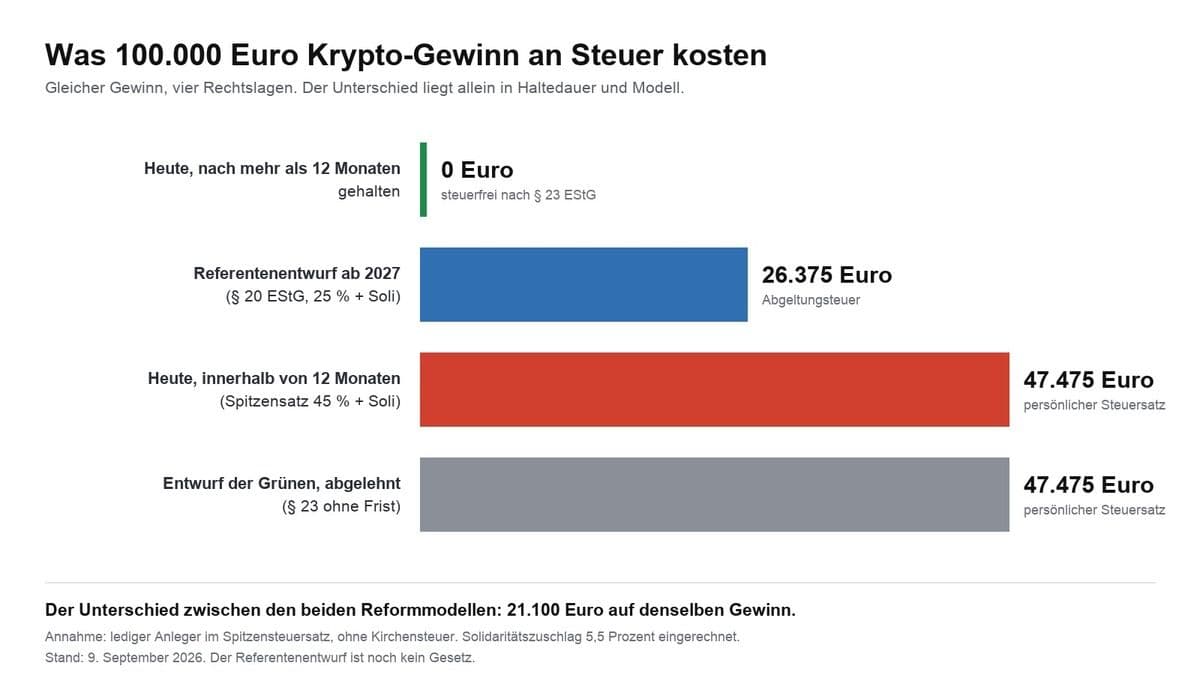
Crypto Tax in Germany: What Applies in 2026 and What Is Set to Change in 2027
Crypto gains are tax-free after twelve months; before that your personal tax rate of up to 45 percent applies. What triggers tax, how the holding period is calculated, what happens with staking and losses, and what the draft bill would change from 2027.
September 22, 2026 1:37 AM

Swapping Bitcoin for Gold: What Happens for Tax in Germany
Moving from coins into gold is a sale in the eyes of the tax office, and the one-year period decides the bill. Where bars, gold ETCs and tokenised gold diverge for tax, and which records you need.
September 26, 2026 1:19 AM
Germany’s Crypto Holding Period Is Wobbling: What to Check Before December 31
A CDU member of the Bundestag makes it plain: the coalition agreement does not guarantee that the one-year holding period for crypto assets will survive. What that means for purchases made before the planned cutoff date of December 31, 2026.
September 26, 2026 7:40 AM
The RAIN Token After the Enlivex Termination: What to Check on Access, Forced Sale and Holding Period
Enlivex terminated a share placement of 66,666,667 shares payable in RAIN tokens on September 22, 2026. The token sits 46.4 percent below its all-time high, and at Kraken the withdrawal deadline expired long ago.
September 24, 2026 4:16 AM
Trump-Xi Summit at the White House: The Crypto Positions to Check Before the Meeting
Xi Jinping is on a state visit to Donald Trump today, and the crypto market comes into the meeting carrying the gains of an exceptionally strong week. What to check on leverage, holding period and custody before the first headline runs.
September 20, 2026 1:11 PM
Bitcoin Golden Cross: What Twelve Signals Since 2014 Really Show
Bitcoin's 50-day line has crossed its 200-day line. We evaluated all twelve golden crosses since 2014 ourselves and measured what happened afterwards. The result argues against the common reading of the signal.
September 18, 2026 10:29 PM
NEAR Jumps 21 Percent: What to Check on the NEAR@3.33 Incentive Programme and the New Perps
NEAR rose to $3.68 on September 18, 2026, after near.com launched confidential perpetuals and set off an incentive programme with a price condition. What is documented, what 40x leverage means and what applies to you in Germany.
September 8, 2026 10:21 PM

Crypto Holding Period and Grandfathering: Why December 31, 2026 Becomes the Cut-Off in Germany's Draft Bill
A ministerial draft bill from Germany's finance ministry names a cut-off date for the first time: crypto assets acquired after December 31, 2026 are to fall under the flat-rate withholding tax. What that means for legacy holdings, running savings plans and staking income, and why nothing has been decided yet.
September 25, 2026 7:24 PM

Bitcoin Forecast: What to Check on Levels, Holding Period and Buying Route Before the Quarter Ends
Bitcoin stands at $83,877 at 16:40 UTC on September 25, 2026, and the measured volatility of the past 30 days spans a band of $73,600 to $94,200 for the coming month. More important than that band before the quarter ends are three checks: holding period, buying route under MiCA and the reporting duty in force since January 2026.
September 24, 2026 1:11 PM
Stellar Becomes a Payment Rail at Mastercard's BVNK: What XLM Holders Should Check on Buying Route, Memo and Holding Period
BVNK has switched on Stellar as a payment rail for business customers in more than 130 countries. On the same trading day XLM falls by around seven percent — we separate what the news means from what the pullback means for your portfolio.
September 19, 2026 7:17 AM
Chainlink Jumps Above $12: What LINK Holders Should Check Now
Chainlink trades at $12.34, 7.4 percent higher than yesterday. What part of the move is the broad market rally, what Chainlink itself contributes, and the three things you should check as a LINK holder.
October 3, 2026 10:33 AM

Shiba Inu 93.4 Percent Below Its Record: 31 December 2026 Splits Old and New SHIB
Shiba Inu trades at $0.00000568 on 3 October, 93.4 percent below its record. More important than the day is the German draft bill on crypto tax: it splits your SHIB into grandfathered and new holdings on 31 December 2026.
September 24, 2026 10:11 PM

Bitcoin Price Prediction: What to Check on Levels, Holding Period and Leverage Before the October 28 Rate Decision
Bitcoin is trading at around $83,800, a third below its October 2025 high, while the sentiment index reads greed. Which dates, levels and deadlines over the coming weeks really decide your net gain, and which of them you steer yourself.
September 23, 2026 7:22 PM
Solana Price Holds $114: What Holders Check Five Days Before Alpenglow
SOL stands at $114.55 on September 23, after a 17.7 percent gain in seven days and a 2.2 percent loss on the day. Two deadlines matter more than the daily move: Alpenglow opens on September 28, and every purchase made this week starts a holding period of its own.
September 13, 2026 10:12 PM
Chainflip Hack on Tron: How to Check Whether Your USDT Swap Is Still Stuck
An attacker drained 736,442 USDT through Chainflip's Tron rail on September 12, 2026, and trading has been at a standstill ever since. On September 13 we measured for ourselves which functions of the protocol are switched off and which are still running.
October 2, 2026 10:17 PM
Dogecoin breaks below $0.093: the BWOW fund turns every DOGE into cash on October 14
Dogecoin costs $0.0914 on Friday evening and has lost 3.4 percent in 24 hours. On October 14 the US fund BWOW sells its entire holding, and on the same day the German cabinet takes up the reform of crypto taxation.
October 1, 2026 7:16 AM

Bitway (BTW) hits a record $1.43: 27 percent in a week while the market stood still
Bitway marked an all-time high of $1.43 on Monday and trades at $1.32 after a weekly gain of around 27 percent, while the broader market stood still. What carried the jump, when the incentive campaign ends, and what applies to circulating supply, authorisation and tax in Germany.
September 28, 2026 1:26 PM
Shiba Inu Price Below Six Millionths of a Dollar: 477 Million Burned Tokens Are 0.000081 Percent of Supply
The Shiba Inu price stands at $0.0000056 on September 28, 2026 and has lost a good 6 percent in 24 hours, although 476.96 million SHIB were destroyed over the past 30 days. The arithmetic behind it explains why the burn does not carry the price, and what counts for holders in Germany on tax before the year turns.
September 26, 2026 10:12 AM

Canton Jumps 15.6 Percent to $0.13: What to Check on Trading Volume Before You Order
Canton (CC) gains 15.64 percent in 24 hours to $0.13443, making it the strongest mover in the top 25. Our own count shows that CC trades at just 0.94 percent of its market capitalisation, a fifth of the median.
September 26, 2026 7:14 AM
Cardano Before the RealFi Launch on October 1: What ADA Holders Should Check on USDr, MiCA and Tax
On October 1, 2026 the stablecoin platform RealFi goes live on the Cardano mainnet, and ADA has gained 14.67 percent in a week. What is documented about the yield-bearing dollar token USDr, and what investors should settle beforehand.
September 24, 2026 10:19 AM

Uniswap Falls 11.8 Percent After a 114 Percent Month: What to Check on Profit Taking, Holding Period and Leverage
UNI lost 11.75 percent on Wednesday morning but is still up 113.85 percent over the month. Anyone realising gains now almost certainly triggers a taxable disposal in Germany.
September 22, 2026 1:15 AM
Memecoin Rally: Why Memecoins Are Rising and What to Check Before You Buy
The memecoin sector stands 9.01 percent higher, the overall market only 2.90 percent. The arithmetic behind it shows that two tokens carry three quarters of the move and that the sector has no occasion of its own.
More from CryptoTicker