
SpaceX Lockup: What the Release Dates Through December 8 Mean for Tokenized SPCX Stock
The SpaceX lockup expires in five stages, the next on September 9, 2026. Anyone holding a tokenized SPCX share carries the full supply pressure and runs into a hole in the calendar on October 24.



Which topics should we dive deeper into?
Select what genuinely interests you. Your picks feed directly into our editorial planning.
Crypto news that's actually worth your time.
Weekly. 60 seconds. Carefully curated by our editors: no hype, no promo flood, no spam.
At SpaceX the lockup does not expire on a single day but in fixed stages. The next of these dates is September 9, 2026, followed by September 24, October 9, October 24 and, as the closing point, December 8, 2026. If you hold a tokenized SPCX share, this calendar concerns you just as much as a shareholder on the Nasdaq, even though you own no stock at all. This article sorts the dates, works out how many shares sit behind each stage, and shows the point where stock and token part ways.
What a lockup is and why it hits holders of tokenized SPCX stock
A lockup means that anyone who held shares before the listing is barred from selling them for a set period. The purpose is to stop early shareholders from flooding the market on the first day of trading. When the period ends, those shares join the freely tradable pool, the free float. Whether anyone actually sells is up to the holder alone; the release only permits it.
A tokenized stock is not a share in a company but a token on a blockchain that tracks the price of a deposited share and whose value is guaranteed by an issuer. The price of that token hangs on the price of the underlying. So when additional shares become sellable on September 9 and the price reacts, your token carries that move with it, without you being able to trade on the Nasdaq at all.
This exact seam has so far been left uncovered in German-language coverage. Plenty of outlets report the price reaction; what the chain of dates means for someone holding the value as a token in a crypto account appears nowhere. This article closes that gap.
These lockup release dates through December 8, 2026 are written into the prospectus
The dates are not an estimate from a research house. They are named in the prospectus (Form 424B4) that SpaceX filed with the US Securities and Exchange Commission on June 12, 2026. The prospectus distinguishes three groups of shares, and only one of them is due for release this autumn.
Group 1: the 180-day lockup
All remaining outstanding shares are subject, according to the prospectus, to a lockup running to the 180th day after the prospectus date, that is to December 8, 2026. This group carries automatic early releases:
- up to 20 percent on the second full trading day after the release of second-quarter 2026 results
- a further up to 10 percent if the closing price stood at least 30 percent above the offer price on at least five of the ten trading days up to that cut-off
- a further up to 7 percent on each of August 20, September 9, September 24, October 9 and October 24, 2026
- a further up to 28 percent after third-quarter 2026 results
- on December 8, 2026 the entire remainder
Group 2: the extended lockup
Several large shareholders agreed to an extended period that ends only after second-quarter 2027 results. Early releases start there in the first quarter of 2027, among them on March 18, 2027 and May 17, 2027.
Group 3: the founder shares
The founder's shares are locked until the 366th day after the prospectus date, that is to June 12, 2027, and expressly without any early release. Together with the extended group they account for around 7.8 billion shares, more than 63 percent of all shares outstanding immediately before the listing, according to the prospectus.
For this year that means the entire pressure comes from Group 1. The large blocks held by the founder and the anchor shareholders stay locked through 2026.
How many shares sit behind a 7 percent lockup stage
The prospectus gives percentages, not share counts, and the percentages refer to the pool of the 180-day group rather than to every share in the company. A defensible order of magnitude can still be derived. CNN reported on August 6, 2026 that up to 911.5 million shares were released that day; that was the 20 percent stage. Working backwards puts the pool at around 4.56 billion shares, and 7 percent of that is roughly 320 million shares per date.
That figure is a back-of-the-envelope calculation from two documented statements and not a company disclosure. As an order of magnitude it serves: each of the five autumn stages is about half the size of the first release in August, and all five together come to roughly one and a half times it.
For comparison the starting position, also following the CNN account of August 6: around 640 million shares were sold in the listing, less than 5 percent of all shares. After the first release, around 12 percent was tradable. In total there are more than 7.5 billion Class A shares and more than 5.5 billion Class B shares.

Why your stock token carries the lockup supply pressure without giving you a vote
The decisive difference lies in the legal nature. A share is a stake in the company and carries voting and dividend rights. A stock token is a claim against the issuer, who promises to track the value of the deposited share. What you actually hold with a tokenized stock, and which rights are missing, we took apart in the explainer Tokenized stocks: why you do not own a share.
For the lockup this produces an uncomfortable asymmetry. You are fully exposed to the price risk of the releases, because the token follows the underlying. You have no part in the rights that could protect a shareholder in such a situation: no vote, no direct relationship with the company, no position in the share register. Your counterparty is the issuer of the token and the platform where you hold it.
That this construction creaks under pressure was visible at the start. Looking back at the first day of trading, CryptoTicker described on June 13, 2026 how the tokenized versions of SPCX stock stumbled, and reported the same day that several venues received no allocation from the tranche and cancelled customer orders. Anyone who believed they had bought got their money back instead of a token.
 Trading tokenized stocks: regulated or not at all
Issuer risk: the lockup question that comes before the price
Issuer risk describes the danger that whoever issues a security or a token cannot honour their commitment. With a tokenized stock this sits at the centre of the construction: your position is worth as much as the issuer's promise holds.
Ahead of a release date it is therefore worth reading up on three points before you think about prices. First: who issues the token, and under whose supervision does that issuer stand? Second: is there a binding redemption promise, and at what price is redemption made? Third: what happens to your position if the platform suspends trading while the underlying falls? Trading suspended on the very day of a release is the case you want to think through in advance.
If those questions go unanswered for you, that is already the answer. Where a provider discloses supervision, custody and redemption, you can check it; our comparison of regulated crypto exchanges ranks providers by exactly these features.
October 24 falls on a Saturday: the hole in the lockup calendar
Here lies the point German coverage has missed so far. The prospectus names calendar days, not trading days. Four of the five autumn dates fall on weekdays: September 9 on a Wednesday, September 24 on a Thursday, October 9 on a Friday, December 8 on a Tuesday. October 24, 2026 falls on a Saturday.
The Nasdaq is closed that day. A shareholder can react to the release on Monday at the earliest, and until then the share price does not move. A stock token, by contrast, trades around the clock, weekends included. The consequence: over the weekend the token reflects only what the crypto market makes of the release, without the reference price it otherwise orients itself by.
Two things come together here. At the weekend the order book is thinner, because fewer participants are active; smaller orders then move the price further. And the premium, the gap between the token price and the last closing price of the share, can open wide in either direction, because no trading in the underlying pulls it back. Anyone selling into an order book like that on a Saturday evening pays that gap.
In practice: for this date the orderly market ends on the Friday evening before. Anyone wanting to change a position ahead of the release has a reliable reference price behind them until then.
What August 6 taught about lockup release dates
The first stage provides the best experience available, and it turned out differently than expected. On August 5, 2026, the day before the release, the stock fell by almost 14 percent and closed at $108.27 according to CNN, an all-time low. On August 6, when up to 911.5 million shares were released, the price rose by more than 6 percent.
The market had therefore anticipated the release, and the date itself brought relief instead of pressure. A second point from the same account: on both days retail participation was as high as it had last been in the week after the listing, and on balance there was net buying every trading day.
The price condition from the prospectus shows how far the stock stood from its offer price. The additional 10 percent stage would have required a price at least 30 percent above the offer price of $135, that is around $175.50. With a closing price of $108.27 the day before, that mark was out of reach. For context: at that point the stock stood more than 40 percent below its record high of June 16 and 15 percent below the offer price.
One date is deliberately missing from the calendar. The 28 percent stage hangs on the publication of third-quarter 2026 results, and that date is not yet fixed. It is the largest single stage of the year, and it can fall between October 24 and December 8. On top of that comes the quarterly rebalancing of the Nasdaq 100 in September: because that index weights the freely tradable pool among other things, the stock's weight grows with every release.

How to check your position before a lockup release date
None of this yields a trading recommendation. What it does yield is a checklist. The list costs you twenty minutes and answers the questions that count when it matters.
- Where does the token sit? On a trading venue, or in a wallet only you can access? That decides whether you can trade at the weekend at all.
- Who is the issuer, and what do they promise? Redemption, custody of the underlying, supervision: is that on the product page, or do you have to guess?
- How thin is the order book outside Nasdaq hours? A look at spread and depth on any given Sunday says more than any volume report.
- How large is the premium to the last closing price of the share? Anyone who checks this regularly recognises an outlier situation when it arrives.
- Are your purchases documented? You will need the purchase date, price and fees at the latest when you sell.
Point five sounds like bookkeeping and is the most expensive one when it is missing. Why, is in the next section.
Tax in Germany: why selling a stock token follows its own rules
A sale around a lockup release date is rarely tax-neutral, and with tokenized stocks the treatment differs from selling a share through a broker. The reason lies in the classification: a token that tracks a share is not automatically treated like a share. Which periods and which records apply in Germany, we wrote up in detail in Taxing tokenized stocks in Germany.
For this autumn's chain of dates one thing matters above all. A hurried sale on the Friday evening before October 24 can break a holding period that would have expired four weeks later. Anyone who knows their purchase data sees that in advance. Anyone who first digs it out in the spring finds out too late.
A warning about the self-reporting of trading venues: an annual report from a crypto venue is not a tax certificate in the sense of German law. It is a data extract that you have to check and prepare.
Bull case and bear case: what specialists say about the lockup releases
Assessments diverge, and both camps have an argument. All the statements that follow come from CNN's coverage of August 6 and are attributed here to their authors.
The cautious view
Jay Ritter, professor emeritus at the University of Florida and a specialist in listings, places the experience like this: when less selling pressure emerges than expected, the price sometimes even rises on a release; usually it falls, but not always. Ryan Lee of Direxion points to the incentives of early shareholders: anyone who came in long before the listing is sitting on gains and has a reason to sell.
The relaxed view
Justus Parmar, founder of Fortuna Investments and invested himself, counters that an inflow of new shares can weigh on any price in the short term but changes nothing about the business picture. Viraj Patel of Vanda points to the demand side and notes that retail investors bought on net on every single trading day.
What both camps share: a release is a supply event, not a verdict on the company. For you as a token holder there is the additional question of whether your platform works on the day it matters.
Frequently asked questions about the SpaceX lockup
What exactly happens on September 9, 2026?
Up to a further 7 percent of the 180-day group becomes sellable, around 320 million shares by the calculation above. Selling happens only to the extent that holders want it.
Does my token expire when a lockup ends?
No. The lockup concerns early shareholders of the company, not you. You are affected only through the price your token follows.
Why is December 8, 2026 the most important date?
That is the day the 180-day period ends and the entire remainder of that group becomes sellable. Every date before it releases only a portion.
Can I sell directly on the Nasdaq as a token holder?
No. You trade the token on the platform that carries it. The detour via the issuer is exactly the difference this article is about.
Checking the SpaceX lockup: what to take away
- Put the dates in your calendar before they surprise you. September 9, September 24, October 9, October 24 and December 8, 2026 belong in your calendar, with the Saturday date carrying the Friday before it as the practical deadline. Which venues you can actually trade on is shown by the crypto exchange comparison.
- Settle the issuer risk before the price forecast. Redemption promise, custody and supervision decide more in an emergency than any price expectation. The tax and portfolio tools comparison also holds on to the purchase data you need when you sell.
- Take larger positions out of platform dependency. Anyone holding meaningful amounts across several release dates should look at custody and access separately; the hardware wallet comparison shows what works and what does not.
Sources to read up on: the 424B4 prospectus at the SEC with the full release calendar, and CNN's coverage of the first release on August 6, 2026.
(As of August 30, 2026. This article is not investment advice. Prices and fee structures change; check the terms with the provider before you buy.)
Transparency note: This article was produced with the assistance of artificial intelligence and reviewed by our editorial team before publication. All figures and claims were checked against the primary sources linked in the text. The feature image was generated with AI.
Related articles
- Cerebras Lockup and Tokenized Stocks: The Release Schedule Through November 2026
- Tokenized Stocks: Why You Do Not Own a Share and Which Risk Hangs on the Issuer
- SpaceX Stock (SPCX): From $211 Record to $104.83 Low in 5 Phases
- SpaceX (SPCX) Crashes 10% as Bond Spree and Lockup Fears Spook Investors — Here's Why
- Staking Lock-Up Period: How Long You Wait for Your Coins After Unstaking
Which topics should we dive deeper into?
Select what genuinely interests you. Your picks feed directly into our editorial planning.
Crypto news that's actually worth your time.
Weekly. 60 seconds. Carefully curated by our editors: no hype, no promo flood, no spam.

September 7, 2026 7:14 AM
Stock Tokens: Who Actually Issues Them and What the SEC Wants to Change by November 3, 2026
Behind every stock token sit an issuer, a broker, a custodian and a blockchain, and today you will only find those names in the small print. The US Securities and Exchange Commission wants them written into an official form; the deadline for comments runs out on November 3, 2026.
September 26, 2026 10:33 AM

Monad Unlock on November 24: Why 10.7 Billion MON Equal Around 90 Percent of the Circulating Supply
At the first anniversary of the mainnet launch, Monad's one-year lock-up on team tokens ends. This tranche alone reaches around 90 percent of the amount circulating today. What the primary source evidences, which aggregator figure is wrong, and what you can check before the date.

June 17, 2026 9:41 AM
SpaceX vs Bitcoin: Which Was the Better Investment?
SpaceX stock vs Bitcoin: who actually won? See what investing at SpaceX's launch versus buying Bitcoin a year ago would be worth today.
June 16, 2026 11:16 AM

How to Buy SpaceX Stock (SPCX): Step-by-Step Trading Guide
SpaceX stock (SPCX) jumped to $192 on its second trading day. Here's the price action — and exactly how to trade SPCX step by step.
June 12, 2026 6:23 PM
SpaceX IPO Today: SPCX Stock Opens Near $152 and Jumps Toward $172 — What Happens Next?
SpaceX stock opened around $152 and surged toward $172 after its historic IPO. Is SPCX heading for a bigger rally, or could a sharp post-IPO crash be next?

June 13, 2026 10:33 AM
SpaceX IPO Recap: SPCX Closes +19% in a Record Debut, While Tokenized Stocks Stumble
SPCX jumped 19% to a $2T+ valuation on day one — but the tokenized SpaceX trade split in two, and the difference is the real lesson.
June 17, 2026 1:30 PM
SpaceX or Ethereum: Which Delivered the Better Return?
SpaceX stock versus Ethereum, one year on. We compare the returns, the dollar outcomes, and which is better positioned from here.
August 12, 2026 6:24 PM

Tokenized Stocks and Tax in Germany: When the One-Year Holding Period Applies and When the Flat Tax Bites
If you buy a tokenized stock, you often apply the crypto rule: hold for a year, then the gain is tax-free. For these products that assumption usually does not hold, and this article shows from the wording of the law which feature decides the tax regime and how to find it in the issuer documents.
September 2, 2026 10:30 AM

Tokenized Stocks: Who Owns the Share When the Register Sits on a Blockchain
The US Securities and Exchange Commission wants to allow the official share register to be kept on a blockchain. What the proposal of September 1, 2026 means for tokenized stocks and for your ownership.

September 19, 2026 10:26 PM
World Liberty Financial: Trump's WLFI Stake Locked Until 2028, Voting Rewards From October
Donald Trump's WLFI stake, a good 14 billion tokens, is contractually locked until May 2028. From October 1, holders are to receive rewards for locking their tokens for 180 days and voting. What both mean for the price and what to check before you buy.
June 12, 2026 1:09 PM

How to Buy SpaceX Stock (SPCX): IPO Date, Valuation, and the 3 Best Platforms
SpaceX hits Nasdaq at a ~$1.75T valuation. Here's the IPO date, what to expect on day one, and the 3 best platforms to buy SPCX.
May 22, 2025 11:00 PM
You Can Now Trade Tesla and Apple on Kraken... Here's How
Crypto exchange Kraken is launching tokenized stocks for Tesla, Apple, and Nvidia—giving non-U.S. users 24/7 access to some of the world’s biggest companies.
August 13, 2026 8:19 AM
SpaceX Stock Up 40% in 5 Days: SPCX Adds $530 Billion as Musk Bets the Company on AI
SPCX has ripped 40% higher in five sessions, adding roughly $530 billion in market value. Here is what is driving it and what the chart says next.
July 9, 2026 4:32 PM
Will the SpaceX Stock Price Crash? What Comes Next After the Post-IPO Slide
SpaceX shares have slid from their debut highs back toward the offer price. Here is what is driving the drop and what could happen next.
October 4, 2026 1:23 AM

Avalanche adds $266 million in new RWA in 30 days, price at $11.11: What to watch now
Avalanche took on more tokenised stocks in September than any other chain, and the price stands at $11.11. Nearly half of the increase, however, traces back to a single issuer.
September 12, 2026 1:12 PM

Crypto ETN in Your Portfolio: How to Check Who Really Owes You the Bitcoin
A Bitcoin ETN is legally a debt security, not a fund unit. We counted the 122 crypto ETNs tradable on Xetra ourselves and show you the three details worth checking before you buy.
May 4, 2026 6:15 PM

DTCC Tokenized Securities: Is Wall Street About to Bring Stocks On-Chain?
DTCC plans tokenized securities trades in July 2026, signaling Wall Street’s next major step toward blockchain-based financial markets.
June 13, 2026 11:45 AM
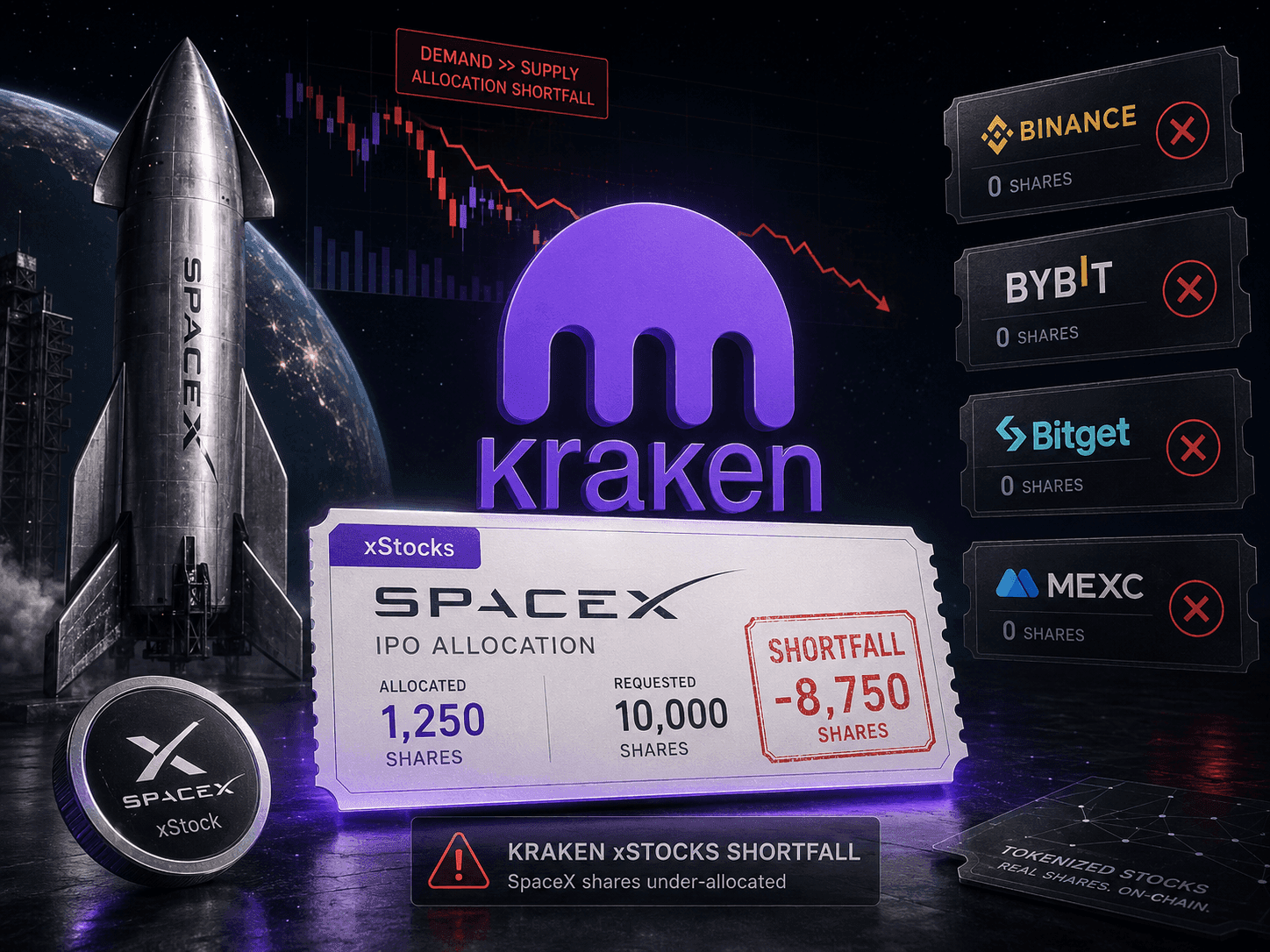
Why Binance, Bybit and Bitget Got Zero SpaceX Shares: Kraken's xStocks Came Up Short
xStocks — Kraken's own tokenized-equity arm — couldn't source SpaceX shares, leaving Binance, Bybit, Bitget and MEXC with zero. Here's why.
September 19, 2026 4:33 PM
Tokenized US Stocks: What the SEC Exemption Changes for You in Germany
On September 17, 2026 the SEC cleared trading in tokenized US stocks for five years, capped at 75 symbols per venue and only with full shareholder rights. What the decision regulates, what it leaves open and the four points you should check as an investor in Germany.
June 1, 2026 1:17 PM
Binance Launches US Stock Trading with Upcoming bStocks Tokenization on BNB Chain
Binance has introduced zero-commission US stock and ETF trading for non-US users, with plans to launch tokenized on-chain equities via bStocks.
September 9, 2025 11:00 PM
You Can Now Buy US Stocks on Kraken – Here’s How
Kraken brings tokenized US stocks to Europe with xStocks. Trade equities like Nvidia and Google onchain, reshaping the future of crypto and finance.
January 26, 2025 1:24 PM
From Skeptic to Advocate: How BlackRock and Larry Fink Are Leading the Crypto Revolution
How are BlackRock News and Larry Fink shifting towards Bitcoin and tokenized assets shaping a crypto revolution?
September 17, 2026 10:12 PM
Stock Tokens: How to Check Whether Yours Carries Real Shareholder Rights
The SEC allows US trading venues to handle tokenized stocks only if the token carries the same rights as the original. That condition does not automatically apply to the stock token you buy here, so here is how to check what is inside yours.
August 21, 2026 10:16 AM

24-Hour Trading on US Exchanges: What the SEC Roundtable Means for Tokenized Stocks
The US Securities and Exchange Commission takes up the path to round-the-clock trading on American equity markets on September 17, 2026. For tokenized stocks on Kraken and Binance, that puts their most important selling point back on the table.
November 5, 2025 1:16 PM

$1 Trillion Wiped: Risk-Off Storm Engulfs Stocks & Crypto
Global markets plunge as tech stocks and crypto crash, wiping over $1 trillion in value amid AI bubble fears and investor risk-off panic.
October 1, 2026 4:45 PM

XRP price prediction after the release of 1 billion tokens: what to watch now
Ripple took one billion XRP out of escrow on October 1, and the price still stands almost unchanged at $1.49. For you in Germany, though, a different number than the price decides this quarter, namely December 31, 2026.
September 30, 2026 10:27 AM

92.6 Million ARB Every Month: When the Arbitrum Lockup Runs Out
Every month exactly 92,645,833 ARB fall out of the lockup at Arbitrum, and only a few tranches are left. We recalculate the monthly instalment from the Arbitrum Foundation's allocation table and name every remaining date.
More from CryptoTicker