
MSCI Wants Bitcoin Giant Strategy Out: $2 Billion Is on the Line
MSCI has proposed rules that would remove Strategy and Metaplanet from its global indexes in November, triggering up to $2 billion in forced selling.


Which topics should we dive deeper into?
Select what genuinely interests you. Your picks feed directly into our editorial planning.
Crypto news that's actually worth your time.
Weekly. 60 seconds. Carefully curated by our editors: no hype, no promo flood, no spam.
Index provider MSCI opened a public consultation on 14 August 2026 that would make so-called non-operating companies ineligible for its Global Investable Market Indexes. Applied to May 2026 data, the proposed screen deletes Strategy (MSTR), Metaplanet (3350) and uranium holder Yellow Cake (YCA) from the MSCI ACWI IMI. Feedback closes on 30 September, results arrive on 16 October, and any change takes effect at the November 2026 index review.
Why Does MSCI Want to Remove Strategy From Its Indexes?
MSCI argues that companies holding assets without running a substantive operating business should not qualify for equity indexes designed to track investable markets.
The msci strategy index removal proposal is the provider's second attempt in ten months. An earlier consultation opened on 10 October 2025 targeted digital asset treasury companies directly, defining them as firms holding 50% or more of total assets in Bitcoin or other digital assets. That proposal named 39 companies and triggered significant volatility in mstr stock.
Strategy objected formally in December 2025, arguing the 50% threshold was arbitrary and would cause repeated index entries and exits as the bitcoin price moved. MSCI confirmed on 6 January 2026 that it would not implement the exclusion at the February 2026 index review.
The January decision was not a full reprieve. MSCI froze digital asset treasury companies in place, blocking increases to Number of Shares, Foreign Inclusion Factor and Domestic Inclusion Factor, and deferring additions and size-segment migrations. The August 2026 replacement is asset-agnostic and contains no reference to digital assets.
 Buy crypto: compare the best exchanges
What Are the MSCI Non-Operating Companies Rules?
The proposed screen applies a two-stage test: an operating asset threshold, followed by five financial ratios, with companies failing four of the five deemed ineligible.
Stage one assesses whether operating assets exceed 50% of total assets. Companies that clear this threshold remain index-eligible with no further review.
Companies that fail stage one proceed to the five-ratio test. At the softer thresholds applied to existing index constituents, the msci non-operating companies criteria are:
- Operating asset intensity below 10% of total assets
- Operating expenses below 5% of total assets
- Operating cash flow below zero
- Non-operating fair value changes above 5% of total assets
- Financing cash flow above 30% of total assets, combined with filings showing capital raised for asset accumulation
Failing four of the five results in ineligibility. Deletion follows only after two consecutive annual filings fail the test.
The fifth ratio carries particular weight for bitcoin treasury companies. Issuing equity through at-the-market programmes to fund Bitcoin purchases is the defining mechanism of the treasury model, and it is the behaviour the ratio identifies. Share buybacks, USD reserve building and convertible note retirement do not alter any of the five measures.
Which Bitcoin Treasury Companies Fail the MSCI Screen?
MSCI's simulation using May 2026 data produced three outright deletions from the ACWI IMI: Strategy, Metaplanet and Yellow Cake.
Strategy is the largest affected constituent at approximately $23.93 billion, followed by Yellow Cake at $1.81 billion and Metaplanet at $654 million. Metaplanet currently holds 43,000 BTC.
Three further companies were placed on a watchlist, including Ethereum treasury firm SharpLink Gaming (SBET). A second consecutive weak annual filing would move them into the deletion category.
The inclusion of Yellow Cake, a London-listed uranium holding vehicle with no crypto exposure, is central to MSCI's position on metaplanet msci eligibility and the wider proposal. Under the framework, a uranium storage vehicle and a Bitcoin treasury share the same structural profile: an entity holding an appreciating asset without substantive operations. Three companies out of roughly 9,000 index constituents fail the screen.
How Much Forced Selling Would MSTR Index Removal Trigger?
JPMorgan estimated that MSCI exclusion alone could force approximately $2.8 billion in passive outflows from Strategy, rising to about $8.8 billion if other index providers adopt comparable screens.
The November 2025 estimate, produced by analysts led by Nikolaos Panigirtzoglou, remains the largest published figure for strategy passive outflows. The gap between the two numbers defines the risk: MSCI acting alone represents an absorbable event, while adoption by FTSE Russell, S&P Dow Jones and comparable providers represents a materially different scale.
Independent estimates cluster lower on the MSCI-specific component. TD Cowen attributed $2.5 billion of Strategy's market value to MSCI inclusion and $5.5 billion to other index memberships. Adjusted for the share price prevailing in August 2026, current framing places the MSCI-only figure closer to $1.8 billion to $2.0 billion.
One constraint limits the impact of any mstr index removal. Deletion compels selling only by passive index-tracking funds. Active managers are under no obligation to mirror benchmark changes, which places a ceiling on the mechanical outflow.
How Did Strategy Respond to the MSCI Proposal?
Strategy rejected the premise of the proposal, stating that index providers should measure markets rather than determine which assets companies are permitted to hold.
In a statement published on X on 14 August, the company said digital assets are assets, and argued that the proposal places MSCI out of step with regulators, markets and its own customers. The statement concluded that neither Bitcoin nor Strategy requires MSCI.
 Compare crypto brokers for stocks and crypto
The response follows the company's formal objection of December 2025, which preceded MSCI's decision not to implement the earlier crypto-specific rule. The circumstances differ in one respect. The December objection rested substantially on the argument that the rule discriminated against a single asset class. That argument applies less directly to a screen that also captures a uranium holding vehicle.
MSTR shares declined approximately 4% on the session following the announcement, closing near $93.
Why Is Metaplanet Under Pressure Beyond the MSCI Index Risk?
Metaplanet's mNAV has fallen below 1.0, closing off common share issuance as a funding channel and forcing a shift toward debt financing.
mNAV measures a company's market value against the net asset value of its holdings. A reading above 1.0 indicates investors are paying a premium to the underlying Bitcoin. A reading below 1.0 indicates the market values the company at less than the Bitcoin on its balance sheet.
The distinction determines whether the treasury model functions. At a premium, issuing shares to purchase Bitcoin increases Bitcoin held per share for existing holders. At a discount, the same transaction is dilutive. Sub-1.0 mNAV effectively suspended common-share issuance for Metaplanet in the second quarter.
The company announced BitBonds on 13 August, a continuous programme of senior unsecured ordinary bonds. The inaugural issuance comprised four privately placed series totalling approximately 200 million yen, or about $1.3 million. Metaplanet describes the programme as converting treasury value into fixed-rate funding, and retains a target of 100,000 BTC by the end of 2026. The company has used 83% of a $500 million credit line reaching its current position.
Separately, a transfer of 5,014 BTC between wallets on 12 August prompted speculation of a sale. CEO Simon Gerovich confirmed the movement was a routine custody operation between Metaplanet-controlled addresses, with holdings unchanged at 43,000 BTC and total network fees of approximately $8.
Combined, bitcoin treasury companies face constrained equity issuance from below and index eligibility risk from above.
When Will MSCI Decide on the Strategy Index Removal?
MSCI will announce consultation results on 16 October 2026, with implementation at the November 2026 index review if the proposal is adopted.
- 30 September 2026: Consultation feedback closes
- 16 October 2026: MSCI publishes results and final methodology
- 11 November 2026: Implementation at the November index review, subject to adoption
MSCI has stated that any resulting changes would take effect no earlier than the November 2026 review, and that the proposal may not be adopted. The provider declined to implement its previous consultation following industry feedback.
How Is the Bitcoin Price Trading During the MSCI Consultation?
Bitcoin is trading at $63,058.36, down 2.94% on the week and 27.94% year to date.
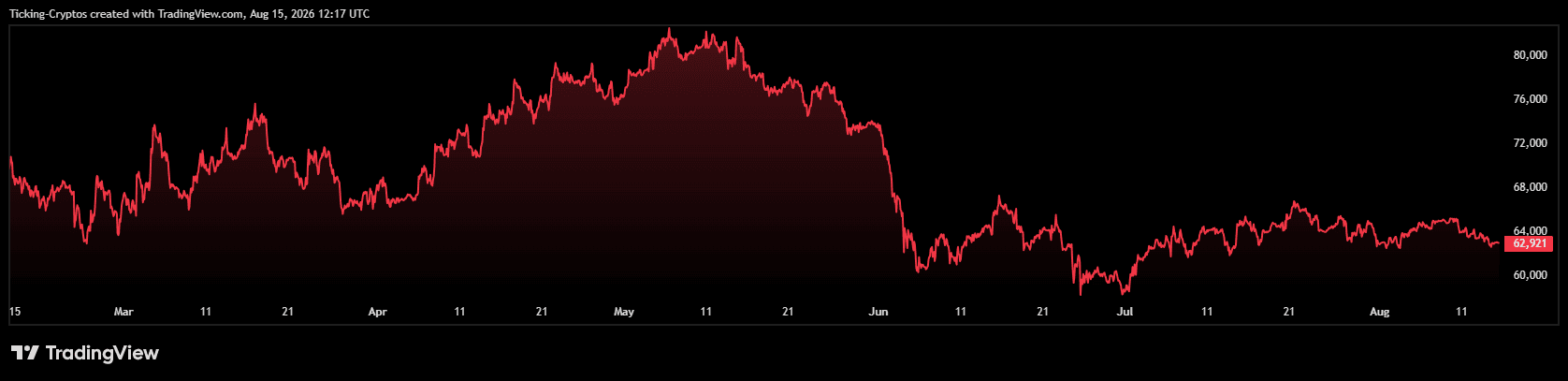
$Bitcoin holds a market capitalisation of $1.26 trillion and is up 0.20% on the day. $Ethereum trades at $1,881.02, up 0.50% on the day and down 36.60% year to date, with a market capitalisation of $227 billion.
Across the remaining large caps:
- $BNB: $611.23, up 0.53% on the day and 2.84% on the week
- $XRP: $1.00, down 0.17% on the day and 45.38% year to date
- Solana ($SOL): $75.38, down 0.19% on the day, up 0.94% on the week
- TRON ($TRX): $0.3323, up 16.91% year to date
- Hyperliquid ($HYPE): $56.24, up 121.18% year to date
- Dogecoin ($DOGE): $0.07012, up 0.67% on the day, down 40.22% year to date
Below the top ten, Chainlink ($LINK) leads weekly performance at $9.41, up 14.07% over seven days, followed by Monero ($XMR) at $407.32, up 7.29%. Cardano ($ADA) is the weakest major at $0.1797, down 10.07% on the week and 46.00% year to date.
A declining bitcoin price reduces the premium investors assign to treasury company equity, which compounds the funding constraint these firms face independently of index eligibility.
What Does the MSCI Proposal Mean for Bitcoin Treasury Companies?
The consultation raises a structural question about whether asset-holding vehicles belong in equity indexes, with implications extending beyond the three companies currently flagged.
If MSCI adopts the screen, affected companies have limited remedies. The five ratios assess operational activity rather than asset composition, and standard capital management measures do not change the outcome.
If MSCI declines to adopt it, the provider retains the constraints imposed in January 2026, which continue to limit index weighting increases for bitcoin treasury companies.
Frequently asked questions about Strategy and MSCI
Partner links: some links on this page are partner links. If you become a customer through one of them, we may earn a commission at no extra cost to you. Selection, ratings and ranking are decided independently by our editorial team. Ethics and Independence · Ownership and Funding
Transparency note: This article was produced with the assistance of artificial intelligence. Figures and claims are based on the primary sources linked in the text.
For later? Save this article and find it again in your profile.
More on Bitcoin: All Bitcoin news at a glance
Related articles
- Strategy mNAV below 1: Saylor's company is worth less than its bitcoin
- Strategy Is $9 Billion Underwater as MSCI Kicks It Out: Will Saylor Sell Bitcoin?
- Crypto news, November 13: bitcoin down 6 percent, more than $1.3 billion liquidated
- How to buy bitcoin stocks as Strategy exits the MSCI World on November 30
- Metaplanet holds 44,000 bitcoin, but its shares trade far below that value
Which topics should we dive deeper into?
Select what genuinely interests you. Your picks feed directly into our editorial planning.
Crypto news that's actually worth your time.
Weekly. 60 seconds. Carefully curated by our editors: no hype, no promo flood, no spam.

November 12, 2026 12:33 AM

MSCI removes Strategy from the MSCI World: index funds sell their MSTR shares by November 30
MSCI will drop Strategy from the MSCI USA, World and ACWI on November 30, the first case under its new rule for non-operating companies. MSCI World ETFs adjust on their own, while Strategy shareholders lose a large group of buyers.

November 6, 2026 11:19 PM

Michael Saylor: how Strategy became the largest corporate holder with 849,327 Bitcoin
Explainer: Michael Saylor turned the software company MicroStrategy into the largest publicly listed Bitcoin holder, with 849,327 BTC in early November 2026. How the model is financed, where its risks lie and how stock and Bitcoin differ for tax purposes for investors in Germany.
October 27, 2026 12:17 AM

Strategy pauses its Bitcoin buying: $204.9 million into its own shares
Strategy bought no Bitcoin at all in the week of October 19 to 25, 2026 and put $204.9 million into repurchasing its own STRC preferred shares instead. The stack stays at 848,517 Bitcoin, while free cash fell by about 46 percent.
October 16, 2026 10:25 AM

MSCI exclusion decided and Strategy is on the list: how to check your ETF holdings before November 30
MSCI decided on the evening of October 15 to exclude non-operating companies from its world indices, and Strategy was on the provisional removal list. What it means for European savers: which two dates count, how the methodology sorts companies out, and where to find the weight of the Bitcoin share in your own fund.
September 3, 2026 1:27 PM

MSCI Index Removal of Strategy: What It Means for Your ETF and When It Bites
MSCI decides by October 16, 2026 on a screen that could take Strategy and Metaplanet out of the global equity indexes. What that means for your ETF savings plan, when a deletion actually bites, and how to check in minutes whether your fund would be affected.
August 18, 2026 7:35 AM

Bitcoin Treasury Stock at a Discount: How the mNAV Gap Arises
Twenty One Capital holds 43,514 Bitcoin and is valued well below that on the stock market. The freshly filed quarterly report shows how the mNAV discount arises and why it ranges between 43 and zero percent depending on the method.
August 1, 2026 10:59 AM

Bitcoin Treasury Model Under Fire: Strategy Posts $8.22 Billion Loss as BTC Slips Below $63,000
Strategy booked an $8.22 billion quarterly loss and Coinbase missed again. Here is what crypto's brutal earnings week means for Bitcoin.

June 24, 2026 7:05 PM

Bitcoin Crash: Will BTC Fall to $55K Next as Strategy Losses Deepen?
Bitcoin crashes below $60K as Strategy’s BTC losses deepen. Is $55K the next stop, or can the market recover?
February 8, 2026 5:42 PM

BREAKING: Michael Saylor Hints at Buying More Bitcoin
Michael Saylor sparks excitement with a new "More Orange" teaser on X. Explore Strategy's latest Bitcoin holdings and what these hints mean for the market.
January 11, 2026 7:34 PM

Saylor Teases New Bitcoin Buy as Strategy BTC Holdings Hit Record Highs
Michael Saylor hints at new Bitcoin buys as Strategy holdings hit 673,783 BTC. Here's the latest MSTR treasury updates and its market impact.
January 7, 2026 8:25 AM

MSCI Keeps Strategy ($MSTR) in Its Indexes: The January 2026 Decision and What Came Next
On 6 January 2026 MSCI decided not to exclude Strategy and other crypto treasury companies from its indexes. The decision was interim: MSCI announced a broader review.
November 22, 2025 6:27 PM

Why the Crypto Crash on Oct 10 Was No Accident...
The October 10 crypto crash was triggered by a hidden MSCI classification shock. Here’s why the market couldn’t bounce — and what happens on Jan 15.


More from CryptoTicker