
AI Crypto Crime: How Scams Are Getting More Convincing
AI is sharpening fake support, deepfakes and phishing across the crypto space. Why the data still needs a careful reading and which security routines protect a wallet.




Which topics should we dive deeper into?
Select what genuinely interests you. Your picks feed directly into our editorial planning.
Crypto news that's actually worth your time.
Weekly. 60 seconds. Carefully curated by our editors: no hype, no promo flood, no spam.
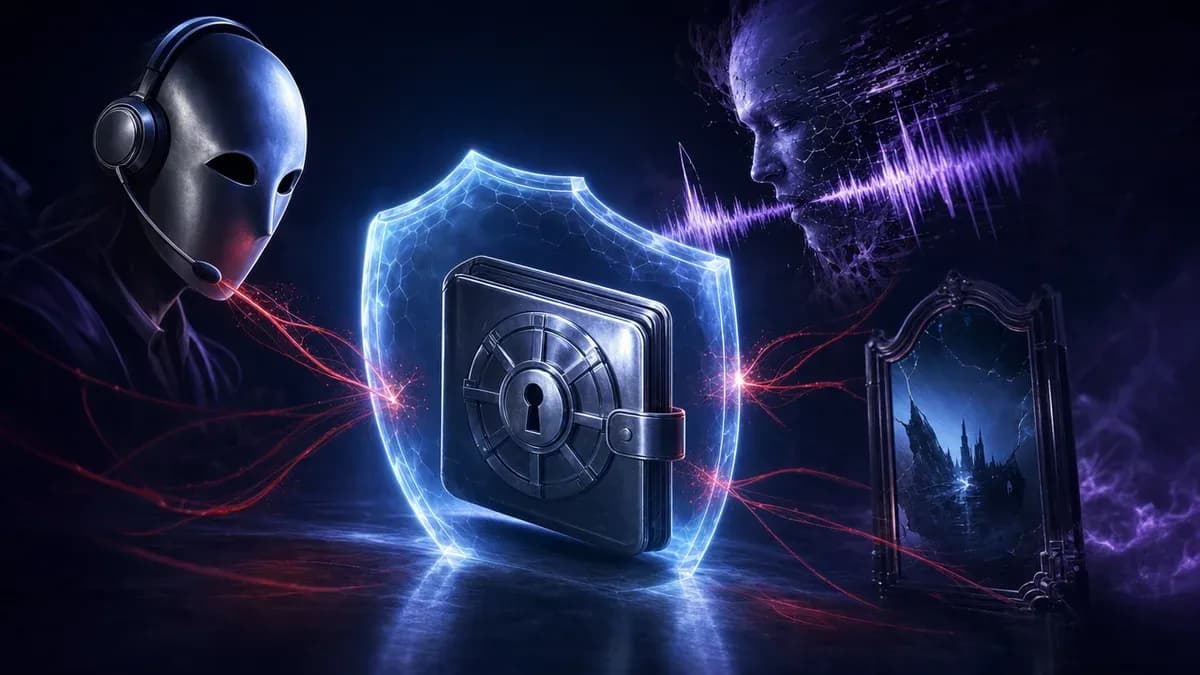
AI crypto crime has moved out of its niche and onto the agenda of analysts and regulators. On August 21, 2026, The Block reported on the new “AI-in-Crime Adoption Index” from TRM Labs, which assesses the role of artificial intelligence in crypto-related crime in a systematic way. One caveat matters here: The Block summarises the TRM Labs analysis, but it supplies no independent global statistics on crypto fraud. According to TRM Labs, AI is increasingly used to run existing attacks faster, in more convincing language and with sharper targeting. More AI in cybercrime does not automatically mean that every crypto loss has grown to the same degree. This article sets out which forms of attack gain plausibility, where the data gaps sit and which protective measures still count.
What Is Behind the AI Crypto Crime Trend
AI crypto crime describes the use of artificial intelligence to prepare, personalise or automate criminal activity in the crypto space. In practice, AI generates or improves text, translations, images, voices, chat replies and variations of a lure. It does not necessarily replace known fraud models; more often it amplifies classic social engineering, in which attackers exploit trust, helpfulness, fear, time pressure or apparent authority so that victims hand over data, connect a wallet or sign a transaction themselves. According to TRM Labs, fraud is the most advanced category for the use of AI in criminal contexts within its own index.

 Regulated Crypto Exchanges Compared
Three AI Crypto Scams That Are Getting More Convincing
Fake Support
Contact usually starts with a comment, a direct message, a search ad or a fake profile. The supposed support agent then claims there is a security problem or that a “wallet verification” is required. AI can produce multilingual, professional-sounding dialogue and fast replies, which means a badly worded message no longer works as a reliable warning sign. The most important rule is unchanged: legitimate support never asks for a seed phrase, private key or password. As MetaMask sets out in its official support guidance, genuine support makes no unsolicited calls and never asks for the Secret Recovery Phrase. Anyone who hands over that data normally gives attackers full control of the wallet.
Voices, Videos and Apparent Authorities
Deepfakes are AI-generated or manipulated audio, image or video content that can imitate real people convincingly. In a crypto context that shows up as a faked video appeal from a founder, the cloned voice of an acquaintance reporting an alleged emergency, or a manipulated livestream with a giveaway and a wallet link. Not every odd-looking video is a deepfake; what matters is the source, an unusual call to action and the time pressure being built up.
Lures in Search and Social Media
Phishing tries to capture credentials and approvals through fake websites, login masks or wallet connections. AI can create many varied ads, posts and landing pages and tailor the language to a target group, which makes phishing more scalable without automatically making it more successful. Typical examples are paid search ads with fake download or support pages, lookalike domains, hijacked social media accounts and fake airdrops.
Why the Data on AI Crypto Crime Needs Careful Reading
TRM Labs is a blockchain analytics firm whose assessment is a valuable industry signal, though not a final measurement of global crypto crime as a whole. “AI-assisted fraud” describes the method behind an attack or the support it received, whereas a “confirmed rise in losses” requires comparable, traceable data on cases, damages and time periods. The data gaps are real: many victims never report an incident, the use of AI often cannot be established in an individual case, and losses are sometimes discovered late or categorised inconsistently. That methodological caution matches an assessment of generative AI by the German federal cyber security agency BSI, which finds that generative models enable convincing, automated phishing messages and fake profiles. That confirms the methodological risk, not a global loss rate.
 Hardware Wallets Compared
Wallet Security Routines That Slow Attacks Down
A handful of fixed habits reduce the risk regardless of how convincing an attack looks:
- Never enter, upload or send a seed phrase, private key, password or recovery code to anyone claiming to be support.
- Open exchange and wallet sites from saved bookmarks or the official app, never through search ads, direct messages or comments.
- Before every wallet connection, check which website is being connected, and leave signatures you do not understand unconfirmed.
- With hardware wallets, check the recipient address, amount, network and permissions on the device display itself.
- Switch on two-factor authentication, where the BSI recommendation favours a security key or an authenticator app over SMS.
- With unusual calls, videos or urgent security warnings, open a second, known contact channel yourself instead of replying to the message.
- Treat time pressure as a warning sign: phrases such as “act now” or “your account will be locked” are typical fraud patterns.
For teams and companies one more rule applies: larger transactions should be secured with role-based permissions and a four-eyes principle.
AI Crypto Crime: Methods Change Faster Than Measurements
AI crypto crime is a real trend, and one that deserves a careful reading. TRM Labs supplies a relevant external assessment, according to which AI affects fraud, social engineering, deepfakes and automated campaigns in particular; on its own it is no evidence that all crypto losses have risen proportionally. For users, robust wallet security is what counts: safe contact routes, scepticism when time pressure appears and a careful check of every approval protect you even when an attack looks technically convincing.
Transparency note: This article was produced with the assistance of artificial intelligence and reviewed by our editorial team before publication. All figures and claims were checked against the primary sources linked in the text.
Related articles
- Crypto Phishing After a Data Breach: The Warning Signs in a Fake Exchange Email
- Crypto Wallet Provider Ledger Hacked: Data Leak Results in Phishing Scams
- Crypto Scams: How to Protect Your Cryptos?
- Operation ASTERIX: How a Fake Support Call Delivers a Counterfeit Wallet App
- Beware of New Ethereum Node Scam: USDT Fraud Exposed
Which topics should we dive deeper into?
Select what genuinely interests you. Your picks feed directly into our editorial planning.
Crypto news that's actually worth your time.
Weekly. 60 seconds. Carefully curated by our editors: no hype, no promo flood, no spam.

August 25, 2026 10:31 PM
Crypto Wallet Phishing by Letter: Why the QR Code From Your Postbox Wants Your Recovery Phrase
Letters carrying a QR code urge a supposedly urgent wallet update on grounds of quantum resistance and lead to a page that asks for the recovery phrase. The Federal Office for Cybersecurity reported the ploy on August 18, 2026.

August 13, 2026 4:59 PM
Trezor Data Breach: First 13,689 Customers, Then Roughly 67,000 More Exposed
A breach at Trezor shipping partner ShipMonk exposed names, phone numbers and home addresses of 13,689 customers in August; in September Trezor reported roughly 67,000 more in the US. Devices are safe, phishing risk is not.
June 5, 2026 3:00 PM
Zcash Crash: ZEC Coin Falls 40% After AI Bug Scare — Here Are the Next Supports
Zcash crashes over 40% as AI-linked bug fears, whale shorts, liquidations, and weak crypto sentiment hit $ZEC.
January 22, 2025 11:31 AM
How to Identify Fake TRUMP tokens: A Guide to Staying Safe in the Crypto World
The rise of fake TRUMP and MELANIA tokens is alarming crypto enthusiasts. Learn how to distinguish the official tokens from scams and protect your investments with this essential guide.
December 26, 2025 1:50 PM
Breaking: Trust Wallet Chrome Extension Hack Drains $7M, Full Reimbursements Promised
A supply-chain attack hit Trust Wallet’s Chrome extension, draining $7M from users. Binance’s CZ says all victims will be reimbursed.
September 19, 2026 10:11 PM
North Korean Hackers Drain 7,000 Crypto Wallets: What to Check on Job Offers and Coding Tests
Seven agencies, among them Germany's BND and BfV, warn about the WaterPlum group: 30,000 infected machines, more than 7,000 drained wallets. The bait is a job offer, the trap a coding test.
September 10, 2026 9:13 AM
Trezor Hack Scare: That STM32 Entropy Email Is a Phishing Attack
Trezor users received a fake STM32 entropy warning sent from a real Trezor address. Here is what happened and what to do if you clicked.

April 24, 2023 6:54 AM

3 Types of Scammers in the Crypto World
The recent rise of cryptocurrencies brought about a new threat – scammers. Here are 3 types of scammers in the Wild, Wild West of cryptos.
September 4, 2026 10:15 PM

Trezor Data Breach: Am I Affected and What Should I Do Now?
Trezor widened the ShipMonk data breach on September 4, 2026: around 67,000 further people affected, just over 80,000 in total, from orders placed between November 2019 and August 2021. How to check in two minutes whether you are among them, and what an exposed home address means for self-custody.
August 22, 2026 4:13 AM

SafePal Data Breach: 39,798 Customers Exposed With Names, Addresses and Phone Numbers
SafePal confirmed a data breach on August 16, 2026: the names, delivery addresses, phone numbers and order details of 39,798 customers were exposed. Seed phrases and private keys were not affected, but the phishing risk is substantial.
March 31, 2026 5:13 PM

Quantum Threat to Bitcoin? Google Research Sparks Urgent Crypto Security Debate
Google’s quantum breakthrough raises fears for Bitcoin security. Can crypto survive quantum attacks—or is an upgrade urgent?
September 5, 2026 10:24 PM

Fake German Finance Ministry Letters: Why Nobody May Demand 19 Percent VAT on Your Crypto Purchase
Since September 1, 2026, Germany's Federal Ministry of Finance has been warning about forged letters that demand 19 percent VAT on cryptocurrency purchases while citing real transactions. That tax does not exist, and this is how to spot the forgery.
August 24, 2026 1:22 PM
Phantom Wallet Ends Sui and Monad Support: What to Do Before the Deadlines
Phantom Wallet removes Monad from its app on August 26 and Sui on September 24. The balances are not lost, but only one of the two ways out leaves your tax position untouched.
September 1, 2026 7:27 AM

Clipboard Attack: How Malware Swaps the Wallet Address You Copied
A clipper replaces the receiving address between copying and pasting with the attacker’s, and your wallet’s checksum notices nothing. What Microsoft and the Federal Office for Cybersecurity have documented, and which check really makes the attack come to nothing.
May 5, 2026 3:15 PM
Coinbase Layoffs: CEO Brian Armstrong Cuts 14% of Staff in Massive AI Pivot
Coinbase cuts 14% of its workforce as CEO Brian Armstrong pivots to an AI-first model, claiming engineers now ship in days what once took weeks.

April 27, 2026 10:30 AM
Win $5,000 in BTC: Tangem Launches Exclusive 2026 Prize Draw
Tangem announces a massive prize draw with $5,000 in BTC and iPhone 17s up for grabs. Secure your crypto and enter today using our exclusive link.

May 4, 2019 5:44 PM

Microsoft Hackers Stole Crypto Using Victims Emails
Another batch of crypto users have lost money recently through an unlikely breach. Recently, Microsoft services such as Hotmail, MSN, and Outlook have been hit by a breach. It was later learned that the breach was due to an employee’s […]
January 16, 2025 12:01 PM

Ripple SEC Lawsuit Updates and Outlook under Trump’s Pro Crypto SEC
The Ripple SEC lawsuit updates on the appeal filed by the SEC, the cross-appeal by Ripple, and what to expect soon under Trump's pro-crypto administration with the new SEC leadership, all in this article!
August 22, 2026 4:16 PM

Stolen Crypto: Where You Actually File a Report and What Counts in the First Hours
After a theft most people google first and preserve the evidence last, when the right order is the other way round. What you have to record in the first hours, where private individuals actually turn, and where the limit of what is possible lies.
August 11, 2026 9:18 AM

Your Crypto Exchange Is Telling You to Withdraw: How to Spot Phishing After the MiCA Deadline
Unauthorised crypto providers now have to tell their EU customers to withdraw, which leaves fraudsters an easy run with faked requests. Here is how to check in two minutes whether the message is genuine.
October 2, 2026 7:16 AM

$1.26 Billion in Three Months: Crypto Hacks Hit Their 2026 High
The security firm CertiK counts around $1.26 billion in damage from 247 incidents for the third quarter of 2026. September was the worst month of the year with 99 cases, and this is the background and what it means for your custody.
September 17, 2026 4:14 PM
D'CENT App Wallet: How to Tell If Your Recovery Phrase Has to Move Now
Manufacturer IoTrust reports suspicious asset transfers in the D'CENT app wallet and asks users to move their holdings. One question decides the matter: has your recovery phrase ever been entered into the app?
September 10, 2026 1:14 PM

Phishing Email From the Real Sender Address: How to Check a Wallet Security Warning
An alleged security warning to wallet customers travelled through the manufacturer's genuine sending channel and passed every technical authenticity check. The test that still holds costs you four minutes.

January 27, 2022 11:03 AM
How to Avoid Crypto Scams? Don’t be a Victim of Squid Tokens in 2022
In this article, we will be looking at the new SQUID token and how traders can avoid rug pulls while investing in digital assets.

March 12, 2020 1:12 PM

What Is A Cold Wallet? And Why Is It Important?
A cold wallet is a wallet which is completely offline and used for storing cryptocurrencies. It is also known as cold storage.
August 18, 2026 7:23 PM

Inheriting Crypto: How Your Heirs Actually Get Access, and Why the Seed Does Not Belong in a Will
The German Federal Court of Justice made clear in 2018 that digital accounts are inherited like everything else. With self-custodied coins succession law still achieves nothing: no key, no access. And anyone who writes the seed into a will has a court send it to every party involved.
August 18, 2026 7:14 PM
Two-Factor Authentication on a Crypto Exchange: Why SMS Is the Weakest Option
SMS codes are the most common form of two-factor authentication on crypto exchanges, and the weakest. The problem is not only SIM swapping, which the FBI has recorded falling for three years. It is real-time phishing, and against that neither SMS nor an authenticator app helps.
More from CryptoTicker