
Redeem aUSDT: What Happens to Your Tether Gold on September 17
Anyone holding aUSDT has until September 17, 2026 to return the gold stablecoin through Alloy by Tether, or the route to the underlying Tether Gold closes. On-chain, there is still no sign of redemptions.





Which topics should we dive deeper into?
Select what genuinely interests you. Your picks feed directly into our editorial planning.
Crypto news that's actually worth your time.
Weekly. 60 seconds. Carefully curated by our editors: no hype, no promo flood, no spam.
If you hold aUSDT, consistent industry reports give you until September 17, 2026 to return the token through the Alloy by Tether platform and take back the Tether Gold (XAUT) held as collateral. After that date, this route through the platform is closed to you. That is the whole action, and it takes a few minutes for as long as the platform is running.
What makes the case notable is something else: on the Ethereum blockchain, the outstanding amount has barely moved. We read the contract ourselves for this article on September 1, 2026, and used an archive node to work back to the day of the announcement. The result is set out in a table further down. It suggests that the vast majority of aUSDT has yet to be returned, with a good two weeks left on the clock.
This piece explains what aUSDT actually is, how redemption works, what hangs on it for tax, where to keep the Tether Gold you free up, and what the case teaches about token wind-downs in general. Alloy is not an isolated incident but the normal course of business in an industry where issuers retire products.
What is aUSDT, and why is Tether winding down the gold stablecoin?
aUSDT is a synthetic dollar, a token pegged in price to the US dollar but backed by gold rather than by cash or government bonds. You may know the mechanism from decentralised lending: you deposit an asset as collateral and receive a dollar unit worth less than what you put up.
The collateral here was XAUT, or Tether Gold in full. XAUT is a token that represents a claim on physical gold; one token corresponds to roughly one troy ounce, held in a Swiss vault. Depositing XAUT with Alloy allowed you to mint aUSDT against it. Because the gold collateral always had to be worth more than the dollar units issued, the arrangement is described as overcollateralised: the buffer absorbs swings in the gold price before the backing gives way.
The product launched in June 2024. Two years later, Tether is pulling the plug. According to the available reports, the company cites simply a lack of demand and a focus on its larger products, above all XAUT itself and the dollar stablecoin USDT. The platform has taken no new positions since the announcement, and nothing is being minted either.
For you as a holder, that changes the picture fundamentally. A token whose issuer closes the issuing desk loses its most important price anchor: the ability to swap it back for the collateral at any time. That is precisely the option that ends with the deadline.
By when do you have to redeem aUSDT? The September 17, 2026 deadline
The stated cut-off date is September 17, 2026. It follows from the three-month redemption window Tether granted when it announced the wind-down on June 17 and 18, 2026. Anyone who has not returned by then can no longer assert a claim on the underlying XAUT through the platform.
Two caveats go with this, and both matter more than they sound.
First, no time of day is known. None of the available sources names an hour at which the window closes, nor a time zone. Acting only on September 17 therefore means trusting that the platform will still be reachable throughout that day. That is a bet taken for no reason: the last day on which the action can safely be completed is September 16.
Second, the date rests on media reporting. We opened Tether's news page on September 1, 2026. Four items were listed there, the most recent dated August 13, 2026, and not one of them covers Alloy or aUSDT. The June statement on which all the reports rely is currently not findable through the company's public news overview. The outlets that reported it consistently include The Block, DailyCoin, CoinCentral and Coinpedia, each with the same date and the same deadline.
A plain recommendation follows: check the cut-off date in the application itself or with the provider's support before you redeem. For an irreversible deadline, do not rely on reporting alone, this article included.
The on-chain supply is not moving: 50 million aUSDT still sit in the contract
The aUSDT contract sits as an ERC-20 token on the Ethereum blockchain at address 0x9eEaD9CE15383cAEEd975427340B3A369410CFBF and uses six decimal places. The totalSupply() function returns how many units exist in total. We queried it on September 1, 2026, plus four historical blocks via an archive node, and cross-checked the current value with two independent providers.
| Timestamp (UTC) | Block | Outstanding aUSDT |
|---|---|---|
| June 18, 2026, 10:36 | 25,343,891 | 50,000,005.00 |
| July 17, 2026, 04:25 | 25,550,000 | 50,000,005.00 |
| August 7, 2026, 02:08 | 25,700,000 | 50,000,005.00 |
| August 23, 2026, 16:35 | 25,819,091 | 50,020,647.05 |
| September 1, 2026, 00:35 | 25,878,879 | 50,020,647.05 |
The first value comes from the day after the announcement. Across 75 days, the amount has not fallen by a single unit. Between August 7 and August 23 it even rose by 20,642.05 units, and has been flat since.
That increase comes with a warning about the obvious false conclusion. Where the additional units came from cannot be read off the total supply alone. A mint by the issuer itself is as possible as an internal transfer or a technical operation in the contract. The number does not work as an accusation against anyone, and we expressly do not make one. All that is solid is the observation: the outstanding contract supply has not shrunk since the announcement.

How large is the affected holding really? The figures diverge widely
This is where it gets murky, and you should treat the numbers with scepticism even when they come from large providers.
The reports from June 2026 put aUSDT at a market capitalisation of around $1.27 million, backed by 14.73 kilograms of gold worth some $2.2 million. Market capitalisation here is nothing other than the circulating supply multiplied by the price.
Data provider CoinGecko, by contrast, listed the full contract supply of 50,020,647.05 units as circulating on September 1, 2026, at a quoted price of $1.08 and a market capitalisation of around $54 million. The underlying data set carried August 29, 2026 as its last update.
Both cannot be true at once. The range therefore runs from a good $1.2 million to around $54 million, a factor of 40. The most plausible explanation is that the overwhelming share of the contract supply sits with the issuer itself and was never in circulation; we cannot prove that without an analysis of holder addresses. So we do not smooth the range and give you both ends of it.
For your own decision the dispute is secondary anyway. What matters is not how much is affected in total, but whether you are affected. Check your wallets and your accounts at trading venues for the balance, and do it before the deadline runs, not after.
 Store Tether Gold securely yourself
Redeeming with Alloy by Tether: how the aUSDT-for-XAUT return works
Redemption follows the same pattern as any collateralised loan, only without interest. You hand back the dollar units and your gold collateral is released. In practice, that means:
- Establish your balance. Open the wallet you minted with at the time and check the aUSDT balance. If you no longer remember the address, a blockchain explorer helps: it shows the tokens held by any address.
- Get access to the platform. Redemption runs through the Alloy interface, connected with the same wallet. Keep some ether ready for transaction fees; without a network fee, no transaction goes through on Ethereum.
- Close the position. You return the aUSDT and thereby release the deposited XAUT. Before confirming, check that the gold amount shown matches your original collateral.
- Check the result. After the transaction, the aUSDT balance should read zero and the XAUT holding should have risen accordingly. Save the transaction hash; it is your evidence for the tax office later.
- Escalate early if something goes wrong. If the interface jams or a transaction fails, you still have time for support before the deadline. Two weeks out that time exists; on the cut-off date it does not.
If your aUSDT sits at an exchange rather than in your own wallet, the route is a different one: the trading venue then decides whether it handles the redemption for you, halts trading, or asks you to withdraw. Ask there actively instead of waiting for a notice. If you want to be more broadly set up, our overview of the best crypto exchanges shows the venues that carry Tether products and offer the swap at all.
What happens to the deposited gold if nobody redeems?
No German-language piece has asked this question so far, and there is no solid answer, because Tether has not commented publicly. All that can be said cleanly is what the reports support and what follows from that.
What is reported: after September 17, holders can no longer settle their claims through the platform. That wording does not rule out other routes, such as a support case or a later special arrangement. But nothing of the sort has been promised. A claim for which no process is provided any more is hard to enforce in practice, even if it survives in law.
That is exactly where the risk lies, and it is independent of the provider. In a wind-down, the burden of proof shifts to you: you then have to demonstrate that something is owed to you, instead of simply pressing a button. That is why the deadline deserves to be taken seriously even if your holding is small. The effort of redeeming today is minor; the effort of sorting it out afterwards is not.

Storing XAUT after redemption: exchange, software wallet or hardware wallet?
After the return you hold Tether Gold, which raises the custody question afresh. XAUT is a token like any other: whoever holds the private key controls the gold behind it.
For small holdings you intend to sell soon anyway, custody at a regulated trading venue is defensible. If you want to hold the gold as a longer-term hedge, more speaks for self-custody. A hardware wallet is a device that generates and stores your private key without ever releasing it to an internet-connected computer; transactions are approved on the device itself. Which models support Ethereum tokens such as XAUT cleanly is shown in our hardware wallet comparison.
One point is regularly overlooked: XAUT is a claim against an issuer, not a coin in a safe deposit box. Self-custody protects you against the failure of a trading venue and against losing your login details. It does not protect you against an issuer's decision to retire a product. The Alloy case demonstrates exactly that.
Tax: is redeeming aUSDT for XAUT a taxable exchange?
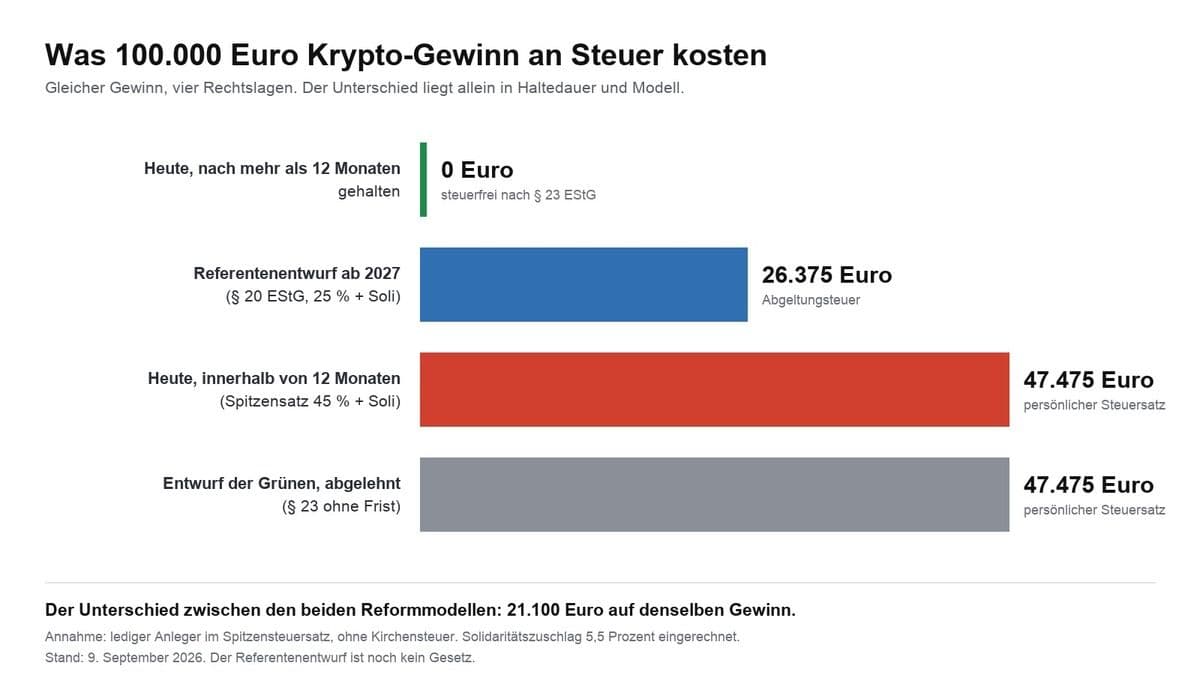
Under the reading common in Germany, swapping one cryptocurrency for another counts as a disposal of the asset given up. For private disposals under Section 23 of the Income Tax Act, that means a gain within the one-year holding period is taxable, and outside it generally is not. An exemption threshold applies, and once it is exceeded the entire gain becomes taxable.
Whether returning aUSDT for your own collateral is an exchange in that sense at all depends on the specific structure. If the position is treated like a collateralised loan, a mere unwinding would also come into question, which is not a disposal. In your case, this distinction can decide a four-figure sum, and it is not something an article can settle for you. Settle it with a tax adviser.
What you should do regardless: document the process without gaps. Date, transaction hash, amount of aUSDT, amount of XAUT received and the price at the time of the transaction belong in your records. Doing this as you go saves you the reconstruction in spring; the usual tools for it are in our overview of crypto tax software and portfolio trackers.
 Document the swap and the deadline properly
Tether is building up gold while switching off the gold derivative
At first glance the wind-down looks like a retreat from the gold business. The opposite is true, and that contradiction explains the decision better than any press release.
In the second quarter of 2026, Tether says it expanded its gold holdings further and reported growth in Tether Gold holdings of 9.5 percent; the quarterly report speaks of more than 146 tonnes of gold. XAUT itself, according to the available reports, most recently reached a market capitalisation of around $3 billion. For comparison: a single XAUT was valued at $4,446.66, or 3,825.55 euros, on September 1, 2026, according to CoinGecko.
The product being retired is therefore not the gold, but the detour via a synthetic dollar built on gold. That detour never found demand, while the plain gold token is growing. From the company's point of view, the wind-down is housekeeping in the product range. For the few holders who took the detour, it is nonetheless a deadline with consequences. Both are true at the same time, and the second half gets lost in international coverage. How tokenised gold was meant to work as a hedge is something we described in detail in our assessment of Tether Gold as a hedge.
If you want to read the original report: the piece by trade outlet The Block from June 18, 2026 summarises the wind-down of aUSDT and the Alloy platform.
What the Alloy case teaches about token wind-downs
The real value of this deadline lies beyond aUSDT. Issuers retire products, exchanges delist trading pairs, networks are shut down. There have been several such cases in recent weeks. Anyone holding crypto assets should therefore have a fixed procedure for them.
Three points have proved their worth. First: every token you hold should have an issuer or a protocol whose announcements you actually follow. Second: for every position, note which address and which access route gets you to it; a claim is no use if the access is missing. Third: deadlines are not dealt with on the last day, because interfaces fail, fees rise and support takes time.
The gap in German-language coverage is also striking. Many outlets write about Tether's gold purchases, while almost none cover the parallel wind-down of the gold derivative with its fixed deadline. Anyone reading only German-language sources may not learn of this date at all. That is not an accusation against individual newsrooms, but it is a reason to check for yourself when you hold assets outside the big names.
Redeem aUSDT: what to take away
- Check by September 16 whether you hold aUSDT, and return it. The last safe day to act falls before the cut-off, because nothing is known about the time the window closes. If your holding sits at a trading venue, ask there actively about the procedure; which venues carry Tether products at all is shown in our crypto exchange comparison.
- Decide deliberately where the freed-up XAUT should sit. For short-term holdings a regulated trading venue is enough; for longer-term ones, more speaks for self-custody with a tested device from our hardware wallet comparison.
- Document the transaction immediately and clarify the tax treatment. Transaction hash, amounts and prices belong in your records the same day, most easily with one of the tax tools and portfolio trackers; whether a taxable exchange has taken place is a question for a tax adviser.
(As of September 1, 2026. This article is not investment advice. Prices and fee structures change; check the terms with the provider before you buy.)
Transparency note: This article was produced with the assistance of artificial intelligence and reviewed by our editorial team before publication. All figures and claims were checked against the primary sources linked in the text. The feature image was generated with AI.
Related articles
- How to Hedge Trade War Uncertainty with Tether Gold (XAUT)
- BitMart Before the Trading Halt: Which Coins Already Have Withdrawals Blocked
- BitMEX Closed on September 23: The Deadlines That Applied and What Remains for Your Balance
- BitMart Plans Restructuring Instead of Wind-Down: What Customers Should Know Now the August 26 Deadline Has Passed
- Crypto Exchange Closure: What Happens to Your Residual Balance and When the Fee Starts
Which topics should we dive deeper into?
Select what genuinely interests you. Your picks feed directly into our editorial planning.
Crypto news that's actually worth your time.
Weekly. 60 seconds. Carefully curated by our editors: no hype, no promo flood, no spam.

August 22, 2026 1:23 AM

Binance Withdrawal Deadline September 9: What ALCX, ARDR, NFP and POND Holders Should Know Now It Has Passed
Recap as of September 27, 2026: Binance had announced it would stop withdrawals of ALCX, ARDR, NFP and POND on September 9, 2026 at 03:00 UTC. Spot trading in these tokens had been suspended since July 10, and the exchange is winding down its EU business. This article describes the situation before the deadline.

July 26, 2026 7:57 AM
BitMart Shuts Down: Second Major Crypto Exchange to Announce Closure in One Week
BitMart is winding down just three days after BitMEX. Here are the withdrawal deadlines, what triggered the closures, and what it means for CEX users.

September 24, 2026 1:11 PM

Stellar Becomes a Payment Rail at Mastercard's BVNK: What XLM Holders Should Check on Buying Route, Memo and Holding Period
BVNK has switched on Stellar as a payment rail for business customers in more than 130 countries. On the same trading day XLM falls by around seven percent — we separate what the news means from what the pullback means for your portfolio.
September 16, 2026 1:12 PM
Bitvavo Delisting of Kava, Nano and Ravencoin: What to Do Before Friday, 2 p.m.
Bitvavo drops KAVA, XNO and RVN on September 18, 2026, and three deadlines expire in a single afternoon. Nano has no withdrawal route at all, and the automatic euro conversion on September 28 counts as a sale for tax purposes.
September 27, 2026 7:22 AM
CoinEx Forced Conversion: Withdraw Non-USDT Balances by September 29
On September 29 at 02:00 UTC spot trading ends at CoinEx, and all holdings outside USDT are sold or delisted after that. What this means for your holding period, your tax bill and your withdrawal.
September 26, 2026 7:14 AM
Cardano Before the RealFi Launch on October 1: What ADA Holders Should Check on USDr, MiCA and Tax
On October 1, 2026 the stablecoin platform RealFi goes live on the Cardano mainnet, and ADA has gained 14.67 percent in a week. What is documented about the yield-bearing dollar token USDr, and what investors should settle beforehand.
September 25, 2026 4:53 PM

Universal Is Winding Down: What to Do With uSOL, uXRP and the Other uAssets by November 17
The cross-chain protocol Universal ceases operations on November 17, 2026. Six uAssets on Base stay redeemable into their bridged counterpart, all the others are converted into USDC. What to decide before then, and why the holding period hangs on it.
August 19, 2026 7:16 AM

Crypto Exchange Deadlines in August: What Still Applies Now the Seven Cut-Off Dates to August 31 Have Passed
Recap as of September 27, 2026: between August 17 and August 31, 2026, deadlines expired at seven providers that affected investors in Germany. We had recorded the dates ourselves on August 16. Only the withdrawal of the six tokens delisted by Binance remains open, possible until October 17, 2026 at 03:00 UTC.
September 9, 2026 4:22 PM
Crypto Tax in Germany: What Applies in 2026 and What Is Set to Change in 2027
Crypto gains are tax-free after twelve months; before that your personal tax rate of up to 45 percent applies. What triggers tax, how the holding period is calculated, what happens with staking and losses, and what the draft bill would change from 2027.
August 26, 2026 10:25 PM

Selling Bitcoin at a Loss: Loss Offsetting in Austria
Sold Bitcoin at a loss? Austria allows the loss to be offset against certain investment income. When loss offsetting is possible and which limits apply.
August 31, 2026 10:23 AM

Bitcoin Abroad: The Tax Duty Austrian Investors Carry Themselves
Sold bitcoin through a foreign platform? When Austrian investors have to declare gains themselves and account for the 27.5 percent tax rate.
August 22, 2026 4:47 PM

Offsetting Bitcoin Losses Against Stock Gains in Austria
Offset bitcoin losses against gains on shares? Austria allows it in principle, but only under certain conditions and usually via the tax return.
August 20, 2024 3:00 PM

New US Senate Proposal Submitted For Crypto Tax Exemption
The US Senate has recently submitted a new proposal to exempt crypto transactions from federal taxes. Here are more details of this submission, and a list of exempted countries it could be joining...
September 9, 2026 1:15 AM

Germany's Crypto Tax: 160 Million Euros for a 555-Billion Budget
The German finance ministry's draft bill puts a figure on the crypto tax for the first time: 160 million euros from 2028. What that number means in the 2027 federal budget, how 11.4 billion became 160 million, and what investors can read from it.
October 2, 2026 1:33 PM

Crypto tax before the cabinet on October 14: “Comments are only possible until October 6”
Germany's Federal Ministry of Finance sent the draft bill on crypto taxation to the associations on September 30, 2026, and the cabinet is to decide on October 14. For your holdings one date counts above all: December 31, 2026.
September 19, 2026 7:12 PM

Bitcoin Sold Without Austrian Tax Withheld: What to Do Next
Sold Bitcoin but no Austrian capital gains tax was withheld? That does not make the sale tax free. When investors have to declare the gain themselves at 27.5 percent.
August 12, 2026 9:12 AM

Bitcoin Losses and Dividends in Austria: How the Tax Offset Works
Can a Bitcoin loss be offset against dividends? This is how loss offsetting works in Austria. It also shows when a tax return is needed for it.

May 4, 2026 11:07 AM
1 Billion USDT Minted: Tether Injects Massive Liquidity Into Crypto Markets
Tether Treasury has just minted 1 billion USDT. This massive liquidity injection signals rising demand and potential upcoming volatility in the crypto market.
February 3, 2026 11:47 AM

Vitalik Sells ETH as Gold and Silver Surge — What the Capital Rotation Is Really Signaling
Vitalik sold $1.9M in ETH as gold and silver surged sharply YTD. Is this bearish for Ethereum, or a broader capital rotation signal?
January 23, 2026 1:00 PM

Gold Hits New All-Time Highs as Crypto Struggles — Is Capital Bracing for a Global Shock?
Gold and silver hit new all-time highs as crypto struggles to hold support. Is rising geopolitical risk pushing markets into defensive mode?

December 10, 2023 6:10 AM

Tether Freezes 40 Crypto Wallets
Tether enhances security by freezing 41 wallets, showcasing its commitment to a safer, more reliable cryptocurrency ecosystem.
July 31, 2023 6:21 PM
Tether Stablecoin Reserves reach a Market Cap Record of $86.5 billion in Q2
Tether, a significant player in the stablecoin market, has recently announced that its reserves have reached an all-time high.
September 26, 2026 1:19 AM

Germany’s Crypto Holding Period Is Wobbling: What to Check Before December 31
A CDU member of the Bundestag makes it plain: the coalition agreement does not guarantee that the one-year holding period for crypto assets will survive. What that means for purchases made before the planned cutoff date of December 31, 2026.
October 1, 2026 7:36 PM

Crypto tax and withholding at source from 2028: what to check now
The German Federal Ministry of Finance’s draft bill goes to cabinet on October 14, 2026. The underexposed part of it is the deduction of tax from 2028: which providers are to withhold the tax on investment income, why self-custody and foreign platforms stay exempt from it, and what you should document by December 31.
August 18, 2026 7:13 AM

Bitcoin Tax Reporting in Austria 2026: What Applies
Bitcoin tax reporting in Austria: which data investors can request from crypto exchanges in 2026, and when the report matters for the tax return.
September 29, 2026 11:45 AM

Tether Freezes $550 Million in Iran-Linked USDT as Senate Probe Turns Up the Heat
Tether says it helped freeze nearly $550 million in Iran-linked USDT in 2026, one day after Senate investigators called USDT central to Iran's shadow banking.
September 27, 2026 1:17 PM
Dogecoin Price: What to Check on Holding Period and Custody Before the Year End
The Dogecoin price stands at $0.0977 on September 27, 2026 and has barely moved in a day. That calm is exactly the moment to work through the holding period, the reporting duty from 2026 and custody without any time pressure.
More from CryptoTicker