
Bitcoin Bought Before March 2021: Is the Sale Tax-Free in Austria?
Bought Bitcoin before March 2021? Why legacy holdings can still be sold tax-free in Austria in 2026, and which exceptions apply.





Which topics should we dive deeper into?
Select what genuinely interests you. Your picks feed directly into our editorial planning.
Crypto news that's actually worth your time.
Weekly. 60 seconds. Carefully curated by our editors: no hype, no promo flood, no spam.
Bitcoin Bought Before March 2021: When a Sale in Austria Can Still Be Tax-Free
Anyone who bought Bitcoin before March 2021 may hold a considerable tax advantage in Austria. Gains on newer Bitcoin holdings are generally taxed at 27.5 percent, but older coins fall under transitional rules. The decisive date is February 28, 2021: cryptocurrencies acquired up to that day generally count as legacy holdings. The Austrian crypto tax regime in force since March 2022 does not automatically extend to those coins.
Why Old Bitcoin Can Be Sold Tax-Free in Austria
Before the crypto tax reform, privately held Bitcoin was generally treated under the rules for speculative transactions. A sale was taxable above all where no more than a year had passed between acquisition and disposal. Once that period had elapsed, the sale could generally take place tax-free.
Take an investor who bought Bitcoin in 2020 and has held it unchanged ever since. The one-year speculative period that applied at the time expired long ago. A sale in 2026 can therefore be tax-free in principle, even if the Bitcoin price has multiplied since the purchase.
Example:
Bitcoin purchase in 2020: 10,000 euros
Sale in 2026: 80,000 euros
Increase in value: 70,000 euros
If the coins genuinely still qualify as private legacy holdings and no special rules apply, that gain can remain tax-free in Austria in principle. Had the same Bitcoin been bought after February 28, 2021, the identical increase in value would generally fall under the new crypto tax regime and, as a rule, under the special tax rate of 27.5 percent.

An Intervening Swap Can End Legacy Status
The transaction history is what matters most here. The question is not whether the investor has been “invested in crypto” since 2020, but whether the precise coins being sold today still trace back to a purchase made before March 2021.
Under the old legal framework, swapping Bitcoin for another cryptocurrency also counts as a disposal. Say old Bitcoin was swapped for Ether in 2023. The disposal of the old Bitcoin can still be tax-free, because the speculative period had expired long before. The Ether acquired in that swap, however, dates from 2023 and therefore forms new holdings.
The Austrian finance ministry confirmed as much in 2025 for a comparable token swap: where the speculative period on the legacy holding has already expired, its hidden reserves are not taxed, and the cryptocurrencies received in exchange count as new holdings from that point on.
An old purchase receipt on its own is therefore not enough. Investors have to be able to trace the entire chain through to the coins they hold today.
 Sign up with CoinTracker and use the crypto tax tool
Legacy and New Holdings in the Same Wallet
Things get complicated when a single wallet holds Bitcoin bought in 2020 alongside coins bought later. The Austrian cryptocurrency ordinance generally allows the holder to choose which units count as sold in a disposal. Where no choice is made, the unit acquired earlier is treated as sold first in case of doubt.
In practice that can make a substantial difference.
An investor holding 0.5 BTC from 2020 and a further 0.5 BTC from 2024 who then sells 0.5 BTC should document which holding is being disposed of. Otherwise the exchange and the investor may reach different conclusions on the tax treatment.

Take Care With Lending and Other Crypto Income
Legacy holdings also become more complicated where the Bitcoin has been used to generate ongoing crypto income.
An investor who used old Bitcoin for lending after February 2022 already falls under the new crypto tax regime as regards the ongoing income earned from it. The cryptocurrencies newly acquired in this way count as new holdings. The fact that the Bitcoin originally deployed is old does not automatically extend legacy status to the lending rewards.
On April 28, 2026 the Federal Finance Court also decided a relevant case on the interest-bearing investment of cryptocurrencies before the new crypto tax law took effect. The court concluded that lending at that time qualified as another service rather than as a classic transfer of capital under section 27(2) of the Austrian Income Tax Act. An official appeal has been lodged against the ruling, so the legal question is not yet finally settled.
For old Bitcoin with a lending history, a blanket claim that legacy holdings are tax-free is therefore inadvisable.
 To the crypto tax software comparison
Documentation Becomes the Decisive Factor
Anyone planning to sell a larger legacy holding tax-free in 2026 should be able to show that the Bitcoin in question was acquired on February 28, 2021 at the latest and that no new acquisition has taken place for tax purposes since.
The following records matter in particular:
- purchase statements from the original exchange,
- bank transfers relating to the Bitcoin purchase at the time,
- wallet addresses and blockchain transactions,
- CSV exports from old exchange accounts,
- evidence of wallet-to-wallet transfers,
- earlier crypto-to-crypto swaps,
- documents on lending or other yield models.
Where legacy and new holdings are mixed, investors should also document which Bitcoin was allocated to the sale.
Conclusion
Anyone who bought Bitcoin on February 28, 2021 at the latest and has held it as a private legacy holding can in principle still sell those coins tax-free in Austria in 2026. The new flat-rate taxation of crypto gains at 27.5 percent does not apply automatically to such legacy holdings.
The history is what decides the matter. Swaps made in the meantime can produce newly acquired cryptocurrencies, lending rewards count as new holdings under certain conditions, and with mixed wallets it has to be established which units were actually sold.
Where values have risen sharply, the problem is therefore less today's Bitcoin price than the question of whether the legacy holding can still be documented without gaps after five years or more.
(As of August 11, 2026. This article is not investment advice. Prices and fee structures change; check the terms with the provider before you buy.)
Transparency note: This article was produced with the assistance of artificial intelligence and reviewed by our editorial team before publication. All figures and claims were checked against the primary sources linked in the text. The feature image was generated with AI.
Related articles
Which topics should we dive deeper into?
Select what genuinely interests you. Your picks feed directly into our editorial planning.
Crypto news that's actually worth your time.
Weekly. 60 seconds. Carefully curated by our editors: no hype, no promo flood, no spam.

August 21, 2026 1:33 PM

Bitcoin With No Cost Basis: How Austria Taxes the Sale
Bitcoin purchase price no longer provable? How Austria works out the capital gains tax, when a flat-rate cost basis applies and what investors can do.
August 12, 2026 9:12 AM

Bitcoin Losses and Dividends in Austria: How the Tax Offset Works
Can a Bitcoin loss be offset against dividends? This is how loss offsetting works in Austria. It also shows when a tax return is needed for it.
September 10, 2026 7:14 AM

Bitcoin Loan Liquidated: Tax Consequences in Austria
If a lender liquidates Bitcoin pledged as loan collateral, a taxable capital gain can arise in Austria. That holds even when the investor never chose to sell.
September 4, 2026 1:34 PM

Bitcoin as Loan Collateral: When No Tax Applies in Austria
Pledging Bitcoin as collateral for a loan? As long as the coins are not realised, no sale arises in Austria in principle.
September 19, 2026 7:12 PM

Bitcoin Sold Without Austrian Tax Withheld: What to Do Next
Sold Bitcoin but no Austrian capital gains tax was withheld? That does not make the sale tax free. When investors have to declare the gain themselves at 27.5 percent.
August 24, 2026 10:26 AM
Bitcoin Savings Plan in Austria: How the Purchase Price Is Calculated
Bought bitcoin through a savings plan? For multiple purchases Austria applies the moving average price as a matter of principle when working out taxable gains.
August 31, 2026 10:23 AM

Bitcoin Abroad: The Tax Duty Austrian Investors Carry Themselves
Sold bitcoin through a foreign platform? When Austrian investors have to declare gains themselves and account for the 27.5 percent tax rate.
August 20, 2026 4:12 AM

Wrapped Bitcoin in Austria: Is Converting BTC to WBTC Tax-Neutral?
Swapping BTC for Wrapped Bitcoin: when the move to WBTC can be tax-neutral in Austria, and which tax risks investors should know about. Acquisition costs carry over, but the classification of the token decides the outcome.

August 20, 2024 3:00 PM

New US Senate Proposal Submitted For Crypto Tax Exemption
The US Senate has recently submitted a new proposal to exempt crypto transactions from federal taxes. Here are more details of this submission, and a list of exempted countries it could be joining...
September 8, 2026 1:25 PM
Bitcoin Mining in Austria: How Mining Rewards Are Taxed
Bitcoin mining in Austria: when mining rewards are taxed at 27.5 percent, and when a commercial activity brings the progressive income tax rate into play.
September 2, 2026 1:39 PM

Bitcoin as Salary in Austria: Which Taxes Arise?
Paid in Bitcoin? In Austria wage tax falls due on the value first. Later Bitcoin price gains can become taxable on top of that.
August 18, 2026 7:13 AM

Bitcoin Tax Reporting in Austria 2026: What Applies
Bitcoin tax reporting in Austria: which data investors can request from crypto exchanges in 2026, and when the report matters for the tax return.
August 14, 2026 6:18 PM

Bitcoin From a Foreign Exchange to Austria: Which Tax Data You Need
Transferring Bitcoin from a foreign exchange to an Austrian platform: which tax data can be missing for the withholding tax. And what investors need to watch out for.
August 20, 2026 4:24 PM

Bitcoin Across Multiple Wallets: How Austria Works Out the Acquisition Cost
Bitcoin spread across several wallets? How Austria works out the acquisition cost and the rolling average price for tax purposes.
September 9, 2026 4:22 PM
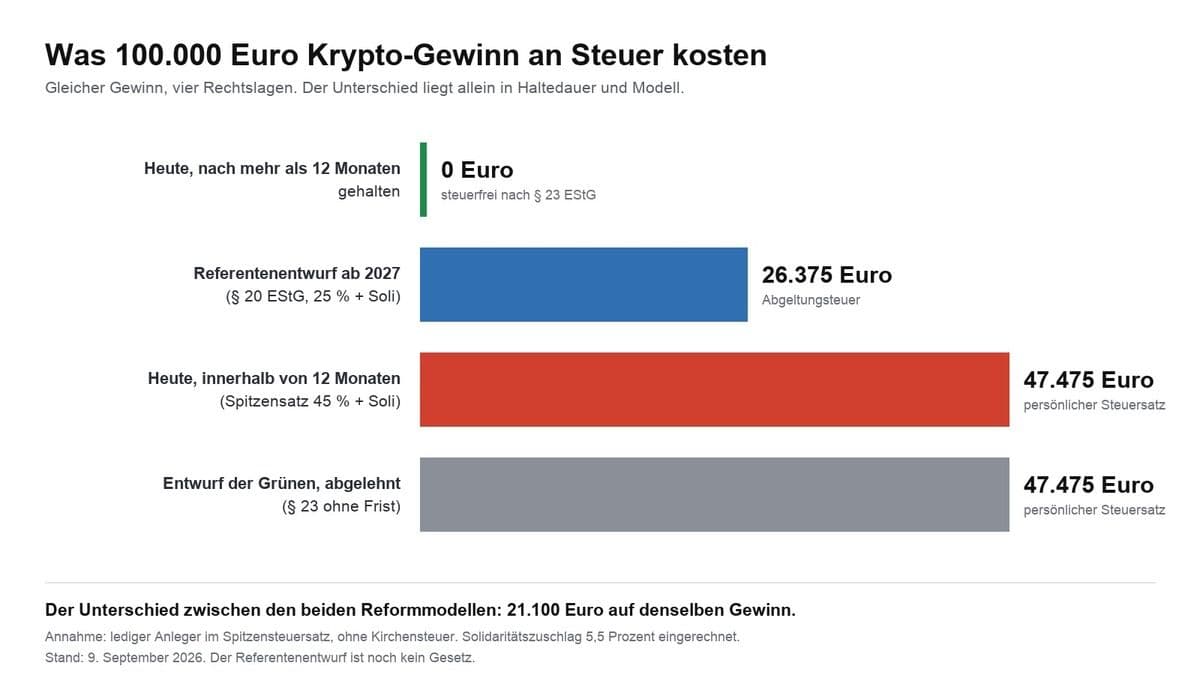
Crypto Tax in Germany: What Applies in 2026 and What Is Set to Change in 2027
Crypto gains are tax-free after twelve months; before that your personal tax rate of up to 45 percent applies. What triggers tax, how the holding period is calculated, what happens with staking and losses, and what the draft bill would change from 2027.
August 27, 2026 10:16 AM

Bitcoin Tax Return in Austria: When You Must File
Even with a crypto exchange, a tax return can still be necessary in Austria. Foreign platforms, missing capital gains tax withholding and cross-provider losses are the typical triggers.
August 20, 2024 7:00 PM

Top Crypto Tax-Free Countries in 2024: A Guide for Crypto Investors
Here are 2024's top countries where you can trade crypto tax-free! Explore this full guide on the adopted taxation options in the current global landscape of cryptocurrency taxation.
October 3, 2026 4:40 PM

Investing in Bitcoin With a Savings Plan or a Lump Sum: What the December 31 Tax Cut-Off Changes
Anyone putting money into Bitcoin now chooses between a lump sum, a monthly instalment and an ETN in a securities account. The German finance ministry’s draft bill would keep the one-year holding period only for holdings bought by December 31, 2026.
September 11, 2026 10:18 AM

Bitcoin Tax Audit: What Proof Austria Requires
Which bitcoin records can the Austrian tax office examine? Purchase dates, wallet transfers, acquisition costs and sale proceeds are what count.
September 1, 2026 1:25 PM

Bitcoin Tax Report Wrong: What Austrian Investors Can Do
Errors in a Bitcoin tax report are not unusual. This is the data Austrian investors should check, and how a wrong capital gains tax deduction is put right.
August 26, 2026 10:25 PM
Selling Bitcoin at a Loss: Loss Offsetting in Austria
Sold Bitcoin at a loss? Austria allows the loss to be offset against certain investment income. When loss offsetting is possible and which limits apply.
September 14, 2026 1:27 PM

Bitcoin Lost to a Scam: What Counts as a Tax Loss in Austria
Lost bitcoin to a scam? Why Austria generally does not recognise the damage as a tax loss for privately held assets, and when compensation payments start to matter.
August 11, 2026 9:13 PM

Germany's Crypto Holding Period Faces Abolition: What Petition 201716 and the Cabinet Decision Mean for Your Tax
Petition 201716 in the German Bundestag calls for the one-year holding period for crypto assets to be kept and has already passed the quorum of 30,000 signatures. This article sets out what the cabinet decision of July 6, 2026 provides for, how much of it is binding and which records you should be pulling together now.
August 25, 2026 10:13 AM
Gifting Bitcoin in Austria: When You Must Report the Gift
Austria levies no general gift tax on bitcoin. Above certain value thresholds, however, a notification to the tax office can be required.
August 22, 2026 4:47 PM

Offsetting Bitcoin Losses Against Stock Gains in Austria
Offset bitcoin losses against gains on shares? Austria allows it in principle, but only under certain conditions and usually via the tax return.


More from CryptoTicker