
Ethereum price prediction: BlackRock fund sheds 580,145 ETH, and BitMine absorbs only a fraction
Analysis: BlackRock's ETHA fund has shed 580,145 ETH in a month, and US ether ETFs have been losing money for six trading days. We work out how much of it is genuine outflow, why BitMine is not offsetting it and which levels the price now hinges on.





Which topics should we dive deeper into?
Select what genuinely interests you. Your picks feed directly into our editorial planning.
Crypto news that's actually worth your time.
Weekly. 60 seconds. Carefully curated by our editors: no hype, no promo flood, no spam.
What is established: BlackRock’s Ethereum fund, the iShares Ethereum Trust with the ticker ETHA, has shed 580,145 ETH within a month, about $1.3 billion, according to data from analytics service Lookonchain. On Monday, US spot ether ETFs recorded a further $139.7 million in net outflows, almost entirely from ETHA. Our assessment follows further down: as long as these fund flows do not reverse, the ETH price faces a steady seller that the known buyers are not offsetting.
Ether cost $2,249 on Tuesday morning, 1.4 percent less than 24 hours earlier and 16.6 percent less than 30 days ago. The range over the past 24 hours ran from $2,235 to $2,301. Where the price could head over a horizon of months is covered in our Ethereum price prediction. This piece is about the shorter term, and right now that depends more on the funds in New York than on the blockchain itself.
A spot ETF is an exchange-traded fund that actually holds the underlying asset, in this case real ether at a custodian. When investors buy fund shares, the fund has to acquire ether. When they redeem shares, its holdings shrink.
580,145 ETH out of BlackRock’s ETHA fund in one month
The figure comes from the wallet movements that Lookonchain attributes to the fund and was published on November 2. According to 24/7 Wall St., ETHA’s net assets fell from $9.9 billion to $6.9 billion between October 5 and October 30. The largest daily outflows were $202 million on October 6 and $105 million on October 26, in each case according to SoSoValue data.
How much of it is outflow and how much is price
Three billion dollars less in fund assets sounds like an exodus. Part of it, however, is simply the lower price. We ran a rough calculation for this article: on October 5 ether stood at around $2,727, and on October 30 it closed at $2,243. Dividing the fund’s assets by the respective price, ETHA held about 3.63 million ETH at the start of October and about 3.08 million at the end. That is roughly 0.55 million ETH less, which fits well with Lookonchain’s 580,145 ETH.
This gives a split worth keeping in mind. Roughly $1.3 billion of the decline is genuine redemptions, meaning investors who pulled their money. The remaining $1.7 billion or so is a valuation loss on holdings that stayed in the fund. For the price, the first part is what matters most, because only that means ether leaves the fund and can end up on the sell side of the market.
Six straight days of outflows from US ether ETFs
On Monday, November 2, a combined $139.7 million flowed out of all US spot ether ETFs. That is what Bloomingbit reports, citing Farside Investors. ETHA accounted for $138.3 million of that, and BlackRock’s staking fund with the ticker ETHB for a further $4.6 million. Only Morgan Stanley’s ether ETF booked an inflow, of $3.2 million. All other products saw no movement.
By the count of Farside and SoSoValue, it was the sixth consecutive trading day of net outflows. In the week from October 26 to 30, the ether funds lost $432 million, more than twice as much as the spot ETFs on bitcoin in the same week. It was the fifth week of outflows in a row. For October as a whole, SoSoValue shows net outflows of $1.61 billion.
The scale can be read from two further SoSoValue figures. All US spot ether ETFs together still manage $13.18 billion, equivalent to 4.8 percent of ether’s total market value. Since their launch in summer 2024 they have collected a net $12.15 billion. October therefore gave back a good eighth of what had flowed in over more than two years.
The mechanism behind the outflow: redemptions hit the spot market
An ETF share is not simply passed back and forth between investors like a stock on the secondary market alone. Behind exchange trading stand so-called authorized participants, large trading firms that create or redeem blocks of shares with the fund provider. When there are more sellers than buyers of fund shares, such a firm buys up the shares, hands them in to the fund and receives ether or dollars in return. It usually sells the ether on the spot market to close out its risk.
It is precisely this last step that makes the outflow relevant for the price. Every million dollars that leaves an ether ETF on a net basis turns into ether that has to find a buyer somewhere. On calm days other market participants absorb it. On days when the overall market is nervous anyway, as it has been since the hack at Binance on October 29, the additional supply weighs more noticeably on the price.
 Compare crypto exchanges for your ETH purchase
BitMine buys around 37,000 ETH a month, ETHA sheds more than fifteen times that
On the buy side, one company stands out at the moment: BitMine, a listed group that holds ether as a reserve. According to 24/7 Wall St., BitMine most recently bought 8,573 ETH for around $19 million and, by its own count, holds 6,060,506 ETH, about 4.9 percent of total supply. Of that, 5,227,037 ETH are locked in staking, meaning they serve as collateral securing the network and earn a reward for doing so.
24/7 Wall St. estimates the buying pace at about 37,000 ETH a month. Set against the 580,145 ETH that ETHA shed over the same period, BitMine mathematically covers only around 6 percent of it. The largest single buyer in the market is therefore nowhere near offsetting the largest single seller. In addition, BitMine’s shares fell 21.5 percent to $20.75 in the same month. That makes it harder for the company to raise fresh money for further purchases by issuing new shares.
Ethereum price since Sunday: the $2,242 level was tested again
In our Sunday analysis of DeFi deposits, ether stood at $2,267 on Sunday afternoon. We had named $2,242 as the lower level, the low of October 31 and the lowest daily close of the preceding 30 days. On the upside, the level was $2,455, the average of the last 30 daily closes.
Two things have changed since then. First, the price has fallen back by just under 0.8 percent to $2,249 and, overnight into Tuesday, briefly dipped below the $2,242 level at $2,235. A daily close below it has not yet happened, so the level is dented but not broken. Second, Monday’s outflow day has revealed a new source of selling pressure that was not yet visible in the DeFi data on Sunday. The $2,455 level on the upside has not come within reach during this time.

Five levels for the ETH price between $2,020 and $2,515
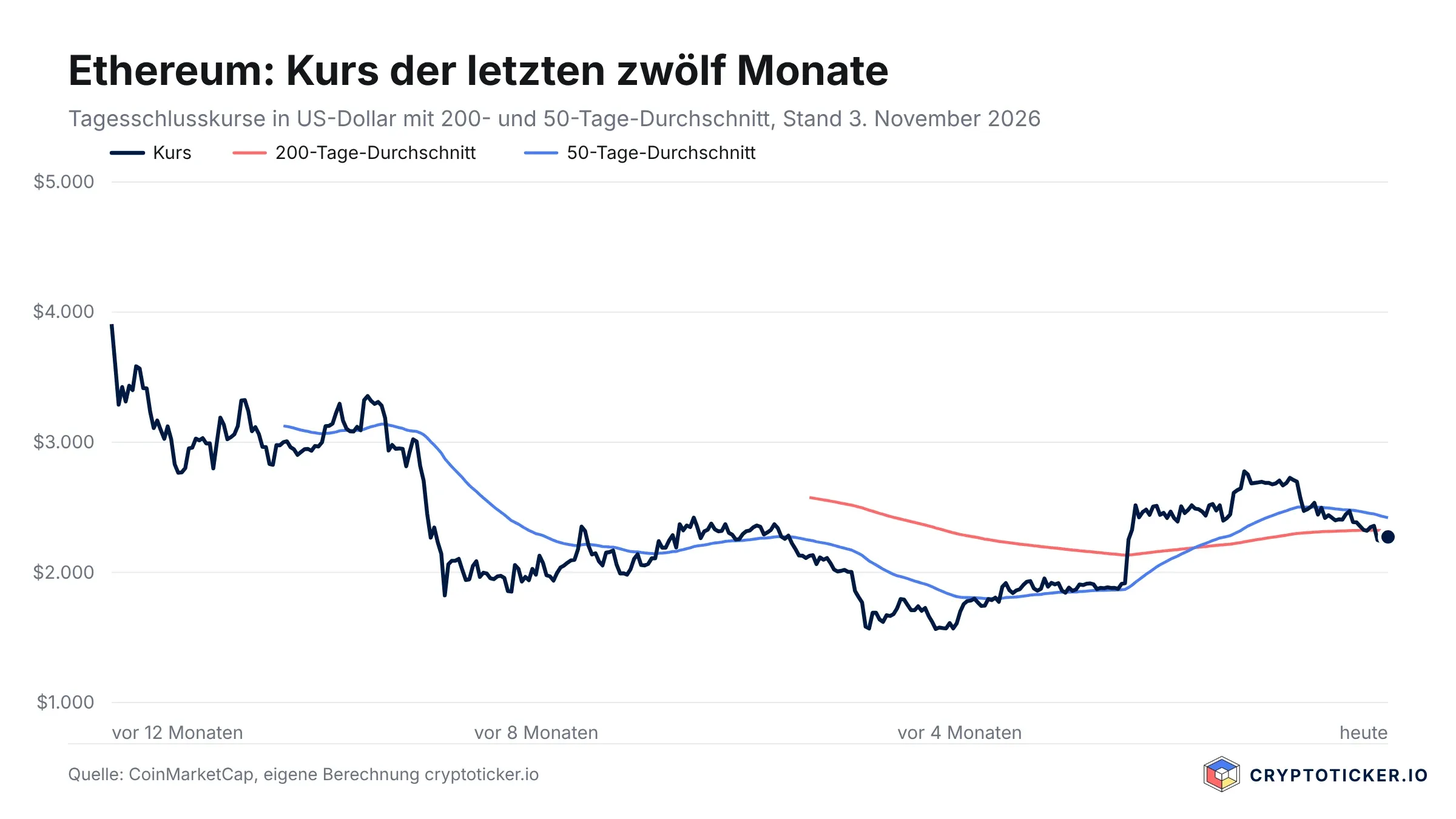
We calculated the moving averages for this article ourselves from CoinMarketCap’s daily closing prices over the past 365 days. The other levels come from the price history.
- $2,515: the simple average of the last 50 daily closes. Ether is 10.6 percent below it. Only above this line would the decline since early October be recovered in technical terms.
- $2,370: the simple 20-day average. It is the first hurdle at which it would become clear whether an end to fund outflows is also showing up in the price.
- $2,170: the low of October 30, which 24/7 Wall St. cites as the current floor.
- $2,158: the simple average of the last 200 daily closes, $2,157.66 by our calculation. The figure matches the value given by 24/7 Wall St. Ether is currently 4.2 percent above it.
- $2,020 to $2,055: a zone where ether turned on a daily-close basis several times in February, March and May.
In the chart above the lines run higher because they are exponentially smoothed and give more weight to recent prices. The exponential 200-day line is at around $2,321. Both readings say the same thing: the price has broken down out of the range of the medium-term averages, and the simple 200-day line at $2,158 is the next level where buyers need to show up. Ether is currently 54.5 percent below its all-time high of $4,946.
US ETFs, German ETNs: access for investors in Germany
Retail investors in Germany generally cannot buy the funds that money is currently flowing out of. US ETFs lack the key information document required by the EU regulation on packaged retail investment products, which is why German custodian banks usually reject the order. The route via a securities account in Germany runs through ETNs, exchange-traded notes listed on German exchanges that in many cases are backed by real ether. Which products exist and how they differ is shown in our overview of crypto ETFs and ETNs in Germany.
The difference is more than a formality. Legally, an ETN is a claim against the issuer, even if ether sits behind it. And the outflows from the US funds affect the ether price that a German ETN also tracks. Anyone invested via a securities account therefore feels the consequences of the New York fund flows just as much as someone holding ether directly on an exchange.
 Find the broker for trading ether ETNs
Holding period and tax on directly held ether
Anyone who holds ether directly, for example on an exchange licensed under the European crypto regulation MiCA or in their own wallet, can sell tax-free after a holding period of more than one year. That is set out in Section 23 of the German Income Tax Act. Within that period, gains are taxable as soon as all private disposal gains in a year together reach the exemption limit of €1,000. Whether the one-year period for crypto assets will remain is politically open; our page on the status of the holding period reform summarises where things stand.
In a phase of falling prices especially, it pays to look at your own purchase dates. Anyone who bought ether less than a year ago at higher prices and sells now realises a loss that can be offset against other private disposal gains in the same year. Anyone close to the end of the one-year period, on the other hand, should check whether selling a few weeks later would be more favourable for tax purposes. These rules do not automatically apply to an ETN in a securities account; the custodian bank usually treats it as a security and withholds flat-rate tax.
The editors’ assessment: fund flows outweigh BitMine
Our assessment: for the coming weeks, the direction of US ether ETFs is the single most important factor for the ETH price. In favour of this view is that ETHA shed 580,145 ETH in a month, while the largest identifiable buyer, BitMine, absorbs only about 37,000 ETH a month according to 24/7 Wall St. estimates. Also in favour is that the outflow continued on Monday at $139.7 million, even though the price was already 16.6 percent below its level of 30 days earlier. Anyone selling purely on price grounds might well have stopped by that point.
Against this view is that ETF outflow streaks rarely run forever and a single inflow day can quickly turn sentiment. The simple 200-day line at $2,158 has also held so far. Only a daily close below it would turn the decline into a situation in which the zone around $2,020 to $2,055 becomes the next target. This assessment is not a recommendation to buy or sell. Crypto assets are highly volatile, and a total loss is possible.
ETHA outflows: the 200-day line at $2,158 is the line in the sand
Three steps that follow from the figures in this article:
- Clarify your own access. If you want to hold ether via a securities account, you will find the products tradable in Germany in the overview of crypto ETFs and ETNs in Germany. Pay attention to collateral, costs and issuer.
- Choose a regulated exchange for buying directly. Which providers have a MiCA licence and what buying and withdrawing cost is set out in the comparison of crypto exchanges.
- Watch the $2,158 level. If ether closes below it on a daily basis, the picture described in this article changes. Anyone who then wants to trade short term needs access with clear fees and reliable execution; see the comparison of crypto brokers.
(As of November 3, 2026. This article is not investment advice. Prices and fee structures change; check the terms with the provider before you buy. Crypto investments are high risk, and a total loss is possible.)
Frequently asked questions about Ethereum ETFs
Transparency note: This article was produced with the assistance of artificial intelligence and reviewed by our editorial team before publication. All figures and claims were checked against the primary sources linked in the text. The feature image was generated with AI.
More on Ethereum: All Ethereum news at a glance
Related articles
- Ethereum Price Prediction: “We Thought It Would Take Five Years”, and 100,000 Ether Separate BitMine From Its Buying Cap
- Ethereum Price Prediction: Ether ETFs Lose $118 Million in Three Days, Bitcoin Funds Gain
- Ethereum to $10,000 in 2025? Why Institutions Are Betting Big on ETH
- Crypto News Today: The CLARITY Act Vote Nears and Bitcoin Holds Its Range
- Ethereum Price Prediction: Can ETH Blast Toward $2,750 Next?
Which topics should we dive deeper into?
Select what genuinely interests you. Your picks feed directly into our editorial planning.
Crypto news that's actually worth your time.
Weekly. 60 seconds. Carefully curated by our editors: no hype, no promo flood, no spam.

August 8, 2025 1:20 PM

Ethereum Price Prediction: Can BlackRock’s $103M Buy Push ETH to $4,000?
Ethereum is trading just below $3,900 after BlackRock reportedly bought $103 million worth of ETH. Could this institutional move be the spark that sends ETH to $4,000?
February 15, 2025 3:01 PM

Ethereum News: NYSE Proposes Staking Rule and Pectra Launches on Sepolia while ETH Price Defends Key Zone
Ethereum is making headlines with its latest news, the NYSE rule change proposal in Grayscale's Spot Ether ETF, and Pectra launch ready on Sepolia in March 2025. All that while ETH defends a critical price zone amid market volatility...
August 21, 2026 5:08 PM

Ethereum Price Above $2,300: 3 Reasons Why ETH Is Leading This Rally
Ethereum jumped past $2,300 and is now testing $2,400. ETH is outpacing Bitcoin, and the reasons are specific to Ethereum.

September 18, 2026 11:39 AM

Ethereum Price Prediction: Why ETH Is Closing In on $3,000
Ethereum is coiling between $2,400 and $2,600 with a rising 200 EMA underneath. Here is what the ETH chart says about $3,000.
July 6, 2026 5:43 PM

Ethereum Price Prediction: BitMine Buys $74M ETH as Strategy Sells Bitcoin
Ethereum price prediction as BitMine adds more ETH while Strategy sells Bitcoin. Is institutional money rotating from BTC to ETH?
April 26, 2026 3:14 PM

Will Ethereum Coin Break its $4,900 ATH in 2026?
Ethereum eyes a potential return to its $4,900 ATH in 2026. Discover the technical hurdles and institutional catalysts driving the current ETH price action.
October 10, 2026 1:19 PM

Crypto ETF Outflows Pass $1 Billion in October: Is Wall Street Dumping Bitcoin and Ethereum?
Bitcoin and Ethereum ETFs just bled over $1 billion in October. Here is who is selling, who is still buying, and what it means for your coins.
July 23, 2024 9:09 AM

Ethereum Price Prediction: Will ETH price reach $5K With The Launch Of ETH ETF?
With Spot ETH ETF trading launched today, what can you expect for Ethereum price and other altcoins, a surge or dip?
August 10, 2025 11:00 PM

Ethereum Price Prediction: Can the OKX Giveaway Boost ETH Price to a New ATH?
Ethereum trades above key support with bullish momentum. Could OKX’s latest giveaway help push ETH toward a new all-time high?
March 4, 2026 10:29 AM

Ethereum Price Reclaims Crucial Levels as Institutional Rotation Accelerates
Ethereum price shows bullish resilience as it battles key resistance at $2,100. Analysts weigh in on the impact of Harvard’s latest portfolio rotation into ETH.
August 13, 2025 8:40 AM

Ethereum Price Hits New High at $4,678 – $5K SOON as BlackRock Buys $318.7M in ETH...
Ethereum reached a new high of $4,678, edging closer to its 2021 record. With BlackRock purchasing $318.7M worth of ETH, the $5K milestone may be next.
May 20, 2024 12:08 PM

Ethereum (ETH) Up To $4000: Can ETH Break Out From The 3K Levels?
With 2 days until the SEC's decision on spot Ethereum ETFs, ETH price surges above the 3.1K and hints about new all-time-highs are on the horizon. Could ETH break out of the current levels and go back to around 4K as back in early March of this year?
September 22, 2026 7:20 PM

ETH Price Prediction: What to Check at the $2,800 Mark Now
Ether stands at $2,735.96 on September 22, 2026, right below the zone at which it has failed repeatedly. Instead of a target number, you get four checks that count before your next order: holding period, buying route, the staking line and the distance to liquidation.
August 10, 2024 6:02 PM

Ethereum Price Prediction: Amid Mixed Signals What To Expect For ETH Price?
Ethereum faces volatility and competition, but signs of bullish activity and whale accumulation suggest potential recovery. How does it compare to Solana, and what does the future hold for ETH?
August 2, 2024 10:32 PM

Ethereum Price Crash: What Next Support Levels For ETH Price Below $3K?
Ethereum fees just hit their lowest since late 2023, and now Ethereum price is trading near $3K with a high potential to drop below it... What's next?
May 27, 2025 11:59 AM

Ethereum Price Prediction: Will ETH Hit $3,000 in May and a New ATH in 2025?
Ethereum (ETH) is the most trending coin in May 2025. With Bitcoin cooling off, investors are now turning to ETH as their next opportunity. Potential breakout above $3,000 this month and a new all-time high before the year ends?
March 31, 2026 8:12 AM

Is Ethereum Insanely Undervalued? Bitmine’s $6.7 Billion Staking Bet Says Yes
Bitmine has staked 3.31 million Ethereum worth $6.72 billion. Here's why institutional giants are betting on ETH being undervalued and what it means for the price.
March 16, 2026 10:31 AM

Ethereum Price Prediction: ETH Coin Reclaims $2,250 as Bull Run Targets THIS New Price
Ethereum price surges 7% in 24 hours, breaking the $2,250 resistance. Analysts eye this target next, while key support levels at $2,200 and $2,050 remain critical.
July 25, 2024 12:35 PM

Ethereum Price Analysis: Why is Ethereum Price Down?
Here is the impact of the recent Ethereum ETF launch on the crypto market, leading to a significant sell-off and a $300 million liquidation event. Not what was expected?
December 19, 2024 11:38 AM
Is an Ethereum Price Crash Imminent?
Ethereum price has dipped igniting fears of a potential price crash. Analysts highlight bearish signals, but some still predict a recovery. Which is it next?
April 6, 2025 9:31 PM

Ethereum Price Crash Below $1,800 - Is $1,200 Next?
Ethereum just suffered one of its worst daily drops in recent months, plunging below key support levels. With the broader crypto market in freefall and heavy outflows hitting exchanges, what's next for ETH?
August 25, 2024 11:08 AM

Ethereum Price Prediction: ETH Eyes $3,000 After 5% Weekly Gain
Ethereum price gained 5% over the past week, reaching the critical price area of $2,750. Can Ethereum break through the psychological barrier of $3,000?
March 1, 2025 2:14 PM

Bitcoin March 2025 Price Prediction: After the WORST February for BTC Price in 11 years - How Will March Unfold?
February 2025 saw Bitcoin's sharpest decline in over a decade. Explore the factors behind this downturn and the potential for a market rebound.
August 24, 2026 12:22 PM

Ethereum Price Prediction: Is $3,000 the Next ETH Target?
ETH ripped 29% and reclaimed the 200 EMA. Our Ethereum price prediction explains the path to $3,000 and the one level that kills the bull case.
December 4, 2025 7:45 AM
Ethereum Price Explodes Back Above $3,200: Bigger Moves Coming?
Ethereum jumps back above $3,200 as Bitcoin reclaims $90K. Fresh U.S. liquidity signals and strong risk-asset demand now set the tone for ETH in December.

More from CryptoTicker