
ECB rate decision: all dates to 2027 and how Bitcoin reacted
Overview: the ECB kept the deposit rate at 2.50% on 29 October 2026, and the next decision follows on 17 December at 14:15 CET. Here are all dates to the end of 2027, the policy rate, the race to succeed Lagarde and how Bitcoin reacted to 15 decisions.




Which topics should we dive deeper into?
Select what genuinely interests you. Your picks feed directly into our editorial planning.
Crypto news that's actually worth your time.
Weekly. 60 seconds. Carefully curated by our editors: no hype, no promo flood, no spam.
At the ECB rate decision on 29 October 2026, the Governing Council of the European Central Bank left its three key rates unchanged: the deposit facility rate stays at 2.50%, the main refinancing rate at 2.65% and the marginal lending rate at 2.90%. The next ECB rate decision is due on Thursday, 17 December 2026, at 14:15 CET (13:15 in London), together with new projections. On the same day as the decision, Christine Lagarde announced that she will step down as ECB President on 7 February 2027, almost nine months before her term ends. We have also measured how Bitcoin reacted to the last 15 decisions: the table further down shows the price at the moment of the announcement, 24 hours and seven days later. Our assessment: the direction of the rate move did not predict the direction of the price in this series, and the US Federal Reserve matters more for Bitcoin.
Key points
- Next ECB rate decision: 17 December 2026, 14:15 CET, press conference at 14:45 CET, with new staff projections.
- Decision of 29 October: hold, deposit rate 2.50%. The Council says it does not pre-commit to a particular rate path.
- Current policy rate: deposit rate 2.50% since 16 September 2026, after two hikes in June and September, the first since 2023.
- Inflation: 3.8% in the euro area in September 2026, the highest since September 2023. Energy prices were up 18.9% on the year.
- Lagarde leaves: departure on 7 February 2027, her last meeting is the one on 4 February. EU leaders aim to settle the succession by the summit on 17 and 18 December.
- Bitcoin after 15 decisions: higher six times and lower nine times after 24 hours, and six times higher and eight times lower one week after 14 decisions. The strongest week followed a cut: up 9.4% after 17 April 2025.
For the US side of the picture, see our overview of the Fed rate decision, which tracks every FOMC meeting and Bitcoin's reaction. This page remains the ECB overview: dates, decisions and Bitcoin's response, updated after every meeting.
 Compare staking yields against the ECB rate
ECB rate decision on 29 October 2026: hold at 2.50%
On 29 October the Governing Council kept all three key rates at their September level. It explains the pause with risks pointing in both directions: rising energy prices raise the risk to inflation and weigh on growth at the same time. According to the Council, underlying inflation has so far remained broadly stable, and wages are not yet responding noticeably. The ECB publishes the transcript and video on its press conference page. 24 hours after the announcement Bitcoin stood at $77,174, down 3.5% from $80,000 at 14:15 CET, matching 5 February 2026 as the largest 24-hour drop in the series.
More important than the decision is the sentence about what comes next. The Council decides meeting by meeting based on the data and does not commit in advance. Inflation figures for October and November will be published before 17 December, and either could tip the balance. For your portfolio this means: a position that only works under a single rate expectation carries an unnecessary risk.
On the same day Christine Lagarde announced that she will leave office on 7 February 2027. Her eight-year term would have run until the end of October 2027. According to Reuters, she wants to be free to speak on topics beyond monetary policy. The rate decision itself was not affected.
What the ECB rate decision sets
The Governing Council sets three rates. The most important is the deposit facility rate: banks park money overnight at the central bank at this rate, and it anchors overnight deposits, fixed-term deposits and money market funds across the euro area. The main refinancing rate is the price at which banks borrow from the central bank for a week, the marginal lending rate applies to short-term overnight loans. Since September 2024 the gap between the deposit rate and the main refinancing rate has been only 0.15 percentage points.
The ECB's goal is price stability, defined as 2% inflation over the medium term. The target is symmetric: undershooting is considered as undesirable as overshooting. Unlike the US Federal Reserve, the ECB has no equal-ranking employment goal. The Council consists of the six members of the Executive Board and the governors of the euro area's national central banks, whose voting rights rotate.
For investors, the deposit rate is what counts. It roughly determines what you earn on safe euro balances and is therefore the benchmark for any return in crypto, whether from staking, lending or price gains.
ECB rate decision dates 2026 and 2027 with times
The Governing Council holds eight monetary policy meetings a year, each over two days. The decision is published on the second day at 14:15 CET, the press conference starts at 14:45 CET. In London that is 13:15 and 13:45 all year round, because the UK and the euro area change their clocks on the same days.
| Meeting | Decision | Time (CET/CEST) | New projections |
|---|---|---|---|
| 16 and 17 December 2026 | Thu, 17 Dec 2026 | 14:15 | yes |
| 3 and 4 February 2027 | Thu, 4 Feb 2027 | 14:15 | no |
| 17 and 18 March 2027 | Thu, 18 Mar 2027 | 14:15 | yes |
| 28 and 29 April 2027 | Thu, 29 Apr 2027 | 14:15 | no |
| 9 and 10 June 2027 | Thu, 10 Jun 2027 | 14:15 | yes |
| 21 and 22 July 2027 | Thu, 22 Jul 2027 | 14:15 | no |
| 8 and 9 September 2027 | Thu, 9 Sep 2027 | 14:15 | yes |
| 27 and 28 October 2027 | Thu, 28 Oct 2027 | 14:15 | no |
| 15 and 16 December 2027 | Thu, 16 Dec 2027 | 14:15 | yes |
The dates come from the Governing Council meeting calendar. The meeting on 4 February 2027 is the last one chaired by Lagarde. The ECB publishes an account of each meeting about four weeks later.
ECB policy rate today: deposit rate at 2.50% since 16 September
Since 16 September 2026 the deposit rate has stood at 2.50%, the main refinancing rate at 2.65% and the marginal lending rate at 2.90%. The ECB got there in two steps of 0.25 percentage points each, decided on 11 June and 10 September 2026. Before that it had held the deposit rate at 2.00% for a year, after eight cuts between June 2024 and June 2025. The ECB lists every level in its table of key interest rates.
Energy tipped the balance towards the hikes. The war in the Middle East and disrupted passage through the Strait of Hormuz pushed up oil prices, and the euro area imports most of its energy. According to Eurostat, euro area inflation rose to 3.8% in September 2026, from 3.2% in August. Energy cost 18.9% more than a year earlier. Core inflation, excluding energy and food, was 2.5%. Among the largest economies, the rate was 3.3% in Germany, 3.4% in France, 4.2% in Italy and 5.0% in Spain.
This split explains the October pause. As long as inflation comes mainly from energy and wages and services do not follow, the Council treats it as a supply shock. A rate hike does not make oil cheaper, but it dampens demand and therefore growth. That trade-off is what December will decide.
Every ECB rate decision since 2025 and how Bitcoin reacted
The table shows every monetary policy decision since January 2025 and the Bitcoin price at the minute of the 14:15 CET announcement, 24 hours and seven days later, based on Coinbase 15-minute prices in US dollars. The 24-hour value for 29 October is in, only the one-week value follows on 5 November.
| Decision date | Decision | Bitcoin at 14:15 CET | after 24 hours | after 7 days |
|---|---|---|---|---|
| 29 Oct 2026 | Hold at 2.50% | $80,000 | −3.5% | due 5 Nov |
| 10 Sep 2026 | Hike to 2.50% | $77,801 | −1.2% | −1.4% |
| 23 Jul 2026 | Hold at 2.25% | $65,472 | −0.7% | −0.9% |
| 11 Jun 2026 | Hike to 2.25% | $63,085 | +0.7% | +1.4% |
| 30 Apr 2026 | Hold at 2.00% | $76,123 | +1.9% | +6.5% |
| 19 Mar 2026 | Hold at 2.00% | $69,094 | +1.8% | +0.5% |
| 5 Feb 2026 | Hold at 2.00% | $69,359 | −3.5% | −2.2% |
| 18 Dec 2025 | Hold at 2.00% | $87,868 | +0.1% | −0.5% |
| 30 Oct 2025 | Hold at 2.00% | $108,535 | +1.3% | −5.2% |
| 11 Sep 2025 | Hold at 2.00% | $114,288 | +0.5% | +2.6% |
| 24 Jul 2025 | Hold at 2.00% | $118,645 | −1.8% | −0.2% |
| 5 Jun 2025 | Cut to 2.00% | $105,157 | −1.0% | +1.7% |
| 17 Apr 2025 | Cut to 2.25% | $84,708 | −0.1% | +9.4% |
| 6 Mar 2025 | Cut to 2.50% | $90,291 | −0.9% | −8.6% |
| 30 Jan 2025 | Cut to 2.75% | $105,072 | −0.2% | −6.4% |
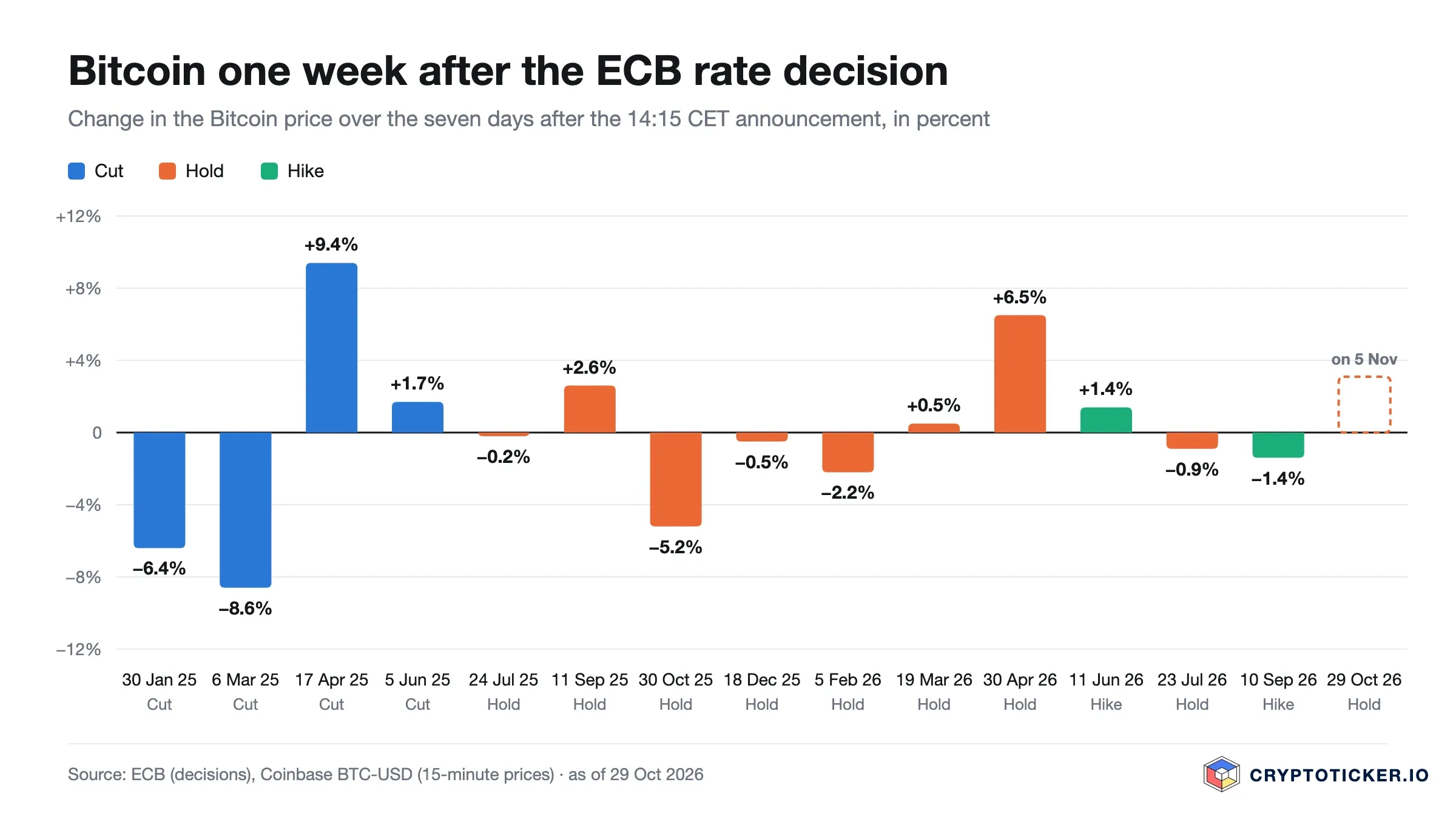
Three patterns stand out. First: the four cuts in 2025 were followed by two losing weeks, down 6.4% and 8.6%, and two winning weeks, including the strongest week in the series, up 9.4% after 17 April 2025. Second: the two hikes in 2026 barely moved Bitcoin, up 1.4% in the week after the June decision and down 1.4% after the September decision. Third: in the three hours after the announcement, the range between high and low was between 0.8% and 2.7% in 14 of 15 cases. The outlier was 5 February 2026 with 6.4%, on a day when the ECB changed nothing.
How the ECB rate decision affects the Bitcoin price
The short answer: indirectly, and less than the US Federal Reserve. Bitcoin trades mainly against the US dollar, and crypto market liquidity depends on monetary policy in Washington. The ECB works through three channels that partly offset each other.
The euro exchange rate. For investors in the euro area, Bitcoin in euros equals Bitcoin in dollars divided by EUR/USD. If the euro gains 5%, the euro price of Bitcoin falls by about 4.8% with an unchanged dollar price. A tighter ECB tends to support the euro and thus lowers the euro price of Bitcoin even when the dollar price does not move.
The safe rate. With 2.50% on overnight deposits, the bar rises for any asset without a running yield. Bitcoin pays no interest. Staking on proof-of-stake networks earns a few percent a year depending on the network, but with the price risk of the coin. The higher the deposit rate, the less that risk pays off for cautious investors.
Liquidity. Low rates and ample money encourage risk-taking across markets. For Bitcoin, however, this channel runs mainly through the dollar and therefore through the Fed.
Our assessment from the series above: anyone betting on the outcome of an ECB meeting is relying on a weak signal for Bitcoin. The direction of the rate move did not predict the direction of the price in any recognisable pattern. If you think in euros, the exchange rate matters more than the meeting day, and for regular purchases a Bitcoin savings plan is more robust than buying around the meeting.
Lagarde's successor: who could lead the ECB from February 2027
The new President is appointed by the European Council by qualified majority, on a recommendation from the finance ministers and after consulting the European Parliament and the ECB Governing Council, as set out in Article 283 of the Treaty on the Functioning of the EU. The term is eight years and cannot be renewed. European Council President António Costa opened the process on 29 October. Observers such as Berenberg's chief economist expect a decision by the EU summit on 17 and 18 December 2026 at the latest.
The timing has a political core. France elects a new president in April 2027. The early departure allows Emmanuel Macron and Friedrich Merz to settle the appointment before that election.
| Candidate | Current role | Country | Policy stance |
|---|---|---|---|
| Pablo Hernández de Cos | General Manager of the Bank for International Settlements, Governor of the Banco de España until 2024 | Spain | centrist |
| Klaas Knot | President of the Dutch central bank and Chair of the Financial Stability Board until 2025 | Netherlands | leaning hawkish |
| Joachim Nagel | President of the Deutsche Bundesbank | Germany | hawkish |
| Nadia Calviño | President of the European Investment Bank | Spain | centrist |
Hawks are central bankers who fight inflation early with higher rates, doves give more weight to growth. Hernández de Cos and Knot are seen as the frontrunners. On the prediction market Kalshi, Hernández de Cos led with 42% on 29 October, ahead of Knot with 34%, as Seeking Alpha reports. Spain backs Hernández de Cos, the Netherlands back Knot. Executive Board member Isabel Schnabel moves to the International Monetary Fund in January 2027.
The real turning point is bigger than a single post. Schnabel leaves in January, Lagarde in February, and chief economist Philip Lane's term ends in May 2027. Half of the six-member Executive Board will change within five months. A hawkish President such as Knot would likely keep rates higher for longer and support the euro, a centrist such as Hernández de Cos would give more weight to growth and to the bond spreads of southern member states. For Bitcoin priced in euros, a stronger euro would be a headwind.
The Lagarde era in review: from minus 0.50% to 4.00% and back
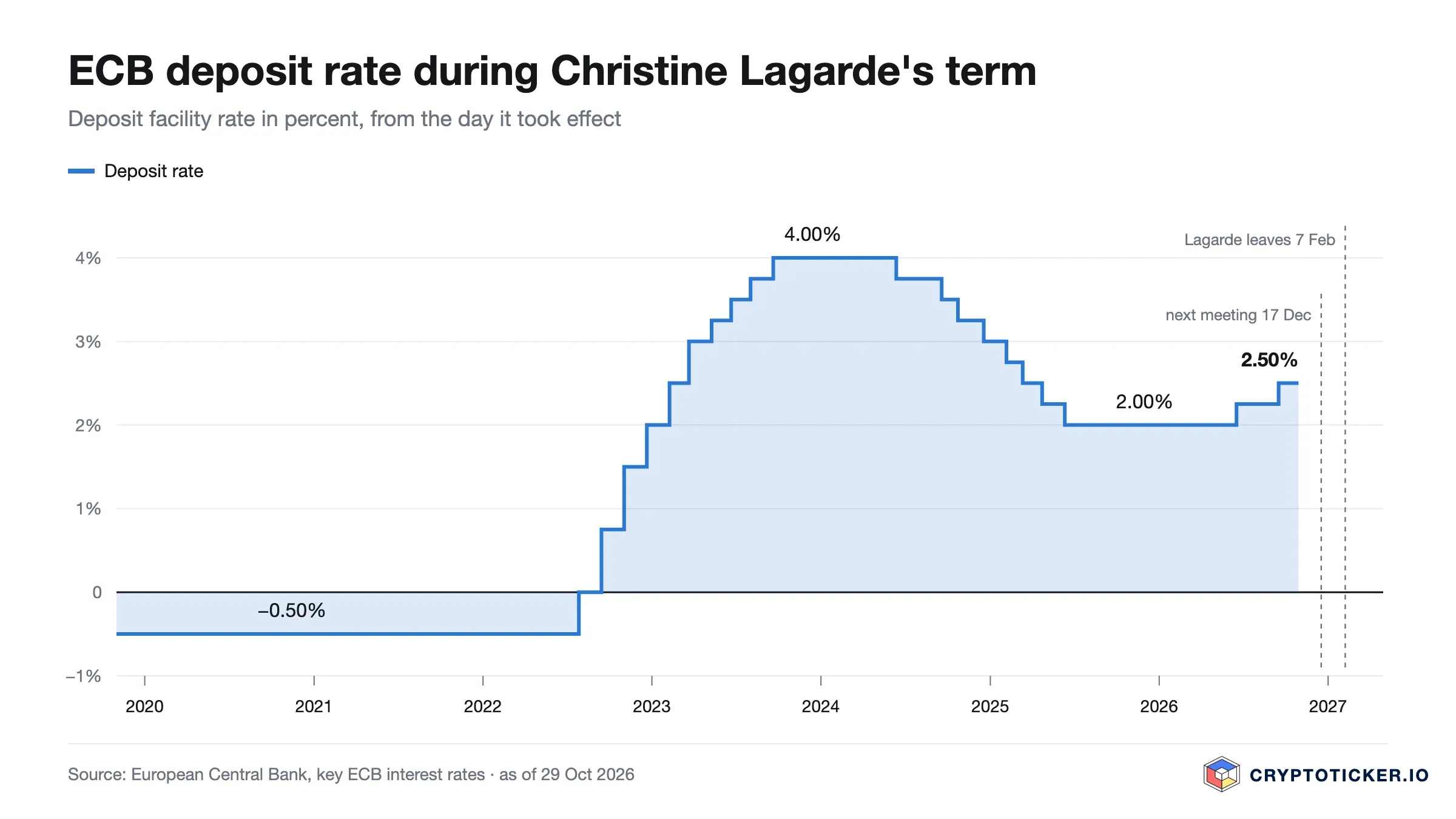
Christine Lagarde took over the ECB from Mario Draghi on 1 November 2019, with the deposit rate at minus 0.50%. A lawyer by training, she had previously been Managing Director of the International Monetary Fund and French finance minister. Her term falls into four phases.
- Pandemic 2020: after a bumpy start in March 2020, when a remark about bond spreads put Italian government bonds under pressure, the ECB launched its pandemic emergency purchase programme PEPP, eventually worth €1,850 billion. It prevented a new debt crisis in the euro area.
- Inflation 2021 and 2022: the ECB long considered rising prices transitory and only hiked in July 2022, four months after the Fed. Inflation reached 10.6% in October 2022. That was the biggest mistake of her term.
- Tightening 2022 and 2023: what followed was the fastest rate increase in the history of the euro, ten hikes from minus 0.50% to 4.00% in 14 months, backed by a new tool against diverging government bond yields. By 2025 inflation had fallen back to about 2% without a deep recession.
- Easing and energy shock 2024 to 2026: eight cuts until June 2025, starting three months before the Fed, then two hikes in 2026 because of energy prices.
For savers, eight years of negative rates ended under Lagarde. She was sceptical of crypto: she called Bitcoin highly speculative, warned of money laundering risks and pushed for strict stablecoin rules. How tense the relationship with the industry was is shown in our report on whether Lagarde blocked Binance's MiCA licence. Her most important unfinished project is the digital euro. The European Parliament adopted its negotiating position in July 2026, and the ECB plans a twelve-month pilot from the second half of 2027. Her successor will therefore decide on the pilot and the launch.
ECB and Fed: why the US meeting moves Bitcoin more
The Federal Reserve is the central bank of the United States and sets the rate of the world's reserve currency. It has a dual mandate of price stability and maximum employment. Since 16 September 2026 its target range has been 3.75% to 4.00%, confirmed on 28 October. The gap to the ECB deposit rate is therefore 1.25 to 1.50 percentage points, which tends to support the dollar.
In December both central banks decide in quick succession: the Fed on 9 December at 2:00 p.m. ET, the ECB eight days later. On the prediction market Polymarket, 76.5% was priced on a Fed hike in December as of 29 October. Across the two series, Bitcoin's change one week after the decision ranged from minus 18.1% to plus 11.4% for the Fed and from minus 8.6% to plus 9.4% for the ECB. All Fed dates and Bitcoin's reaction are in our overview of the Fed rate decision.
 Find an exchange with direct euro deposits
ECB meetings and your crypto portfolio: euro balances, staking and stablecoins
A deposit rate of 2.50% sets the benchmark for safe money. Euros held on a crypto exchange usually earn no interest there. Euro stablecoins issued under the EU's MiCA regulation may not pay interest to their holders. Staking offers come in above or below the deposit rate depending on the network, but carry the price risk of the coin.
For EU readers, the regulatory side matters as much as the rate. MiCA-licensed platforms can serve customers across the euro area, and the digital euro, once issued, will compete with private euro stablecoins for everyday payments. Who leads the ECB from February will shape how open that competition is.
ECB in December: new projections and an open direction
On 17 December the ECB will publish new projections for inflation and growth. They will show whether the central bank sees the energy shock as temporary or expects knock-on effects in wages and services. If core inflation keeps rising, a third hike becomes more likely. If oil prices fall, the case for a longer pause grows. The Council has explicitly not committed to either direction.
The EU summit starts on the same day, and observers expect Lagarde's successor to be decided there. We update this page after every meeting: with the decision and the Bitcoin price after 24 hours and after seven days.
Frequently asked questions about the ECB rate decision
Transparency note: This article was produced with the assistance of artificial intelligence and reviewed by our editorial team before publication. All figures and claims were checked against the primary sources linked in the text. The feature image was generated with AI.
Related articles
- Fed Rate Decision: Every FOMC Date to 2027 and How Bitcoin Reacted
- ECB holds rates at 2.50 percent as Lagarde announces her exit
- Fed rate decision without a cut: “Inflation remains elevated”
- ETF inflows of $526.7 million meet a Bitcoin price of $82,708: the levels that decide before the Fed meeting
- Fed Rate Decision of September 16: What It Means for Your Bitcoin Savings Plan
Which topics should we dive deeper into?
Select what genuinely interests you. Your picks feed directly into our editorial planning.
Crypto news that's actually worth your time.
Weekly. 60 seconds. Carefully curated by our editors: no hype, no promo flood, no spam.

October 14, 2026 7:40 PM

US inflation rises to 3.7 percent, core rate above forecast: what matters now for Bitcoin
US consumer prices rose 3.7 percent in September, and the core rate 2.6 percent. Both figures came in above forecast, two weeks before the Fed decision on October 28.
October 2, 2026 7:20 PM

Bitcoin after the US jobs report: 29,000 positions, and the Fed pause moves closer
The US labour market produced just 29,000 jobs in September, and July was revised after the fact to a loss of 10,000. What that means for the Fed meeting on October 27 and 28, for the levels on your chart and for leveraged positions.
September 24, 2026 10:11 PM

Bitcoin Price Prediction: What to Check on Levels, Holding Period and Leverage Before the October 28 Rate Decision
Bitcoin is trading at around $83,800, a third below its October 2025 high, while the sentiment index reads greed. Which dates, levels and deadlines over the coming weeks really decide your net gain, and which of them you steer yourself.

July 25, 2026 11:27 AM
Crypto Price Today: Market Slides Again as Bitcoin Fails at $67,000
Bitcoin slipped back under $64,000 after tapping $66,990. Oil, ETF outflows and Fed nerves are dragging the whole crypto market lower.
June 13, 2024 4:13 PM

Crypto Market DOWN As Bitcoin Price Slides, Ethereum Price Consolidates, And XRP Price Nears New Lows
The recent Federal Reserve decisions and market dynamics impact Bitcoin, Ethereum, and XRP. How to manage and what to monitor amid market volatility and uncertainty?
October 1, 2026 7:25 AM

US core inflation falls to 3.0 percent: what investors need to know before the Fed decision on October 28
US core inflation ran at 3.0 percent in August, clearly below the expected rate. That shifts expectations for the Fed meeting on October 28 and helps decide how much room the Bitcoin price gets in the fourth quarter.
September 5, 2026 12:57 PM
Top 5 Cryptos To Watch In September 2026
Bitcoin has climbed back near $80,000 from its June low. Here are the five cryptos worth watching this September, and the risks around them.
January 28, 2026 10:44 AM

FOMC Rate Decision: Bitcoin Braces for Volatility as Gold Hits $5,300
Bitcoin stays under $90k as the FOMC meeting approaches. With Gold hitting a record $5,300, traders expect major crypto market volatility after Powell's speech.
January 11, 2026 8:38 PM

Polymarket in January 2026: 90% Chance of a 50 Bps Rate Cut in 2026? What the Fed Did Instead
In January 2026 Polymarket traders put the odds of 50 basis points of Fed cuts in 2026 at 90%. By September the Fed had not cut once and raised rates by a quarter point instead.
December 30, 2025 10:07 AM

Polymarket Traders Expect the Fed to Pause Rates in 2026: What That Usually Means for Crypto
Polymarket traders see the Fed holding rates in 2026. Here’s how rate pauses have historically affected crypto prices.
January 29, 2025 8:00 AM

FOMC and Crypto: How Can the First FOMC Meeting Under Trump Affect the Crypto Market?
The first FOMC meeting under President Trump is set to take place tomorrow. Discover all possible scenarios and their impact on Bitcoin and the crypto market.
September 19, 2026 1:31 AM

Bank of Japan rate move: how to spot a carry trade unwind before it hits your Bitcoin holdings
Japan raises to 1.25 percent, the Fed to 3.75 to 4.00 percent two days earlier, and the crypto market rises anyway. How to tell whether an unwinding of yen-funded positions is under way, and what to check now on leverage, holding period and loss offsetting.
November 11, 2025 10:25 AM

US Government Reopens After 41 Days – What It Means for Bitcoin, Crypto, and Global Markets
The US government reopens after a record 41-day shutdown. Rate cuts, QT ending, and new crypto laws could reshape markets—here’s what investors must know.
September 14, 2024 12:01 PM
Bitcoin Surges Past $60K: The Start of a Major Rally or Just Another Bull Trap?
Bitcoin has surged past $60,000, sparking optimism among investors. But with looming market volatility and whale activity, is this the start of a new rally or just another bull trap?
September 9, 2024 8:00 AM
How Fed Rate Cuts Could Shake Global Markets and Boost Tokenized Treasuries
With looming Fed rate cuts, global markets are bracing for impact. Check how these changes could affect risk-on assets like Bitcoin and tokenized treasuries.
October 24, 2026 3:28 PM

Bitcoin Price Prediction: Fed on Wednesday, $11.1 Billion Expiry on Friday, Which Date Moves the Price?
Analysis: the Fed decides on October 28, and two days later more than $11.1 billion in bitcoin options expire. The market has moved the rate rise to December, and that shifts the levels for this week.
October 3, 2026 7:37 PM

Bitcoin price down 4.4 percent in dollars and 0.5 in euros: what investors in Germany need to know
Bitcoin costs $84,828 and €75,348 on Saturday evening. In dollars the year stands at minus 4.4 percent, in euros at minus 0.5. Where the gap comes from, what the exchange adds on top and why the tax office knows only the euro figure.
October 12, 2026 7:53 PM

Bitcoin Forecast: Last Inflation Print Before the Fed, and $82,500 Is the Level That Decides
Bitcoin trades at $82,663 on Monday evening, below its 20-day line but above its 50-day line. Wednesday brings the last US inflation print before the Fed decision of October 28, and it sets the range for the next two weeks.
March 8, 2026 7:33 PM
Bitcoin Price Prediction: Can BTC Recover After the Drop to $66K?
Bitcoin trades near $66K after a sharp correction. Is BTC preparing for a recovery or could another drop happen first?
October 25, 2026 6:19 AM

Bitcoin Price $80,853: The Fed Statement Comes at 7 p.m. German Time This Week
Germany moved its clocks to winter time last night, the United States does not follow until November 1. For one week every US date shifts forward by an hour, and this is the week that carries the rate decision on Wednesday and the options expiry on Friday.
October 23, 2026 7:15 AM

Bitcoin price $81,568 after $431 million in long liquidations: how to proceed now
The Nasdaq closed 2.6 percent lower, Bitcoin fell to $80,989 overnight and derivatives exchanges closed leveraged long positions worth several hundred million dollars. What is behind the wave, which levels apply today and what you can settle now on leverage, the holding period and the buying route.

October 18, 2026 4:33 AM

Bitcoin Cash (BCH): 131 blocks instead of 144 in a day, here are the reasons
Bitcoin Cash produced 131 blocks in 24 hours instead of the targeted 144, and average block time stands at 11.0 minutes. The price is almost unchanged at $275.66, yet every deposit and withdrawal now keeps you waiting longer.

September 27, 2026 4:40 AM

Crypto Dates in Q4 2026: The Days That Decide Supply, Rates and Tax Duties
From the end of the lock-ups at DoubleZero and Ethena through two rate decisions to the first reporting year under the German Crypto Asset Tax Transparency Act: this calendar lists eighteen dates before New Year's Eve with magnitude and source. You also learn how to tell whether a date will hold at all.
October 23, 2025 12:26 PM

Bitcoin Awaits FOMC Decision as Gold Cools Off: Will Crypto See an Inflow of Capital?
Bitcoin trades around $109K ahead of next week’s FOMC meeting. With gold slipping, will capital rotation favor crypto as markets brace for new Fed moves?
October 29, 2026 9:33 AM

Bitcoin Cash falls below $286: the 200-day line that decides the trend
Bitcoin Cash loses almost 6 percent to $279.87 and slips below its 200-day line at $286.19. The trigger is the Fed rate pause of October 28, at which two members even voted for an increase.
October 28, 2026 9:18 AM
Bitcoin price $80,913: why ETF buyers are still in the red
Bitcoin trades at $80,913 on Wednesday morning, just below the average price at which the US spot ETFs bought their holdings. What this line at $81,500 means, and which levels count before the evening rate decision.
October 27, 2026 3:39 PM

Bitcoin price prediction: a 6 percent range in Fed week, what you can do now
Analysis: Bitcoin stands at $80,302 at Tuesday midday, and the range of the past 30 days has fallen to 10.2 percent, the tightest reading since mid-August. What the three comparable phases since November 2024 say about the next trading days, and which levels frame the corridor.
More from CryptoTicker